
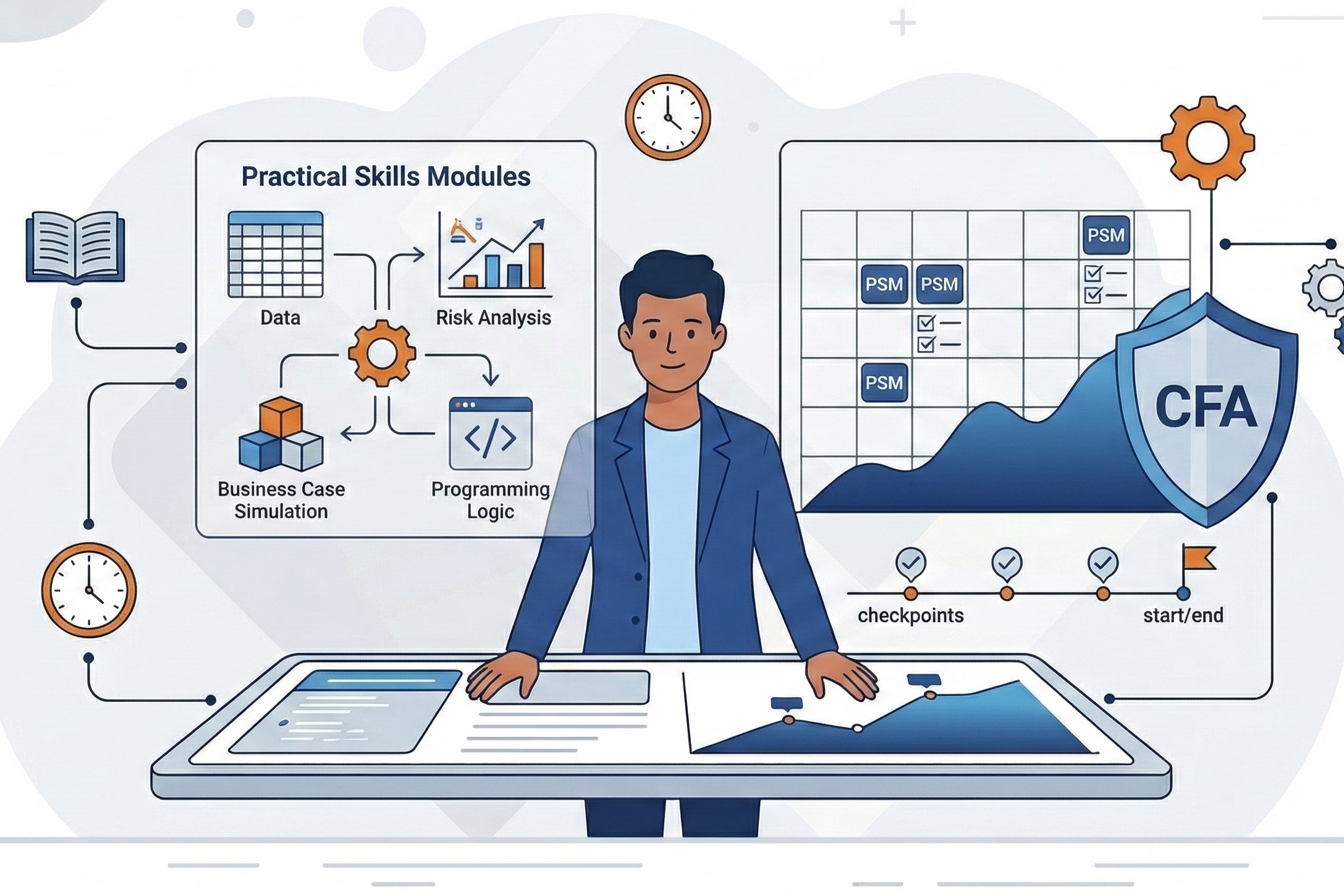
CFA Practical Skills Modules (PSM) are no longer "nice-to-have" extras — they're a requirement you must complete to receive your exam result. If you miss the requirement by the time results are released, your exam result can be voided, so it's worth planning early instead of treating it as an afterthought.
Key Takeaways
-
- PSM are mandatory modules you must complete by the time results are released to receive your CFA exam result.
- If you don't complete and submit a PSM by the time results are released, your exam result may be voided and you won't receive a pass/fail result.
- PSM are built around practical learning formats like videos, multiple-choice questions, guided practice, and case studies.
- PSM options vary by level; don't assume Level III uses "pathway-specific PSM" unless it's explicitly listed for your level in the CFA Institute portal.
- The safest time-management strategy is to block time for PSM in your plan and finish well before results release.
- Choose your module based on the skill you actually want to build (Excel/valuation workflows vs Python/data workflows), not just what sounds impressive.
- Avoid rushing: the point is applied skill-building, not speed-running.
- Track your completion status in the CFA Institute candidate portal so you're not guessing close to the deadline.
Whether you're aiming for CFA Level 1, Level 2, or Level 3, completing these modules is essential for meeting the exam requirements. Explore the different module options available (like Financial Modeling, Python, and Pathway-specific modules), and work on managing your time effectively to avoid missing the mandatory deadline.
What Are CFA Practical Skills Modules (PSM)?
The Practical Skills Modules are a set of online modules that CFA candidates must complete before they can receive their official exam results. They are designed to build job-relevant skills through applied learning. Unlike the core CFA 2026 curriculum, these modules help bridge the gap between theoretical knowledge and practical application.
According to CFA Institute's candidate guidance, PSM content can include videos, multiple-choice questions, guided practice, and case studies. So, you'll be learning by doing, not just reading. That practical format is why many candidates find PSM useful for interviews and internships even beyond the exam requirement. Moreover, it enables candidates to have hands-on experience and learn valuable skills that are directly applicable to their future roles in finance.
PSM is Mandatory
For CFA 2026, completing the Practical Skills Modules is mandatory. Failure to complete these modules will result in voiding your exam results. Therefore, it's essential to allocate time for these modules before your exam, ensuring that you meet the necessary requirements.
ℹ️ Info
Don't leave these modules to the last minute. Start planning ahead and incorporate them into your study schedule to avoid unnecessary stress.
The Danger of Missing the Deadline
⚠️ Warning
No Results: If you do not complete the PSM modules, you will not receive your CFA exam results.
Retake the Exam: You will need to retake the entire CFA exam, wasting time and effort.
ℹ️ Info
Be mindful of the deadlines. Complete your PSM modules at least one month before the results are released to avoid unnecessary stress.
Which Modules Are Available for CFA 2026 Candidates?
The CFA Institute offers several modules by level in its candidate resources, and the exact set can vary by level. So, you can select them based on your career goals and areas of interest.
Here's a breakdown of the available modules:
1. Financial Modeling (Listed for Level 1)
Financial Modeling focuses on building practical modeling skills, typically in a guided, structured way so you can translate financial statement inputs into outputs you can interpret.
If you're early in your CFA journey, this can be a strong "career utility" module because it maps to common entry-level tasks in finance. It provides critical skills for any finance professional and covers various aspects of financial modeling, including:
-
- Valuation techniques
- Discounted cash flow (DCF) models
- Sensitivity and scenario analysis
- Budgeting and forecasting
2. Python Programming Fundamentals (Listed for Level 1 & 2)
Python programming fundamentals are valuable because they teach you how to work with data more efficiently than Excel alone for many tasks (cleaning, merging datasets, repeatable analysis). Even if you don't want a quant job, basic Python can improve productivity in research and analytics.
It is a must for those looking to advance in quantitative finance or risk management roles. This module introduces candidates to programming and data analysis using Python, a highly sought-after skill in today's data-driven financial industry. Some key topics include:
-
- Data manipulation with Pandas
- Visualization using Matplotlib and Seaborn
- Python for financial risk analysis
ℹ️ Info
Check out our detailed blog on CFA + Python: Skills Beyond the Curriculum to learn what Python skills actually matter for CFA candidates and what you can ignore.
3. Python, Data Science, and AI (Listed for Level 2)
At Level II, CFA Institute's PSM list includes a more advanced Python/data/AI-oriented module option. This is a better fit if you already have basic comfort with Python or you specifically want to move toward data-driven roles.
It helps candidates with:
-
- Practical exposure to data science workflow concepts
- Translating AI buzzwords into something you can actually do with data
4. Pathway-Specific Modules
For CFA Level 3 candidates, there are additional pathway-specific modules designed to cater to different career paths. These include:
-
- Practical Macro: For those who want applied macro context that improves how you interpret markets rather than just compute outputs.
- Portfolio Development & Construction: For candidates pursuing a career in portfolio management or wealth management.
- Managing Private Wealth Clients: For those looking to work with high-net-worth individuals (HNWI) and private wealth management.
These modules are designed to dive deep into specialized areas, helping you refine your skills according to your career aspirations.
⚠️ Important
Don't assume there are "pathway-specific PSM" for Level III unless the CFA Institute portal explicitly lists that as a PSM option for your level. Level III does have specialized pathways as part of the exam structure, but pathways and PSM are different program components.
Quick Decision Guide: Which PSM Should You Choose?
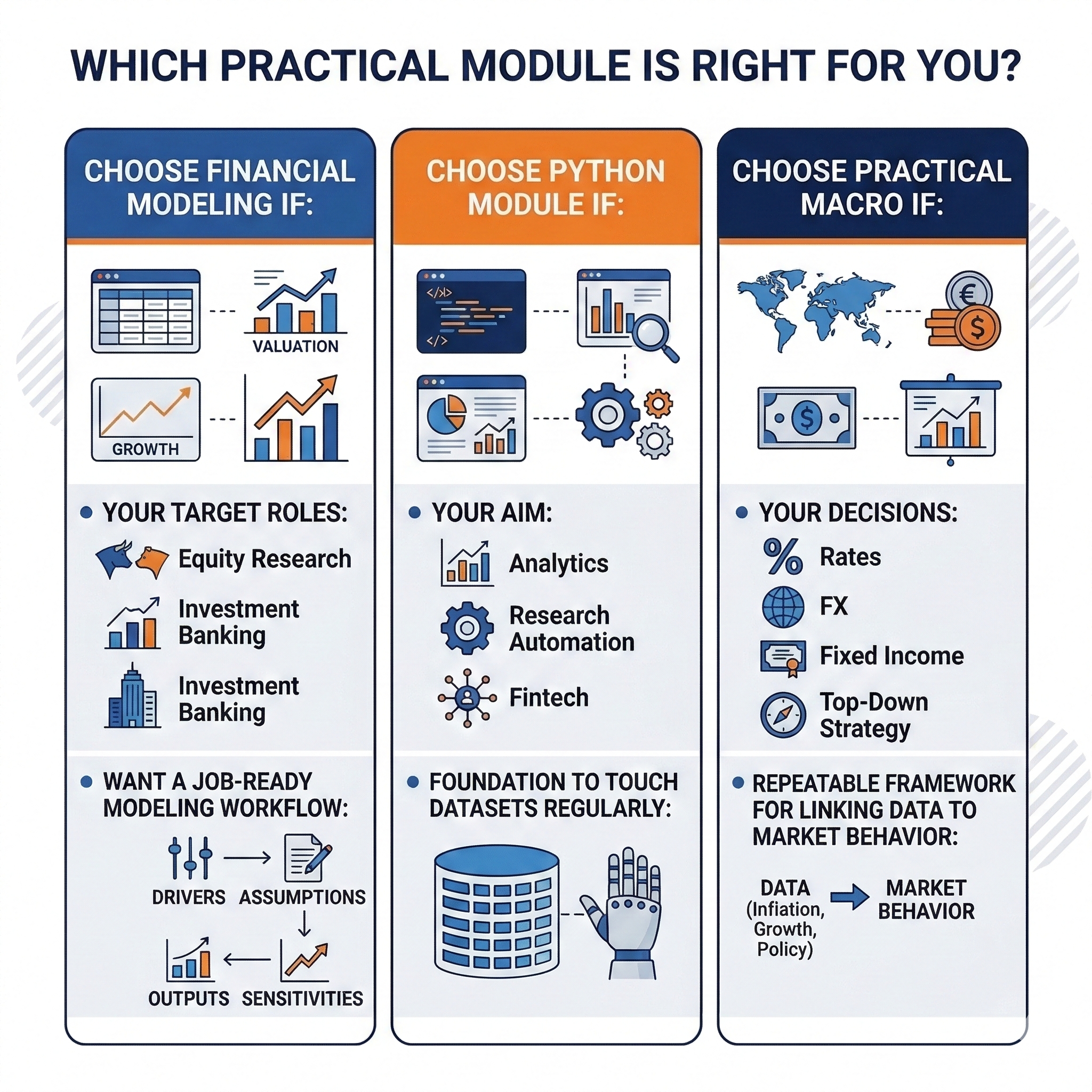
Pick the module that (1) matches the work you want in the next 6–18 months and (2) closes your biggest skills gap fastest. For reference, you can decide based on the following:
| Choose This Module | If Your Goals Include | Target Roles |
|---|---|---|
| Financial Modeling | Excel-based valuation and forecasting work; a job-ready modeling workflow (drivers → assumptions → outputs → sensitivities) | Equity research, investment banking, corporate finance, FP&A, credit research |
| Python Module | Working faster with data (cleaning, joining, analysis, automation); analytics-heavy career paths | Quant support, risk/analytics, research automation, fintech |
| Practical Macro | Interpreting macro regimes and market narratives; a repeatable framework for linking data to market behavior | Rates, FX, fixed income, multi-asset, top-down strategy |
If you're torn between two, default to the one you'll use weekly — practical repetition beats novelty.
When Should You Complete PSM?
There's no single "best" time to complete a PSM, but the hard requirement is that it must be done by results release. Practically, you can choose one of these strategies:
| Option | When | Best For | Details |
|---|---|---|---|
| Option A: Finish Early | First 4–8 weeks after registration | Anxious planners | Complete PSM early, then focus fully on exam prep. Reduces "deadline risk" to near zero and gives you a confidence boost. |
| Option B: Do It Mid-Prep | 1–2 hours per week alongside study | Steady consistency | Block time weekly and complete it gradually. Prevents last-minute cramming and keeps your schedule balanced. |
| Option C: After the Exam | Post-exam, before results release | Common but risky | Many candidates prefer this, but completion must happen before results release. Schedule it like a fixed project immediately after the exam. |
PSM Time Management
The CFA PSM modules are designed to be manageable and should take around 10–20 hours to complete, depending on the module and your pace. Here's how to manage your study time effectively:
-
- Set Aside Dedicated Time: Dedicate a fixed amount of time each week to complete the modules. For example, allocate 2–3 hours per week if you're starting early.
- Start After Your Exam: Most candidates finish the PSM after their CFA exam preparation is over. This allows you to focus on exam preparation first and then complete the modules in a stress-free environment.
ℹ️ Info
Avoid rushing through the PSM modules. Complete them gradually, ensuring that you understand each topic. The knowledge gained is valuable for your career.
Managing PSM Time Efficiently
Here's how you can manage your time effectively when preparing for CFA 2026 and completing your PSM:
-
- Break Down Modules into Chunks: Complete modules in bite-sized chunks instead of cramming them all at once. This will help you retain more information.
- Schedule Weekly Review: After completing a module, review the concepts at the end of each week to reinforce your understanding.
- Integrate with CFA Prep: Combine your PSM preparation with your CFA exam prep. The Python and financial modeling skills you learn will enhance your overall understanding of risk management and financial analysis.
"Success is the sum of small efforts, repeated day in and day out. Start small, stay consistent, and you'll master both the CFA curriculum and the PSM modules."
Common Mistakes Candidates Make (And How to Avoid Them)
| Mistake | Fix |
|---|---|
| Treating PSM as optional until the last moment, then realizing it blocks results | Schedule completion well before results release. |
| Picking a module purely based on hype, not usefulness | Choose your PSM based on your target role and your skill gap. |
| Not confirming completion status | Check the candidate portal progress and ensure that the module shows as completed/submitted. Take a screenshot if necessary. |
| Overloading exam prep weeks | Do your PSM either early or right after the exam with a fixed plan. |
🎯 Ready to start?
Ready to tackle the CFA exam and complete your PSM modules with confidence? Check out our CFA Courses to kickstart your CFA journey.
Conclusion
PSM is a mandatory CFA Program requirement, and you must complete it by the time results are released, or your exam result can be voided and you won't receive a pass/fail outcome. The modules focus on real-world skills that will enhance your career in financial modeling, Python programming, and portfolio management.
By starting early, managing your time wisely, and completing the modules before your exam results are released, you can avoid the risk of having your exam results voided. Follow the strategies outlined in this blog to balance your exam preparation and PSM module completion efficiently.
F A Qs :
Q: What are the CFA Practical Skills Modules?
A: The CFA Practical Skills Modules (PSM) are online learning modules that are mandatory for all CFA candidates. They cover real-world applications such as Financial Modeling, Python, and Pathway-Specific Modules.
Q: How many hours do I need to complete the CFA PSM?
A: The PSM modules can take around 10–20 hours to complete, depending on the module.
Q: What happens if I don't complete the PSM before my CFA results?
A: If you don't complete the PSM modules, your CFA exam results will be voided, and you will need to retake the exams.
Q: Can I complete the CFA PSM after my exam?
A: Yes, you can complete the PSM modules after the exam. However, make sure you complete them before your results are released.
Q: How can I manage my time while preparing for both CFA and PSM?
A: Break down your PSM modules into manageable chunks and integrate them into your CFA exam preparation plan to ensure efficient time management.