

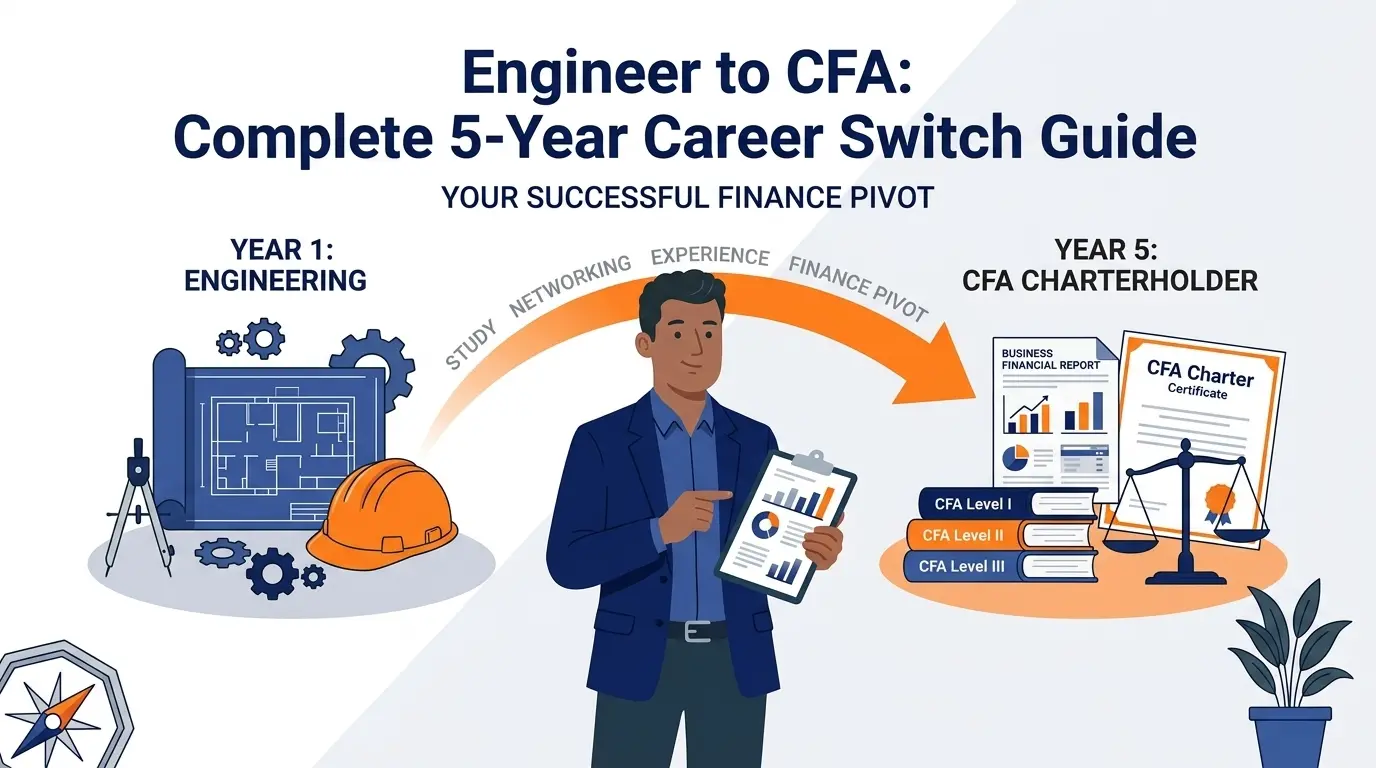
Many engineers often reach a stage where they begin exploring careers beyond traditional technical roles. Some are looking for stronger long-term growth, while others want better compensation, greater business exposure, or work that combines analytical thinking with decision-making. Finance naturally becomes an attractive option because it values many of the same problem-solving and quantitative skills that engineering develops.
At the same time, transitioning into finance can feel confusing without a clear direction. Questions around the right roles, required skills, CFA preparation, work experience, and salary growth often make the shift seem more complicated than it actually is. This five-year roadmap is designed to simplify that journey. From identifying suitable finance career paths to building relevant expertise and positioning yourself for long-term growth, this guide will help engineers make a structured and confident transition into finance.
Eligibility Criteria: Engineers → CFA
The good news is that a technical background does not prevent engineers from entering finance or pursuing the CFA charter. Many engineers successfully make this transition every year. What requires more planning is gaining finance-related work experience and developing industry-relevant expertise along the way.
Entry Criteria: What the CFA Institute Requires
To register for the CFA Program (i.e. sit for Level I), you need one of the following:
- A bachelor's degree in any field, including engineering, or its equivalent.
- Or being in your last year of a bachelor's degree program (as long as your exam window falls within 23 months of the month you graduate).
- Alternatively, a combination of professional work experience (up to 4,000 hours over three consecutive years) and higher education may also be eligible.
Work Experience Requirements to Earn the CFA Charter
The journey doesn't end with passing the Levels I, II, and III exams. You must also meet the CFA Institute's work-experience requirement to obtain the CFA Charter and use the "CFA" designation:
- At least 4,000 hours of relevant work experience over a minimum of 36 months (3 years) are required.
- Importantly, this experience needs to be "investment-related," which means that your work needs to directly assist or contribute to the process of making investment decisions. Financial analysis, modelling, corporate finance, risk analysis, research, and creating work products that guide investment decisions are a few examples of such tasks.
- This experience can be finished prior to, during, or following the tests. Work can be done remotely, part-time, or full-time, allowing professionals to change careers with flexibility.
The 5-Year Roadmap: Year-by-Year Milestones for Career Switchers
Moving from engineering to finance does not always require an immediate career switch. With the right strategy, engineers can prepare for the CFA program alongside their technical jobs, gradually build relevant exposure, and position themselves for high-finance opportunities with significant career and salary growth.
Year-by-Year Practical Roadmap
| Year | Exams & Skills | Role Targets | Networking/Experience | Challenges & Goals |
|---|---|---|---|---|
| Year 1 | Level I (focus FRA/Econ – engineer weaknesses) | Engineering + side projects | CFA Society, LinkedIn (50 connects/mo) | 42% pass rate; build basics |
| Year 2 | Level II + modelling (DCF/GitHub) | FP&A internal/data analyst | Freelance valuations | 45% pass; first finance tasks |
| Year 3 | Level III + specialize | Risk/equity intern | Referrals via CFA events | 52% pass; land investment role |
| Year 4 | Apply in-role | Core analyst (ER/AM) | Track 4,000 hours | Burnout risk; log rigorously |
| Year 5 | Charter submission | Senior track | References | Award + acceleration |
Pro Tip:
Engineers ace quants/derivatives but struggle with FRA (lengthy). Allocate 30% study time.
From Engineering to High-Finance: Career Growth & Opportunities Ahead
Passing the CFA exams is only one aspect of moving from engineering to high finance; another is changing your career path and gaining access to positions that provide greater responsibility, international opportunities, and higher long-term compensation.
CFA vs. MBA: What Engineers Should Know Before Choosing
Both an MBA and a CFA have advantages if you have an engineering background and want to work in finance or management, but they serve different purposes. To help you make a decision, here is a head-to-head comparison.
What each route provides
- CFA: Ideal for people pursuing positions in asset management, risk, equity research, portfolio/investment analysis, or specialized finance. It provides in-depth technical expertise in ethics, investment tools, valuation, and finance.
- MBA: For those looking to pursue careers in investment banking, consulting, general management, corporate leadership, or entrepreneurship, the MBA program offers a comprehensive education in business and management. It's great if you are looking for exposure outside of finance.
Choose CFA if you want to:
- Build a career in the process of making investment decisions: You want to work in positions where data, models, and market insights drive success, such as risk management, market analysis, portfolio construction, and company valuation.
- Continue working while you change careers to finance: With CFA, you can continue working as an analyst or engineer, study part-time, and move into finance without taking a career break.
- Make wise career investments: For individuals seeking financial expertise without the burden of debt, CFA offers a high return on investment at a substantially lower cost than MBA programs.
- Be acknowledged as an expert: Credibility is important to investment professionals around the world, particularly if you want to be recognized for your technical proficiency rather than your general managerial abilities.
Choose MBA if you want to:
- Take on leadership or cross-functional business positions: You want to work in areas other than finance, such as strategy, operations, product, consulting, or the C-suite.
- Make use of organized placement pipelines: You can break into prestigious consulting or banking firms with the help of MBA programs' strong alumni connections, career coaching, and campus recruiting.
- Quickly transition into management: You want to develop your communication, leadership, and business strategy skills, which are important for executive, team-leading, and deal-making positions.
- Develop your identity as a professional: You want a brand reset that includes exposure to a new industry, a new network, and possibly a change in geography or function.
Target Roles: Where Engineers with CFA Credentials Excel
Financial firms value the quantitative strength, technical intuition, and industry knowledge that engineers bring, especially when combined with the investment expertise of the CFA Program. An overview of the positions in finance where engineering talent flourishes is provided below:
High-Potential Career Paths for Engineer → CFA Candidates
| Category | Role Titles | Why Engineers Excel | In-Demand Skills |
|---|---|---|---|
| Quant/Analytics | Quant Analyst, Risk Modeler, Fintech Risk | Math/programming edge | Python/SQL/ML, Basel models |
| Research/Buy-Side | Equity Research (Tech), Portfolio Analyst | Sector knowledge + modeling | DCF/comps, sector reports |
| Corporate/PE | FP&A, Valuation Analyst, VC Due Diligence | Tech diligence | BI tools, deal analysis |
Building Qualifying Work Experience Without Starting Over
The idea that prior work becomes "irrelevant" is one of the main concerns of engineers entering the finance industry. The good news is that you can fulfil CFA's work-experience requirement without restarting your career. The path ahead is straightforward: "Even if your designation still says 'Engineer,' focus on work that influences investment decisions."
Here are some doable tactics to begin gaining qualifying experience in your current location:
| Strategy | How It Works | Eligible Examples | Success Rate Tips |
|---|---|---|---|
| Internal Pivot | Transfer to FP&A/treasury in current firm | Capital budgeting, project NPV analysis | 60% engineers succeed in 1–2 years |
| Finance Firm Entry | Tech role in bank/fintech, pivot to risk/analytics | Model validation, data for lending decisions | Use engineering for quant risk |
| Freelance/Projects | Paid valuation/research gigs | DCF for startups, equity reports on Upwork | Document client decisions influenced |
| Volunteering/Internships | Non-profits, investor groups | Portfolio review, angel advisory | Builds hours + network |
Caution:
Pure engineering (e.g., process optimization) rarely qualifies. Aim for 4,000 hours over 36 months; pre/post-exam OK.
Action Steps for Every Engineer-to-CFA Candidate
When making the switch from engineering to finance, one of the most crucial things you can do is begin recording your qualifying experience right away. This guarantees that no pertinent work is missed and facilitates a smooth CFA charter application.
What to Track:
- Dates of the Project: The beginning and ending times of every project should be clearly documented. As long as they are pertinent to investments, even temporary assignments or part-time finance projects are acceptable.
- Activities Completed: Make a note of the particular tasks you completed, such as financial modeling, valuation, reporting, equity or credit analysis, and recommendation memo preparation. Clearly state how your work influences investment choices.
- Affected Stakeholders: Determine who was impacted by your work. CFOs, portfolio managers, and investment committees may fall under this category. Emphasizing the decision-makers who are impacted by your work demonstrates the concrete influence of your contributions.
- Impact of Investment: Keep track of the results your efforts made possible, such as improved portfolio performance, risk mitigation, cost of capital optimization, or wise investment choices. These specifics are essential for demonstrating that the experience satisfies CFA Institute requirements.
Info:
Achieve your career goals by signing up for CFA today.
Compensation Reality Check: Engineer vs. CFA Charterholder Earnings
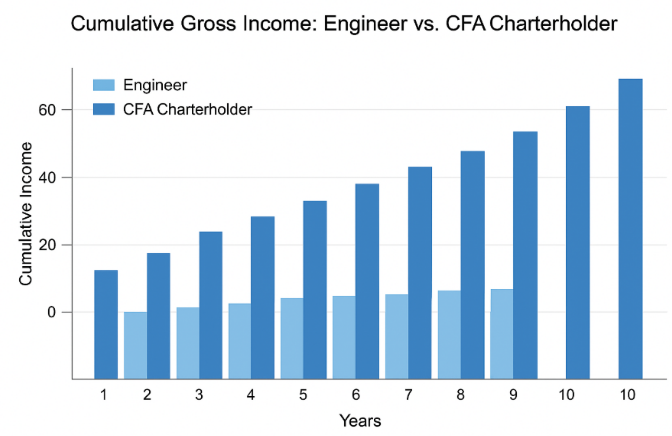
It is crucial for engineers thinking about going the CFA route to comprehend the timelines, potential ROI, and salary trade-offs. The transition from a technical position to finance may involve some short-term adjustments, but there may be significant long-term benefits, especially when focusing on investment banking, hedge funds, or portfolio management.
India Compensation Overview
| Role | Typical Salary Range (LPA) |
|---|---|
| Mid-career Engineer | ₹8–25 LPA |
| Entry CFA Analyst (post-Level I/II) | ₹6–12 LPA (often lateral from engineering) |
| Mid CFA (Analyst/Risk) | ₹12–25 LPA |
| Senior CFA (PM/Senior Analyst) | ₹25–60 LPA + bonuses |
| Top (Hedge/IB) | ₹40–100+ LPA (top 10%) |
USA Overview
| Role | Typical Range (USD) |
|---|---|
| Mid Engineer | $100k–$180k |
| Entry CFA | $70k–$110k |
| Experienced | $140k–$250k |
| PM/Hedge | $250k–$600k+ |
Visualization: 10-Year Cumulative Income Comparison
Info:
Check out the complete CFA salary guide for more detailed insights.
Reframe Your Engineering Experience: Resume & Interview Strategies
When moving from engineering to finance, think in terms of analytics, quantitative reasoning, and problem-solving. Here's how to translate:
| Engineering Skill | Finance-Friendly Reframe |
|---|---|
| Quantitative/problem-solving | Modeling, valuation, risk analysis, scenario testing |
| Technical communication | Report writing, executive/board presentations, client deliverables |
| Project management | Stakeholder management, deal execution, cross-functional leadership |
| Programming/Tech stack | Analytics work using Python, R, SQL, Excel/VBA |
| System/process optimization | Operational efficiency, cost-benefit analysis |
Note:
Switchers often take a 10–20% pay cut initially; focus on 5-year total comp.
Resume Musts: "Use your CFA credentials to lead"
For instance, "CFA Level II Candidate | Expected June 2026"
Calculate the financial or operational effects of engineering. For instance, "optimized production workflow, resulting in $2M annual savings" → Rephrase: "Performed process optimization and cost-benefit analysis, increasing ROI by $2 million annually."
Add projects that are specific to finance — financial data analysis projects, sector reports, DCF valuations, and personal trading algorithms. Emphasize analytics tools as essential competencies.
Interview Preparation
- Build a clear narrative that connects your engineering background to finance skills.
- When answering "Why Finance?", highlight your analytical, quantitative, and problem-solving strengths.
- Emphasize your ability to turn complex data into actionable insights.
- Show how skills like modeling, analytics, and project management support investment decisions.
- Explain how technical expertise in predictive modeling, large datasets, and process optimization applies to valuation, financial modeling, and risk analysis.
- Demonstrate genuine interest in using engineering rigor for business and investment decisions.
Prepare Across Three Interview Areas
- Technical Preparation: Practice stock pitches and valuation case studies. Strengthen Excel and Python modeling skills. Be ready to showcase quantitative and analytical abilities.
- Behavioral Preparation: Prepare STAR-based examples from engineering projects. Highlight leadership, teamwork, problem-solving, and project management skills. Reframe engineering experiences in a finance context.
- Fit Preparation: Clearly explain why you are transitioning into finance. Prepare answers for "Why this firm?" and long-term career goals. Show alignment between your background, interests, and the role.
Thorough preparation across technical, behavioral, and fit rounds helps you confidently position your engineering experience for finance roles.
Conclusion
Switching from engineering to CFA demands strategy: leverage quant skills, pass exams progressively, and log true investment experience via pivots or projects. Realistic timelines (4–5 years) and initial pay adjustments yield high ROI in quant/risk roles, with engineers thriving in data-driven finance.
Track hours rigorously, reframe resumes, and network via CFA societies for success. This path transforms technical rigor into finance leadership amid 2026's AI/quant boom.
Info:
Still confused about switching careers? Fill the form below to get a quick consultation.
FAQs
Q: Can engineers become CFA charterholders?
A: Yes, engineers face no restrictions when registering for CFA Level I. To earn the charter, candidates must complete 4,000 hours of investment-related work experience over 36 months, which can be gained through strategic transitions into roles such as FP&A, valuation, or risk analytics.
Q: How long does it take for engineers to switch to CFA?
A: Most engineers complete the switch in 4–5 years, with 2–3 years for all three CFA levels and 2–3 years accruing qualifying experience. This timeline works while maintaining full-time employment through internal transfers or side finance projects.
Q: CFA vs MBA for engineers?
A: CFA suits engineers targeting investment analysis, portfolio management, or risk roles with its low cost (~₹4L total) and flexibility to study while working. MBA better fits investment banking or consulting, offering strong alumni networks and campus placements but requiring ₹20L+ investment and career breaks.
Q: Best CFA roles for engineers?
A: Engineers excel in quant analyst, risk modeling, and tech-sector equity research roles due to their math/programming foundation. These positions leverage Python/SQL skills alongside CFA's valuation expertise, especially in fintech and AI-driven risk management.
Q: How to get CFA experience as engineer?
A: Start with internal transfers to FP&A, treasury, or capital budgeting roles where project valuations count toward investment decisions. Supplement with freelance DCF analyses or fintech risk internships, rigorously logging hours via CFA's self-assessment tool to ensure eligibility.
Q: Salary after CFA switch India?
A: Entry-level CFA roles post-Level II typically pay ₹6–12 LPA, often matching or slightly below engineering salaries initially. Mid-career charterholders reach ₹25–60 LPA in portfolio or senior analyst positions, with top 10% earning ₹40L+ including bonuses.