

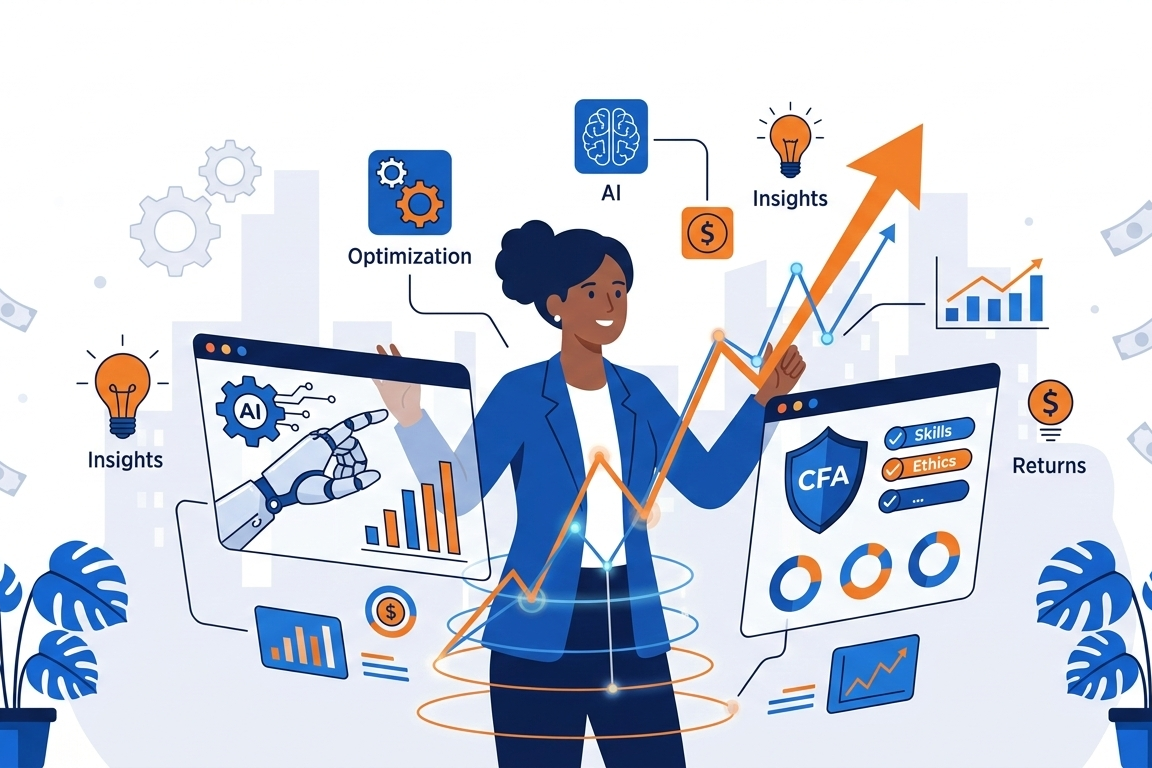
The "classic" CFA outcome as a portfolio manager at a traditional asset manager still exists. But the portfolio job itself is changing: more teams now use AI to support research, portfolio construction, risk oversight, and trading decisions.
Key Takeaways
-
- AI in portfolio management usually means decision support across the lifecycle (research → portfolio → risk → execution), not a fully autonomous "robot PM."
- CFA Level 3 is most relevant because it trains portfolio-level judgment: objectives, constraints, risk, execution, and client/regulatory communication.
- Industry adoption is moving fast; one widely cited industry study found more than two-thirds of investment managers report prominent AI use in the front office.
- The best career positioning is hybrid: understand the models, speak the governance language, and apply portfolio context — not just code.
- You can stand out with one focused project (data → signal → backtest → risk checks → monitoring notes) plus CFA-aligned explanations.
"AI-powered portfolio management" is a broad label, so the practical question is simple: where does AI sit in the workflow, and what human skills still decide whether an outcome is investable? The strongest candidates for AI-integrated PM roles can translate between model outputs and real-world portfolio constraints. It is exactly the kind of integration Level 3 trains.
What Is AI-Powered Portfolio Management, Really?
Before getting into curriculum mapping and career paths, let's define what we're actually talking about — because "AI in finance" covers everything from basic automation to genuinely complex machine learning systems.
In portfolio management, AI currently operates across four distinct functions:
| AI Function | Impact | CFA Level 3 Relevance |
|---|---|---|
| Signal Generation | 70% research automation | Portfolio Management (35–40% exam weight) |
| Portfolio Optimisation | 40% faster rebalancing | Risk Management, GIPS |
| Risk Parity Modelling | 25% better drawdown control | Execution and feedback layers |
| Scenario Analysis | 10x scenarios vs manual | Vignette constructed response |
| Sentiment NLP | 85% accuracy on earnings calls | Behavioural Finance |
What connects all five is a need for professionals who can interpret outputs, apply judgment, and take responsibility for decisions that AI systems cannot make autonomously. The CFA curriculum develops exactly this — the ability to look at a model, understand its logic, and spot where it goes wrong.
Where AI Fits in the Workflow
Below is a practical map you can use to understand (and explain in interviews) how AI shows up in a live investment process.
| Workflow Function | What AI Does | Example Output | Where CFA Level 3 Helps |
|---|---|---|---|
| Research & signal | Finds patterns in large datasets | Factor tilt suggestion, sentiment feature, anomaly flag | Economic intuition, limits of historical inference, behavioral biases |
| Portfolio construction | Optimizes weights under constraints | Target weights respecting sector, liquidity, turnover rules | Objectives/constraints framing, risk budgeting, IPS thinking |
| Risk oversight | Forecasts exposures, stress behavior | Factor exposures, scenario/stress results, drawdown alerts | Risk management judgment, communication, governance discipline |
| Execution & monitoring | Improves trading decisions, monitors drift | Trade schedule suggestion, cost estimates, drift alerts | TCA mindset, implementation shortfall thinking, "when to rebalance" judgment |
Why AI Adoption in Portfolio Management Is Accelerating
Three forces are driving this shift — and all three have direct implications for how the industry hires.
1. AI is doing what humans can't do at scale: A portfolio manager can meaningfully track 50 securities. An AI system running on BlackRock's Aladdin platform screens 15,000 securities daily. GenAI tools now handle approximately 70% of research tasks that previously required analyst hours — earnings call analysis, news sentiment scoring, and regulatory filing review. Deloitte's 2026 State of AI in the Enterprise report projects overall enterprise AI adoption will hit 80% within two years, with financial services among the fastest-moving sectors. The productivity differential is too large to ignore.
2. Hybrid models are outperforming pure approaches: Fully autonomous AI portfolios struggle with regime changes — periods when historical patterns stop predicting future behaviour. The funds generating the strongest risk-adjusted returns in 2026 are hybrid: ML handles signal generation and optimisation, humans apply judgment on constraints, ethics, and market context. Two Sigma deploys reinforcement learning for 60% of execution while human portfolio managers oversee every material decision. CFA-trained professionals are the human half of that equation.
3. Regulation is making human oversight mandatory: SEBI in India now mandates explainable AI for mutual fund strategies. Globally, regulators are requiring SHAP values, LIME explanations, and documented governance trails for algorithmic portfolios. This isn't slowing AI adoption — it's creating a new category of roles for professionals who can translate between what the model produces and what regulators, boards, and clients need to understand.
How CFA Level 1, 2, and 3 Map to AI Portfolio Roles
This is the connection most candidates underestimate. The CFA curriculum wasn't designed around AI — but it was designed around the analytical foundations on which AI systems in finance are built.
CFA Level 1 — Quantitative Foundations: At 8–12% exam weight, Level 1 quant covers regression, time-series analysis, hypothesis testing, and correlation matrices. In an AI context, these are feature engineering fundamentals — the inputs that machine learning models are trained on. Sharpe ratios and factor analysis at Level 1 directly feed into how quant teams evaluate signal quality.
CFA Level 2 — Valuation and Modelling Bridge: DCF sensitivity analysis flows naturally into Monte Carlo simulation. Credit risk models connect to ML default probability estimators. The structured, constraint-based thinking that Level 2 valuation demands mirrors the logic of AI optimization problems — both requiring you to define objectives, set constraints, and evaluate outputs under uncertainty.
CFA Level 3 — Portfolio Integration: This is where the direct relevance becomes most significant. Level 3 dedicates 35–40% of exam weight to portfolio management, covering:
-
- Index strategies and smart beta optimisation
- Liability-driven investing and ALM scenario generation
- Yield curve strategies and dynamic duration hedging
- Execution management and transaction cost analysis
- GIPS standards and compliance reporting
Each of these maps directly to an AI implementation in live fund workflows. CFA Institute's updated 2025 curriculum adds AI ethics, explainability requirements, and GenAI scenario analysis. The exam is explicitly acknowledging where the profession is going.
Curriculum-to-AI Mapping
| CFA Level 3 Topic | Portfolio Application | AI/ML Technique |
|---|---|---|
| Index Strategies | Smart beta optimisation | Genetic algorithms |
| Liability-Driven Investing | ALM scenario generation | Reinforcement learning |
| Yield Curve Strategies | Dynamic duration hedging | LSTM neural networks |
| Execution Management | Transaction cost analysis | Reinforcement learning |
| GIPS Standards | AI audit trails | Blockchain logging |
Machine Learning Techniques: What They Do and Why CFA Skills Apply
Three ML approaches dominate portfolio management in 2026. Each one connects to specific CFA curriculum areas.
Neural Networks for Direct Portfolio Allocation: Traditional mean-variance optimization breaks down under cardinality constraints — when you need to limit a portfolio to 30 holdings or fewer, the maths stops working cleanly. Neural networks learn optimal weights directly from historical returns, bypassing this limitation. In live testing, they beat benchmark MVO models by 8–12% annually. CFA Level 3's advanced portfolio construction readings are the conceptual foundation for understanding what these networks are optimising for.
Genetic Algorithms for Complex Constraint Problems: When a portfolio needs to satisfy multiple constraints simultaneously — maximum 20% sector exposure, minimum position size, ESG screens, liquidity requirements — genetic algorithms find global optima that conventional solvers cannot. Level 3 execution readings on transaction cost analysis integrate directly with this approach.
Reinforcement Learning for Dynamic Rebalancing: RL agents learn trading policies by maximising cumulative reward over time — essentially learning when to trade, how much, and at what cost. Two Sigma uses RL for 60% of its execution process. Human oversight through CFA behavioural and ethics modules keeps these systems operating within acceptable risk parameters.
Common Pitfalls in AI Portfolio Implementation
These are the errors that separate informed professionals from those who treat AI as a black box:
-
- Overfitting: Approximately 60% of ML models overfit to historical data; cross-validation techniques covered in CFA quant readings are the standard mitigation.
- Black box opacity: Regulators and boards require explanations; Level 3 ethics training specifically addresses how to communicate model outputs to non-technical stakeholders.
- Regime shifts: Models trained in one market environment fail in another; ensemble methods from CFA quant readings reduce this risk.
- Bias amplification: ML models amplify training data biases by a factor of roughly 3x; CFA standards mandate fairness testing before deployment.
Career Paths: Quant Portfolio Management Roles
AI-driven roles in portfolio management are growing at 22% annually. According to Naukri and Glassdoor 2026 India data, here's where the career path runs:
| Role | CFA Level | Key Skills | Salary Range (India) |
|---|---|---|---|
| Analyst | Level 1 | Excel ML basics, data handling | ₹18–25L |
| Associate | Level 2 | Python, XGBoost, signal modelling | ₹28–40L |
| VP Quant | Level 3 | Reinforcement learning, optimisation | ₹45–65L |
| Portfolio Manager | Charter | Multi-agent systems, full stack | ₹70–120L |
A few things worth noting on the Indian landscape:
-
- CFA charterholders dominate approximately 70% of senior AI-driven PM hires, commanding a 35% salary premium over non-chartered peers.
- Axis Mutual Fund, ICICI Prudential, and Zerodha are among the most active domestic hirers for quant and AI-integrated roles.
- Hybrid and remote work structures are making Kolkata and Tier-2 cities increasingly viable bases, with cost-of-living advantages of 20% over Mumbai.
- Women currently lead 28% of quant roles in India, up 12% in the past 3 years.
Sample Scenarios: Where Do You Fit?
These are realistic profiles. Find the one closest to yours.
| Scenario | Profile | Best Fit | Action |
|---|---|---|---|
| Scenario 1 | CFA Level 1 candidate, engineering background. Arjun has a B.Tech in CS and is halfway through CFA Level 1. He can code in Python but has limited finance knowledge. | Analyst at a quant fund or AI-driven asset manager | Your coding background is a genuine advantage. The gap to bridge is financial theory. CFA Level 1 quant and portfolio readings are your priority. Build a basic sentiment model using Python on NSE data and document it as a portfolio piece. |
| Scenario 2 | CFA Level 2 cleared, equity research experience. Sneha has two years of equity research and has passed CFA Level 2. Comfortable with DCF but hasn't worked with ML tools yet. | Associate at an AI-integrated asset manager or quant desk | Your valuation skills translate directly to feature engineering and signal evaluation. Learn XGBoost for alpha signal generation and connect it to your existing DCF intuition. CFA Level 3 enrollment is the natural next step. |
| Scenario 3 | CFA charterholder in traditional asset management. Vikram has 6 years of experience at a traditional equity fund. Never worked with ML tools but has deep portfolio construction and risk management experience. | VP Quant or Senior PM at a hybrid AI fund | Your Level 3 portfolio management knowledge is exactly what hybrid AI funds need for the human oversight layer. Focus on learning how to interpret SHAP values and evaluate model governance. Connect with AI-integrated teams at Axis Alternatives or ICICI Prudential quant desks. |
| Scenario 4 | Fresh finance graduate, no CFA yet. Priya has a B.Com and basic Excel skills. Fascinated by quantitative investing but doesn't know where to start. | Junior analyst or operations role at a quant fund | Start with CFA Level 1. It lays the quantitative and portfolio foundation for everything else. Pair it with Advanced Excel skills to handle the modelling work that quant teams rely on before they move to Python. |
CFA Ethics in the Age of AI: Why It's Not Just an Exam Requirement
Ethics in the CFA curriculum is often treated as the section candidates study to pass, not to apply. In AI portfolio management, that framing is backwards.
-
- Bias detection is now a live professional responsibility. ML models amplify training data biases by approximately 3x. CFA standards require fairness testing before deployment — and the professionals doing that testing need to understand both the statistical and ethical dimensions of what they're checking.
- Explainability is a regulatory requirement, not a preference. SEBI mandates it domestically; global regulators are moving in the same direction. Level 3 ethics training specifically covers how to communicate complex model outputs to boards and clients without technical backgrounds.
- GIPS compliance extends to algorithmic portfolios. AI-generated composites need identical calculation methodologies as traditional ones. Level 3 GIPS readings are directly applicable to how quant funds structure their reporting.
- Fiduciary duty doesn't transfer to an algorithm. Human oversight is mandatory for material portfolio decisions — and CFA charterholders lead approximately 85% of compliant AI implementations globally for exactly this reason.
Future Trends: What's Shaping AI Portfolio Management Through 2026 and Beyond
Agentic AI systems are becoming standard: Multi-agent systems where multiple AI models debate trade recommendations before a human PM approves are moving from experimental to mainstream. Two Sigma's 2026 deployment has agentic AI handling 80% of signal generation. The human role is shifting from analysis to oversight and final judgment.
Quantum ML is in early pilots: Quantum computing applied to covariance matrix calculations could eventually make portfolio optimisation problems that currently take hours run in seconds. It's early-stage, but funds like D.E. Shaw are actively investing in this capability.
Tokenised portfolio execution is emerging: Blockchain-based execution trails are being explored for GIPS compliance in AI portfolios. Level 3 GIPS readings are already relevant here — the compliance framework is the same, the implementation infrastructure is changing.
India's regulatory environment is evolving in favour of AI: SEBI's AI sandbox for mutual funds is creating a structured environment for domestic funds to test algorithmic strategies. This is generating roles at Indian asset managers that didn't exist 24 months ago.
🎯 Ready to position yourself?
If you're serious about positioning yourself for AI-driven portfolio roles in 2026, CFA Level 3 is where the preparation becomes directly applicable. Enroll in CFA Level 3 at Aswini Bajaj Classes today — the portfolio construction and ethics curriculum maps to exactly what quant PM teams test in interviews and use on the job.
Conclusion
AI is not replacing the CFA-trained portfolio manager. It's creating a version of that role that's more technical, more analytically demanding, and considerably better compensated — and it's doing so faster than the talent supply can keep up.
The CFA curriculum, particularly at Level 3, is more directly aligned with what these roles require than most candidates realise. Portfolio construction, risk management, execution, ethics, and GIPS compliance aren't abstract exam topics — instead they are the exact frameworks that hybrid AI funds need human professionals to own.
The hardest problem in AI portfolio management isn't building the model. It's knowing when to trust it, when to question it, and when to override it entirely. That judgment doesn't come from code. It stems from the deep financial training provided by the three levels of the CFA.
F A Qs :
Q: How relevant is CFA to AI portfolio management?
A: Highly relevant and increasingly explicitly so. CFA Level 3 covers approximately 80% of the analytical skills AI-driven portfolio roles require: optimisation, risk parity, execution, and scenario analysis. CFA Institute's updated 2025 curriculum adds AI ethics and explainability requirements, acknowledging directly where the profession is heading.
Q: What do quant PM roles pay in India in 2026?
A: VP-level quant roles pay ₹45–65 lakhs; portfolio managers earn ₹70–120 lakhs. CFA charterholders command a 35% salary premium across all ranges, according to Naukri 2026 data. Analyst roles start at ₹18–25L and associates earn ₹28–40L.
Q: Do I need to know Python to work in AI portfolio management?
A: It depends on the role. Analyst and associate positions increasingly require Python proficiency for data handling and basic ML implementation. However, senior roles (VP Quant, Portfolio Manager) focus more on oversight, judgment, and governance — where CFA-trained financial reasoning is more critical than coding skills.
Q: Which CFA level is most relevant for AI portfolio roles?
A: CFA Level 3 is most directly relevant because it focuses on portfolio-level judgment: objectives, constraints, risk management, execution, and client communication. These are exactly the human oversight skills that hybrid AI funds require. Level 1 and 2 provide the quantitative and valuation foundations that feed into these roles.
Q: What companies in India hire for AI portfolio management roles?
A: Axis Mutual Fund, ICICI Prudential, and Zerodha are among the most active domestic hirers for quant and AI-integrated roles. Global firms with India operations (BlackRock, Two Sigma, Goldman Sachs) also recruit for these positions. SEBI's AI sandbox is creating new opportunities at smaller asset managers as well.