

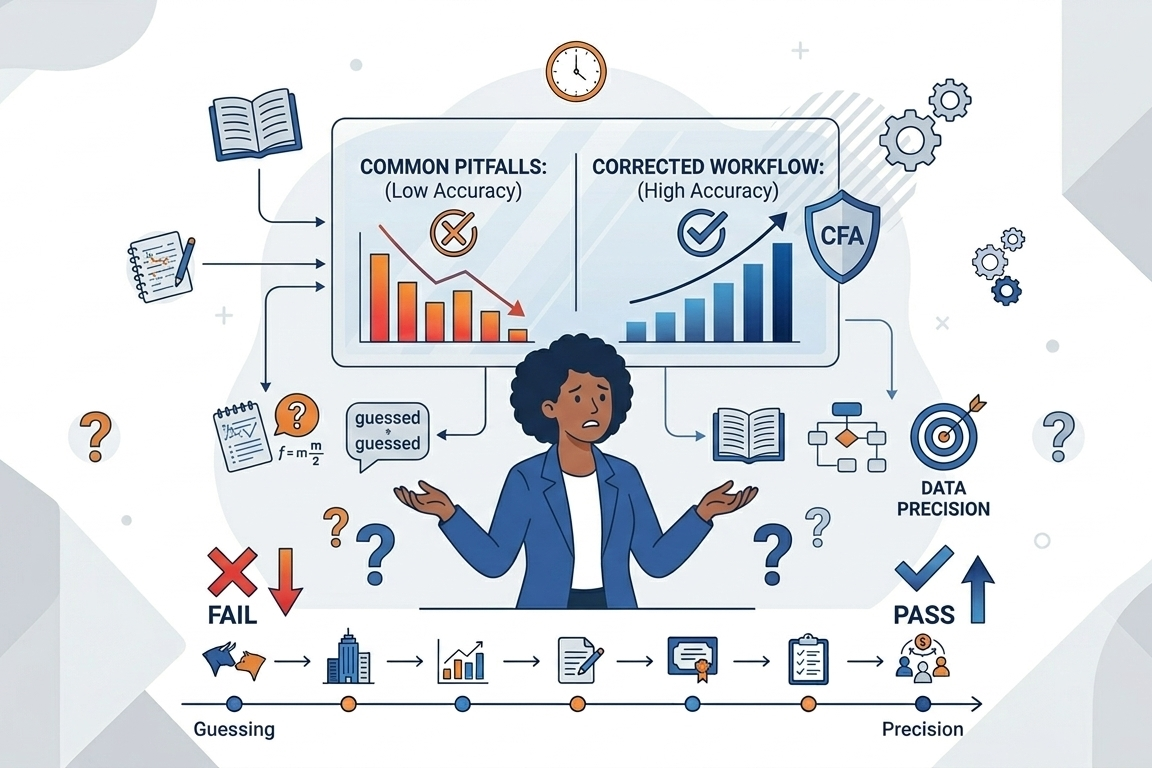
Most CFA candidates who fail are not people who did not study. They are people who studied the wrong way, measured progress by the wrong metric, and walked into the exam relying on a version of their preparation that did not match the reality.
Key Takeaways
-
- Accuracy in CFA is not just about getting answers right. It is getting them right fast and consistently across a range of topics under time pressure.
- Most failing candidates fall into one of three traps: coverage illusion, recognition illusion, or comfort-zone practice.
- Every wrong answer belongs to one of four buckets: concept gap, method gap, execution slip, or exam-management error. The fix for each is different.
- Topic practice questions and mock exams serve different purposes. Confusing them is one of the most common reasons scores stagnate.
- The fastest score gains come from an error log and drill loop system, not from doing more random questions.
- Ethics is a scoring swing area. Weak performance there has cost borderline candidates the exam.
If you are preparing for CFA Level 1, 2, or 3 in India alongside college, articleship, or a full-time job, your biggest constraint is not motivation. It is bandwidth. The goal is not to study harder. It is to build an accuracy system that converts limited hours into reliable exam marks.
One crucial insight from long-term results analysis is that marginal failures often occur despite strong preparation. In several analysed results across all three CFA levels, candidates missed the minimum passing score by just five marks. These results typically showed stable performance across subjects with no extremely low scores, yet one relatively weak subject, combined with its exam weightage, prevented the candidate from crossing the threshold. This demonstrates how accuracy across every subject matters — not just overall effort.
What Accuracy Actually Means in CFA
Most candidates think accuracy means the percentage of questions they get right. That is one part of it.
In exam conditions, accuracy means performance under three simultaneous constraints: exam-style wording, time pressure, and mixed-topic switching. Remove any one of those three, and your scores improve. The exam applies all three at once.
Here is the pattern that plays out repeatedly. In learning mode, you solve topic-wise questions right after reading a chapter. Accuracy feels high. You feel prepared. Then you sit a mock exam, topics are mixed, time is running, and you misread the question stem, select the wrong method, or rush a calculation. Accuracy drops by 15 to 20 percentage points.
CFA Institute's own guidance reflects this distinction. Practice questions within topics are used to confirm understanding and identify gaps. Mock exams are designed to replicate exam timing, structure, and topic weights. Both are necessary. They train different things. Treating them as interchangeable is where preparation breaks down.
Most marginal failures occur not because candidates lack knowledge, but because their overall accuracy falls slightly below the required threshold. While candidates often believe 60 per cent accuracy might be enough, the practical benchmark for a safe passing probability tends to be around 70 per cent or higher across subjects.
Why Students Feel Prepared but Still Fail
Most failure stories are not about zero effort. They are about effort spent in the wrong places.
The coverage illusion. You finish the readings and feel done. The CFA exam tests application, not familiarity. Finishing the curriculum is the beginning of preparation, not the end.
The recognition illusion. You recognise formulas and definitions when you see them. Recognition is not retrieval under time pressure. These are different cognitive skills, and the exam tests the second one.
The comfort-zone practice trap. You keep doing the same style of questions, untimed and topic-wise, so you get better at that format. The exam is a different format entirely.
Candidates rely heavily on shortcuts or selective preparation strategies suggested online. While a few outliers may pass using such approaches, they do not represent the typical pattern. The overwhelming majority of successful candidates achieve strong results by studying the full curriculum in depth and building conceptual clarity rather than relying on shortcuts.
The fix is not extreme. Shift the centre of gravity of your preparation toward timed, exam-replicating practice while still using topic questions to build fundamentals. The ratio matters more than the volume.
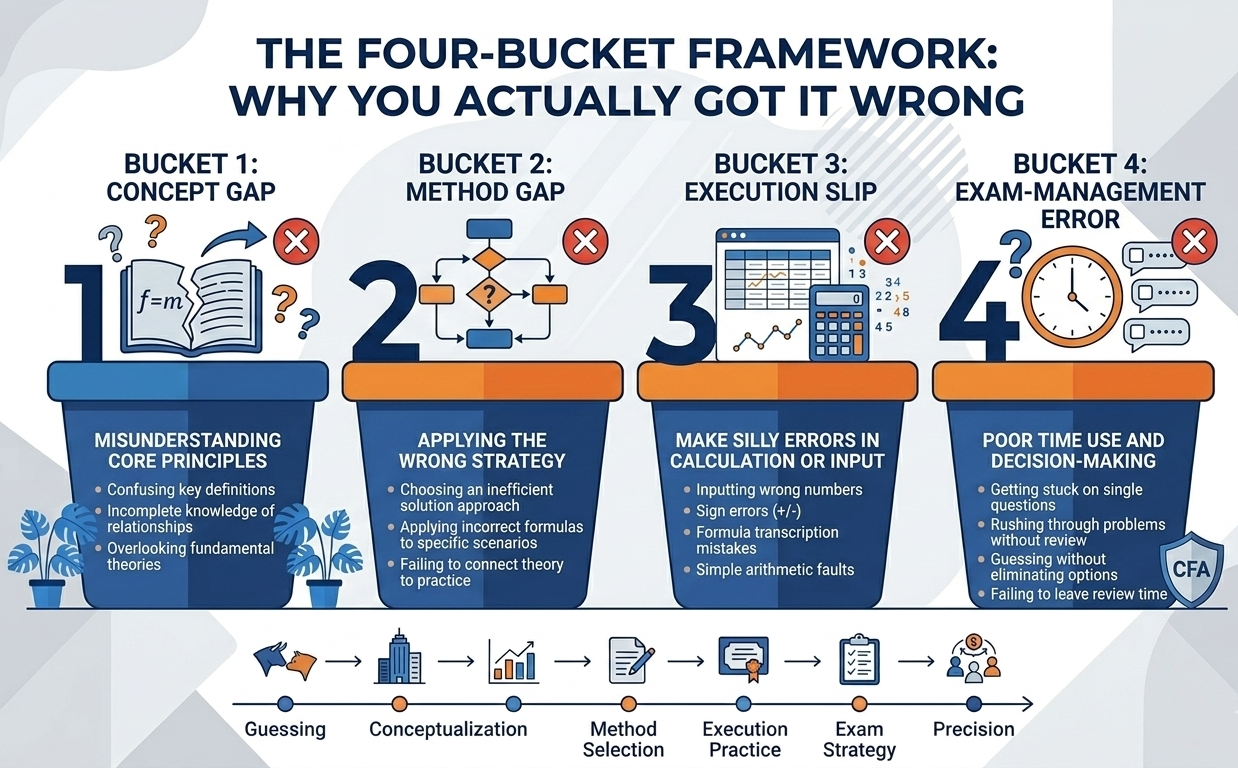
The Four-Bucket Framework: Why You Actually Got It Wrong
Stop treating all wrong answers as one category. Every mistake belongs to one of four buckets, and the fix for each is completely different.
| Bucket | What Happened | The Fix |
|---|---|---|
| Bucket 1: Concept Gap | You did not know it. You cannot explain the reasoning even after seeing the solution. You confuse similar concepts: real vs nominal, holding period vs expected return, duration vs convexity. | Re-learn that micro-topic. Create a short reference note with the definition, when to use it, one example, and the common trap. Re-attempt 15–25 focused questions on that topic. |
| Bucket 2: Method Gap | You understood the chapter but chose the wrong formula or approach. You got caught by keywords like "most likely," "least appropriate," and "increase or decrease." | Write a method map for that question type. Build a simple decision rule for recurring item formats. |
| Bucket 3: Execution Slip | Sign error, wrong unit, wrong time index, calculator mistake. You say, "I knew it, I just made a silly mistake." | Apply a 10-second check rule consistently. Do deliberate slow practice on 20 questions before re-adding speed. |
| Bucket 4: Exam-Management Error | Your accuracy is fine in the first third of the exam but collapses in the last third. You spend six minutes on a two-minute question. You start guessing too early or too late. | Build pacing rules and practise them in full mock conditions — not just understand them conceptually. |
Practice Questions vs Mock Exams: They Are Not the Same Thing
This distinction matters more than most candidates realise when you are into the CFA exam preparation phase.
Topic practice questions are lesson-rooted checks of understanding. They give you feedback and explanations. They are best used right after studying a topic to confirm accuracy and identify gaps.
Mock exams are designed to replicate exam-day timing, structure, topic weights, and difficulty. They are best used in the final revision phase to test end-to-end performance under pressure.
If your topic question bank accuracy is 75 to 80%, but your mock scores are 55 to 65%, the issue is almost never knowledge. It is the exam management and the selection of the mixed-topic method. Doing more topic questions will not close that gap. Better mock review and targeted drills will.
| Dimension | Topic Practice Questions | Mock Exams |
|---|---|---|
| Primary purpose | Confirm understanding after learning | Replicate exam-day conditions |
| Best used | During learning and early revision | Final revision and readiness checks |
| What it trains | Concept clarity, targeted accuracy | Timing, switching, stamina, pressure |
| If score is low | Fix concept and method gaps, then drill | Diagnose exam management and weak links |
ℹ️ Info
If you are not a registered student, you can still get concrete insights on your preparation by trying our CFA mock tests.
Building the Accuracy Stack: A Step-by-Step System
Think of accuracy as a set of habits built in sequence.
Step 1: Standardise your solving process. For every question, use a consistent sequence: identify exactly what is being asked, note the given data and units, choose the formula before plugging numbers, compute, and run a quick sanity check on direction and magnitude. This looks basic. It eliminates execution slips.
Step 2: Add micro-checks for your top three careless patterns. Pick from this list: per cent versus decimal, sign check for long and short positions, time index at t equals zero versus t equals one, annual versus monthly units, rounding mid-calculation. Most candidates have the same two or three patterns. Name them and deliberately check for them.
Step 3: Build an error log. Update it after every practice set and mock. For each mistake, record the topic, question type, error bucket, root cause in one sentence, the fix, and when you will re-drill it. The rule is simple: if you make the same mistake twice, you must change the process, not just decide to be more careful.
Step 4: Run drill loops. After every mock: identify your top three weak micro-topics, do 30 to 50 targeted questions across them over three days, then re-test with a timed mini-mock of 30 to 45 minutes. The loop is mock → diagnose → drill → re-test. Volume without this loop quickly produces diminishing returns.
Time Management Without Sacrificing Accuracy
Most candidates think time management means going faster. It means stopping the time you waste on questions where you have already lost the thread.
The practical rule is to cap your time on any question that is not progressing. Mark it, move on, return if time allows. This must be practised in mocks, not just understood. If you have only read this rule, you have not yet trained it.
Accuracy also drops in the final third of most exams for three reasons: cognitive fatigue, dehydration, and an emotional spiral after two or three wrong answers in a row. The fix for all three is to practise full-length mocks regularly to build stamina and to use a short reset ritual between question blocks: re-read the stem, re-establish your pace, and continue.
The Hidden Accuracy Killer: Misreading the Question
In CFA-style questions, the trap is usually not the calculation. It is the stem.
The most common misread patterns are: "most likely" versus "least likely," "increase" versus "decrease," "nominal" versus "real," "before tax" versus "after tax," "required return" versus "expected return," and "appropriate" versus "accurate."
A simple habit fixes most of these. Underline two things in every question stem: the action word (most, least, increase, decrease) and the output variable (NPV, duration, residual income). This takes three seconds and prevents the single most avoidable category of errors.
What Aswini Bajaj's Analysis of Marginal Failures Shows
After reviewing thousands of results across CFA Level 1, 2, and 3 over more than a decade, a consistent pattern appears in near-miss failures.
Students who miss the passing score by a few marks usually show a similar performance profile:
-
- Six or more subjects score 70% or higher.
- No subject falls below 50%.
- But one subject remains around 50–55%, and depending on its weightage, that gap cannot be compensated for by stronger subjects.
The minimum passing score benchmarks illustrate how narrow the margin can be:
| Level | Passing Score | Marginal Failure Score |
|---|---|---|
| Level 1 | 1600 | 1595 |
| Level 2 | 2600 | 2595 |
Candidates scoring in this range did not study too little. The problem is that they prepared with 40–50% accuracy as their mental benchmark, instead of targeting 70%+ accuracy.
⚠️ Important
In most Indian school and college exams, the passing mark is 40–50%. In CFA exams, success typically requires around 70% aggregate accuracy across subjects. The gap between 40% and 70% is not simply twice the effort. It demands deeper conceptual clarity, stronger practice discipline, and a fundamentally higher preparation standard.
-
- Exam predictability is extremely limited: You cannot know whether a session will be numerical or conceptual. A low-weightage topic may still produce an item set. A niche chapter can appear prominently.
- The only rational strategy is: Cover the full syllabus, revise at least 95% of it, and avoid selective studying.
- Subject weightage significantly influences marginal outcomes: A relatively weak score in a high-weightage subject can outweigh strong scores in smaller subjects. Even if most subjects are near or above 70%, a 20% gap in one moderately weighted subject can reduce overall accuracy enough to push the total score below the passing threshold.
Because of this uncertainty, questions can emerge from both high-visibility and less-discussed chapters. Even a topic that appears minor in the curriculum can appear as a full item set. This makes selective studying a risky strategy. Leaving even one chapter unprepared can directly affect exam performance.
To get a complete grasp on the near-miss failures, check out this detailed video on Why Students Fail CFA.
Additional Reality About CFA Preparation
Another key lesson from long-term observation is that completing the syllabus alone is not enough. Candidates often study chapters months before the exam but fail to complete comprehensive revision. If a topic is not revised properly, the ability to recall it during the exam declines sharply. As a result, successful candidates typically revise at least 90 to 95 percent of the syllabus before exam day to ensure reliable recall.
-
- Difficulty increases progressively across CFA levels, but the conceptual base built in Level 1 plays a decisive role in later success.
- Many advanced topics in Level 2 and Level 3 build directly on concepts introduced in Level 1, making early conceptual clarity essential.
- Candidates who rush through Level 1 without developing depth often struggle later when the same ideas appear in more complex analytical forms.
- Core concepts such as regression analysis, duration, currency valuation, and portfolio theory appear repeatedly with increasingly sophisticated applications at higher levels.
- Without a strong foundation, candidates often end up relearning earlier material while preparing for advanced levels, which slows down preparation.
As a finance professional, you must interpret analytical outputs, evaluate models, and judge whether quantitative results are logically sound — especially in an environment where automation and artificial intelligence generate many of these outputs.
Ethics and Accuracy: Why This Pairing Matters
Ethics is consistently treated as theory. It is not. It is accuracy training. Ethics questions require careful reading, nuanced distinctions between options, and specific knowledge of Standards. Many options are designed to look almost correct. Weak ethics performance has cost borderline candidates the exam at every level.
The fix is not to read Ethics once and hope. It is to do short daily ethics sets of 10 to 15 questions throughout your preparation and to log the specific misread patterns that trip you up repeatedly. "Most likely" and "least likely" appear heavily in Ethics. So does the difference between what a Standard requires versus what it permits.
ℹ️ Info
If you still need help in the subject, check out our dedicated CFA Ethics Course.
A 6-Week Accuracy Plan for Indian Candidates
Most CFA candidates in India are preparing alongside college, articleship, or a full-time job. This plan is built for that reality.
| Weeks | Phase | What to Do | Target |
|---|---|---|---|
| Weeks 6–5 | Build your accuracy base | Complete remaining content at a sustainable pace. After each topic, do practice questions to confirm understanding and identify gaps. Start your error log from day one. | Topic-wise accuracy improvement and visible error patterns |
| Weeks 4–3 | Shift to exam accuracy | Begin full mock exams that replicate exam timing and structure. After each mock, spend a full day reviewing, logging errors, and practicing targeted drills. Add two timed mini-mocks per week (45–60 minutes each). | Stable pacing and fewer unforced errors |
| Weeks 2–1 | Polish and protect | Focus entirely on repeating mistakes, not new material. Run final mocks with light targeted drills. Avoid burnout. | Controlled, repeatable performance on exam day |
How to Review a Mock Properly
Mock review is where accuracy is actually built. Most candidates spend 20 minutes on it. The candidates who improve spend two to three hours.
The three-pass method works as follows. First pass: re-solve every wrong question without looking at the solution. Second pass: compare with solutions and classify each mistake into the four buckets. Third pass: create drills of 10 similar questions for each weak micro-topic and complete them within 72 hours.
What not to do: read the explanation, think "oh, I see," and move on. That is the most common way to guarantee the same mistake appears in the next mock.
Exam-Day Accuracy Checklist
Preparing for CFA is a systematic process. Follow the pattern.
The night before: Sleep plan confirmed. Avoid new topics. Calculator and spare battery checked. Pacing rules written on one card: time cap per question, skip rules, micro-checks.
During the exam: Underline the action word and output variable in every stem. Write the formula before plugging in numbers. Apply your three micro-checks. If stuck, cap your time, mark the question, and move.
Between blocks: Thirty-second reset. Breathe, re-read the next stem carefully, and recommit to your pacing rules.
Conclusion
Students fail CFA when they treat accuracy as a volume problem. "Doing more questions will improve accuracy." It does not work that way.
Accuracy improves when you diagnose why you are getting things wrong, change the specific process that produced the mistake, and re-test under conditions that match the exam. Topic practice questions confirm understanding. Mock exams test whether that understanding holds under pressure. The error log and drill loop connect the two.
The candidates who pass are not always the ones who studied the most. They are the ones who built a system that converted study hours into exam-day accuracy — and did not walk in trusting a preparation method the exam was not designed to reward.
F A Qs :
Q: Why do candidates fail the CFA even after studying 300 hours?
A: Because hours do not automatically produce exam accuracy. Most of those hours are spent in learning mode, where topic-wise, untimed practice creates false confidence. The exam is mixed-topic, timed, and trap-heavy. Mock exams that replicate exam timing and structure bridge that gap, yet most candidates underuse them.
Q: How do I improve accuracy in CFA mock exams?
A: Classify every wrong answer into one of four buckets: concept gap, method gap, execution slip, or exam-management error. Log it, identify the root cause, and drill that specific micro-topic within 72 hours. Doing more random questions without this review system produces slow improvement at best.
Q: Is speed or accuracy more important in CFA?
A: Accuracy comes first, but it must be trained under realistic time constraints. The two are not in opposition. Mock exams that replicate exam timing and structure are where you learn to be accurate at speed — not by going faster, but by eliminating wasted time and unforced errors.
Q: How should I use topic practice questions?
A: Use them immediately after studying each topic to confirm understanding and catch gaps before they become exam problems. They are not a substitute for mocks. They train topic-level accuracy. Mocks train exam-level accuracy. Both are necessary at different stages.
Q: How many mock exams should I take?
A: Enough to stabilise your pacing and reduce repeat errors to a low level. Most candidates need multiple full-length mocks plus targeted mini-mocks in the final four weeks. The number matters less than the quality of the review after each one.
Q: Why is Ethics so important for accuracy?
A: Because it is not theory. Ethics questions require careful reading, nuanced distinction between options, and specific knowledge of Standards. Many options are designed to look almost correct. Weak ethics performance is a consistent factor in borderline failures. Treat it as accuracy training from the beginning, not a last-minute review topic.