
The CFA Program has undergone noticeable curriculum updates in recent years for Level I in 2027. No doubt, the changes have created a lot of buzz, but in reality, these are more subtle in practice than they appear in discussion.
While most of the syllabus remains familiar, certain subjects, especially Equities, Quantitative Methods, and Ethics, have been reorganised and updated to reflect a more applied, industry-oriented approach.
Let’s find out exactly what is changing, what it means for candidates, how it will impact your study habits, and most importantly, revamp your preparation strategy.
Key Takeaways
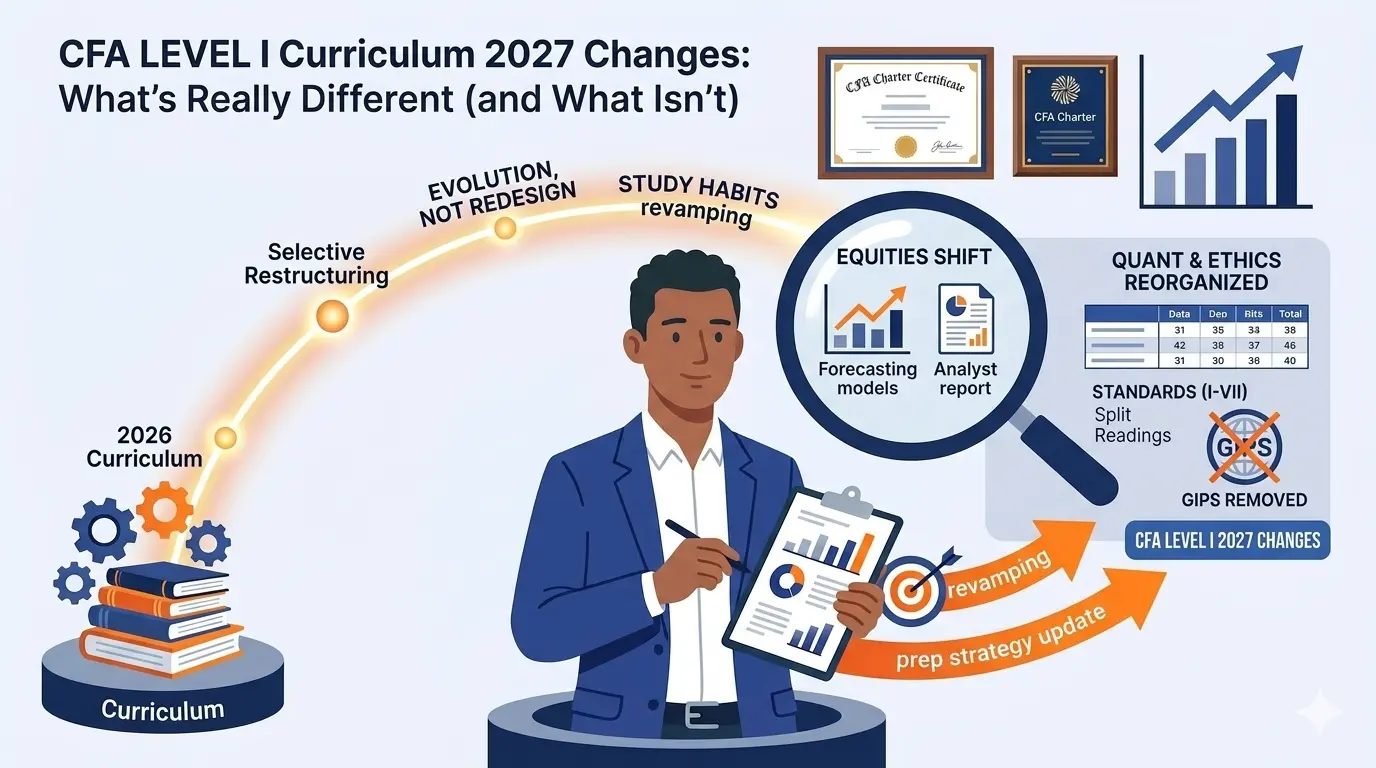
- The 2027 CFA Level I curriculum is an evolution, not a redesign.
- Major updates are concentrated in Equities.
- Quantitative Methods has been reorganised for more applied learning.
- Ethics is more structured, with separate standards and the removal of GIPS.
- The CFA Level I 2027 curriculum is more application-driven than theory-heavy.
- Equity learning now focuses more on valuation, forecasting, and research-style thinking.
- Quantitative Methods is increasingly linked to real portfolio decision-making.
- Ethics is now more structured and readable.
- Core preparation pillars remain unchanged: concept clarity, revision cycles, question practice, mock exams, and consistency, most importantly.
What’s Changing in the CFA Level I 2027 Curriculum?
According to the official update from the CFA Institute, the 2027 curriculum changes include:
- Selective restructuring of readings
- Reorganisation of topic flow
- Renaming of subjects
- Stronger focus on applied investment skills
Subject Name Changes (Structural Updates Only)
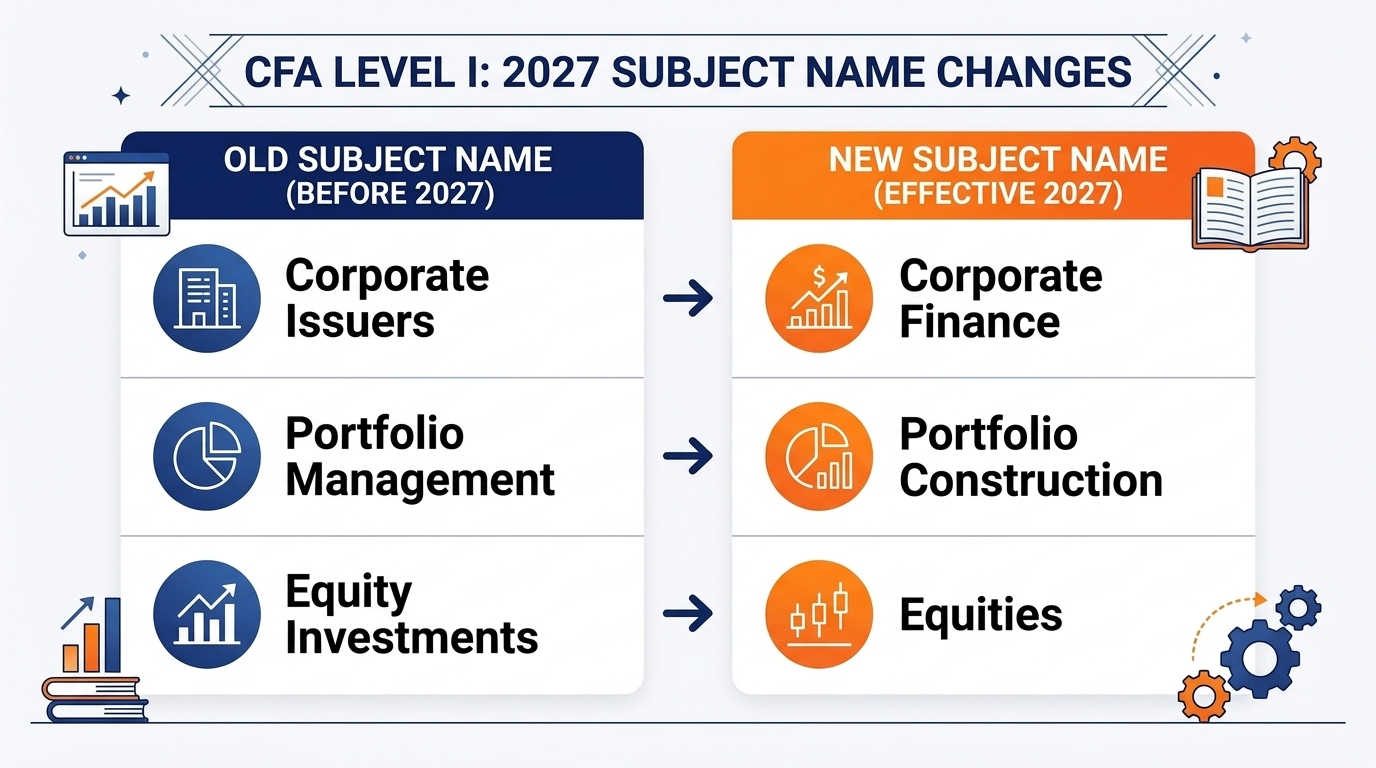
Several subjects have been renamed:
- Corporate Issuers → Corporate Finance
- Portfolio Management → Portfolio Construction
- Equity Investments → Equities
However, it is important to understand what these changes actually represent. These are primarily structural and naming updates designed to improve clarity, alignment, and presentation within the curriculum.
They do not indicate a complete redesign of the underlying subject matter or a major overhaul in concepts being taught. Most of the core learning outcomes and foundational ideas remain largely consistent with previous years.
Quantitative Methods: More Connected, Less Fragmented
Quantitative Methods has not been fundamentally rewritten for the 2027 CFA Level I curriculum, but the subject has undergone a meaningful reorganisation in terms of structure and presentation.
What has changed is the way topics are grouped and connected. Several readings have been merged, renamed, or redistributed to create a more integrated learning flow rather than treating concepts in isolation. The curriculum now appears to place greater emphasis on practical application and real-world analytical thinking.
Core areas are also being framed in a more applied manner, particularly topics such as:
- Portfolio mathematics
- Hypothesis testing
- Benchmarking returns
- Statistical distributions
- Financial data science
Overall, the objective seems to be improving conceptual continuity and making quantitative concepts feel more relevant to investment decision-making and financial analysis.
Info:
Begin your journey with CFA Level 1 today.
The Big Shift: From Theory to Investment Application
A key trend in 2027 is a clear emphasis on how quant tools are used in real investing decisions. Instead of studying concepts in isolation, candidates are expected to understand how they connect.
For example, in a portfolio allocation decision:
- Expected return of an asset
- Added portfolio risk
- Valuation attractiveness
- Diversification impact
- Risk-adjusted return contribution
Earlier CFA structures often separated these topics. The 2027 structure integrates them more closely, mirroring real portfolio management workflows. The direction is focused on less formula memorisation, more decision-making logic.
Info:
Check out our blog on AI in Portfolio Management to learn how the CFA Institute is introducing changes.
Ethics: Cleaner Structure, Same Core Principles
Ethics has been reorganised for clarity, not rewritten.
What changed:
- Standards I–VII are now split into individual readings
- Easier navigation and reduced cognitive load
- GIPS (Global Investment Performance Standards) has been removed from Level I
Core areas still covered:
- Professionalism
- Integrity of Capital Markets
- Duties to Clients
- Duties to Employers
- Conflicts of Interest
- Candidate responsibilities
Even though it is easier to read, Ethics remains one of the highest-weighted and most scoring-critical sections.
Equities: The Biggest Curriculum Shift
The most significant update is clearly in Equities.
Topics which are removed:
- Market Organisation and Structure
- Security Market Indexes
- Market Efficiency
- Company Analysis: Forecasting
New emphasis areas:
- Equity research frameworks
- Analyst reports
- Forecasting models
- Valuation methodologies
- Practical equity analysis
Stronger focus on:
- Discounted Cash Flow (DCF) and Growth Models
- Relative valuation
- Factor-based investing
- Investment research interpretation
This signals a stronger alignment with real-world equity research roles.
What This Means for CFA Level I Candidates
For most candidates, the strategy remains largely unchanged. You still need to focus on:
- Strong conceptual clarity
- Repeated revision
- Extensive question practice
- Mock exams under timed conditions
- Consistency over intensity
Pro Tip:
Students using 2026 materials can continue preparation safely for now, especially in unchanged or lightly modified subjects.
Should You Change Your Preparation Strategy?
No major change in preparation strategy is required for most students. The core foundation of the CFA Level I curriculum remains largely intact.
However, a few subtle adjustments in approach can make preparation more effective under the updated structure:
- Focus more on application-based understanding rather than purely theoretical reading
- Avoid over-memorising isolated formulas or disconnected concepts
- Pay closer attention to the restructuring within Equities and how topics are linked together
- Approach Quantitative Methods as a decision-support and analytical tool, not just as standalone theory blocks
Overall, the direction of the curriculum seems to reward conceptual clarity, interpretation, and practical understanding more than mechanical memorisation alone.
Info:
Watch the video on CFA Level 1 Changes for more detailed insights.
The Bigger Direction of the CFA Program
Across recent curriculum updates, the CFA Institute appears to be steadily moving the program toward a more practical and professionally integrated learning approach. The emphasis is gradually shifting away from purely compartmentalised academic learning and more toward how investment decisions are actually made in real-world financial environments.
This broader direction can be seen through increasing focus on:
- Real-world investment analysis
- Integrated valuation thinking across asset classes
- Practical portfolio construction and risk considerations
- Analyst-style interpretation and decision-making skills
Rather than treating subjects as isolated silos, the curriculum increasingly connects concepts across areas such as Quantitative Methods, Equities, Financial Statement Analysis, and Portfolio Management.
The objective seems to be helping candidates think more like investment professionals who must combine data, valuation, risk, and portfolio context simultaneously while making decisions. In many ways, this reflects how finance professionals actually work today, where investment analysis is interconnected, dynamic, and application-driven rather than divided into separate theoretical subjects.
Conclusion
The CFA Level I 2027 curriculum changes are important, but not disruptive.
- Structure has evolved
- Equities have been meaningfully updated
- Quant and Ethics are more organised
- Core preparation strategy remains intact
At this stage, students must focus less on syllabus noise and more on conceptual depth.
Info:
Still unsure of how to strategize your preparation for CFA 2027? Fill out the form below and get consultation from a career expert.
FAQs
Q: Has the CFA Level I 2027 curriculum changed completely?
A: No. It is an evolution, not a full redesign. Core concepts remain largely intact.
Q: Which subject changed the most?
A: Equities have undergone the most significant update, especially in valuation and research-focused content.
Q: Can I still use the 2026 study material?
A: Yes. Most subjects remain stable enough for continued preparation, especially in the short term.
Q: What changed in Quantitative Methods?
A: It has been reorganised into a more applied structure focusing on portfolio interpretation, benchmarking, and statistical applications.
Q: What happened to Ethics?
A: Standards are now split into separate readings, and GIPS has been removed from Level I.
Q: Does my preparation strategy need to change?
A: Not significantly. Core success factors remain: concept clarity, revision, practice, and consistency.
Q: Why is CFA becoming more application-based?
A: To better reflect real investment roles where analysts use integrated thinking across valuation, risk, and portfolio construction.