
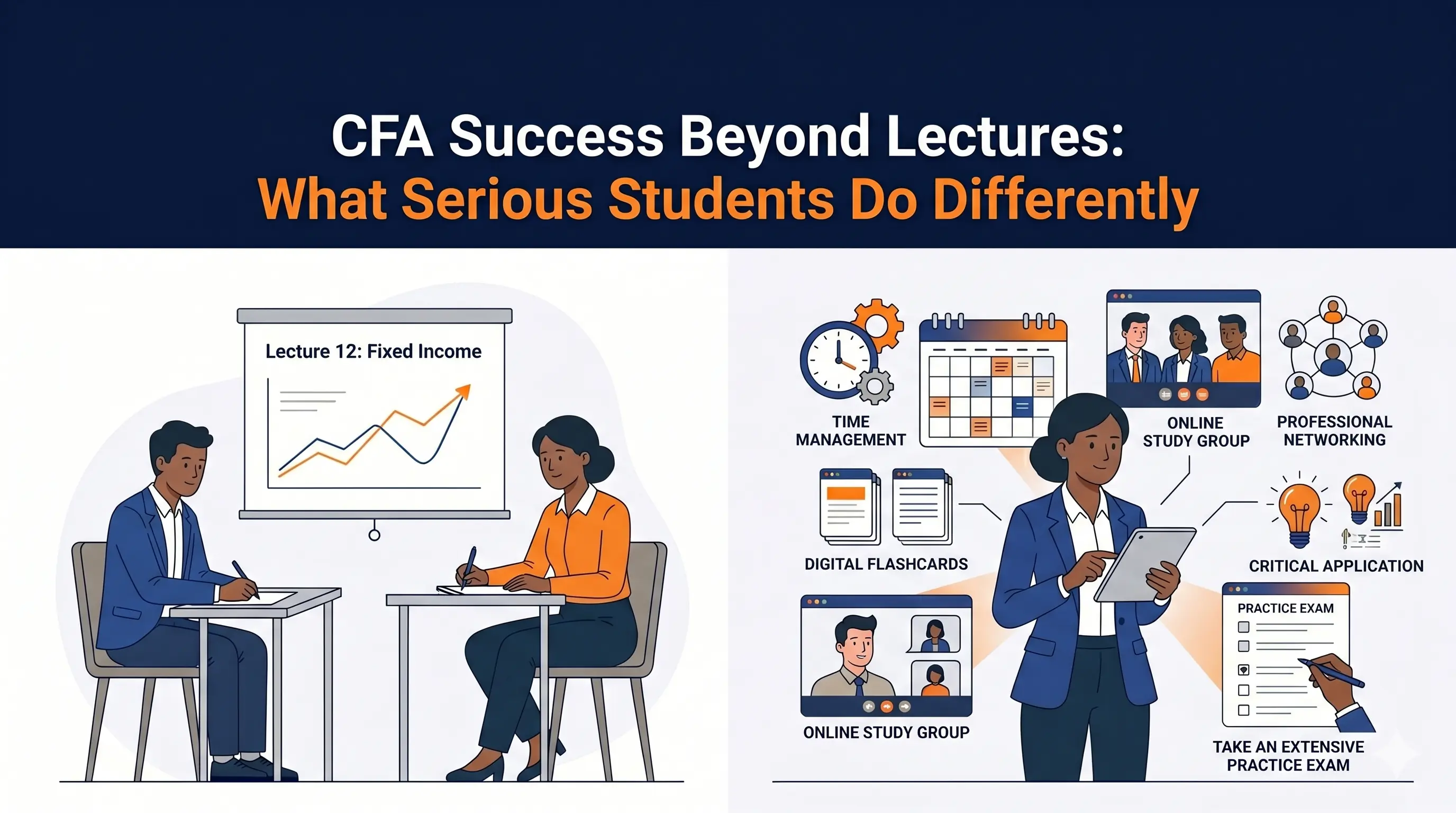
Most CFA candidates believe they are making good progress once they attend classes, complete lectures, and prepare notes. But strong preparation usually starts after the lecture ends. The strongest candidates spend more time practising questions, revising concepts, checking how much they actually remember, and applying what they have studied.
This matters even more today because the CFA Institute provides far more than just readings and recorded lectures. The Learning Ecosystem includes practice questions, mock exams, flashcards, study planners, and Practical Skills Modules. Candidates who rely only on lectures often end up underusing a major part of the official preparation resources.
Key Takeaways
- Lectures are useful, but they are only the starting point. The real preparation happens after the lecture ends.
- Serious CFA students spend far more time on retrieval, practice, revision, and application than on passive watching.
- CFA Institute’s Learning Ecosystem includes practice questions, mock exams, flashcards, a study planner, and Practical Skills Modules, all of which support active preparation.
- Strong candidates revise while the syllabus is still moving instead of waiting until the end.
- Mock exams work best as diagnostic tools, not just final rehearsals.
- The best preparation systems combine learning, solving, reviewing mistakes, revising, and practical application.
Why Lectures Fall Short
Lectures help you understand topics for the first time. They provide structure, explanation, and initial confidence. That is genuinely useful.
But lectures have two limits that most candidates only discover late in their preparation -
- First, they create the feeling of progress faster than actual retention. Watching a well-explained lecture feels productive, but understanding something in the moment is not the same as being able to retrieve it under exam pressure three months later.
- Second, they do not build the recall speed or judgment that the CFA exam actually tests. A candidate can finish the entire syllabus and still perform poorly in mocks because understanding once is not the same as being able to apply correctly and quickly under timed conditions.
That is the gap that lectures cannot close on their own. Only active practice, revision, and error correction can close it.
CFA Institute’s own preparation tools reflect this logic. Practice questions in the Learning Ecosystem are built around the curriculum and give answer explanations, while official mock exams are designed to mirror exam format and help candidates identify strengths and weaknesses under realistic conditions.
What Serious Students Do
| Area | Lecture-Only Candidate | Serious Candidate |
|---|---|---|
| Learning style | Watches classes and feels productive | Uses lectures for first understanding, then shifts to active recall and practice |
| Practice | Solves a few questions after class | Solves enough questions to identify patterns and weak areas |
| Revision | Revises late and inconsistently | Uses weekly and monthly revision cycles |
| Mock exams | Delays mocks until the end | Uses mocks early enough to diagnose timing and topic gaps |
| Mistakes | Checks answers and moves on | Maintains an error log and retests recurring mistakes |
| Notes | Makes long notes | Builds short recall sheets, formula lists, and weak-area summaries |
| Application | Stops at exam prep | Uses PSMs or small outputs to connect learning to real finance tasks |
The difference is not in the hours studied. It is what those hours are actually spent doing.
Info:
Check out our detailed blog on Passive Studying vs Active Recall for more studying tips and insights.
The System Strong Students Build
Strong candidates treat lectures as input, not achievement. They do not count lecture completion as a milestone. They count what they can solve, recall, and explain without help.
They use official tools as the core engine. CFA Institute's candidate resources include the Learning Ecosystem, study planner, flashcards, practice questions, mock exams, and Practical Skills Modules. The difference between average and serious candidates is not access to these tools. It is how deeply they use them.
They solve far more than they watch. Once a topic is understood, serious students move quickly into practice questions, timed sets, wrong-answer review, formula recall, and mixed-topic revision. Watching more lectures feels easier than solving difficult questions, which is exactly why passive study quietly replaces active study for most candidates.
They revise before they feel fully prepared. Weaker candidates often wait to complete the entire syllabus before starting revision. Strong candidates understand that memory fades quickly, so they keep revising even while the syllabus is still ongoing.
A practical revision structure looks like this:
- Daily: Quick recall of what was studied that session.
- Weekly: Revisit weak areas and formulas from the past week.
- Monthly: Mixed-topic revision and testing across the syllabus covered so far.
- Final phase: Mocks, error logs, and speed correction on persistent gaps.
They keep an error log. Serious students do not just check scores. They study mistakes.
A simple error log can include:
- Topic
- Question source
- Error type: concept, formula, interpretation, or careless mistake
- Why was the answer wrong
- Correct takeaway
- Retest date
It allows for more targeted revision instead of emotional studying.
Beyond The Exam
CFA Institute now includes Practical Skills Modules as part of the candidate ecosystem, and candidates must complete at least one PSM at each level to receive their exam result. These modules vary by level and are designed to connect curriculum knowledge with practical tasks such as financial modelling, Python fundamentals, analyst-style work, data science and AI, and portfolio-related workflows.
Serious candidates do not postpone PSMs indefinitely or treat them as side tasks. At least one PSM must be completed at each level to receive the exam result, and each module is designed to build practical finance skills beyond pure exam recall.
| Output | Why It Matters |
|---|---|
| Stock research note | Shows analysis and written communication ability |
| Simple valuation model | Shows structured thinking and financial logic |
| Excel dashboard | Shows comfort with numbers, organization, and presentation |
| Industry summary | Shows commercial awareness and synthesis |
| Portfolio memo | Shows judgment and decision framing |
| Completed PSM | Shows engagement with practical finance workflows required by CFA Institute |
A lecture-first mindset assumes exam success is enough. The market is moving differently. Modern finance increasingly rewards candidates who can interpret data, communicate insights, and apply frameworks to live decisions.
A Practical Weekly CFA Study Model
| Block | What to Do |
|---|---|
| 30% | Lecture or reading for first understanding |
| 35% | Practice questions and topic drills |
| 15% | Revision of older topics |
| 10% | Formula recall, flashcards, or summary sheets |
| 10% | Applied work, mock review, or skill-building |
In earlier phases, lecture and reading time may be slightly higher. In later phases, mock exams, mixed practice, and revision should take a larger share of the week.
Non-negotiables every week:
- Solve questions from every topic studied that week.
- Revisit at least one older topic.
- Update the error log.
- Spend time on active recall instead of only rereading.
- Build one small output every few weeks, such as a short note, model, or summary.
Info:
Read our blog on Self-Study vs Coaching for more exam preparation insights.
Common Mistakes Students Make
- Confusing lecture completion with exam readiness.
- Making too many notes and solving too few questions.
- Postponing revision until the final month.
- Avoiding mock exams because the scores feel uncomfortable.
- Treating Practical Skills Modules as optional because they feel separate from the exam.
- Treating a low mock score as failure instead of as diagnosis.
- Assuming the credential alone compensates for weak communication or weak applied output.
- Ignoring official LES tools and relying only on lectures or third-party explanations.
Conclusion
The strongest candidates use a blended model: lectures for first understanding, official tools for structured practice, questions for mastery, mocks for diagnosis, and PSMs for practical skill development.
That approach is stronger than lecture-only preparation because it matches both exam reality and market reality. The exam rewards retrieval and application under pressure. The market rewards candidates who can demonstrate that their learning did not stop at the exam hall door.
Info:
Still wondering how students strategize their preparation strategy? Fill out the form below to get in touch with an expert counselor.
FAQs
Q: Are lectures enough to clear CFA?
A: Lectures help you understand the syllabus, but are not enough on their own. Serious preparation also requires question practice, revision cycles, mock exams, and regular error review.
Q: What do top CFA students do differently?
A: They solve more questions, revise earlier, track mistakes systematically, use mocks as diagnostic tools rather than final rehearsals, and build applied skills beyond passive lecture watching.
Q: What should I do immediately after finishing a CFA lecture?
A: Start practice questions on that topic, make short recall notes rather than long summaries, and add any weak areas to your error log for the next revision cycle.
Q: Do Practical Skills Modules matter for CFA students?
A: Yes. CFA Institute includes them as part of the candidate resource ecosystem precisely because they connect curriculum knowledge to real-world finance skills. Serious candidates complete them alongside exam preparation rather than after it.
Q: How do I go beyond lectures in my CFA preparation?
A: Use practice questions, flashcards, mock exams, and a running error log as the core of your weekly system. Add applied work such as research notes, simple valuation models, or sector summaries to build the kind of visible output that differentiates a profile in the job market.