
Every year, thousands of CFA candidates quietly drop out of the registration process. Not because they lacked the ability, but because the fees did the deciding for them. The CFA Level I exam alone can cost up to $1,450 just to register. For a student or early-career professional in India, that is not just an expense. It is a decision that gets postponed indefinitely.
The CFA Access Scholarship isn't a merit badge. It's a financial tool. And the question you actually came here with — "Am I even eligible? Or will I get rejected?" — deserves a straight answer. That's exactly what this guide gives you, before you talk yourself out of applying.
Key Takeaways
-
- The Access Scholarship reduces your exam registration fee to just $250 per level, a saving of over $3,500 across all three levels.
- There is no fixed income cutoff. CFA Institute evaluates financial need in context, not against a universal threshold.
- You are automatically ineligible if you are currently registered for an exam or awaiting results. Apply before you register, always.
- Common rejection reasons are entirely avoidable: vague essays, missing documents, and applying in the wrong order.
- Before writing a single word of your essay, run a quick self-check. Use the CFA Scholarship Eligibility Checker to confirm which scholarship fits your profile.
The CFA is expensive, and it is worth it. Charterholders consistently move into roles that a standard commerce degree doesn't unlock: investment banking, equity research, portfolio management, risk. The salary differential is real, and it compounds over a career. See the data behind it in our CFA salary and experience guide. The scholarship exists so that the upfront cost doesn't become the reason you never found out.
What Is the CFA Access Scholarship, Really?
Before getting into eligibility and timelines, let's make sure we're talking about the same thing.
The CFA Access Scholarship is a need-based financial assistance programme run directly by CFA Institute. It's designed for candidates who want to pursue the CFA Program but face genuine financial constraints — not just those at the lowest income levels, but anyone for whom the exam fee represents a real, meaningful financial stretch.
Here's what it covers:
-
- Available for each exam level separately, meaning that you can apply at every stage of your CFA journey.
- Does not cover study materials, but removes the single largest cost barrier to getting started.
There isn't just one CFA scholarship, either. The institute offers multiple types and knowing which one applies to you matters before you spend time on an application.
| Scholarship Type | Who It's For |
|---|---|
| Access Scholarship | Anyone facing financial hardship — students or working professionals |
| Student Scholarship | Students currently enrolled in a partnered college or university |
| Professor Scholarship | Full-time faculty at qualifying academic institutions |
ℹ️ Info
Not sure which one fits your profile? Use our CFA Scholarship Eligibility Checker.
Why Does the Access Scholarship Matter More Than Most Candidates Realise?
The CFA designation isn't just a credential. It's a career accelerator with a measurable salary premium.
According to CFA Institute's compensation data, charterholders consistently report stronger career progression and higher compensation than their non-chartered peers, particularly in investment management, equity research, portfolio management, and risk analysis. These are roles that a standard commerce or finance degree rarely unlocks directly.
The financial logic is straightforward:
| Full Registration Fee | With Access Scholarship | |
|---|---|---|
| Per exam level | Up to $1,450 | $250 |
| All three levels | Up to $4,350 | $750 |
| Total saving | Over $3,500 |
The scholarship doesn't change what the CFA demands of you. It changes whether you can afford to find out. For candidates who qualify, not applying is simply leaving money on the table.
The Most Important Rule (Read This Before Anything Else)
Before you explore income criteria, essay tips, or document requirements — there's one thing you need to check first.
Are you currently registered for a CFA exam, or waiting for your results?
⚠️ Important
If the answer is yes, you are not eligible to apply for the Access Scholarship at this stage. This isn't a technicality — it's the single most common reason applications get disqualified, and it's entirely avoidable.
CFA Institute is unambiguous on this: once you've registered for an exam, you cannot apply for the scholarship until your results have been officially posted. If you're new to the registration process, our CFA Program Registration Guide walks you through every step.
The correct sequence is always:
-
- Apply for the scholarship
- Receive the award
- Register for the exam using your scholarship code
A significant number of candidates reverse this order every cycle and lose their chance for that window entirely. Getting the timing right costs nothing. Getting it wrong costs you a full cycle.
CFA Access Scholarship Eligibility: The Quick Self-Check
Think of this as a five-step filter you run on yourself before investing time in the full application. It takes under 10 minutes, and it can save you from submitting an application that was never going to move forward.
There are no right or wrong answers here — just honest ones. The self-check only works if you treat it that way.
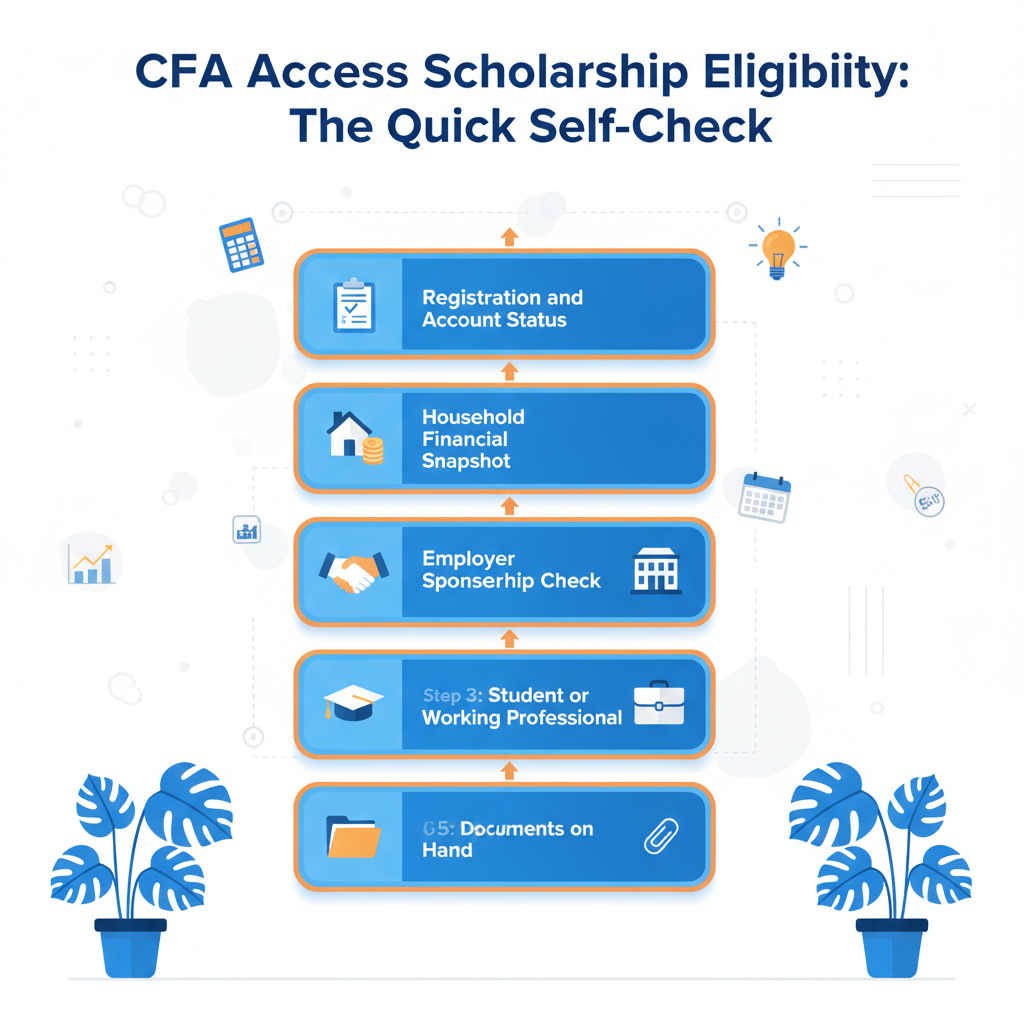
Step 1: Registration and Account Status (1 minute)
Log into your CFA Institute account and confirm the following:
-
- Are you currently registered for any CFA exam level?
- Are you awaiting results from a recent exam?
- Do you already have an active, unused CFA scholarship on your account?
If any of these apply to you, your application will not be processed at this stage. Wait until your results are officially posted and your account is clear before proceeding.
Step 2: Household Financial Snapshot (2 minutes)
One of the most common misconceptions about the CFA Access Scholarship is that there's a fixed income threshold you need to fall below. There isn't. CFA Institute evaluates financial need in context — what your income looks like relative to your actual living costs, obligations, and dependents.
To get a clear picture, put together a rough monthly breakdown:
| Item | Monthly Amount (₹ or $) |
|---|---|
| Your income | |
| Spouse/partner income | |
| Parent(s)' income (if dependent) | |
| Rent / loan EMI | |
| Number of dependents | |
| Outstanding debt / EMIs |
If your income is modest relative to where you live, and the exam fee represents a genuine financial stretch rather than a minor inconvenience, you're likely to clear this filter.
Step 3: Employer Sponsorship Check (1 minute)
This step matters more than most candidates realise. Reviewers look at whether you have access to external funding — and if your employer is covering the cost, your financial need is considerably weaker.
-
- Full employer sponsorship → Your case for financial need is significantly reduced
- Partial sponsorship → You may still qualify; quantify the gap and explain it in your essay
- No employer support → This works in your favour; state it clearly
Step 4: Student or Working Professional (1 minute)
Your current status determines which scholarship you should actually be applying for.
If you're a final-year undergraduate or postgraduate student, the Student Scholarship may be a stronger fit. Many institutions receive scholarship allocations directly from CFA Institute and a large number of those slots go unclaimed simply because students don't know what to ask. Check with your college's finance department or career services office before assuming the Access Scholarship is your only option.
If you're a working professional without employer sponsorship, the Access Scholarship is the right path.
Step 5: Documents on Hand (2 minutes)
Before you begin the application, take a quick inventory. The full checklist is in the Documents section below — but at this stage, ask yourself:
-
- Do you have salary slips or bank statements from the last 3 months?
- If you're a student, do you have a bonafide or enrollment letter?
- If primary documents aren't available, can you provide a credible substitute, such as an affidavit, an advisor's letter, or a guardian's income declaration?
If the answer to all three is yes, or close to yes, you're ready to move forward. If significant documentation is missing with no substitute in sight, strengthen that before applying. Reviewers respond to transparency, not gaps.
CFA Access Scholarship Dates 2026: When to Apply
Timing is one of the most overlooked parts of the scholarship process — and getting it wrong can cost you an entire cycle.
Here's what you need to know about CFA Access Scholarship dates 2026:
-
- Scholarship application windows open before exam registration deadlines, not alongside them.
- CFA Institute typically notifies applicants approximately 4 weeks after the application window closes.
- Early Bird registration deadlines run on their own schedule and do not align with scholarship windows.
The safest approach is always to apply for the scholarship first, wait for the decision, and register only once you've received your award.
Practical Rule of Thumb
| Your Situation | Recommended Action |
|---|---|
| Scholarship window is open | Apply first. Register only after receiving the award. |
| Registration deadline is approaching | Prioritise the scholarship application; delay registration where possible. |
| Employer is partially sponsoring | Apply to quantify the funding gap clearly in your essay. |
| You absolutely must register now | Register, but accept that you won't be eligible for the Access Scholarship this cycle. |
Always verify the exact dates on CFA Institute's official scholarship page before each cycle. Windows shift year to year and missing them by even a few days means waiting for the next one.
Why Do CFA Scholarship Applications Get Rejected?
The reasons most CFA scholarship applications get rejected aren't complicated. They're the same handful of mistakes, repeated every cycle, by candidates who didn't know to look out for them.
-
- Registered before applying: The most common and most preventable mistake. Once you've registered, you're automatically ineligible. No appeals, no exceptions.
- Vague essays with no numbers: "I really want to pursue this but can't afford it" does not move a reviewer. What moves them is: "My household income is ₹42,000/month, my monthly obligations are ₹28,000, and the exam fee represents X months of savings." Specificity signals that the need is real.
- Inconsistent information: Your essay says one thing. Your bank statement reflects another. Reviewers flag contradictions immediately, and inconsistency is treated the same as dishonesty.
- Missing documentation with no explanation: Applications that look incomplete without context rarely advance. If a document is unavailable, then say so and offer a credible substitute.
- Active unused scholarship on account: If you received a scholarship in a previous cycle and didn't use it, you are ineligible to apply for another until the existing one is used or expired.
How to Write a CFA Scholarship Essay That Actually Works
Here's the reality about the sample CFA scholarship essay access candidates submit: most of them fail because they're emotional, vague, and short on substance.
Reviewers read hundreds of applications per cycle. What stands out is clarity, honesty, and specificity — not effort or sincerity alone.
Use This 3-Paragraph Structure (300–500 words per paragraph):
| Paragraph | What to Write |
|---|---|
| Paragraph 1: Your Context | Who are you? Student or working professional? What's your household situation? Open with 1–2 concrete numbers — monthly income, number of dependents, existing obligations. |
| Paragraph 2: Why You Need the Scholarship | Be specific. What does the scholarship cover, and what would it mean for your finances? Show the arithmetic. Example: "My household monthly income is ₹45,000. After rent, dependents, and existing EMIs totalling ₹30,000, the remaining ₹15,000 cannot cover the exam fee without significant strain spread over several months." |
| Paragraph 3: Your Plan and the Impact | How will you study? What's your timeline? What career outcome are you working toward? This tells reviewers the scholarship won't be wasted and that you've thought beyond the application itself. |
Sample Micro-Essay (Final-Year Student, India)
"I am a final-year B.Com student with no steady income. My father earns ₹35,000 per month and supports our family of four, including two younger siblings currently in school. The full CFA Level I registration fee would require our family to divert nearly two months of savings, which isn't feasible without affecting core household expenses. The Access Scholarship would allow me to register for Level I in November 20XX without creating financial strain at home. I plan to study 12–15 hours per week, use the library and free online resources, and aim to complete Level I within 12 months. My goal is to secure an investment analyst role within two years of completing the programme."
Notice what this does: specific numbers, a realistic household picture, a clear study plan, and a concrete career outcome. No dramatisation. Just an honest, structured case.
Sample Scenarios: What's the Right Move for You?
These are a few realistic profiles. Find the one closest to yours.
| Scenario | Profile | Best Fit | Action |
|---|---|---|---|
| Scenario 1 | Final-year college student, no personal income. Riya is in her final year of B.Com (Hons) in Mumbai. Her parents support her expenses, but allocating funds for the CFA programme isn't feasible right now. | Student Scholarship (check with college first) or Access Scholarship | Apply before registering. Attach a bonafide letter and parental income proof. Write a numbers-based essay. While preparing, consider getting started on CFA Level 1 prep. |
| Scenario 2 | Working professional, modest income, no employer support. Arjun works at a small CA firm in Pune, earning ₹28,000 per month. His firm doesn't sponsor professional certifications. | CFA Access Scholarship | Prepare three months of salary slips and bank statements. Quantify monthly income versus obligations in the essay. Confirm no employer sponsorship upfront. |
| Scenario 3 | Mid-level professional with partial employer sponsorship. Neha works at a mid-sized AMC in Delhi. Her employer covers 50% of certification costs but only upon passing. | CFA Access Scholarship (with clear explanation of funding gap) | Explain in your essay that 50% coverage still leaves a significant out-of-pocket cost, quantify the gap, and note that reimbursement is conditional on passing. |
| Scenario 4 | Career changer with savings but no current income. Karan left his IT job three months ago to focus on CFA prep. He has some savings but no steady income stream. | CFA Access Scholarship | Provide bank statements showing your financial position. Explain the career transition honestly. Show that using savings for the exam fee would significantly deplete your runway. |
Conclusion
The CFA Access Scholarship exists because CFA Institute recognises that financial constraints shouldn't determine who gets access to the programme. If the exam fee represents a real stretch for you — not a minor inconvenience, but a genuine financial decision — you are exactly who this scholarship is designed for.
Run the self-check. Prepare your documents. Write an essay that is specific, honest, and structured. And apply before you register — not after.
If you're still unsure whether you qualify, use the CFA Scholarship Eligibility Checker to get a quick answer before you invest time in the full application.
F A Qs :
Q: What is the income limit for CFA Access Scholarship?
A: There is no fixed income cutoff. CFA Institute evaluates financial need in context — your income relative to your living costs, obligations, and dependents. If the exam fee represents a genuine financial stretch, you may qualify regardless of your exact income level.
Q: Can I apply for the CFA Access Scholarship if I've already registered for the exam?
A: No. If you are currently registered for a CFA exam or awaiting results, you are not eligible to apply. You must apply for the scholarship first, receive the award, and then register using your scholarship code.
Q: How much does the CFA Access Scholarship save me?
A: The scholarship reduces your registration fee to $250 per level. Across all three levels, this represents a saving of over $3,500 compared to full registration fees.
Q: What documents do I need for the CFA Access Scholarship application?
A: Typically, you'll need salary slips or bank statements from the last 3 months, and if you're a student, a bonafide or enrollment letter. If primary documents aren't available, you can provide credible substitutes such as an affidavit, advisor's letter, or guardian's income declaration.
Q: When should I apply for the CFA Access Scholarship?
A: Scholarship application windows open before exam registration deadlines. Always apply for the scholarship first, wait for the decision (typically 4 weeks after the window closes), and register only after receiving your award.