

Here is a test. Without looking at your notes, write down three conditions under which an analyst should use the residual income model instead of the Dividend Discount Model (DDM) or free cash flow. Take 60 seconds.
If you could not solve it, the problem is already clear. It's not that you have never learned it. You likely read it and understood the concept at that time. The real issue is recall. Unfortunately, passive reading did not store information in a way your brain can access under pressure.
Key Takeaways
- The "illusion of knowing" is the single biggest preparation trap in CFA and FRM. Familiarity feels like understanding. The exam tests neither. It tests retrieval under pressure
- Passive studying (rereading, highlighting, rewatching) improves your ability to recognise material. It does not improve your ability to produce answers without prompts
- Active recall works because retrieval effort is what strengthens memory. The harder your brain works to find something, the more durably it stores it
- Subject-specific recall looks different for ethics, fixed income, financial reporting, and quant. One generic method does not fit all
- Spaced repetition is not a system. It is a principle: revisit material just before you would forget it, not while it still feels fresh
- The most useful question to ask after any study session is not "did I understand this?" It is "can I produce this without help?"
Most people think getting better in a subject just means studying more. It sounds impressive but it's not really how it works, especially if you are preparing for CFA or FRM.
If you look closely, the candidates who improve the fastest aren't the ones putting in the most hours. They're the ones studying in a way that actually makes their brain work a little harder.
Because here's the thing: reading notes, highlighting pages, or rewatching lectures can feel productive. But most of the time, your brain is just... comfortable. And comfort doesn't lead to real progress.
Improvement starts when your study method pushes you to think, recall, and struggle just enough to learn.
That's what this blog is about: what effective studying actually looks like, and how you can apply it across the subjects that matter most.
The Illusion of Knowing: Why Your Brain Lies to You
Reading a chapter and feeling like you understand it is a real cognitive experience. It is also a deeply unreliable signal of whether you have learned anything durable.
Psychologists call this the fluency illusion. When information feels easy to process, the brain interprets that ease as competence. Re-reading your own notes feels smooth because the material is already familiar. Following a worked solution feels like understanding because the steps make sense as you observe them. Neither of these experiences means you could have produced the answer on your own.
CFA and FRM exams do not ask you to follow. They ask you to lead. You see a question stem, no chapter heading, no topic label, no hint about which concept is relevant. You retrieve the method, apply it correctly, and move on in roughly two minutes. That cognitive sequence is completely different from the experience of reading a clear explanation in a textbook.
The fix is not to reread more carefully. It is to test retrieval regularly, before you feel ready, and to treat the discomfort of not knowing as feedback rather than failure.
What Active Recall Actually Looks Like: Subject by Subject
Generic advice about "testing yourself more" is not useful. What active recall looks like is different depending on what you are studying.
Fixed Income
Fixed income is a subject where most candidates can follow explanations perfectly and still make consistent errors in practice. Duration, convexity, spread analysis, and bond pricing all involve formulas that interact with each other in ways that require conceptual clarity, not just memorisation.

Passive trap: Reading through the duration chapter and feeling like the logic makes sense.
Active version: Close the chapter. Write from memory: what modified duration measures, what it does not measure, and what convexity corrects for. Then construct a scenario: a bond with duration 7 and convexity 45, yields rise 80 basis points. Calculate the approximate price change. Check whether your formula application matched what you expected.
This is not hard content. It is the same content retrieved rather than recognised.
Financial Reporting and Analysis
FRA is the subject where recognition illusions are most dangerous. Inventory methods, lease accounting, pension obligations, and deferred taxes all involve distinctions that are easy to follow when explained and easy to confuse when not prompted.
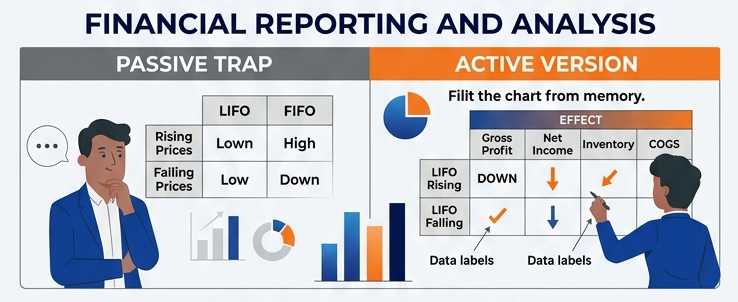
Passive trap: Reading through LIFO versus FIFO comparisons and feeling like the direction of effects is clear.
Active version: Without notes, write the direction of effect on gross profit, net income, inventory value, and COGS when a firm switches from FIFO to LIFO in a rising price environment. Then do the same for a falling price environment. If you hesitated on any of those eight cells, that is where your preparation needs work.
Quantitative Methods
Quant is where passive studying most obviously fails. Most candidates can follow a hypothesis testing work example. Very few can set up the correct test, state the null correctly, identify the right critical value, and interpret the result without seeing the structure laid out for them first.

Passive trap: Reading through hypothesis testing and feeling like you understand the logic.
Active version: Given a scenario with no test statistic type specified, determine: what is the appropriate test, what are the null and alternative hypotheses stated correctly, what are the decision rules, and what does rejecting the null actually mean in context. If you cannot write all four from a cold start, you have not yet learned this in retrievable form.
Ethics
Ethics doesn't test how well you remember the Standards. It tests how precisely you can apply them when every option sounds reasonable.

Passive trap: Reading through Ethics and feeling like you understand the Standards because the explanations seem straightforward and logical.
Active version: Given a question where multiple options seem correct, slow down and identify the qualifier: what is being asked: "most appropriate," "least likely to violate," "required," or "recommended"? Then, for every option, explain why it is wrong, not just why one is right. If you cannot clearly eliminate each incorrect choice with reasoning, you have not yet built precision in Ethics.
ℹ️ Info
For CFA candidates, read our blog on Why Students Fail CFA for more insights on better preparation.
Why Spaced Repetition Is a Principle, Not a Schedule
Most explanations of spaced repetition describe it as a system: revisit on day 1, day 3, day 7, and day 14. That framing is fine as a starting point. But the underlying principle is more useful than the specific intervals.
Spaced repetition works because memory decays over time, and retrieval is most valuable when it happens just before the memory would otherwise be lost. Revising material while it still feels completely fresh requires almost no retrieval effort and leaves almost no additional memory trace. Revising it when it has partially faded requires real retrieval effort and leaves a significantly stronger trace.
The practical implication is this: if you can still answer a question easily when you revisit a topic, you revisit too soon. The slight difficulty of having to search for the answer is the mechanism, not a sign that your preparation is failing.
For CFA and FRM candidates, this means treating the mild discomfort of partially forgotten material as useful rather than alarming. The answer is still there. Your brain is just being asked to work for it. That work is the point.
The Question Most Candidates Do Not Ask
After most study sessions, candidates ask some version of "did I cover enough today?" or "Do I understand this?"
The more useful question is: "Can I produce this without help?"
These sound similar. They are not. You can cover a chapter and understand it while reading it without being able to produce a single element of it ten minutes later. The gap between comprehension during reading and retrieval under pressure is where most exam preparation fails.
A simple habit closes that gap. Before closing your notes at the end of any session, take five minutes to write, without looking, the key ideas from what you just studied. Not a summary. Not highlights. Whatever you can produce from memory. What you cannot produce, you have not yet learned in a form the exam will reward.
This is not an extra task on top of studying. It is the second half of the study session. The reading is the input. The recall is the learning.
Common Passive Habits and What to Replace Them With
When something feels unclear, rereading the same passage rarely fixes it. Try a question on that concept before going back. The gap will become obvious. Then reread with that specific gap in mind the second read becomes targeted, not passive.
Habit: Rereading for clarity
Replace with: Attempt a question first.
Habit: Highlighting
Replace with: Writing margin notes in your own words. Highlighting feels like engagement, but it doesn't require you to think. Instead, write short notes explaining why something matters or how it connects to what you already know. Writing forces processing; highlighting doesn't.
Habit: Rewatching lectures
Replace with: Attempting questions after the first watch. Lectures are useful for first exposure. After that, questions are where learning actually happens. Rewatching feels easier because it's familiar but familiarity doesn't mean you can recall or apply the concept.
Habit: Making detailed notes
Replace with: Prioritising retrieval over documentation. Notes help in the beginning, but they quickly become a comfort zone. If you're spending more time writing notes than solving questions, the balance is off. Shifting focus to retrieval notes should support it, not replace it.
Conclusion
Passive studying is not wrong. It is incomplete. It handles the first encounter with a concept reasonably well. It does not handle everything after that.
The exams you are preparing for do not test whether you have seen the material. They test whether you can produce the right response without prompting, under time pressure, when the topic is not labelled. That is a retrieval skill. It is built through retrieval practice, not through more exposure to the material.
Study in a form that your brain has to work at. End sessions with recall, not rereading. Build the habit of asking "can I produce this?" rather than "do I understand this?" The difference in those two questions is the difference between exam preparation and exam performance.
ℹ️ Info
Are you still doing passive study? Check out the CFA preparation guide to get more insights.
F A Qs :
Q: I understand the material when I reread it. Why does my exam score not reflect that?
A: Because understanding while reading and retrieving under pressure are different cognitive processes. Reading is recognition: your brain confirms the material is familiar. The exam requires retrieval: your brain must produce the answer without any prompt. Passive rereading trains the first skill. Only active practice under closed-book conditions trains the second.
Q: Which CFA or FRM subjects benefit most from active recall?
A: All of them, but differently. Fixed income and quant benefit most from problem template drills because method selection is the failure point. Financial reporting benefits from scenario-based recall where you write the directional effects of accounting changes from memory. Ethics benefits from close attention to wrong answer analysis, not just correct answer review.
Q: How do I know if I am spending enough time on active recall versus reading?
A: A rough check: if you can answer questions on today's material immediately after reading without referencing your notes, your recall ratio is probably healthy. If you feel like you need to reread before attempting questions, you are still in recognition mode. Flip the ratio. Attempt first, reread only to address the specific gap the question exposed.
Q: Does active recall replace mock exams?
A: No. They serve different purposes. Active recall within topics builds the foundational retrieval that makes mock exam performance possible. Mock exams test whether that retrieval holds under full exam conditions: time pressure, mixed topics, and sustained concentration across a full session. Both are necessary. Neither replaces the other.
Q: Is spaced repetition practical with a tight study schedule?
A: Yes, because it is a principle rather than a rigid system. The core habit is simple: do not return to material while it still feels completely fresh. Let some forgetting happen, then retrieve. Even loosely applied, this produces significantly better retention than blocking all study of a topic into a single period and not returning to it.