


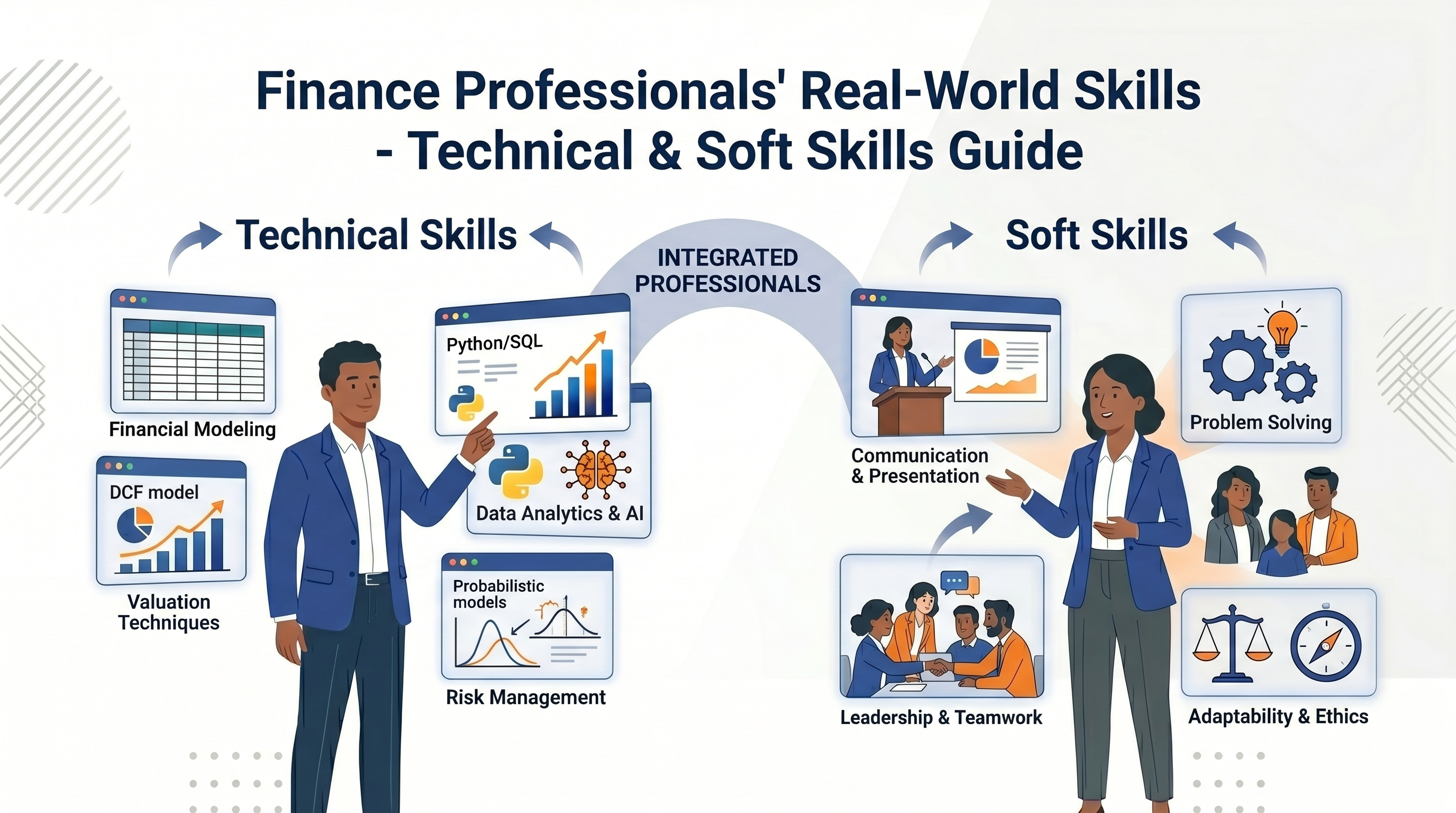
The finance education system continues to focus heavily on theory, while the job market increasingly rewards application. Business schools still spend years teaching spreadsheet modelling, yet employers today are actively hiring candidates with skills in Python, automation, and data analytics. Universities emphasise financial analysis, but organisations are looking for professionals who can also communicate strategy, collaborate across teams, and contribute to decision-making beyond numbers alone.
As the industry evolves, the gap between what finance professionals learn in classrooms and what they are actually expected to do on the job has become impossible to ignore.
Key Takeaways
- The biggest career accelerators in finance are not taught in most MBA or university programs.
- Technical skills (Excel, SQL, Python, data visualization) are table stakes; soft skills (communication, stakeholder management, business acumen) differentiate high performers.
- The finance skills gap represents both a risk (falling behind competitors) and an opportunity (upskill strategically and leap ahead).
Yet this gap is also your greatest opportunity. Master the real-world skills employers are actively seeking, and you will compress years of learning into months of focused development. This guide reveals the exact skill stack that separates mid-level analysts from CFOs: the technical tools you need to master, the soft skills that move organizations, and the strategic thinking that drives C-suite decisions.
The Real-World Finance Skill Stack: Technical, Soft, and Strategic
Success in finance is not driven by technical knowledge alone. Sustainable career growth comes from developing a balance of technical expertise, communication skills, and strategic thinking over time. Here's what it takes to start and grow in a finance career.
Technical skills
- Professionals today are expected to work confidently with financial analysis, Excel, data interpretation, reporting tools, budgeting, forecasting, and business modelling.
- The ability to analyse numbers accurately and convert data into actionable insights is critical for decision-making.
- As industries become more data-driven, practical knowledge of financial systems, automation tools, and business analytics is becoming increasingly valuable.
Soft Skills
- As professionals move into managerial roles, communication, collaboration, and stakeholder management become equally important.
- Professionals with strong technical expertise but weak communication skills may struggle to move into leadership positions.
Strategic Thinking
- At leadership levels, strategic thinking becomes critical to connect financial analysis with broader business decisions and long-term direction.
- Strategic decisions without practical, hands-on experience often result in disconnected execution.
Keep in mind that overdependence on only one skill often limits career growth and progression. Long-term growth is usually achieved by professionals who continue developing all three capabilities together as their roles evolve.
How the Skill Mix Evolves by Career Level
| Career Level | Technical Skills (Focus) | Soft Skills (Focus) | Strategic Skills (Focus) |
|---|---|---|---|
| Entry-Level (Analyst) | 70%: Excel, financial modeling, SQL basics | 20%: Communication, teamwork, listening | 10%: Learning business context, industry dynamics |
| Mid-Level (Senior Analyst, Manager) | 40%: Python, advanced SQL, automation | 35%: Stakeholder management, influence, persuasion | 25%: Business acumen, budget decisions, project strategy |
| Senior-Level (Director, VP) | 20%: ML/AI understanding; oversee rather than execute | 30%: Leadership, change management, executive communication | 50%: Business strategy, risk management, organizational vision |
| C-Suite (CFO, CIO) | 10%: Understand concepts; delegate execution | 30%: Board communication, stakeholder influence, culture-building | 60%: Company strategy, financial policy, competitive positioning |
Success requires progressive rebalancing. Don't ignore technical skills early because they are your credibility foundation. But don't stay trapped in them. The professionals who reach senior leadership build all three pillars, shifting emphasis as their role expands. Recognize where you are now and intentionally develop the skills for the next level.
The Education-Industry Gap: What an MBA Doesn't Teach
MBA programs focus on theory and frameworks, but the finance industry has evolved faster than business school curricula. Universities emphasize financial accounting, valuation methodologies, and business strategy, but largely skip skills that modern finance demands. The result: MBA graduates arrive at their first job requiring 6-12 months of onboarding to become truly productive.
This gap is widening.
Data shows that 75% of finance leaders report a skills gap in their organizations, and 93% of business leaders cite talent shortages, with 42% specifically flagging business acumen as missing. The issue isn't that MBAs don't teach finance, but it's that they under-teach the practical, technical, and soft skills that drive real value on the job.
What MBA Teaches vs. What Industry Actually Demands
| Skill Area | MBA Teaches | Industry Actually Demands | Gap Size |
|---|---|---|---|
| Excel | Basic modeling | VBA, advanced formulas, dashboards | Large |
| Python | None (usually) | Automation, ML, data processing | Huge |
| SQL/Databases | Rarely covered | Querying databases, data extraction | Huge |
| Data Visualization | Marginal (basic charts) | Power BI, Tableau, interactive dashboards | Large |
| Communication | Theory (case studies) | Client-facing storytelling, executive influence | Large |
| Business Acumen | Strategy frameworks (Porter, SWOT) | Cross-functional thinking, operational reality | Huge |
| Problem-Solving | Case study analysis | Real-time troubleshooting under pressure | Large |
The gap exists because MBA curricula lag industry changes by 2-3 years. Universities prioritize enduring theory over rapidly evolving tools. Finance has transformed (Python wasn't standard five years ago), but classrooms move slowly. Most importantly, soft skills are notoriously difficult to teach in lecture halls.
Info:
Build practical finance expertise to complement your MBA and career growth.
The Modern Finance Tech Stack: Excel, SQL, Python, and AI
Finance professionals now need to think in layers. Excel is your foundation; SQL lets you access data independently; Python enables automation and advanced analytics; and AI tools amplify your leverage. The catch: you need all four, but in progression, not all at once.
Excel Mastery: Your Non-Negotiable Foundation
Excel is used daily by 90% of finance professionals. You cannot skip this. Master these core competencies:
- Formulas: VLOOKUP, INDEX/MATCH, SUMIF/SUMIFS, INDIRECT
- Pivot tables: Creation, drilling down, source data management
- Data validation and conditional formatting for clean, auditable models
- Charts and dashboards that communicate insights visually
- Named ranges, absolute vs. relative references for formula clarity
Don't waste time on obscure functions, advanced chart design, or VBA macros - Python is better for automation anyway.
Time to proficiency: 3-6 months of consistent practice. Salary impact: Excel mastery is assumed; weakness here limits advancement.
Info:
Learn advanced Excel skills with VLOOKUP and Smart Charts.
SQL: The Data Extraction Layer
Most finance data lives in databases (ERP systems, data warehouses). SQL is how you access it. You don't need to be a database engineer; you just need four core concepts:
- SELECT, WHERE, GROUP BY, JOIN (these four cover 90% of real-world queries)
- Filtering and aggregation across multiple tables
- Basic database schema understanding so you know where data lives
A simple real-world scenario is this: "Get me all Q3 revenue by customer from our ERP." In practice, that requires a SQL query. An analyst who can independently extract and work with that data becomes significantly more valuable than someone who has to rely on the IT team for every request.
Time to proficiency: 1-2 months (easier than Excel mastery). Salary impact: SQL knowledge increases earning potential 10-15%.
Python: Automation and Advanced Analytics
Python matters when you're dealing with large datasets (1M+ rows), repetitive tasks, or advanced analytics. Master these libraries:
- Pandas for data manipulation
- Matplotlib/Plotly for visualization
- Scikit-learn for basic machine learning
- Automation scripts to replace manual, repetitive work
Real-world scenarios: Automate monthly reconciliation, predict customer churn, optimise portfolio allocation.
Time to proficiency: 2-3 months for basics; 6-12 months for proficiency. Salary impact: Python proficiency increases earning potential 20-30%.
AI Tools: ChatGPT, Excel Copilot, GitHub Copilot
Modern AI has become a leverage multiplier. Use it strategically:
- ChatGPT: Write Excel formulas, summarize reports, generate financial narratives
- Excel Copilot: Suggests formulas, auto-creates pivot tables, recommends dashboards
- GitHub Copilot: Auto-generates Python and SQL code, saves 30-40% of coding time
These aren't replacements for learning, but they're force multipliers once you understand the fundamentals.
Recommended Progression for Career Advancement
| Year/Stage | Focus Skill | Why |
|---|---|---|
| Year 1 | Excel mastery | Foundation; required for all finance roles |
| Year 2-3 | SQL | Enables data analysis independence |
| Year 3-5 | Python | Automation and career differentiation |
| Year 5+ | AI tools + strategy | Leadership leverage and decision-making speed |
Many professionals jump straight to Python without mastering Excel first. The problem: they can't validate data or understand the financial logic underlying their code. Excel mastery teaches you how to think about finance; Python is just automation built on top of that foundation. Learn in sequence, not in parallel.
Beyond Numbers: Communication, Storytelling & Business Acumen
Soft skills determine 70% of promotions, yet most finance professionals focus entirely on technical competency. Exceptional analysts without strong communication and business acumen plateau at mid-level. C-suite roles are 50%+ soft skills, 30% strategic thinking, and just 20% technical expertise. This section covers the three pillars that separate high performers from those who stay stuck.
Communication & Storytelling: The Differentiator
Finance professionals produce strong analysis but struggle to make people care. The issue: numbers without context mean nothing. Your job is to translate data into narratives that move decisions.
Structure your insights this way: Situation → Problem → Data → Solution → Action
Instead of: "Revenue down 15%"
Say: "We lost 12% market share to Competitor X, costing $2.3M in Q3. If we execute Strategy Y, we regain 8% share by Q4, recovering $1.8M."
Every number needs a "so what?" attached. When presenting to leadership:
- Lead with the conclusion, not the analysis
- Tailor your message (CFO cares about P&L; CTO cares about system impact)
- Use visuals (humans process images 60,000x faster than text)
- Anticipate objections and address them upfront
Critical Thinking & Problem-Solving: The Execution Engine
Critical thinking makes you ask "Why?" until you find the root cause, not just the symptom.
Example: Revenue is down. Why? Sales efficiency declined. Why? Longer sales cycles. Why? Product complexity increased. Only the third "why" reveals the actionable insight.
Problem-Solving Steps:
- Define the problem (identify root cause, not just symptoms)
- Gather data (don't assume)
- Generate options (develop at least 3 solutions)
- Execute and measure results
Real example: Budget vs. actual variance. Surface problem: the forecast was wrong. Critical thinking: Was the market unpredictable, was an internal assumption flawed, or is data quality poor? Your solution depends on the real cause.
Business Acumen: The Strategic Multiplier
Business acumen is the ability to see how financial decisions connect to broader business outcomes. 93% of leaders say it's lacking, and companies investing in it see 15-20% profit margin improvement.
| Component | What It Means | How to Develop It |
|---|---|---|
| Financial Literacy | Read statements; understand cash flow and ROI | Analyze your company's 10-K; identify 3 key risks |
| Strategic Thinking | Anticipate competitor moves; identify opportunities | Compare your company to 3 competitors; find gaps |
| Market Awareness | Understand industry trends and customer needs | Read industry news 30 min/week; spot patterns |
| Operational Insight | Know how the business actually works (not just finance) | Interview operations, sales, product teams |
| Risk Assessment | Identify financial risks and plan mitigation | Create a risk matrix for your organization |
Business Acumen Progression:
- Years 1-2: Understand your function (finance processes and metrics)
- Years 2-4: Understand the business (how revenue flows, cost structure)
- Years 4-7: Understand strategy (competitive advantage, market positioning)
- Years 7+: Shape strategy (influence direction, allocate capital)
Start building acumen now: attend strategy meetings, listen to earnings calls, analyze financial statements, and have cross-functional conversations. The earlier you see the whole business, the faster you'll rise.
Emerging Skills: AI, ESG, Data Visualization, and Cybersecurity
Finance roles are expanding beyond traditional modelling and reporting. Employers now expect you to work with AI tools, understand ESG reporting, make data visually consumable, and be aware of cybersecurity risks. You do not need to become a specialist in all four, but you do need working familiarity in each area.
| Skill | Why It Matters | What You Need to Know | Approx. Time to Competence |
|---|---|---|---|
| AI Integration | Automates reports, improves forecasting, flags anomalies | How to use tools, how to validate outputs, when not to use them | 2-3 months |
| ESG Reporting | Driven by regulation and investor demand | Key ESG metrics, reporting frameworks, disclosure basics | 3-6 months |
| Data Visualization | Executives prefer dashboards over static reports | Tools like Power BI/Tableau and how to tell a clear data story | 1-2 months per tool |
| Cybersecurity Awareness | Finance teams are prime fraud and data-theft targets | Phishing awareness, MFA, core data-protection principles | 1 week (awareness), 1-2 months (deeper) |
- AI in finance now supports report automation, forecasting, and anomaly detection. Your edge is not writing models from scratch, but knowing how to use AI outputs responsibly.
- ESG is moving from "nice to have" to "must report" in many markets. Understanding basic frameworks and metrics is becoming a core part of finance work.
- Data visualisation skills help you translate complex information into dashboards that decision-makers will actually use.
- Cybersecurity awareness is now a baseline expectation for anyone handling financial data.
Career Progression: Skills Needed at Each Level
The mix of skills that matter changes as you move from analyst to C-suite. Technical depth helps you start; soft skills and business acumen help you advance.
| Level | Role Focus | Technical | Soft Skills | Strategic |
|---|---|---|---|---|
| Entry (Analyst / Associate) | Execute tasks, learn processes | ~70% | ~20% | ~10% |
| Mid (Senior Analyst / Manager) | Lead workstreams, mentor juniors, own outcomes | ~40% | ~35% | ~25% |
| Senior (Director / VP) | Set direction, manage teams, shape business | ~20% | ~30% | ~50% |
| C-Suite (CFO / CIO) | Set company direction, manage stakeholders | ~10% | ~30% | ~60% |
Entry level: Focus on flawless execution and learning core tools: Excel, modelling, basic SQL, and financial statement analysis. Communication and attention to detail are your key soft skills.
Mid level: You are expected to lead initiatives and create impact beyond your own tasks. This is where Python, automation, stakeholder management, and business understanding become crucial.
Senior and C-suite: The emphasis shifts to strategy, leadership, and organisation-wide impact. You still need to understand the technical work, but your main value lies in setting direction, managing risk, allocating capital, and communicating with boards and investors.
Common blockers at all stages include staying technical for too long, weak communication, shallow business understanding, and not developing others. These patterns make promotion difficult even for high performers on paper.
Demonstration Matters: Building Your Finance Skills Portfolio
Hiring is increasingly skills-first. Degrees and job titles still matter, but employers pay close attention to what you can actually do. A strong portfolio makes that visible.
Why a Portfolio Helps
- A résumé shows where you studied and worked; a portfolio shows what you can build.
- Portfolios differentiate you from candidates with similar qualifications.
- They give you concrete, confidence-building examples to discuss in interviews.
Practical Portfolio Projects
- Financial model: Build a three-statement model for a listed company using public data. Include clear logic, scenarios, and sensitivity analysis.
- Data analysis project: Use SQL and Python on a public dataset (for example, from Kaggle) to clean data, run analysis, and visualise key insights.
- Dashboard: Create an interactive dashboard in Power BI or Tableau that tracks a set of financial or business metrics.
- Written case study: Publish a short analysis of a company or investment with a clear structure: situation, analysis, recommendation, and expected impact.
Host your work on platforms like GitHub, Tableau Public, or a simple personal site, and link it to your LinkedIn profile. At the entry level, these projects help you land interviews; at the mid-level, they signal a growth mindset; at senior levels, they reinforce your credibility as a strategic thinker.
Avoid making projects either too simple (no depth) or so complex that a non-technical reviewer cannot understand them. Always explain the business question you answered, not just the tools you used.
Conclusion
Finance professionals who stand out now combine three elements: solid technical skills, strong communication, and real business understanding. Traditional education alone does not provide this mix, but a deliberate skill-building plan does.
Start by securing your technical foundation in Excel, then layer in SQL, Python, and basic AI tools. In parallel, invest in communication, problem-solving, and business acumen from day one. Over time, this combination is backed by a visible portfolio of work that moves you from competent analyst to trusted finance leader.
Info:
Unsure which practical skills can truly accelerate your finance career? Fill out the form and let our coordinator help you find the right direction.
FAQs
Q: What skills do finance professionals need?
A: Finance professionals in 2026 need a combination of technical skills, communication abilities, and business acumen. Employers increasingly expect proficiency in Excel, SQL, Python, Power BI, and AI tools alongside stakeholder management, strategic thinking, and problem-solving skills.
Q: Is Excel enough for a finance career anymore?
A: No. Excel remains a foundational skill, but modern finance roles also require knowledge of SQL, Python, data visualization, and automation tools. Employers now prefer candidates who can analyze large datasets and improve workflow efficiency using technology.
Q: Why are Python and SQL important for finance professionals?
A: Python and SQL help finance professionals automate repetitive tasks, extract data independently, analyze large datasets, and improve forecasting accuracy. These tools are widely used in financial analysis, reporting, risk management, and business intelligence.
Q: What soft skills are important in finance careers?
A: Communication, stakeholder management, teamwork, leadership, and business storytelling are critical soft skills in finance. Professionals who can explain financial insights clearly and influence business decisions are more likely to move into leadership roles.
Q: Does an MBA teach enough practical finance skills?
A: Most MBA programs provide strong theoretical knowledge but often lack practical training in tools like SQL, Python, automation, dashboards, and real-world business communication. Many graduates still need additional upskilling to become industry-ready.
Q: How can finance students gain real-world finance skills?
A: Finance students can build practical skills through portfolio projects, internships, financial modeling practice, dashboard creation, case studies, and learning tools like Excel, SQL, Python, Power BI, and AI-based productivity tools.