

Most misconceptions around the CFA program do not arise from the lack of information, but from the narrow understanding of what Finance truly involves. When the program is viewed only through the lens of stock markets, difficulty levels, or outcomes like salary and job roles, the bigger picture is missed.
To be honest, CFA is not a shortcut to a prestigious role in the Finance domain. Neither is it limited to a single domain. It is a structured pathway that builds your knowledge across multiple areas within Finance. It requires consistency, context and application rather than rote effort.
The real gap, therefore, is not between myths and facts, but between how the program is perceived and what it actually demands.
Key Takeaways
-
- Target the Right Path: Choose the CFA program when you want investment-focused depth and the flexibility to study alongside your work.
- Leverage Structured Recruiting: Choose an MBA when you need a structured recruiting channel through a top-tier business school and broader management training.
- Understand Access Routes: If your goal is to secure front-office roles that hire heavily through campus placements, such as Investment Banking or Consulting, an MBA from the right campus can be the fastest access route.
- Build Specialist Skills: If your goal is long-term investing roles like Equity Research, Portfolio Management, Wealth, or Risk, a CFA-first approach is often more aligned, provided you build proof of skills alongside it.
- Ignore the Trends: Do not choose a credential based on current trends; choose based on whether you want to manage portfolios (CFA) or manage people and companies (MBA).
The Gap Between Expectation and Reality
A useful way to read this post is to ask yourself: "Which of these misconceptions is shaping your thinking?".
If your understanding is built on flawed assumptions, it will eventually break under real-world expectations. The shift is therefore from how the program is perceived to what it actually represents.
The Reality Framework
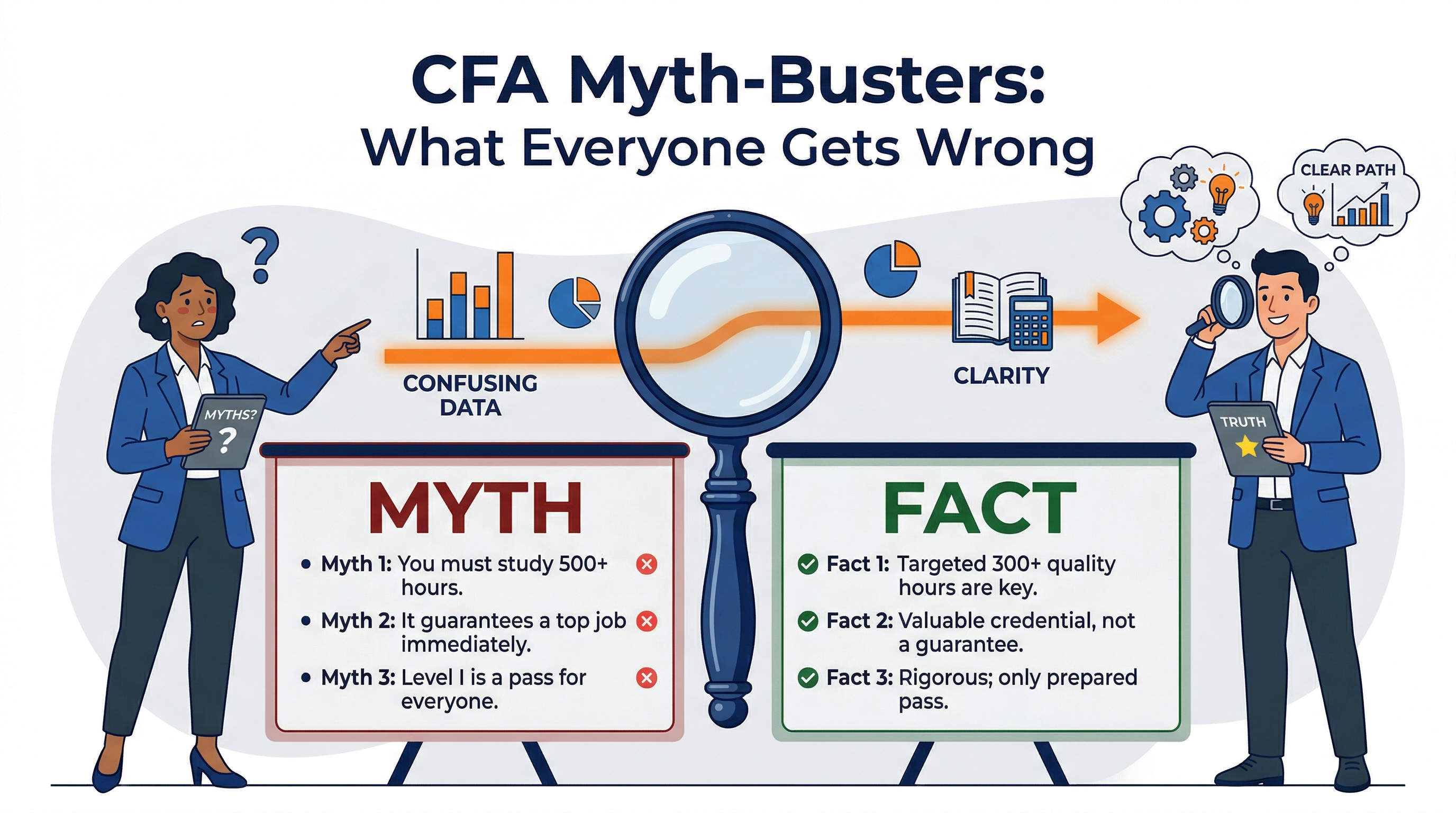
| Myth | Reality | What to Do Next (Actionable) |
|---|---|---|
| "CFA guarantees a job" | It boosts credibility, not placement. | Pick a target role and build one proof project (e.g., a research report). |
| "Passing exams = Charter" | You need 4,000 hours of work ex. | Don't just study; map your current job to "investment decision" criteria. |
| "300 hours is enough" | It is just a benchmark. | Measure focus, not just time. Track "deep work" hours. |
| "It is only for finance grads" | Diverse backgrounds often succeed. | Fix your basics first: Accounts + Quants foundations. |
| "CFA is too expensive" | Cheaper than an MBA (₹3L vs ₹20L). | Budget for one attempt. The cost doubles if you study inefficiently. |
Phase 1: The "Barrier to Entry" Myths
(Stop telling yourself you are not qualified)
The first hurdle is psychological. Many of you accept rejections before you even register for the CFA exam.
Myth: "It is only for finance grads, math geniuses, or English experts"
Engineers and arts graduates outperform finance students simply because they are more disciplined. You do not need to be a calculus expert; CFA is a logic exam, not a math degree. Similarly, you do not need Shakespearean English; you need specific comprehension.
-
- The Reality: 70–80% of the quantitative section is just Statistics and Time Value of Money. By Level III, standalone "Quants" disappears.
- The Fix: Leverage your logical reasoning if you are from a science background. Read financial news (Mint or WSJ) daily to fix your vocabulary.
Myth: "CFA is too expensive" or "I should wait for the perfect time"
"I'll start when I have more time" is just procrastination dressed up as planning. That day never comes.
-
- The Reality: An MBA costs ₹20–30 Lakhs; CFA costs ₹2.5–3 Lakhs. The real cost isn't money; it is the opportunity cost of studying inefficiently.
- The Fix: Treat your first attempt as your only attempt. Budget for one shot.
Phase 2: The "Study Trap" Myths
(Stop confusing motion with progress)
Once you register for CFA, the next set of myths gradually destroys your study efficiency.
Myth: "You must study exactly 300 hours"
The industry treats '300 hours' like a law of physics; in reality, it is just a rough average.
-
- The Reality: The 300-hour rule is just an average, not a guarantee. Clocking the time doesn't entitle you to a passing score; only comprehension does. If you check your phone 4 times an hour, those hours are useless.
- The Fix: Count "phone-free hours," not just "seated hours." This focus on intensity over duration is the exact strategy to clear exams successfully in the first attempt, so stop watching the clock and start watching your retention.
Myth: "Pass rates are so low that only geniuses pass"
Obsessing over negative headlines is a classic case of "Framing Bias," a psychological trap you will actually study in the curriculum.
-
- The Reality: Failing in CFA isn't usually about a lack of intelligence; it's about a lack of process. The low rates are often skewed by non-serious candidates, so don't let the statistics frame your reality.
- The Fix: Create Error Logs. When you get a question wrong, write down why. Was it a concept gap or a silly mistake?
Myth: "CFA teaches you how to pick multi-bagger stocks"
This is a common confusion between short-term trading and long-term investing.
-
- The Reality: CFA is not a course on Technical Analysis (charts). It is a course on Fundamental Analysis (business valuation). It prepares you for wealth management, not day-trading on a mobile app.
- The Fix: If you want to trade price movements, learn Technical Analysis separately. If you want to build a career in understanding value, do CFA.
Phase 3: The "Career Mirage" Myths
(Stop assuming the degree will do the work for you)
This is the most dangerous phase. You pass the exams but fail the interview because you relied on the wrong myths.
Myth: "CFA guarantees a high-paying job" or "Level I gets you placed"
You think, "I will clear the exams, and then Goldman Sachs will call me." Unfortunately, it doesn't work like that.
-
- The Reality: The charter gets you the interview; your skills get you the seat. Passing makes you a fund manager for your personal portfolio, not for a firm. No one hands over ₹100 crores of AUM just because you passed a test.
- The Fix: You need to understand exactly what the industry expects beyond just the exam result. Watch the complete breakdown in this CFA Myths vs Reality Video, to see the difference between a student mindset and a professional one.
Myth: "Passing all 3 levels means you are a Charterholder"
Many candidates put "CFA" next to their name on LinkedIn after passing Level III. That is an ethics violation.
-
- The Reality: You need 4,000 hours of work experience involving investment decision-making. You cannot claim the title in a vacuum.
- The Fix: Audit your current role. Are you adding value to the investment process? If not, ask for projects that do.
Myth: "CFA is only useful abroad, not in India"
-
- The Reality: The Indian market is maturing. Valuation concepts do not change between Mumbai and New York.
- The Fix: Build India-specific proof. Write a research note on Reliance or HDFC and read the guide on Choosing a Career here.
Focus on the Karma, Not the Phala
Stop looking for the "easy" hacks because the CFA program is specifically designed to filter out those who are not serious. Myths are dangerous precisely because they give you a false sense of security by paralyzing fear.
Instead of letting myths frame your reality, you must detach from the result and focus entirely on your Karma (the study hours and discipline) rather than just the Phala (the result).
If you treat this as a professional project rather than a college exam and validate your path early, perhaps by taking the Finance Quiz to confirm your calling, the results will naturally follow. You are in control, so build the discipline, ignore the noise, and do the work.
ℹ️ Info
Ready to begin the first step to your CFA journey? Fill the form below to get started or browse our courses.
F A Qs :
Q: Does the CFA charter guarantee a job?
A: No. It builds your skills for the specific roles in Finance, improves your credibility and opens doors, but hiring depends on your practical skills, experience, and interview performance.
Q: Is CFA Level I enough to get a job in finance?
A: Level I signals seriousness and financial literacy, but it usually needs to be backed by internships or practical projects to land a good role.
Q: How hard is the CFA exam really?
A: It is challenging because of the volume of the syllabus, not just the difficulty of concepts. Success comes from consistent practice and discipline, not intelligence alone.
Q: Do I need work experience to become a Charterholder?
A: Yes. You need 4,000 hours of qualified work experience completed over a minimum of 36 months.
Q: Is CFA only for math geniuses?
A: No. While you need to be comfortable with numbers (Statistics and TVM), the exam focuses heavily on logic, ethics, and reading comprehension.
Q: Is CFA worth the cost in India?
A: Yes, especially compared to an MBA. The financial cost is low (₹2.5–3 Lakhs), but the return is high if you target investment-focused roles like Research, Wealth Management, or Risk.