

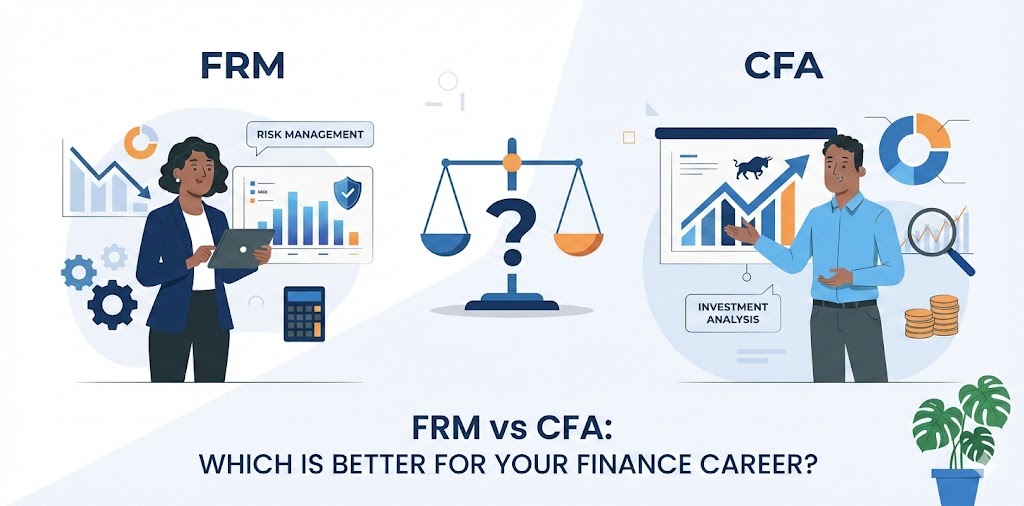
The Financial Risk Manager (FRM) and Chartered Financial Analyst (CFA) are two of the most respected certifications in finance, but they serve very different purposes. FRM is designed for professionals focused on risk management, covering credit, market, and operational risks, while CFA offers a broader exposure across investment research, portfolio management, and corporate finance. Choosing the appropriate certification depends on your career goals, preferred skill set, and long-term ambitions.
While FRM prepares you for specialized roles in risk assessment and management, CFA equips you for a relatively wider range of roles in investment banking, asset management, and corporate finance. Many professionals also choose to pursue both credentials sequentially to gain versatility, increase leadership potential, and enhance earning power.
Key Takeaways:
-
- FRM is centered on risk modelling and regulatory frameworks, while the CFA provides a more comprehensive foundation across investment and finance domains.
- Your choice should align with your career goals, role preference, and learning interests.
- Pursuing both certifications can provide a competitive edge and open leadership opportunities in finance.
Understanding FRM vs CFA Certifications
The Chartered Financial Analyst (CFA) is a globally recognized credential for careers in investment research, portfolio management, and corporate finance. It helps professionals build expertise in valuation, financial reporting, and client advisory. Candidates learn how to analyze securities, manage portfolios, and provide investment guidance to clients, making the CFA an ideal choice for those seeking broad exposure across various investment roles.
The Financial Risk Manager (FRM) designation takes a much more concentrated path within finance. It trains professionals to work with the realities of market, credit, and operational risk by using practical quantitative tools and the regulatory standards that guide decision-making. Due to this foundation, FRM-qualified professionals are trusted by banks, financial institutions, and corporate finance teams to judge uncertainty accurately, strengthen internal controls, and help safeguard an organization's overall financial health.
Structure and Study Requirements
The CFA program consists of three levels:
-
- Level I: Introduces fundamental concepts in investment tools and ethical standards.
- Level II: Focuses on asset valuation and complex financial analysis.
- Level III: Emphasizes portfolio management and the synthesis of investment strategies.
Completing the CFA typically requires 900+ study hours over 18–24 months, depending on your pace and prior experience.
The FRM program has two parts, both centered on risk management principles, quantitative analysis, and practical application:
-
- Part I: Covers risk foundations, quantitative analysis, and core topics in market and credit risk.
- Part II: Focuses on operational and systemic risk, investment management, and risk-related case studies.
FRM generally requires approximately 400–500 study hours over 12–18 months, making it a more compact program compared to the CFA.
Focus Areas: Investment vs. Risk
| Category | FRM (Financial Risk Manager) | CFA (Chartered Financial Analyst) |
|---|---|---|
| Core Focus | Risk measurement, model validation, regulatory frameworks | Investment analysis, valuation, portfolio theory |
| Key Topics | VaR, Expected Shortfall (ES), stress testing, operational risk, cyber risk, compliance | Equity and fixed-income analysis, financial modeling, portfolio construction, investment mandates |
| Skill Orientation | Deep specialization in identifying, quantifying, and managing risk | Broad toolkit for investment research, client advisory, and buy-side analysis |
| Typical Roles | Risk analyst, risk manager, regulatory/compliance roles | Investment analyst, portfolio manager, research associate, client-facing advisory roles |
| How It Positions You | Prepares professionals to strengthen risk controls and meet regulatory standards | Prepares candidates for decision-making in investment management and security analysis |
Combining FRM and CFA
Some professionals choose to pursue both certifications to maximize their career options. A phased approach is often best: start with the certification that aligns most closely with your current role, then pursue the other to broaden your expertise. Holding both FRM and CFA can open doors to leadership roles that require both quantitative depth and broad investment knowledge.
FRM Certification Details
Eligibility
Since the FRM does not mandate a bachelor's degree, it attracts individuals at various stages—students, new graduates, and career shifters alike. It's a practical route for anyone who wants to enter finance early rather than delaying their start for a full academic cycle.
Employers also recognize the FRM's focus on applied knowledge, so starting early helps candidates demonstrate initiative and technical interest even before formal experience.
Difficulty
FRM exams dive deep into quantitative risk. Expect heavy exposure to Value at Risk (VaR), Expected Shortfall, stress testing, and model validation — all areas that require comfort with formulas and numerical problem-solving.
The exam also tests how well you understand real-world failures, regulatory frameworks, and the reasoning behind risk controls, making it more application-driven than theory-driven.
Preparation Style
Because the exam is calculation-intensive, FRM candidates often focus on speed and accuracy under time pressure. Prep typically includes timed drills, formula reviews, and practice sets that mirror the fast-paced nature of the actual exam.
Pass Rates & Approach
FRM pass rates shift from one exam cycle to another, so use them as rough reference points, not rigid standards. What matters most is consistent practice — breaking the syllabus into manageable chunks, regularly reviewing weak areas, and building a strong foundation in risk fundamentals.
Effective Prep Tips
-
- Maintain an error log that tracks recurring mistakes; this helps you spot patterns and fix them early.
- Use spaced repetition to retain formulas, especially those tied to VaR, ES, and risk modeling.
- Begin mixed-item practice early so you learn to shift between topics quickly — a key FRM skill.
- Sit for full-length mocks 4–8 weeks before the exam and analyze your performance thoroughly.
CFA Certification Details
Eligibility
To register for CFA Level I, you must have a bachelor's degree or be in the final year of your program, which ensures that candidates have a basic academic foundation before handling the CFA's wide-ranging content.
A valid passport is required, which sometimes catches first-time candidates off guard — but it's essential for exam day identification and scheduling.
Difficulty
The CFA is demanding because of its breadth across three levels. Each level builds on the previous one, testing your ability to retain and connect concepts across valuation, financial reporting, portfolio strategy, economics, and ethics.
Many candidates find the cumulative nature of the program challenging — you're expected not just to learn topics but to integrate them.
Preparation Style
CFA prep is more about understanding frameworks and linking ideas across subjects than about memorizing formulas alone. Candidates spend considerable time revisiting earlier topics, building conceptual clarity, and practicing multi-topic item sets that mimic real market decision-making.
Pass Rates & Approach
Pass rates for the CFA vary each year, with each level showing its own different pattern. Instead of getting caught up in these shifts, it's better to maintain a consistent study plan—monitor topic weights, schedule mock exams, and refresh ethics often.
FRM vs CFA Careers: Roles, Pay & Future Scope
Both the FRM (Financial Risk Manager) and CFA (Chartered Financial Analyst) certifications open doors to high-growth careers across finance.
-
- While FRM professionals specialize in identifying and managing risk, CFA holders focus on investments, valuations, and portfolio performance.
- The right choice between FRM and CFA depends on whether you prefer analytical risk modelling or strategic investment decision-making.
FRM vs CFA Roles and Salary Outlook
The FRM certification is best suited for professionals pursuing risk-focused roles within banks, NBFCs, fintechs, and consulting firms.
| Category | FRM Roles | Salary (India) | CFA Roles | Salary (India) |
|---|---|---|---|---|
| Entry-Level Analysis | Risk Analyst – assesses market & credit exposures | ₹6–8 LPA | Equity Research Analyst – company analysis & financial modelling | ₹7–9 LPA |
| Specialized Analyst | Credit Risk Specialist – borrower & counterparty evaluation | ₹8–10 LPA | Fixed-Income / Derivatives Analyst – bonds & derivative pricing | ₹10–15 LPA |
| Mid-Level Management | Market Risk Manager – monitors trading book risk & VaR | ₹12–18 LPA | Portfolio Manager – manages client/fund portfolios | ₹15–25 LPA |
| Regulatory & Compliance | Regulatory Risk Advisor – Basel norms & compliance | ₹10–15 LPA | Corporate Finance Associate – valuations, M&A, capital raising | ₹8–12 LPA |
| Model-Focused Roles | Model Validation / Model Risk Expert – validates financial models | ₹15–20 LPA | Investment Banker – deal structuring & IPOs | ₹20–35 LPA + bonuses |
| Operational / Tech Risk | Operational / Cyber Risk Manager – internal controls & cyber risk | ₹10–16 LPA | Wealth / Investment Advisor – HNI portfolio management | ₹10–18 LPA |
| Leadership Track | CRO (Chief Risk Officer) – enterprise-wide risk oversight | ₹25 LPA+ | Senior Portfolio / Investment roles – strategy leadership | ₹25 LPA+ (varies by firm) |
Future Scope
The future outlook for FRM professionals is strong, driven by tighter risk governance, expanding model validation requirements, and the growing importance of cyber-risk management. Demand continues to rise across banks, NBFCs, fintechs, and consulting firms—especially in metro cities and global capability centres.
For CFA professionals, opportunities are widening with the growth of investment platforms, asset managers, and wealth-tech firms. Their strengths in valuation, portfolio construction, and capital markets also offer strong international mobility. As treasury, ALM, and strategy teams adopt a more risk-aligned approach, professionals who hold both the CFA and FRM see even broader career pathways.
Is Pursuing Both FRM and CFA Beneficial?
Earning both the CFA and FRM can be a major advantage for candidates aiming for roles that bring together investment analysis, risk strategy, and high-level financial decision-making. Employers across banks, NBFCs, consulting firms, asset managers, and GCCs place strong value on this combined skill set.
The pairing of investment depth with risk expertise builds a well-rounded profile, making you better prepared for leadership roles in treasury, ALM, model oversight, and portfolio management.
| Benefits | Why Does It Matter? |
|---|---|
| Higher Career Flexibility | Move across investment, risk, treasury, and strategy roles with ease. |
| Better Compensation | Often a 15–25% salary premium over single-credential professionals. |
| Global Opportunities | CFA's global recognition and FRM's risk focus opens international roles. |
| Stronger Leadership Fit | Balanced skills in valuation, modelling, and risk oversight support leadership growth. |
| Future-Ready Skill Set | Combines investment depth with risk governance—highly valued in modern finance. |
Conclusion
The answer to FRM vs CFA, which is better, ultimately depends on your career direction. Choose the FRM if you aim to specialize in risk management within banks, consulting, or fintech, where expertise in market, credit, and operational risk is in demand. Opt for the CFA if your interests lean toward investment research, portfolio management, or corporate finance, since it offers a broader exposure across both the buy-side and sell-side functions.
Currently, a growing number of professionals are pursuing both FRM and CFA to gain an edge in cross-functional leadership, particularly in treasury, model governance, and capital markets. The best approach is to align your choice with daily role interests, commit to a realistic study plan, and maintain steady mock test practice—helping you stand out in interviews and accelerate long-term career and compensation growth.
💡 Pro Tip
Start with the certification that aligns most closely with your current role or immediate career goals. Once you've built momentum, consider adding the second credential to maximize your career flexibility and earning potential.
F A Qs :
Q: Who earns more, CFA or FRM?
A: Investment-centric roles often pay higher salaries for CFA tracks, while FRM roles are competitive in risk domains; dual credentials can unlock higher-paying hybrids in treasury, model governance, and quantitative strategy.
Q: Is FRM very difficult?
A: It is quantitatively demanding with dense readings and applied metrics; disciplined practice, error logs, and timed sets improve outcomes.
Q: Is FRM better than CFA?
A: Neither is universally better; FRM suits risk specialists, while CFA suits investment generalists and portfolio paths—choose based on target teams and tasks.
Q: Can I do FRM before CFA?
A: Yes. Prioritize the one that fits your immediate role goals, and bring in the second once the first provides you with meaningful career momentum.
Q: What is the best strategy to choose between CFA and FRM?
A: Map desired job descriptions to certification outcomes, assess math vs valuation preferences, and align exam windows to recruiting timelines for compounding momentum.