

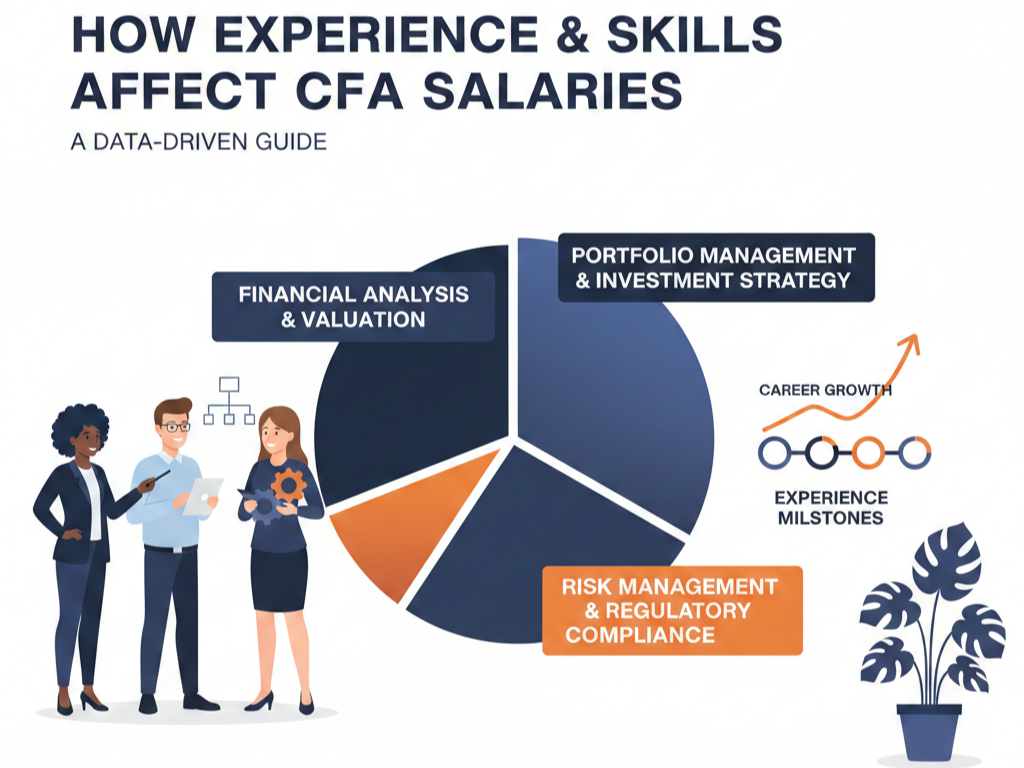
CFA salaries are not determined by "CFA Level cleared" alone. In real hiring markets, compensation is shaped by your years of experience, whether your experience is actually finance-relevant, your industry (buy-side, sell-side, risk, IB, consulting), your location (India vs. abroad), and the specific skills you can demonstrate on day one.
Key Takeaways
-
- Experience is the primary anchor for CFA salaries, with survey data showing that a new charterholder with around six years of experience earns approximately INR 28.6 lakh within a broad range of INR 9.8 - 44 lakh across candidates and charterholders.
- High-demand skills significantly influence pay, as regulatory changes are increasing demand for risk professionals while AI and data analytics are driving premiums for tech-enabled finance roles.
- Industry choice plays a major role in compensation, since targeting buy-side, sell-side, risk, or back-office functions often determines your salary ceiling more than exam levels alone.
- The CFA charter acts as a strong entry signal, with 42% of entry-level professionals reporting that pursuing it helped them secure their first investment job.
- Ultimately, your skills stack is the biggest salary lever, as valuation, modeling, performance analytics, risk frameworks, and data capabilities convert credentials into measurable business value.
Industry research from the CFA Institute India impact survey reveals that average annual income increased by 192% from new Level I candidates to recently awarded CFA charterholders. However, this growth isn't automatic. It requires navigating specific role types and skill stacks.
CFA Salary Dispersion Explained: Why Role, Region & Function Matter More Than Your Level
Two candidates can both be "CFA Level II cleared" and still earn very different salaries. This is not a contradiction; it is how compensation in finance works. The 2024 CFA Institute Compensation Study highlights that "typical pay" varies widely because compensation is a function of role, region, and seniority, not just certification. Here are the factors that create cfa salary gaps across candidates.
-
- Total Compensation vs. Base Pay: It includes base salary, cash bonuses, and long-term incentives (LTI). Two people with similar base pay can have vastly different total outcomes depending on their firm's bonus structure.
- Region & Market Structure: The Americas generally pay higher than EMEA/APAC, but APAC shows wider dispersion. Your "job location" choice (India vs. Abroad) shifts both your pay scale and your tax/savings potential.
- Job Function: The study groups are organized by function, such as portfolio management, risk, or consulting. A Portfolio Manager and a Compliance Officer with the same CFA status operate on completely different pay curves.
CFA Salary in India: What the CFA Institute's Own Survey Data Reveals
If you want authenticity, start with the data. The CFA Institute press release summarizing an India compensation survey (conducted with Kantar, 2,154 responses) provides a realistic look at the market.
While the headline figure of a 192% income increase is attractive, it is vital to read the fine print regarding experience levels.
The 192% Income Growth Claim: What It Means and What It Doesn't
| Data point | What it says | How to use it correctly |
|---|---|---|
| +192% income growth | Big increase from Level I candidate to newly awarded charterholder | Treat as a progression signal, not a guarantee for individuals |
| INR 28.6 lakh at ~6 years | Typical remuneration for new charterholder with ~6 years exp | Use as a planning anchor for "charter + mid experience" |
| INR 9.8–44 lakh range | Wide range across Level I candidates to charterholders | Shows role and seniority dispersion is real |
The 2024 CFA Institute Compensation Study includes data from more than 17,000 members across 132 markets. The executive summary provides valuable insights into what is currently driving pay premiums globally.
ℹ️ Info
Read our blog on CFA Salary in India to get more insights.
Global CFA Compensation Trends in 2024–2026: Risk, AI, and the New Pay Premiums
| Trend | Impact | Who Benefits |
|---|---|---|
| Regulatory Changes | Increase demand and budgets for compliance/risk talent | Professionals in Risk Management, Compliance, and Governance roles |
| AI & Analytics Adoption | Pays a premium for "Tech + Finance" combined skills | Quant researchers, data-driven analysts, and tech-savvy portfolio support staff |
| Talent Competition | Raises packages to attract and retain top performers | High-skill, high-impact roles where talent scarcity is real |
| Seniority Structures | Shifts pay towards bonuses and LTI at senior levels | Management and leadership roles (VP and above) |
CFA Pay Drivers: A Breakdown of What's Moving Compensation and Why
To accurately estimate your market value, you must look at the "Salary Equation": Experience Quality + Skills Stack + Industry Choice.
The India survey explicitly anchors "new charterholder with ~6 years of experience" at INR 28.6 lakh. This tells us that experience is a core driver. A fresh Level I candidate is not competing for the same roles (or pay) as a seasoned professional.
1. Experience Bands and Salary Levers
-
- 0–1 Years: Getting hired into a relevant lane. Excel, Accounting basics, Professional Communication.
- 1–3 Years: Switching from generalist to specialist. Financial Modeling, Valuation, or Risk Analytics.
- 3–5 Years: Becoming independently productive. Industry domain expertise + Stakeholder management.
- 5–7 Years: Owning deliverables and managing juniors. Strategic frameworks + Team management.
- 7+ Years: Owning P&L, risk, or portfolios. Leadership + Strategic judgment.
2. Skills: The "Tech Premium" in 2026
The global executive summary is direct: generative AI, automation, and data analytics have increased demand for tech specialists. Adding these skills to your CFA foundation is the fastest way to move from the median salary to the top quartile.
Skills to Salary Impact Map:
| Skill | Target Industry | Impact |
|---|---|---|
| Modeling & Valuation | IB, PE/VC, and Equity Research | Directly drive deal execution and research outputs |
| Writing & Thesis Building | Equity Research, Asset Management | Converts raw analysis into sellable investment decisions |
| Portfolio Analytics | Asset/Wealth Management | Improves performance reporting and builds client trust |
| Risk Frameworks | Risk, Compliance | Regulatory-driven hiring tailwinds make this highly stable |
| Data & Automation | All Sectors | Additive skills (Python, SQL) are rewarded as tech adoption rises |
3. Industry Choice: The Ceiling Effect
Your industry selection dictates your pay structure. The compensation study notes that asset management and private wealth management are prevalent, but pay differs significantly by function.
-
- Asset Management: Research and portfolio support. Bonuses are often linked to firm performance.
- Wealth Management: Client portfolio and advice. Pay is a mix of base salary plus incentives/commissions.
- Investment Banking: Deals and models. High hours with higher variable pay potential.
- Compliance & Risk: Controls and governance. Generally offers greater stability and scales with regulatory complexity.
Estimate Your CFA Salary: How to Use Our CFA Salary Calculator Accurately
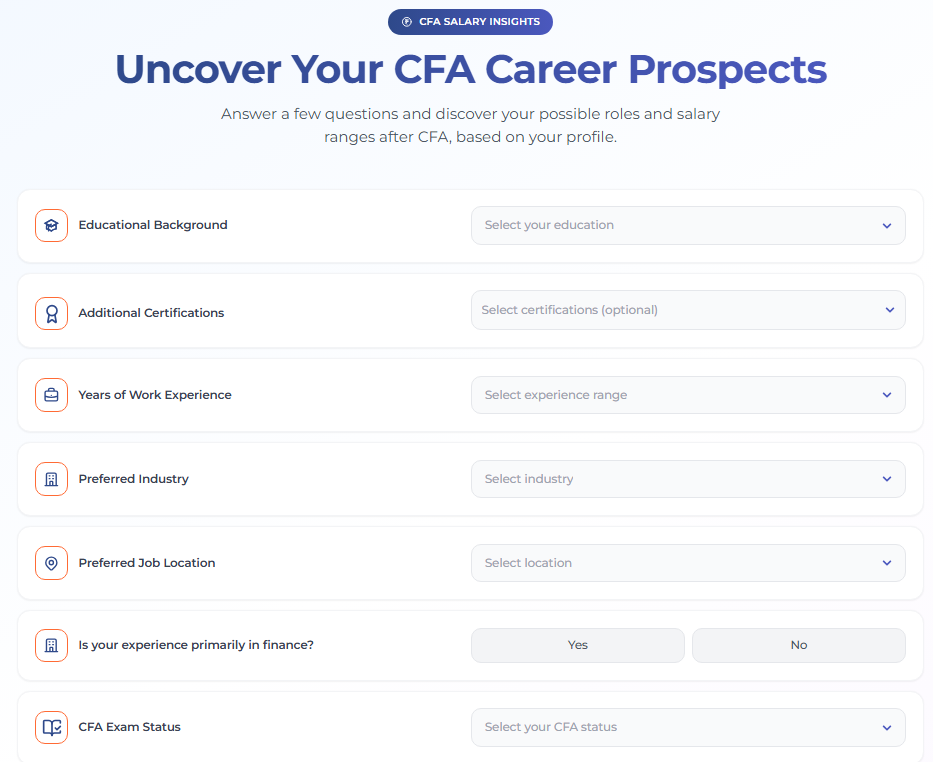
We have designed a CFA Salary Calculator to help you output possible roles and salary ranges based on your specific profile. To get the most accurate result, you must input your data correctly.
Calculator Fields: Why It Matters
Use the best-fit, not the "best sounding" option.
-
- Educational Background: choose your real degree (BCom, MBA, Engineering, etc.).
- Additional Certifications (optional): select what you truly hold (CA, FRM, CPA, ACCA, etc.).
- Years of Work Experience: choose your bracket (<1, 1–3, 3–5, 5–7, 7+).
- Preferred Industry: choose the industry you want to be hired into, not just what sounds prestigious.
- Preferred Job Location: India or Abroad.
- Is your experience primarily in finance: answer honestly.
- CFA Exam Status: select your current status.
This is the profile-to-salary mapping most competing blogs do not provide.
Position Yourself to Increase Your Salary in 6 Months
Most salary articles stop at "factors," but you need a plan. Here is a tactical 6-month roadmap to improve your standing in the salary data.
-
- Pick One Lane: Choose between Equity Research, Credit, Risk, or IB Support. Do not try to be everything.
- Build Proof Assets: Create one stock report, one clean financial model, or one investment memo.
- Align with Macro Drivers: If you are at risk, lean into the "regulatory change" driver mentioned in the CFA Institute report.
The 6-Month Execution Roadmap:
| Timeline | Action | Outcome |
|---|---|---|
| Month 1 | Choose Industry + Role | Target list of 20 relevant companies |
| Month 2 | Build Skill 1 (Technical) | One complete financial model or dashboard |
| Month 3 | Build Skill 2 (Presentation) | One written report + one presentation deck |
| Month 4 | Interview Readiness | 20 mock interview questions answered perfectly |
| Month 5 | Apply at Scale | 60 applications sent, 15 referrals requested |
| Month 6 | Negotiate Better | Have your "Evidence Pack" and salary range anchor ready |
Conclusion
CFA salary outcomes are primarily driven by experience quality, role, and industry selection, and skills that translate into measurable business value. This explains the wide compensation dispersion seen in credible studies. In India specifically, the data indicates substantial progression, anchoring a charterholder with ~6 years of experience at INR 28.6 lakh, but with a wide range depending on competence.
If you want a personalized estimate, use our CFA Salary Calculator. Enter your education, certifications, experience band, target industry, and location to get role suggestions and salary ranges aligned to your profile.
Start by strengthening your foundations through Aswini Bajaj Classes' CFA Level I coaching or FRM Part I preparation to build the modeling and credit-thinking skills recruiters actually pay for.
F A Qs :
Q: Does CFA salary depend more on exam level or work experience?
A: Work experience and role seniority are the major drivers of compensation dispersion, according to the CFA Institute's compensation study. The CFA charter mainly serves to improve entry, career progression, and competitiveness in the job market.
Q: What is the salary of a CFA charterholder in India with experience?
A: The CFA Institute's India impact survey reports that a new CFA charterholder with approximately six years of work experience earns typical remuneration of INR 28.6 lakh.
Q: Which skills increase CFA salary the most?
A: The 2024 executive summary highlights that AI, automation, machine learning, and data analytics are in increasing demand. Tech-based skills in finance roles often drive up compensation.
Q: Is CFA worth it for a salary in India?
A: Yes. The India impact survey reports that average annual income increased by 192% from new Level I candidates to recently awarded charterholders, and more than half of respondents reported a tangible impact on compensation growth.
Q: How can I estimate my salary after CFA based on my profile?
A: You can use our CFA Salary Calculator. By entering your education, certifications, experience band, preferred industry, and location, you can get an estimate of roles and salary ranges that fit your specific background.