

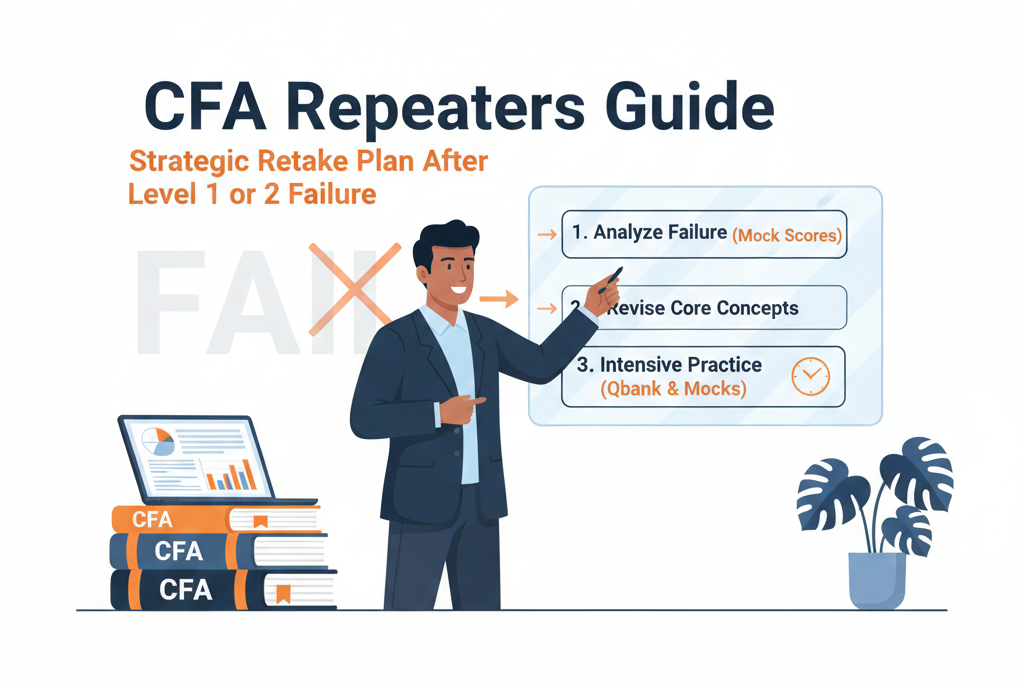
Failing the CFA Level 1 or Level 2 exam can be disheartening, but it doesn't mean the end of your CFA journey. In fact, many successful CFA charterholders have had to retake an exam or two before they achieved their goal. The key to success after a setback is having a strategic retake plan. This guide will help you understand how to bounce back from a CFA failure, the best study strategies to follow, and how to stay motivated and focused during your retake preparation.
Key Takeaways
-
- CFA results include a Minimum Passing Score (MPS) range (typically 60–70%), a confidence interval around your score, and topic-wise performance relative to a 70% reference (not a pass mark per topic).
- You must wait a minimum of 6 months between attempts, counting from your exam date, so a May failure allows November retake but not earlier.
- Forum advice and prep guides converge on practice-led learning: review weak areas using your performance feedback, prioritize Ethics/FRA (30%+ combined weight), and drill with mocks.
- Retaking with the same plan fails; change to active recall, spaced repetition, and error logging to boost pass probability.
- Charterholders often retake 1–2 times, and passing after failure can lead to salary uplifts of 32% (Level 1) or 39% (Level 2) in some data.
Whether it's your first retake or you're looking for tips to improve your chances after a previous setback, this blog will give you the tools you need to succeed in your next attempt.
Understanding CFA Level 1 & 2 Failure
Failing the CFA Level 1 or Level 2 exam can happen to anyone, and it doesn't reflect your ability or potential in finance. The CFA exams are notoriously challenging, and many candidates don't pass on their first try. The key to success is to learn from the failure, improve upon your weaknesses, and come back stronger in your retake.
CFA Institute does not publish pass marks or exact MPS, but your results include: MPS range: Set via Modified Angoff workshops (typically 60–70%). Confidence interval: Your score vs MPS with margin. Topic performance: Relative to 70% reference (aim for consistent >70% across topics).
Table: How to read your performance feedback
| Result type | What it shows | What to do |
|---|---|---|
| Close to MPS | Small gaps | Drill weak topics, 1–2 mocks/week |
| Low Ethics/FRA | Common failure drivers (30%+) | Prioritize, as high Ethics can tip MPS |
| Mixed topics | No mastery | Mixed practice sets + spaced review |
Why CFA Failures Happen
Before diving into the strategic retake plan, it's important to understand why you might have failed the exam in the first place. Common reasons for failure include:
-
- Insufficient preparation time: Many candidates underestimate the amount of time needed to prepare for the CFA exams. Ideally, candidates should invest around 300 hours for Level 1 and 350-400 hours for Level 2 preparation.
- Time management issues during the exam: The CFA exam is a time-sensitive test, and many candidates struggle with managing the time allotted for each section.
- Lack of understanding of the CFA curriculum: Simply memorizing formulas or relying on generic study materials without a deep understanding of concepts can lead to failure. The CFA exams focus heavily on applying knowledge in real-world scenarios.
- Stress and anxiety: The CFA exams are known for their high pressure. Candidates may not perform to the best of their abilities due to stress or exam-day anxiety.
Failure causes (forum/prep insights)
| Cause | Symptom | Fix |
|---|---|---|
| Insufficient practice | Low scores despite "knowing" | 2,000+ questions + mocks |
| Time management | Incomplete paper | Timed sets 3x/week |
| Ethics/FRA weakness | Below 70% reference | Daily drills, 30% exam weight |
| No review loop | Repeat errors | Error log + reattempts |
💡 Pro Tip
Don't be hard on yourself. Many successful candidates have faced setbacks and come back stronger. Use this as a learning experience to guide your preparation moving forward.
Strategic Plan for CFA Retake
1. Evaluate Your Performance
Once the exam results are out, it's essential to carefully analyze your Performance Feedback. CFA Institute provides a breakdown of your performance across different topic areas, which helps you understand where you need to focus your efforts.
-
- Review Weak Areas: If you failed to meet the minimum passing score in certain areas, prioritize improving those specific topics. For example, if you struggled with Ethics or Financial Reporting, dedicate more time to these areas.
- Look at Relative Performance: Understand where you stood in comparison to other candidates. If you were close to passing, you might just need to fine-tune your preparation and practice.
- Focus on the 'Failing' Topics: Spend more time on areas you scored the lowest. This will help improve your weak spots and increase your chances of passing.
2. Assess Your Study Plan & Time Management
If you didn't pass the exam, it's likely that your study plan and time management weren't optimal. It's important to reevaluate your study strategies for the retake:
-
- Commit to a Realistic Study Schedule: Plan your study sessions around your schedule, ensuring you can study consistently without rushing.
- Set Specific Study Hours: Aim for a steady, consistent number of study hours each week. Start with 2 hours per day and gradually increase as the exam approaches.
- Focus on Active Learning: Instead of just reading, actively engage with the material. Use methods like spaced repetition, flashcards, and practice problems to reinforce learning.
- Practice Under Exam Conditions: During your retake preparation, simulate exam conditions by doing full-length practice exams under timed conditions. This will help you manage time more effectively during the real exam.
3. Study Resources for CFA Retake
The CFA exams are unique in that they require both deep conceptual understanding and the ability to apply knowledge in practical scenarios. When preparing for your retake, it's crucial to use the right study materials.
Study Resources to Consider:
-
- Official CFA Institute Curriculum: This is the primary source of material for your preparation. The official curriculum is aligned with the exam's learning outcome statements (LOS) and provides in-depth explanations of key concepts.
- Schweser Notes: If you feel the CFA Institute materials are too dense or time-consuming, Schweser Notes are a popular study aid. They provide concise summaries of key concepts and are designed for focused preparation.
- Practice Questions and Mock Exams: Doing practice questions is essential for success in the CFA exams. Resources like CFA Institute's question bank, Schweser QBank, and Wiley's CFA exam prep offer thousands of practice questions to help you test your knowledge.
- CFA Exam Retake Guides: Certain prep providers offer specific retake guides designed to help candidates who have failed the exam. These resources focus on refining weak areas and making the most of your study time.
💡 Pro Tip
If you find yourself struggling with certain concepts, seek help from others—join CFA forums, online study groups, or work with a tutor. Sometimes, explaining a difficult topic to someone else can help reinforce your understanding.
4. Time Management on Exam Day
The CFA exams are known for their time pressure, especially in Level 2, where you have limited time to answer each item set. Improving your time management is essential to performing well.
Tips for Effective Time Management:
-
- Focus on Easy Questions First: Quickly scan through the exam paper and answer the questions you are most confident about. This will help build momentum.
- Set a Timer for Each Section: For each vignette or essay question, set a timer so that you don't spend too long on any one section.
- Don't Overthink: If you come across a question you're unsure of, make an educated guess and move on. Spending too much time on one question will hurt your overall performance.
Exam Strategy:
-
- Level 1: Spend no more than 1.5 minutes per question to maintain your pace. You have 240 minutes to answer 240 questions.
- Level 2: The time per item set is limited, so aim to spend 12 minutes per set, answering 20 questions in that time frame. Use the remaining 2-3 minutes to review your answers.
- Level 3: Manage the essay section by spending about 1 hour 30 minutes on it, while allocating 45 minutes per item set in the afternoon section.
💬 Motivational Quote
"The secret of getting ahead is getting started." — Mark Twain. Stay consistent, follow your plan, and you'll succeed in your CFA retake.
5. Staying Motivated for Your CFA Retake
Retaking an exam can be mentally exhausting, but maintaining motivation is key to success. Here are some tips to keep your spirits high during the retake journey:
-
- Set Milestones: Break your preparation into manageable milestones. Celebrate small wins, like completing a chapter or finishing a mock exam.
- Stay Positive: Avoid the "I failed once, so I'll fail again" mindset. Understand that failure is part of the learning process and an opportunity to refine your strategy.
- Accountability: Partner up with a friend or study group to stay on track. Having a support system can help you stay accountable and motivated.
Conclusion
Retaking the CFA Level 1 or Level 2 exam can feel like a setback, but it is also an opportunity to sharpen your skills and improve your performance. By evaluating your previous study plan, focusing on key weaknesses, and managing your time effectively, you can turn your CFA retake into a success story. Remember, the CFA journey is a marathon, not a sprint. Stay focused, keep your eyes on the prize, and most importantly, keep learning.
F A Qs :
Q: What should I do if I fail CFA Level 1 or Level 2?
A: Evaluate your performance breakdown, create a focused study plan for weak areas, and seek out additional resources if necessary.
Q: How long should I study for CFA retake?
A: Aim for 300 hours for Level 1 and 350 hours for Level 2. Dedicate time to revising weak areas and practicing with mock exams.
Q: Can I retake the CFA exam in the next window?
A: Yes, you can retake the CFA exam in the next available window. Ensure that you have sufficient time to revise and improve your knowledge.
Q: How do I manage stress while preparing for the CFA retake?
A: Break your study sessions into manageable chunks, take regular breaks, and stay positive. Don't hesitate to reach out to others for support and guidance.
Q: What resources should I use for CFA retake preparation?
A: Use the CFA Institute's official materials, Schweser Notes, and practice exams. Focus on quality resources that target your weak areas.