

Think cybersecurity careers are only for programmers?
Not anymore.
As banks, investment firms, fintech companies, and payment platforms become increasingly digital, protecting financial systems has become a business priority, not just an IT responsibility. Every cyber incident has financial, operational, and regulatory consequences, which is why organisations are looking for professionals who understand risk just as much as technology.
This is where the CFA Program becomes surprisingly relevant.
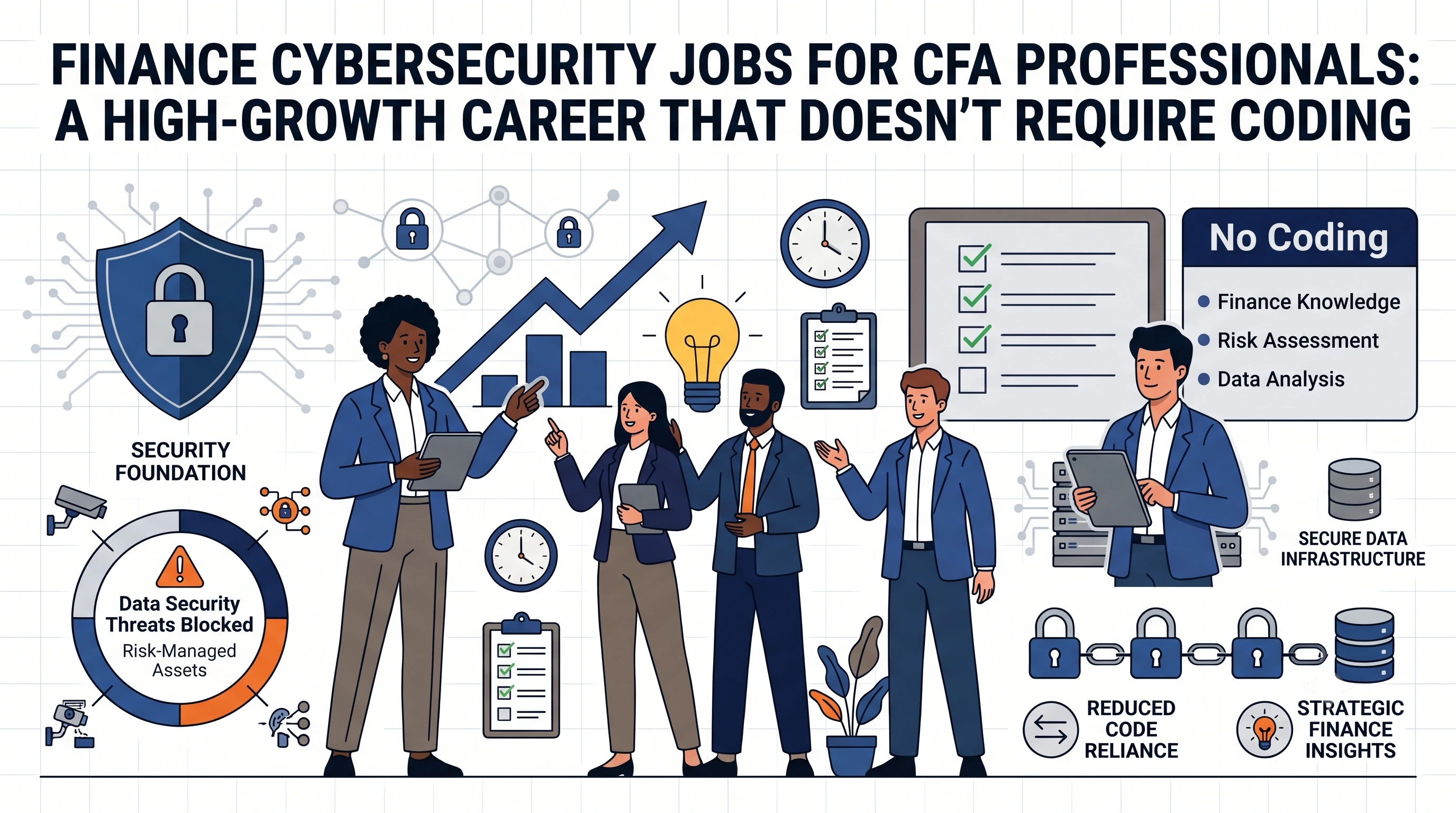
Many of the fastest-growing finance cybersecurity jobs for CFA professionals sit within Governance, Risk, and Compliance (GRC), cyber risk management, operational resilience, and third-party risk. These roles focus less on writing code and more on assessing risks, building controls, measuring business impact, and helping leadership make informed decisions.
If analysing risk, solving complex business problems, and working at the intersection of finance and technology sounds interesting, cybersecurity could be a career worth exploring.
Key Takeaways
- Cybersecurity is now a core business function in financial institutions.
- Many cybersecurity roles focus on governance and risk—not programming.
- CFA professionals already possess several skills these roles require.
- Demand for cyber risk professionals continues to grow across banking, fintech, and financial services.
- Combining finance expertise with cybersecurity knowledge creates a strong long-term career advantage.
Why Cybersecurity Hiring in Finance Is Growing
Banks today are far more technology-driven than they were a decade ago.
Customers transfer money through mobile apps, invest online, use digital wallets, and access financial services around the clock. Behind these services are cloud platforms, APIs, third-party vendors, and thousands of connected systems.
While this digital transformation creates convenience, it also creates new risks.
A cyberattack today can disrupt operations, expose customer data, trigger regulatory penalties, and damage a firm’s reputation. As a result, cybersecurity has moved from the IT department to the boardroom.
Financial institutions are therefore investing heavily in professionals who can answer questions like:
- Which cyber risks matter the most?
- How much could an attack cost the business?
- Are existing controls effective?
- Which vendors create the highest level of risk?
- How should these risks be reported to senior management?
These questions require business judgment as much as technical expertise, which explains why governance and cyber risk roles are expanding rapidly.
Info:
Wondering if you’re eligible for CFA or FRM? Check out our online Eligibility tool to get started.
Can CFA Professionals Build a Career in Cybersecurity?
Yes indeed.
The strongest opportunities are not in ethical hacking or software engineering. They are in roles that combine finance, governance, risk management, and strategic decision-making.
Candidates pursuing the CFA course spend years developing structured thinking around risk assessment, financial analysis, governance, and reporting. These same skills are increasingly valuable in cybersecurity functions where organisations need professionals who can evaluate risk and communicate it clearly to business leaders.
Rather than defending networks directly, these professionals help organisations understand which cyber risks deserve attention, how those risks should be managed, and what financial impact they could have.
Info:
Also check other skills and knowledge professionals need to get better hiring chances.
Cybersecurity Roles That Fit CFA Professionals
1. Cybersecurity Governance, Risk & Compliance (GRC)
GRC professionals help organisations establish cybersecurity policies, monitor compliance with regulatory frameworks, and report cyber risks to senior management.
This is one of the most natural entry points for finance professionals because it combines governance, documentation, risk assessment, and executive communication.
2. Third-Party Risk Management
Banks depend on hundreds of technology vendors.
Before working with a vendor, someone needs to evaluate whether a cyber incident at that company could expose customer information or disrupt critical operations.
Third-Party Risk teams assess these risks, review security controls, and recommend whether business relationships should proceed.
3. Enterprise Cyber Risk Analyst
Technical teams identify cyber vulnerabilities.
Cyber Risk Analysts translate those technical findings into business language by estimating financial impact, prioritising risks, and presenting recommendations to leadership.
For professionals who enjoy analysing risk rather than configuring systems, this role is an excellent fit.
4. Cyber Resilience & Operational Risk
Every organisation needs a plan for responding to cyber incidents.
These professionals help design business continuity plans, conduct resilience exercises, and ensure that critical operations can continue even during major cyber disruptions.
5. Controls Testing & Assurance
Financial institutions regularly test whether cybersecurity controls are working as intended.
This role focuses on reviewing evidence, validating controls, preparing for audits, and ensuring regulatory expectations are being met.
Why CFA Skills Translate Well Into Cybersecurity
Many core competencies developed through the CFA Program already align with cyber governance roles.
| CFA Skill | How it Helps |
|---|---|
| Risk Analysis | Prioritising cyber threats based on business impact |
| Financial Analysis | Estimating the cost of cyber incidents |
| Governance | Designing effective oversight and reporting structures |
| Communication | Presenting cyber risks to senior management and boards |
| Compliance mindset | Supporting audits, controls, and regulatory reporting |
Technical knowledge can be learned. The ability to think critically about risk is much harder to develop, and that’s where finance professionals have an advantage.
Do You Need Coding?
This is one of the biggest misconceptions about cybersecurity. Not every cybersecurity job involves programming.
Governance, risk, compliance, operational resilience, and third-party risk roles rely far more on analytical thinking, documentation, stakeholder management, and business understanding than on writing code.
Having a basic understanding of cybersecurity concepts is important, but becoming a software engineer is not a requirement for many finance-focused cyber careers.
Salary Expectations in India
Compensation varies depending on experience, organisation, and specialisation, but finance-focused cybersecurity roles generally offer attractive long-term growth.
| Role | Typical Salary |
|---|---|
| Entry-level Cybersecurity Analyst | ₹4–8 LPA |
| Cyber Risk / GRC Analyst | ₹8–15 LPA |
| Information Security Manager | ₹15–25+ LPA |
| Senior Cyber Risk / GRC Manager | ₹20–40+ LPA |
Professionals who combine financial expertise with cybersecurity knowledge often progress into leadership positions responsible for enterprise risk, governance, and regulatory oversight.
Info:
Check out our research-backed CFA salary guide for more information on roles and salary expectations.
Transition Into Finance Cybersecurity
A transition into cybersecurity does not require years of technical training. A structured approach can make the process much easier.
Step 1: Choose a Specialisation
Focus on one career path such as:
- Cyber GRC
- Third-Party Risk
- Enterprise Cyber Risk
- Operational Resilience
Trying to learn everything at once usually slows progress.
Step 2: Learn Cybersecurity Fundamentals
Develop a practical understanding of concepts such as:
- Identity and access management
- Cloud security
- Security controls
- Risk registers
- Cyber regulations
- Incident response
The objective is to understand how organisations manage cyber risk, not how to become a penetration tester.
Step 3: Build Practical Work Samples
Recruiters value demonstrated skills. Examples include:
- A cyber risk register
- A vendor risk assessment framework
- A cyber risk dashboard
- A simple governance policy document
These projects show an ability to apply concepts rather than simply understand theory.
Step 4: Position Your Finance Background
During interviews, focus on demonstrating the ability to:
- Analyse business risk
- Quantify financial impact
- Prioritise competing risks
- Present findings clearly
- Support governance and compliance decisions
This is where a CFA background becomes a significant differentiator.
Is This Career Future-Proof?
Few areas within financial services are growing as consistently as cybersecurity.
Digital banking, cloud adoption, AI, fintech partnerships, and increasingly strict regulations all require stronger cyber governance.
As technology becomes more central to financial services, organisations will continue hiring professionals who can connect technical risks with business decisions.
That makes finance cybersecurity more than a short-term trend. It is becoming an essential part of enterprise risk management.
Final Thoughts
Cybersecurity is no longer just a technology function but it is a business function.
Financial institutions need professionals who can evaluate risk, communicate with leadership, strengthen governance, and support better decision-making. These are capabilities that align naturally with the analytical and risk-focused foundation developed through the CFA Program.
For professionals looking to build a career at the intersection of finance, technology, and risk management, finance cybersecurity offers a compelling path with strong demand, attractive career progression, and long-term relevance.
Info:
Need more one-to-one counseling on Finance Cybersecurity with CFA as a background? Fill out the form below for expert guidance.
FAQs
Q: Can a CFA professional move into cybersecurity without coding?
A: Yes. Many finance-focused cybersecurity roles emphasise governance, risk management, compliance, reporting, and business analysis rather than software development.
Q: Which cybersecurity roles are the best fit for CFA candidates?
A: Cyber GRC, Enterprise Cyber Risk, Third-Party Risk Management, Operational Resilience, and Controls Assurance are among the strongest options.
Q: Is cybersecurity hiring expected to remain strong?
A: Yes. Digital transformation and increasing regulatory expectations continue to drive demand across banks, fintech firms, insurers, and investment companies.
Q: What salary can someone expect in India?
A: Entry-level roles typically begin around ₹4–8 LPA, while experienced professionals working in cyber governance and risk management can earn ₹20–40 LPA or more, depending on the organisation and level of responsibility.