


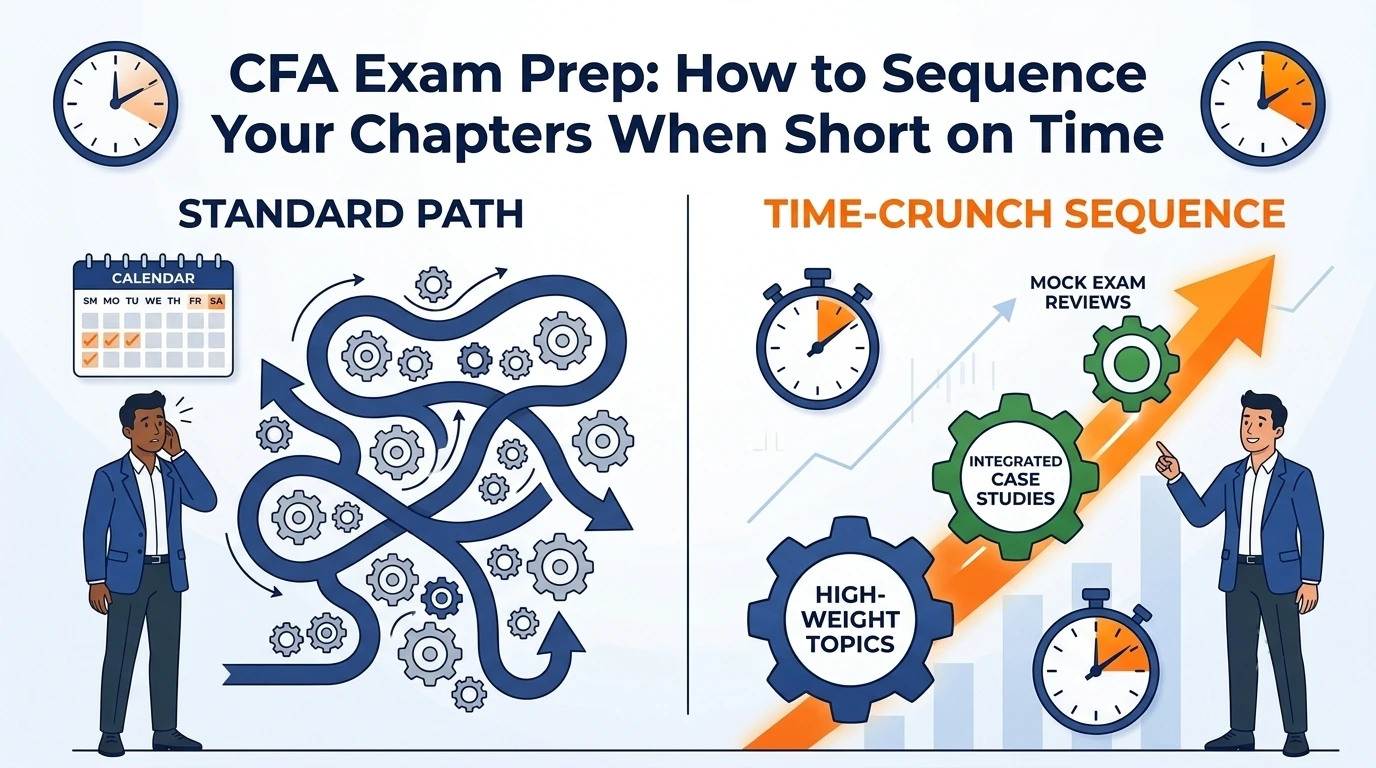
One of the most common questions students ask is, “Sir, I have limited time before the exam. Which subject should I study first?”
Students often think that the only challenge is finding enough time to study. What they miss is that studying the right chapters in the right order can be just as important as the number of hours they put in.
A well-planned study order can improve conceptual understanding, reduce revision effort, strengthen retention, and make preparation significantly more efficient. An incorrect order can create unnecessary confusion, force repeated learning, and waste valuable time.
This becomes especially important when your preparation window is limited.
Key Highlights
In this article, you will learn:
- Why chapter sequencing is critical, particularly in CFA Level 1 and FRM Part 1
- How subject interconnections influence the ideal study order
- Why studying two subjects simultaneously can improve consistency
- How retention should influence chapter prioritization
- A practical framework for sequencing your preparation under time constraints
Start With Subject Dependencies, Not Personal Preferences
Many students choose subjects based on interest, familiarity, or perceived difficulty. Apparently, it feels comfortable, but in reality, it’s one of the most inefficient approaches.
Particularly in CFA Level 1 and FRM Part 1, there are significant interconnections between subjects. Certain concepts learned in one subject become prerequisites for understanding topics in several others.
For example, concepts from Quantitative Methods, especially Time Value of Money, become useful across:
- Fixed Income
- Financial Statement Analysis
- Derivatives
- Portfolio-related applications
Similarly, probability and statistical concepts support portfolio management and several advanced quantitative applications.
When foundational concepts are studied first, later subjects become easier to understand. When foundations are skipped or delayed, students often struggle unnecessarily.
This is one of the primary reasons why I strongly recommend following a structured study order rather than approaching subjects randomly.
Study Two Subjects in Parallel
Another strategy I recommend is maintaining two subjects simultaneously.
Many students believe discipline means forcing themselves to study a single subject continuously until completion. In practice, this often leads to fatigue and inconsistency.
A better approach is to pair:
- One numerical subject
- One relatively theory-oriented subject
For example:
- Quantitative Methods and Economics
- Quantitative Methods and Financial Statement Analysis
This creates variety in the learning process.
On days when you do not feel mentally prepared for intensive calculations, you can continue making progress through the other subject. The objective is to maintain consistency without compromising productivity.
The best study plan is not the one that looks perfect on paper. It is the one you can follow consistently.
Sequence Subjects Based on Revision Needs
Not every subject presents the same retention challenge. Certain subjects are easier to remember over longer periods, while others require more frequent revision.
When a subject has relatively lower retention, studying it too early can create problems later. By the time revision begins, a significant portion may need to be relearned.
For this reason, some subjects should be strategically placed closer to the examination period. This reduces the gap between learning, revision, and examination, improving recall and reducing revision effort.
Remember, when you are preparing for the CFA exam, completing a subject is not the objective. Retaining and applying your learning on the exam day is your primary goal.
Where Should Ethics Be Placed?
Ethics occupies a unique position in the study sequence. Studying it too early can be challenging because many case studies use financial terminology that students may not yet be comfortable with.
Studying it too late creates a different problem. Ethics requires consistent exposure and gradual development of judgment. Leaving it entirely for the end limits the opportunity for meaningful practice.
Therefore, Ethics is generally best positioned somewhere in the middle of the preparation journey.
By that stage:
- You understand the language of finance better.
- You can interpret cases more effectively.
- You still have sufficient time to practice and refine your approach before the exam.
A Practical Framework for Students Facing Time Constraints
If your exam is approaching and you are dealing with a time crunch, follow this sequence framework:
1. Begin with foundational subjects
Prioritize subjects whose concepts are used across multiple areas of the curriculum.
2. Maintain two parallel subjects
Combine a numerical subject with a less numerical one to improve consistency and reduce fatigue.
3. Respect conceptual dependencies
Avoid studying advanced applications before understanding the underlying concepts.
4. Position retention-heavy subjects strategically
Keep them relatively closer to the examination period.
5. Protect revision time
No study plan is complete without adequate revision. Preparation should always be planned backwards from the revision phase.
Info:
Reach out for a personalized 1:1 session for your next career move.
Final Thoughts
When students struggle with preparation, the issue is often not time constraint or effort. In most cases, an unstructured preparation strategy is responsible for it. The right sequence creates momentum. Each subject strengthens the next by connecting concepts naturally. By doing this, revision becomes easier and retention improves.
That is precisely why we design recommended study orders for CFA and FRM students after considering subject dependencies, retention requirements, practice needs, and examination realities.
Preparation should not be treated as a collection of isolated chapters. It should be approached as a structured learning process where every step makes the next one easier.
If you want a preparation framework built around conceptual clarity, efficient study sequencing, and long-term career development, explore the resources available on our platform.
Info:
Fill out the form below to get career guidance from experts today.
FAQs
Q: How much time should I keep aside for revision before the exam?
A: While the exact duration depends on your preparation level, students should ideally reserve a dedicated revision phase rather than studying new topics until the last moment. Revision is where concepts are consolidated, and exam readiness is built.
Q: Is it advisable to skip difficult chapters when time is limited?
A: In most cases, skipping chapters entirely is not recommended. A selective study becomes detrimental on the exam day. Instead, focus on building an understanding of important concepts and solving representative questions. Even partial coverage is often better than leaving a topic completely untouched.
Q: How do I know if my study plan is following the right track?
A: A study plan is realistic if it includes time for learning, practice, revision, and unexpected delays. If your plan assumes perfect consistency every day without accounting for disruptions, it is likely too aggressive and may need adjustment.
Q: How often should I revise previously completed subjects?
A: A good approach is to revisit subjects periodically rather than waiting until the end of the syllabus. Short revision cycles improve long-term retention and reduce the burden of relearning topics before the exam.
Q: Does the ideal study order change for working professionals?
A: Yes. Working professionals often have more time constraints and mental fatigue compared to full-time students. In such cases, study sequencing becomes even more important. A structured plan that balances numerical and theory-based subjects can help maintain consistency alongside work commitments.