
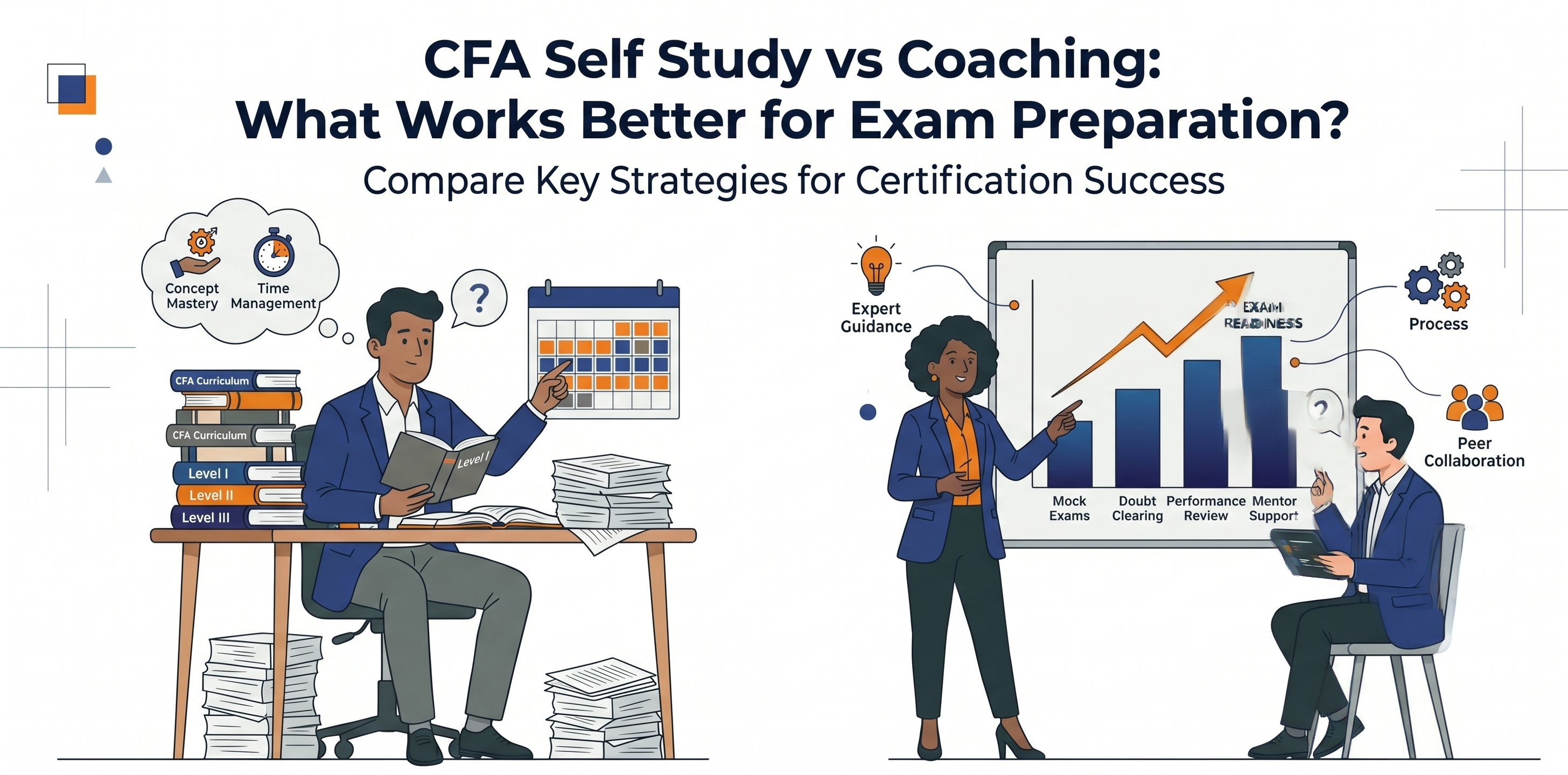
When candidates compare CFA self study vs coaching, the real question is not which is cheaper, but which preparation method helps them stay consistent through the full CFA exam preparation cycle.
And honestly, this is where most candidates get confused. Not because the answer is complicated, but because most advice is either too generic or too biased. Let's compare both options.
Key Takeaways
- There is no universal winner in the CFA self study vs coaching debate. They both work, but only when they provide the right direction and align with your ability to stay consistent.
- Most candidates don't fail the CFA Program because their concepts are unclear, but due to lack of consistency, revision, and mock practice.
- Self-study works best for candidates who can follow a plan without external pressure and learn effectively through practice and self-correction.
- Coaching adds value when your main challenge is execution which is staying on track, clearing doubts, and maintaining discipline over months.
- With CFA Institute's Learning Ecosystem, mocks, and practice tools, self-study is more viable in 2026 than ever before.
- For most candidates, the smartest approach is hybrid where you use official resources as the base and add coaching only where it solves a real problem.
The Reality Most Candidates Ignore
Most candidates do not struggle because CFA concepts are impossible; they struggle because their CFA exam preparation breaks down after the first few weeks.
They fail because:
- They can't stay consistent for 5-6 months
- They don't revise enough
- They avoid mocks until it's too late
So the real question is not self-study vs. coaching. The question is, what will help YOU stay consistent and exam-ready?
Most candidates start with high motivation. They buy courses, make study plans, and feel confident in the first 10-15 days. Then reality hits. Work pressure increases. College assignments pile up. One missed day becomes three.
And slowly, your CFA preparation shifts from "consistent effort" to "last-minute stress." This is where most preparation models fail. Not because they are wrong, but because they don't match how people actually behave over 5-6 months.
Why CFA Self Study Looks Different
Earlier, self-study meant struggling alone with heavy textbooks. That's no longer true.
Today, CFA candidates already get access to:
- CFA Learning Ecosystem
- Study planner
- Practice questions
- Mock exams
- Flashcards
- Practical Skills Modules
This makes self-study far more viable than before. But at the same time, coaching still plays a critical role for candidates who need structure, clarity, and accountability.
Where CFA Candidates Usually Go Wrong
The real problem is rarely understanding the syllabus. It is execution: finishing the CFA study plan on time, revising properly, solving enough CFA practice questions, and learning from mistakes.
That is why the self-study vs coaching choice should be based on whether the candidate struggles more with understanding or execution. Your decision should be based on one simple question: Where do I usually fail - understanding or execution?
Info:
Check out our useful CFA Eligibility tool to learn if you're eligible to sit for the exams.
If You Are a Working Professional
For working professionals, the question is often not whether they can understand CFA material, but whether they can consistently study after long workdays. In summary:
- After a 9-10 hour workday, even 2 hours of study feels exhausting
- Weekends often become recovery time instead of productive study
- Consistency becomes the biggest challenge, not understanding
Key Insight: For working professionals, coaching is rarely about "teaching" but about forcing consistency.
If You Are a Student
Students usually have more time than working professionals. But they struggle to maintain a consistent CFA study plan because:
- You have time, but lack structure
- You start multiple resources but don't finish
- You underestimate revision
Key Insight: Students usually don't lack time but they lack direction.
When Self-Study Works Best
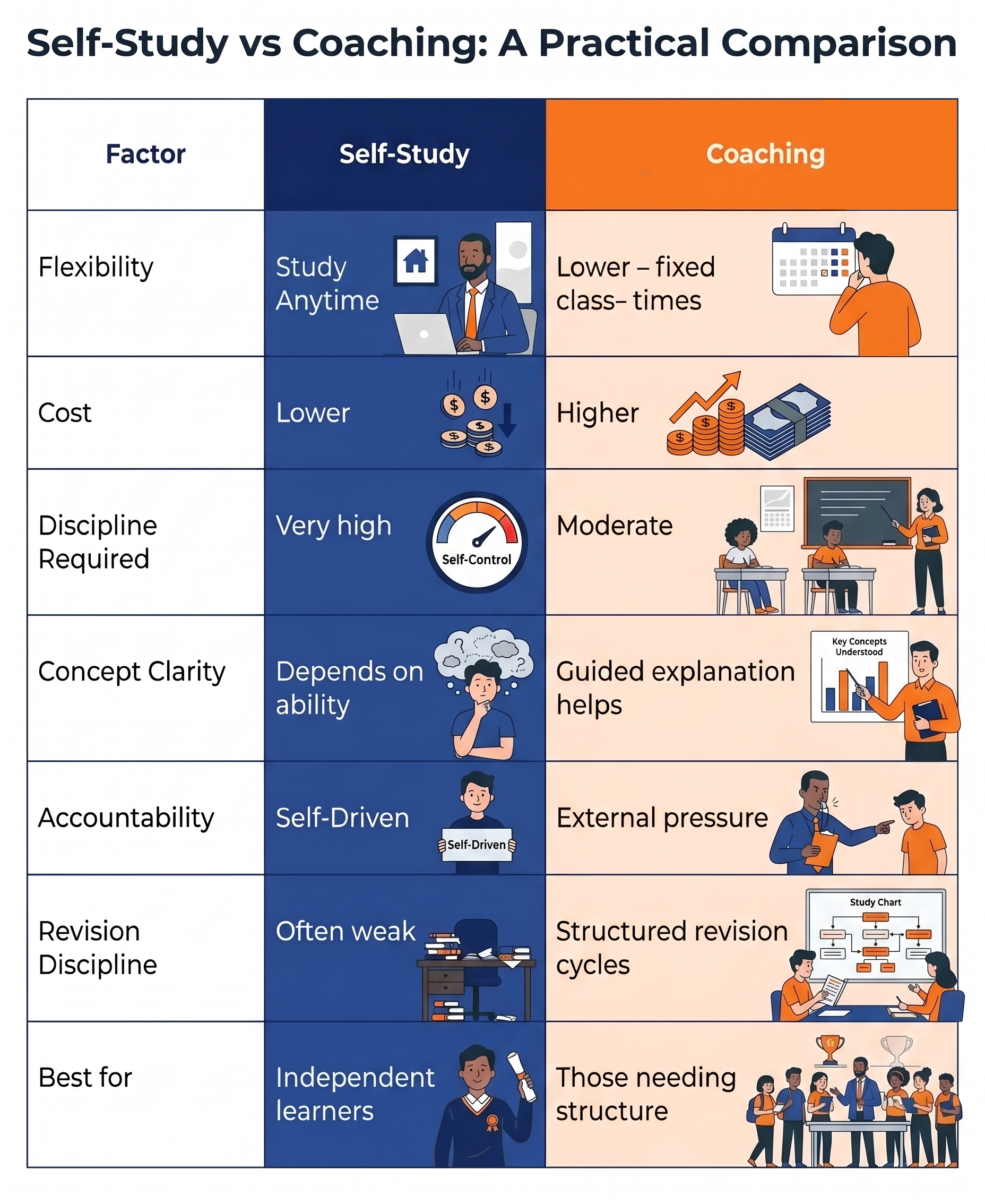
Self-study for CFA works best if you already have a track record of staying consistent with a plan. Self-study is for you if:
- You've actually been consistent with something before
- You can study even when you don't feel like it
- You're comfortable learning from reading + practice
- You want flexibility due to an unpredictable schedule
- You're serious about mocks, revision, and error tracking
When Coaching is a Better Choice
Coaching is most useful when the main challenge is not concepts, but structure, accountability, and doubt resolution. Coaching makes sense if:
- You delay studying without deadlines
- You need concepts explained before solving questions
- You struggle with long-term consistency
- You want doubt-solving and structured progression
- You've already tried self-study and couldn't sustain it
CFA Level-Wise Strategy
Your preparation style may change across levels:
Level I
- Focus: Coverage + understanding basics
- Best approach: Self-study works for disciplined candidates; coaching helps beginners build foundation
Level II
- Focus: Application + problem-solving
- Best approach: Hybrid (self-study + selective support)
Level III
- Focus: Answer writing + judgment
- Best approach: Guided support becomes more useful, especially for exam technique and simulation
Info:
Check out the full range of CFA courses available at Aswini Bajaj Classes.
Practical CFA Study Plan: Hybrid Prep
The most realistic CFA exam preparation strategy is hybrid: use the CFA Learning Ecosystem as the base, add coaching where needed, and build a disciplined revision cycle around mock exams and error logs.
Recommended Hybrid Model
- Core Study: CFA Learning Ecosystem
- Practice: CFA questions + mocks
- Weak Areas: Selective coaching or videos
- Revision: Error logs + repeated testing
- Skill Building: Practical modules + real-world application
- Upskilling: Upskilling beyond CFA should be a priority
A Simple Study Routine (That Actually Works)
A practical CFA study plan depends on your schedule, but consistency matters more than intensity.
For Working Professionals
- Weekdays: 1.5-2 hours (concepts + practice)
- Weekends: 4-6 hours (revision + mocks)
For Students
- Daily: 3-4 hours
- Weekly: 1 full revision day
Consistency matters more than intensity.
What Most Candidates Get Wrong
- Treating lectures as preparation.
- Skipping revision.
- Buying too many CFA resources.
- Following trends instead of matching the method to their own habits.
The Hidden Cost of Choosing Wrong
When evaluating CFA self study vs coaching, the real cost is not just fees but a failed attempt, a delayed exam cycle, and lost momentum.
If self-study saves you ₹40,000 but costs you one failed attempt, it is not cheaper. And if coaching costs more but helps you stay consistent and clear in one go, it may actually be the smarter investment.
The decision is not about money. It is about the probability of completion.
So, What Works Better?
There is no single winner in the CFA self study vs coaching debate. Self-study works for disciplined candidates, coaching works for those who need structure, and the best results often come from a hybrid model.
But the smartest candidates don't choose sides. They build a system where:
- Concepts are clear
- Practice is consistent
- Revision is non-negotiable
In the end, CFA is difficult less because of the concepts and more because of the consistency required to finish the preparation well.
Info:
Need expert career guidance? Fill the form below and we'll get in touch with you.
FAQs
Q: Is self-study enough for CFA?
A: Yes, self-study can be enough for CFA if the candidate is disciplined, follows a structured plan, revises regularly, and practices with mock questions. It works best for those who can stay consistent without external pressure.
Q: Is coaching necessary for CFA Level 1?
A: No, coaching is not strictly necessary for CFA Level 1. However, it can help candidates who need structure, doubt-solving, and accountability during preparation.
Q: Which is better for CFA: self-study or coaching?
A: Neither is universally better. Self-study suits independent learners, while coaching is more useful for candidates who struggle with consistency, planning, or concept clarity.
Q: What is the biggest risk of self-study for CFA?
A: The biggest risk is false progress, feeling prepared without enough revision, practice, or late mock testing. Many candidates realize too late that understanding concepts is not the same as being exam-ready.
Q: Can working professionals prepare for CFA with self-study?
A: Yes, many working professionals do self-study successfully, but they need a realistic schedule and strong discipline. For some, coaching helps mainly by keeping them consistent over several months.