
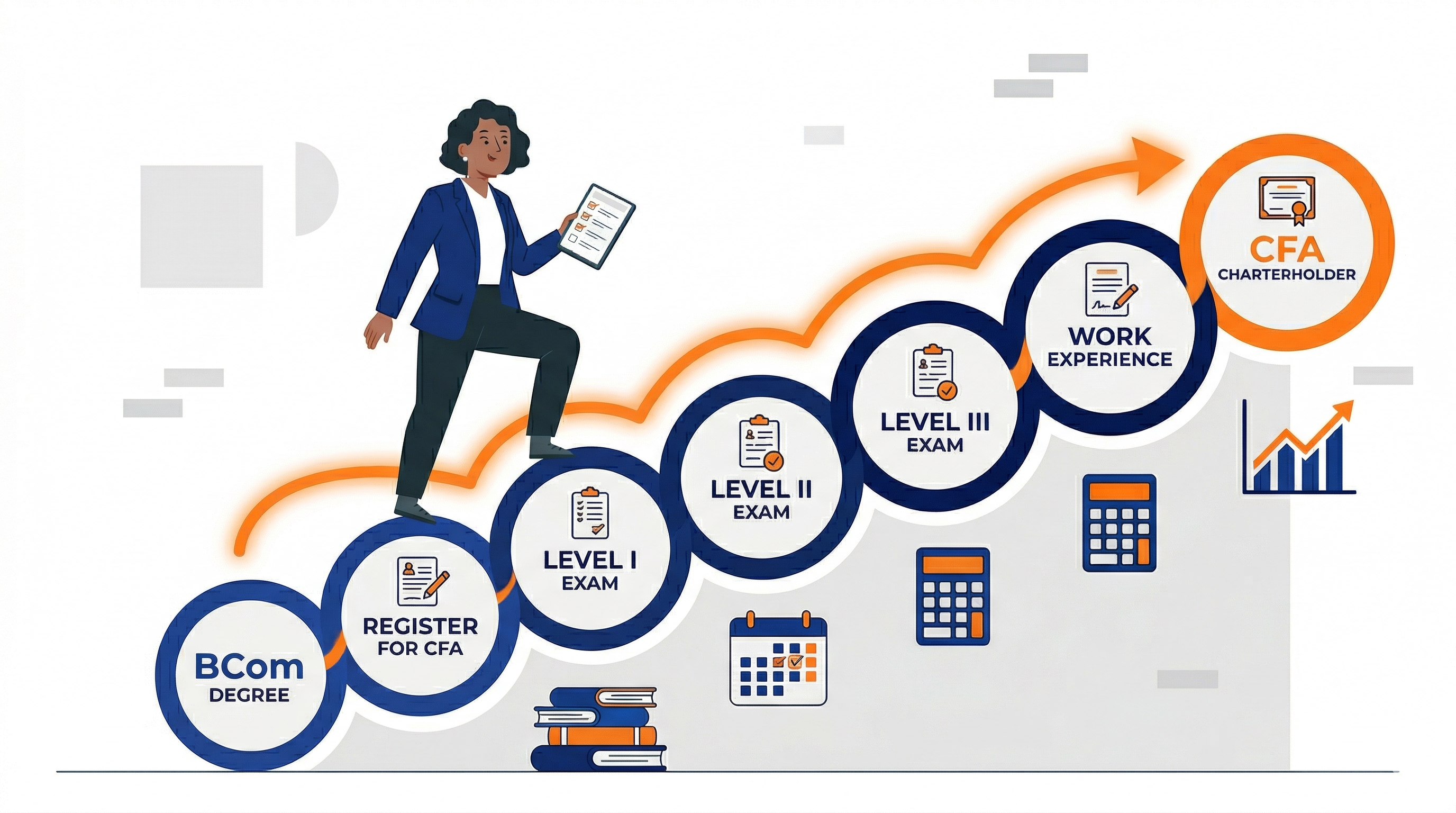
For BCom students and graduates who want to move into investment-focused finance roles, the CFA Program can be a strong next step when approached with a clear plan rather than as a generic add-on qualification.
The program is built across three exam levels, is self-paced, and typically requires about 300 study hours per level, so success depends as much on planning and consistency as on ambition.
Key takeaways
-
- You can start CFA after BCom if you meet CFA Institute's registration rules, and graduates are generally eligible through the bachelor's degree route.
- CFA exams are offered four times a year, but candidates can sit for the exam only twice in a calendar year and not in consecutive windows or within six months.
- Total CFA exam fees for all three levels in 2026 range from USD 3,520 (est. ₹3,46,900 after GST) to USD 4,600 (est. ₹4,50,300 after GST), so registering early makes a meaningful difference.
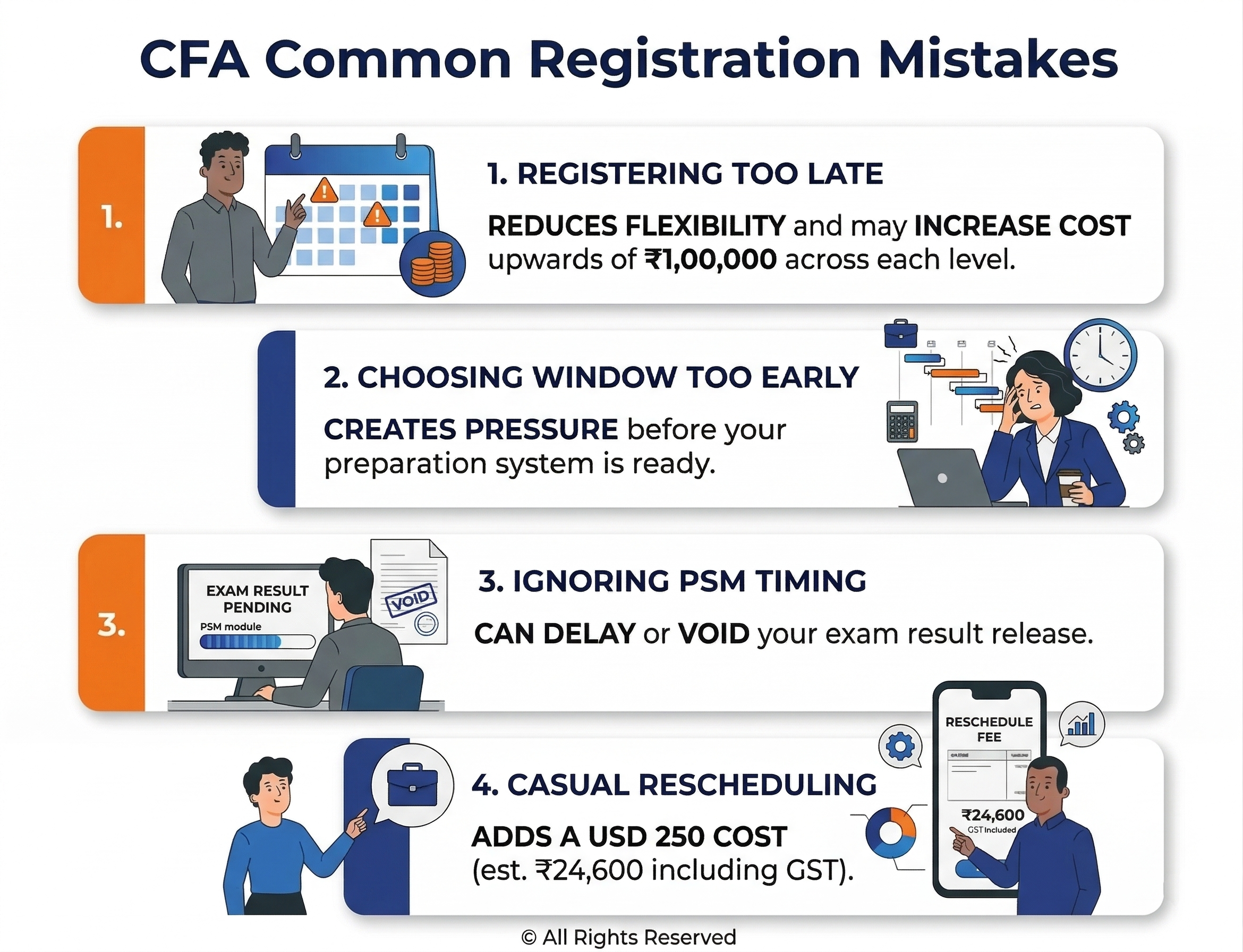
- A USD 250 (est. ₹24,600 after GST) rescheduling fee applies if you change your exam appointment within your exam window.
- Practical Skills Modules (PSM) are now mandatory at every level, and you must complete one PSM to receive your exam result.
-
- CFA after BCom works best for students targeting research, valuation, wealth management, portfolio management, or credit-oriented roles and who are ready to build skills beyond the exam itself.
The main mistake students make is treating CFA as a shortcut to a better title instead of a structured pathway into more specialized finance work. A better way to approach it is to think in stages: check eligibility, choose the right exam window, understand the cost, build a realistic study plan, and pair the program with practical skills that improve employability.
Why CFA after BCom?
A BCom degree usually gives you a broad base in commerce, accounting, and finance. On the other hand, the CFA Program is designed to deepen your understanding of investment analysis, portfolio thinking, ethics, and financial decision-making across three levels. That makes the combination useful for students who want to move from general commerce education into more analytical and market-linked finance roles.
What CFA is:
-
- A three-level professional program.
- A self-paced pathway built around investment and analytical competence.
- A long-term credentialing route that also includes level-wise Practical Skills Modules (PSM).
What CFA is not:
-
- Not a replacement for your BCom degree.
- Not a guaranteed job or salary jump.
- Not a credential that works on exam progress alone without practical skill-building.
Step 1: Check Your Eligibility
Before thinking about fees or coaching, confirm that you are eligible to register for CFA. The Institute's exam and registration system is built around defined eligibility rules, and you should verify your exact position before paying.
Quick Eligibility Guide
| Your situation | Likely next step |
|---|---|
| Completed BCom | Move ahead with Level I planning. |
| In final year of BCom | Check your graduation timing against the exam window you want. |
| Not yet eligible through degree route | Wait until you qualify before registering. |
A practical rule is simple: if you have already completed your BCom, you can usually move directly into registration planning. If you are still studying, do not assume eligibility based on what others say. Check your timing carefully against CFA Institute's current rules and windows.
Info: Check out our 'Am I Eligible' tool for more details on CFA eligibility.
Step 2: Understand the Program Structure
The CFA Program has three levels, and the workload is substantial. CFA Institute describes the program as a three-level pathway and indicates about 300 study hours per level, which means you should plan for sustained preparation rather than a last-minute push.
Level-wise Structure
| Level | What it broadly tests |
|---|---|
| Level I | Core concepts and foundations |
| Level II | Stronger application and analytical depth |
| Level III | Synthesis, judgment, and portfolio-oriented thinking |
This progression matters for BCom graduates because Level I is often where you translate your academic foundation into exam discipline, while Level II and Level III demand much more application and judgment. A BCom background can help in accounting-related areas, but you still need deliberate practice in areas such as quant-heavy topics, fixed income, derivatives, and case-based interpretation.
Step 3: Choose the Right Exam Timeline
The CFA exams take place four times a year, usually in February, May, August, and November. However, you can take the exam at most twice in the same calendar year, but not in consecutive windows or within six months of each other.
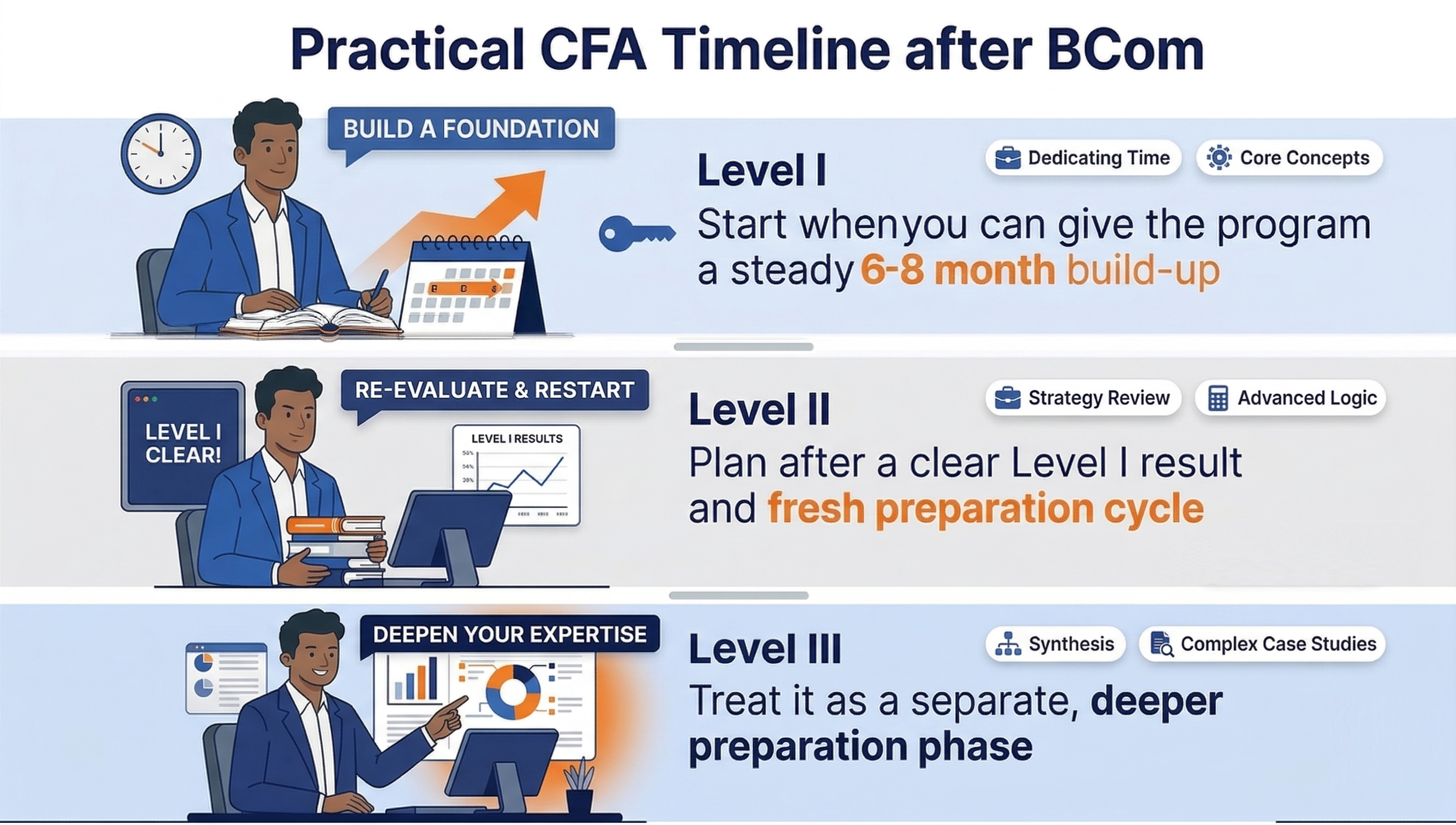
This is why smart students do not rush registration just because an exam window is open. They choose a window only when they can realistically complete the syllabus, revise properly, and stay consistent.
Step 4: Understand the cost before registering
Starting with the 2026 exams, total exam fees across all three levels range from USD 3,520 to USD 4,600, depending on whether you register early or standard. Plus, the fees displayed on its site do not include local taxes (for example, GST in India), and any applicable local taxes are added during payment.
What this Means for Indian Students
-
- Early registration matters because the price gap between early and standard can become large across all three levels.
- Your final payment may be higher than the displayed USD fee because local taxes are added where applicable.
- Budgeting should include not only exam fees but also the risk of delay or rescheduling.
CFA Institute also applies a USD 250 rescheduling fee if you change your exam appointment within your exam window. So if you want to control cost, the two simplest rules are to register early and avoid casual rescheduling.
Step 5: Do Not Ignore Practical Skills Modules
CFA Institute has made it mandatory for candidates to complete at least one PSM at each level to receive their exam results.
Each PSM takes about 10-20 hours to complete, and you can begin after registration. CFA Institute also notes that if you do not complete the PSM by the results release date, your result is voided, and you will not receive a pass or fail result that day.
PSM examples include -
-
- Financial Modelling; Python Programming Fundamentals
- Python Programming Fundamentals; Python, Data Science, and AI; Analyst Skills.
- Portfolio Development and Construction; pathway-specific PSM options.
This matters because the CFA journey is no longer only about reading and exams. The program now explicitly includes practical skill development in areas such as financial modelling, analyst work, portfolio construction, and Python-based finance workflows.
Info: Go through our CFA PSM Guide to get started or to know more.
Step 6: Register the Right Way
The process itself is straightforward, but mistakes can be expensive. So follow the steps carefully -
- Create your CFA Institute account.
- Confirm your eligibility and exam timing.
- Select your exam window carefully.
- Register as early as possible if your preparation plan is clear.
- Keep your identification details exact and consistent.
- Start using the candidate resources and plan your PSM early.
Step 7: Build a BCom-friendly Study Plan
The best study plan is not the most aggressive one. It is the one you can sustain.
A Practical 24-week Level I Model
| Weeks | Focus | Main goal |
|---|---|---|
| 1-8 | First pass | Build familiarity and complete the core syllabus |
| 9-16 | Second pass | Strengthen understanding through practice |
| 17-24 | Revision phase | Use mocks, weak-area review, and timed solving |
Weekly Time Guideline
| Candidate type | Weekday study | Weekend study | Approximate weekly total |
|---|---|---|---|
| Full-time student | 1.5-2 hours | 4-5 hours/day | 14-18 hours |
| Working candidate | 1-1.5 hours | 4-5 hours/day | 10-14 hours |
The CFA Institute estimates about 300 study hours per level. Your real advantage comes from consistency, not bursts of overwork. For BCom students, the most useful habit is to combine topic study with questions quickly instead of waiting to finish the entire syllabus before starting practice.
Step 8: Build Employability Alongside the Exam
Passing exams helps, but career outcomes depend on more than exam progress. If you want CFA after BCom to create better opportunities, you need visible finance skills along the way.
Skills to Build by Stage
| Stage | What to build | Why it matters |
|---|---|---|
| Before Level I | Excel, accounting clarity, business reading | Builds confidence and base readiness |
| After Level I | Basic modeling, finance writing, stock or sector notes | Helps you stand out for entry roles |
| After Level II | Deeper valuation thinking, sector understanding, stronger communication | Improves alignment with research and analytical roles |
| After the Level III track | Portfolio thinking, judgment, and practical decision frameworks | Supports higher-level investment-facing roles |
Best Entry-Level Jobs for BCom Students Pursuing CFA
For students pursuing CFA, the smartest early career moves are usually the ones that build real analytical exposure rather than chase flashy job titles. At this stage, the goal is to enter roles that strengthen your research ability, Excel skills, financial thinking, and practical understanding of how finance work is actually done day to day.
These include -
-
- Research support roles.
- Valuation support roles.
- Credit and fixed-income support roles.
- Wealth and portfolio-assistant roles.
- Risk and analysis-oriented finance roles.
This is a better framing than jumping too quickly to glamorous titles. The strongest outcomes usually come when you combine exam progress with writing ability, Excel comfort, modelling logic, and evidence that you can think through finance problems clearly.
Who Should Choose CFA after BCom?
CFA after BCom is a strong fit for students who want to move toward:
-
- Equity research.
- Wealth and portfolio roles.
- Credit and fixed-income analysis.
- Valuation and investment-oriented finance.
- Long-term analytical finance careers.
It is especially suitable for candidates who are comfortable with a multi-level, self-driven program and who are willing to build practical skills beyond lectures.
Who Should Think Twice Before Choosing CFA?
You should pause and evaluate carefully if:
-
- You want only a broad, generic finance job and have no interest in investment-focused work.
- You expect Level I alone to guarantee placement.
- You dislike self-driven preparation and are unlikely to sustain a long study cycle.
- You are not willing to build job-ready skills outside the exam.
That does not mean CFA is a bad choice. It means it should be chosen for fit, not because it sounds prestigious.
Info: If you're still confused about pursuing CFA, take our quiz 'Is Finance for You?' to see if finance is the right field for you.
Conclusion
Pursuing CFA after BCom can be one of the smartest moves for students who want to shift from a general commerce background into more specialised finance work. But the program works best when treated as a structured long-term plan built around eligibility, timing, cost control, disciplined study, Practical Skills Modules, and practical career preparation.
If you approach it with the right expectations, CFA after BCom can help you build direction, analytical depth, and stronger positioning for investment-related roles. The key is not just to start early, but to start clearly.
Info: Still interested in pursuing CFA? Fill out the form below or contact us to get started on your journey.