

Who ensures that a bank has enough money to meet withdrawal requests? Who helps a company manage its borrowings, pay suppliers on time and protect itself from changing interest rates?
Behind these decisions is a finance function that many students overlook: Treasury.
Treasury professionals manage an organisation's financial resources, including cash, liquidity, funding, investments and financial risks. Within this function, Asset Liability Management (ALM) focuses on balancing an organisation's assets and liabilities to maintain financial stability and profitability.
Unlike investment banking or equity research, which often receive more attention among finance aspirants, Treasury and ALM offer opportunities to work closely with financial markets, banking, quantitative analysis and risk management.
Let's understand what these careers involve, the skills they require and how you can enter the field.
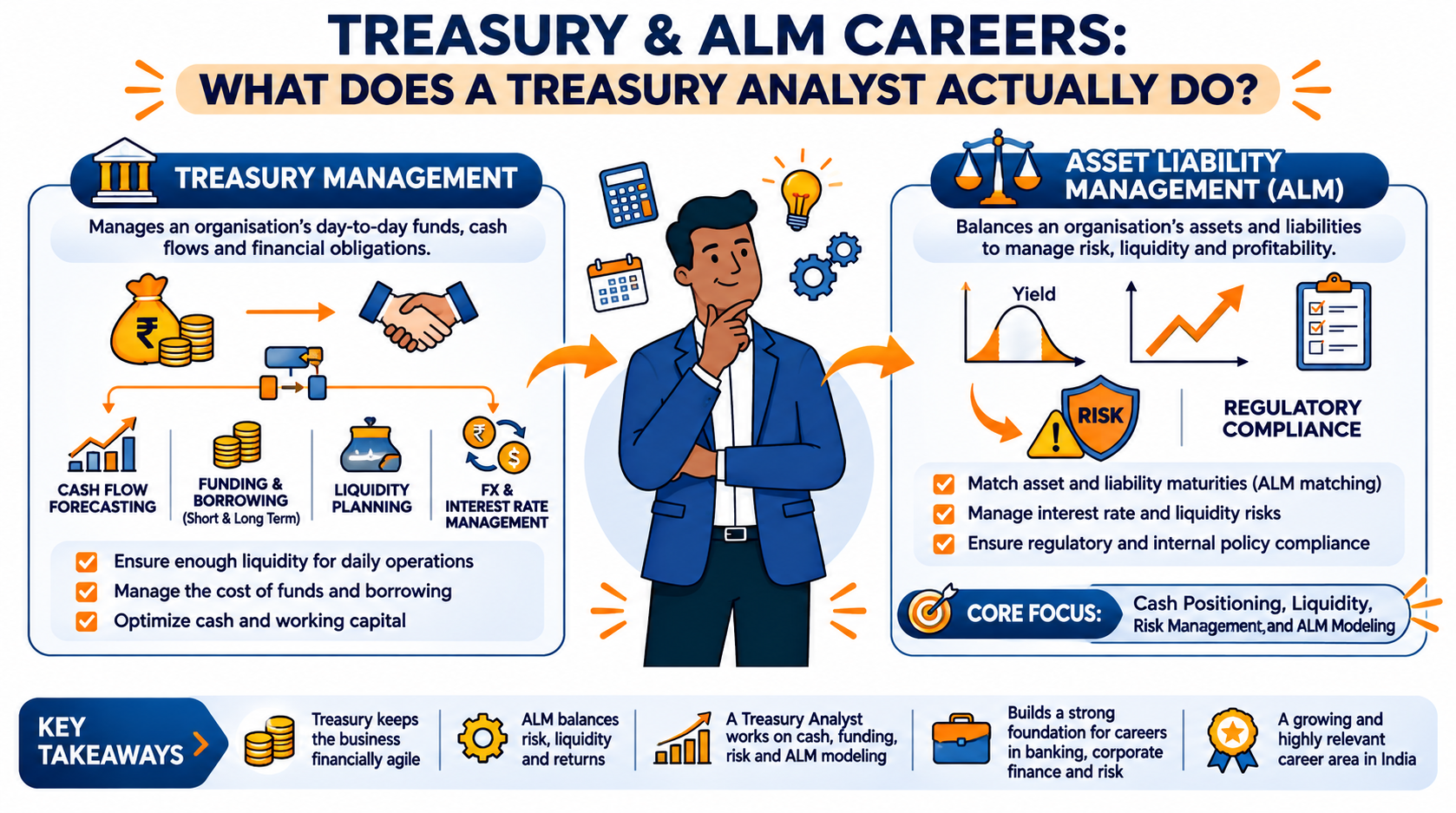
What Is Treasury in Finance?
Treasury is the function responsible for managing an organisation's money and financial resources.
Think of it as managing your personal finances, but on a much larger scale. You receive a salary, pay bills, manage EMIs, maintain emergency savings and invest surplus money. Now imagine doing this for an organisation handling thousands of transactions, multiple bank accounts, international payments and borrowings worth crores.
That is what Treasury teams do.
Their responsibilities generally cover five areas:
1. Cash management: Monitoring bank balances, forecasting cash flows, tracking payments and ensuring funds are available when needed.
2. Liquidity management: Maintaining sufficient cash and liquid assets to meet upcoming financial obligations.
3. Funding: Managing borrowings, debt repayments, refinancing and funding requirements.
4. Investments: Evaluating suitable short-term investment opportunities for surplus cash while balancing returns, liquidity and risk.
5. Financial risk management: Monitoring exposure to foreign exchange, interest rates, liquidity and counterparty risks.
For example, an Indian company importing machinery from the US may have to pay its supplier in dollars after three months. If the rupee depreciates during this period, the company could end up paying more. The Treasury team helps identify this exposure and evaluate hedging strategies to manage it.
ℹ️ Curious about AI in risk management?
Check out our detailed blog on how AI plays a role in current job market for risk management.
What Is Asset Liability Management (ALM)?
Asset Liability Management (ALM) is the process of managing an organisation's assets and liabilities to balance profitability, liquidity and financial risks.
It is particularly important for banks and financial institutions.
Consider how a bank operates. It accepts deposits from customers and uses these funds to provide loans and make investments.
These activities create two sides of its balance sheet.
Assets:
- Loans given to customers
- Investments
- Government securities
Liabilities:
- Savings and fixed deposits
- Borrowings
- Other funding obligations
Now imagine a bank offers a home loan at a fixed interest rate for 15 years, while some of its deposits can be withdrawn or repriced much sooner.
What happens if interest rates rise? What if customers start withdrawing deposits? What if the bank's borrowing costs increase while income from existing loans remains unchanged?
These changes can affect its liquidity and profitability.
An ALM team studies these relationships by analysing:
- When money is expected to come in and go out.
- The maturity periods of assets and liabilities.
- Interest rates applicable to different financial instruments.
- How changing rates affect income and funding costs.
- What happens under different market and liquidity conditions.
Think of ALM as balancing two sides of a seesaw. If assets and liabilities are not managed carefully, even a small change in interest rates or funding conditions can create a significant imbalance.
Treasury vs ALM: What's the Difference?
Treasury is the broader function responsible for managing an organisation's financial resources. ALM is a specialised area focused on managing the relationship between assets and liabilities.
| Treasury | Asset Liability Management (ALM) |
|---|---|
| Cash and liquidity management | Balance-sheet management |
| Funding and borrowing | Interest-rate risk analysis |
| Short-term investments | Net Interest Income (NII) forecasting |
| Foreign exchange exposure | Balance-sheet modelling |
| Banking relationships | Stress testing and scenario analysis |
| Debt management | Interest-rate hedging strategies |
ALM can operate as part of the broader Treasury function, particularly within banks and financial institutions.
For example, State Street's Global Treasury function includes ALM responsibilities such as balance-sheet forecasting, net interest income analysis and interest-rate risk management.
What Does a Treasury Analyst Actually Do?
A Treasury Analyst helps an organisation manage its cash, liquidity, funding, investments and financial risks.
Think of the role as keeping an organisation's financial engine running smoothly. The responsibilities generally include:
1. Cash-flow forecasting: Tracking expected customer payments, supplier expenses, salaries, loan repayments and other cash flows to identify potential shortages or surpluses.
2. Liquidity management: Monitoring available funds, maintaining liquidity buffers and supporting short-term funding decisions.
3. Bank relationship management: Coordinating with banking partners, monitoring accounts and reviewing banking arrangements.
4. Foreign exchange management: Tracking currency exposures and exchange-rate movements and supporting hedging decisions.
5. Interest-rate risk monitoring: Analysing how changing interest rates could affect borrowing costs, investment returns and financial instruments.
6. Investment management: Evaluating short-term investment opportunities based on returns, maturity, liquidity and risk.
7. Reporting: Preparing cash-position statements, liquidity reports, management dashboards and risk reports.
The balance between these responsibilities varies. A Treasury Analyst at a multinational company may focus on corporate cash management, while one at a bank may work more closely with funding, liquidity and financial-market exposures.
What Does an ALM Analyst Do?
An ALM Analyst focuses more specifically on how assets and liabilities interact and how changes in market conditions affect an organisation's balance sheet.
Typical responsibilities include:
- Balance-sheet analysis: Studying the composition and maturity profiles of assets and liabilities.
- Net Interest Income (NII) forecasting: Estimating earnings from interest-bearing assets after accounting for interest paid on deposits and borrowings.
- Interest-rate risk analysis: Assessing how rate changes affect earnings and financial stability.
- Stress testing: Evaluating the impact of unfavourable scenarios, such as rising interest rates or declining deposits.
- Scenario analysis: Comparing different market conditions and their financial implications.
- Hedging analysis: Supporting strategies to manage interest-rate exposure.
- Deposit pricing and Funds Transfer Pricing (FTP): Analysing funding costs and how they are allocated across business units.
- Management reporting: Presenting balance-sheet performance and risk analysis to senior management.
For example, a State Street ALM role in Bengaluru highlights NII forecasting, interest-rate risk reporting, stress testing and balance-sheet modelling. It also mentions SQL and programming as useful skills.
Treasury and ALM Career Opportunities
These careers offer several specialised roles beyond the titles of Treasury Analyst and ALM Analyst.
| Job Role | Main Focus |
|---|---|
| Treasury Analyst | Cash, liquidity and funding |
| Treasury Operations Analyst | Treasury transactions and processes |
| Liquidity Analyst | Liquidity forecasting and risk |
| ALM Analyst | Balance-sheet and interest-rate risk |
| Market Risk Analyst | Financial market exposures |
| Funding Analyst | Borrowing and funding |
| Treasury Risk Analyst | Treasury-related risks |
| Treasury Manager | Treasury strategy and operations |
| ALM Manager | Balance-sheet and interest-rate strategy |
| Treasurer / Head of Treasury | Overall Treasury management |
Job titles and responsibilities vary across employers, so it is important to read the actual job description rather than relying on the designation alone.
ℹ️ Want to explore other risk management careers?
Read our blog on new risk managements career introduced with AI.
Treasury Analyst vs Financial Analyst
Both roles involve working with financial information, but their primary objectives differ.
A Financial Analyst generally studies business performance, budgets, costs and financial forecasts. A Treasury Analyst focuses on managing cash, liquidity, funding and financial risks.
| Treasury Analyst | Financial Analyst |
|---|---|
| Cash and liquidity management | Business performance analysis |
| Funding and borrowing | Budgeting and forecasting |
| Foreign exchange exposure | Financial planning |
| Interest-rate risk | Cost and revenue analysis |
| Banking relationships | Management reporting |
For example, a Financial Analyst may investigate why a company's operating expenses have increased. A Treasury Analyst may examine whether the company has enough cash to meet upcoming payments.
Treasury vs Investment Banking vs Risk Management
If you are exploring finance careers, here is how Treasury and ALM compare with some more familiar options.
| Career | Main Question |
|---|---|
| Investment Banking | How can an organisation raise capital or execute a transaction? |
| Treasury | How should an organisation manage its money and funding? |
| ALM | How should assets and liabilities be managed together? |
| Risk Management | What could go wrong, and how can it be controlled? |
| Asset Management | How should money be invested for clients? |
These functions often work together but approach financial decisions from different perspectives.
ℹ️ Looking for careers beyond investment banking?
Explore top ten finance careers beyond investment banking for more insights.
What Skills Are Required for Treasury and ALM Careers?
You need a combination of financial knowledge, quantitative ability, technical skills and communication.
Financial knowledge
Start with financial markets, banking, fixed income, money markets, foreign exchange, interest rates, bonds and debt instruments.
Understanding financial statements is equally important, particularly for ALM roles.
Quantitative and analytical skills
Useful skills include statistics, financial analysis, cash-flow forecasting, scenario analysis, risk analysis and financial modelling.
Technical skills
Advanced MS Excel is an important starting point for financial analysis and reporting. Depending on the role, SQL, Python, data visualisation tools and Treasury Management Systems can also be useful.
Soft skills
Attention to detail, problem-solving, communication, decision-making and stakeholder management are important.
A good analyst should not simply report that interest-rate exposure has increased. They should also understand why it matters and explain its potential impact.
Is Python Important for Treasury Careers?
Python is not compulsory for every Treasury Analyst role, but data and automation skills are becoming increasingly valuable.
Traditionally, Treasury relied heavily on Excel, financial analysis and reporting. Modern Treasury teams may also use SQL, Python and automation tools to process large datasets, improve forecasting and reduce repetitive work.
For example, a company managing cash positions across 50 countries and hundreds of bank accounts could use automation to collect and analyse financial information more efficiently.
Google's Bengaluru Treasury Analyst role illustrates this shift. Its preferred qualifications include quantitative analytics, data science, programming and data management experience.
You do not need to become a software developer. The objective is to understand finance first and learn how technology can improve financial analysis.
ℹ️ Want to know more?
Read our comprehensive guide to get more insights on Python and finance careers.
What Qualifications Do You Need for Treasury and ALM?
There is no single degree or professional qualification mandatory for every Treasury or ALM role.
Undergraduate degrees:
- B.Com
- BBA
- Economics
- Finance
- Mathematics
- Engineering
Postgraduate qualifications:
- MBA in Finance
- Master's in Finance
- Master's in Economics
- Quantitative disciplines
Professional qualifications:
- CFA (Chartered Financial Analyst)
- FRM (Financial Risk Manager)
- CA (Chartered Accountant)
- Treasury-specific certifications
The right academic background depends on the role. Quantitative and technology-related degrees can also be relevant, particularly for analytics-heavy positions.
Is CFA or FRM Useful for Treasury and ALM?
Both qualifications can help develop knowledge relevant to these careers, although their areas of emphasis differ.
CFA Certification can help with:
- Fixed income
- Financial markets
- Economics
- Portfolio concepts
- Valuation
- Financial risk concepts
FRM certification can help with:
- Market risk
- Liquidity risk
- Credit risk
- Quantitative analysis
- Risk measurement and management
CFA is not exclusively for investment management, and FRM is not exclusively for risk management. Their concepts can be applied across several finance functions.
However, neither qualification automatically makes you job-ready. Employers may also look for banking knowledge, Excel, financial modelling, data analysis and relevant work experience.
Where Can Treasury and ALM Professionals Work?
Treasury and ALM opportunities extend beyond traditional banks.
Banks: Treasury, ALM, liquidity risk and market risk teams.
Corporates: Corporate Treasury, cash management, funding and foreign exchange risk teams.
Asset management companies: Portfolio liquidity, funding and investment operations.
Financial institutions: NBFCs, insurance companies and investment firms.
Global Capability Centres (GCCs): Treasury analytics, ALM modelling, risk analytics and balance-sheet management.
Organisations such as State Street, UBS, BNY, DBS and Google operate in India's financial services and technology ecosystem, offering opportunities across finance, Treasury, analytics and risk functions.
Treasury and ALM Jobs in India: Major Hubs
A few Indian cities are particularly relevant when exploring these opportunities.
- Mumbai: Banking, financial markets, corporate Treasury and funding.
- Bengaluru: GCCs, Treasury analytics, ALM modelling and technology-enabled finance.
- Pune: Global financial services and Treasury operations.
- Delhi NCR: Banks, NBFCs, corporate finance and financial services.
These are broad industry hubs rather than an exhaustive list. Opportunities depend on hiring cycles and employer requirements.
What Does a Day in the Life of a Treasury Analyst Look Like?
Imagine you have joined the Treasury team of a multinational company.
Morning: You review cash positions, expected payments, overnight market movements and exchange rates to identify any liquidity concerns.
Midday: You update cash-flow forecasts, analyse funding requirements, prepare reports and coordinate with banks or internal finance teams.
Afternoon: You review financial exposures, support investment or funding decisions and work on risk analysis.
End of day: You reconcile positions, investigate unusual movements, update reports and prepare for the next day's liquidity requirements.
An ALM Analyst may spend more time on balance-sheet modelling, interest-rate sensitivity and stress testing.
The exact routine depends on the organisation and the nature of the role. Some positions are more operational, while others involve advanced financial analysis.
What Is the Career Path of a Treasury Analyst?
A typical Treasury career progression looks like this:
Treasury Intern / Finance Intern → Treasury Analyst → Senior Treasury Analyst → Treasury Manager → Senior Treasury Manager → Head of Treasury / Treasurer.
For ALM professionals, the progression may be:
ALM Analyst → Senior ALM Analyst → ALM Manager → Senior Manager / Director → Head of ALM / Treasury.
As you progress, responsibilities move beyond reporting and analysis towards financial strategy, risk oversight, team management and decision-making.
What Are the Exit Opportunities After Treasury and ALM?
The exposure to financial markets, funding, liquidity and risk can open doors to related finance functions.
Potential transitions include:
- Treasury to Corporate Finance: Using funding and cash-flow management experience.
- Treasury to Risk Management: Moving into broader financial risk assessment.
- Treasury to Market Risk: Working more closely with interest-rate and currency exposures.
- Treasury to Investment Management: Applying financial markets and investment knowledge.
- Treasury to Investment Banking: Exploring capital and funding-related roles, subject to relevant transaction and modelling experience.
- ALM to Quantitative Risk: Applying financial modelling and quantitative analysis.
- ALM to Balance-Sheet Management: Moving towards broader financial planning and strategy.
These transitions are not automatic. They depend on the projects you handle, your technical skills and the experience required for the target role.
What Is the Salary of a Treasury Analyst in India?
Treasury Analyst salaries vary based on experience, employer, location, technical skills and responsibilities.
An entry-level Treasury Operations Analyst and an experienced ALM Analyst working on quantitative modelling may have very different compensation structures.
Other factors include:
- Bank versus corporate Treasury
- Organisation size
- Financial modelling and programming expertise
- Professional qualifications
- Specialisation in liquidity or interest-rate risk
When comparing salaries, look at roles with similar responsibilities and experience requirements rather than relying on a single average. Use current India-specific salary data and employer disclosures when evaluating opportunities.
ℹ️ Curious about earning potential of CFA?
Check out our updated CFA Salary in India guide for detailed insights or use our tool to measure your potential.
Is Treasury a Good Career?
Treasury can be a rewarding career if you enjoy financial markets, banking, cash management and financial risk.
Advantages:
- Strong understanding of financial markets and banking.
- Exposure to real-world financial decisions.
- Experience in risk management.
- Opportunities across banks, corporates and GCCs.
- Growing use of technology and analytics.
Challenges:
- Requires high attention to detail.
- Involves regulatory and compliance requirements.
- Some decisions are time-sensitive.
- Market volatility can create uncertainty.
- Certain roles involve repetitive reporting and operational work.
- Not every Treasury position offers advanced financial modelling or direct market exposure.
Before choosing the field, understand the actual responsibilities of the role you are targeting.
How to Start a Career in Treasury and ALM
If you are a student or recent graduate, follow a structured approach to build relevant skills.
Step 1: Learn accounting and financial statements. Understand balance sheets, income statements and cash-flow statements.
Step 2: Understand financial markets. Learn about money markets, bonds, foreign exchange, interest rates and debt instruments.
Step 3: Build Excel proficiency. Practise formulas, lookup functions, pivot tables and financial reporting.
Step 4: Learn financial modelling. Build basic cash-flow forecasts and analyse funding requirements.
Step 5: Understand financial risks. Study liquidity, interest-rate, foreign exchange and counterparty risks.
Step 6: Explore SQL and Python. These are particularly useful for analytics-heavy roles.
Step 7: Learn ALM concepts. Understand how assets, liabilities, interest rates and liquidity interact.
Step 8: Build a practical project. Create a liquidity forecasting model for a hypothetical company. Include customer collections, supplier payments, salaries, loan repayments and closing cash balances. Then introduce a scenario where customer payments are delayed by 15 days and analyse how this affects liquidity.
Step 9: Apply for internships and entry-level roles. Explore opportunities in Treasury, finance, liquidity, ALM, risk management and financial markets.
Your first role does not necessarily need to carry the title of Treasury Analyst. A relevant finance or risk position can also help you build experience.
Treasury vs ALM: Which Career Is Right for You?
The right choice depends on the kind of financial problems you enjoy solving.
Treasury may suit you if you enjoy:
- Cash and liquidity management
- Financial markets and foreign exchange
- Funding and borrowing
- Short-term investments
- Banking relationships
ALM may suit you if you enjoy:
- Balance-sheet analysis
- Interest-rate movements
- Financial modelling
- Quantitative analysis
- Forecasting and stress testing
If you are interested in managing an organisation's financial resources, explore Treasury. If you enjoy understanding how assets, liabilities and changing market conditions affect financial stability, ALM may be a better fit.
Neither career is inherently better. What matters is the nature of the work and the skills you want to develop.
Final Thoughts
Finance offers more career paths than the ones students usually hear about first.
Treasury and ALM bring together financial markets, banking, quantitative analysis, technology and risk management. They offer opportunities to understand how organisations manage their money, funding and financial stability.
If you enjoy understanding how money moves and how market changes affect business decisions, these careers deserve a place on your radar.
Start by understanding the work, identifying the skills it requires and building the knowledge to pursue it.
FAQs
Q: What does a Treasury Analyst do?
A: A Treasury Analyst manages an organisation’s cash, liquidity, funding and financial risks. This includes cash-flow forecasting, monitoring bank balances and analysing currency exposure.
Q: What is Treasury in finance?
A: Treasury manages an organisation’s cash, liquidity, funding, investments and financial risks.
Q: What is Asset Liability Management?
A: ALM manages an organisation’s assets and liabilities to balance profitability, liquidity and financial risk. It is especially important for banks.
Q: What skills are required for a Treasury Analyst?
A: Key skills include financial analysis, Excel, cash-flow forecasting, market knowledge and attention to detail. SQL and Python are useful additions.
Q: Is Treasury a good career?
A: Yes. Treasury offers opportunities in banking, financial markets, funding and risk management across banks, corporates and global institutions.
Q: Is CFA useful for Treasury careers?
A: Yes. CFA covers fixed income, financial markets, economics and risk concepts relevant to Treasury roles.
Q: Is FRM useful for ALM careers?
A: Yes. FRM covers market risk, liquidity risk and quantitative analysis, all relevant to ALM roles.
Q: Is Python required for Treasury jobs?
A: No. However, Python can help automate tasks, analyse data and improve forecasting.
Q: What is the difference between Treasury and ALM?
A: Treasury manages cash, liquidity and funding, while ALM focuses on balancing assets and liabilities, particularly their impact on interest-rate risk and profitability.
Q: How do I become a Treasury Analyst in India?
A: Build knowledge of accounting, financial markets, Excel and risk management. Develop relevant technical skills and apply for internships or entry-level Treasury roles.
Q: What is the career path of a Treasury Analyst?
A: A typical path is Treasury Analyst, Senior Analyst, Treasury Manager and Head of Treasury. ALM professionals follow a similar progression.
Q: How much does a Treasury Analyst earn in India?
A: Salary varies by experience, employer, location, skills and responsibilities. Specialised ALM and quantitative roles may offer different compensation from operational Treasury roles.
ℹ️ Need more insights?
Check out our other blogs or fill out the form below to get a one-to-one consultation to answer all your questions.