
We know it’s frustrating to not land a single interview even after passing CFA Level II.
You have spent months studying, cleared a difficult exam, built your knowledge and probably sent out countless applications. Yet the job descriptions still ask for experience, and your inbox remains quiet.
So, what exactly is missing?
First, having a degree does not guarantee a job. There is a huge gap between knowing finance and showing an employer that you can apply it.
CFA can demonstrate finance knowledge, commitment and an understanding of investment concepts. The problem is that employers also want to see what you can do with that knowledge.
That is where many candidates get stuck.
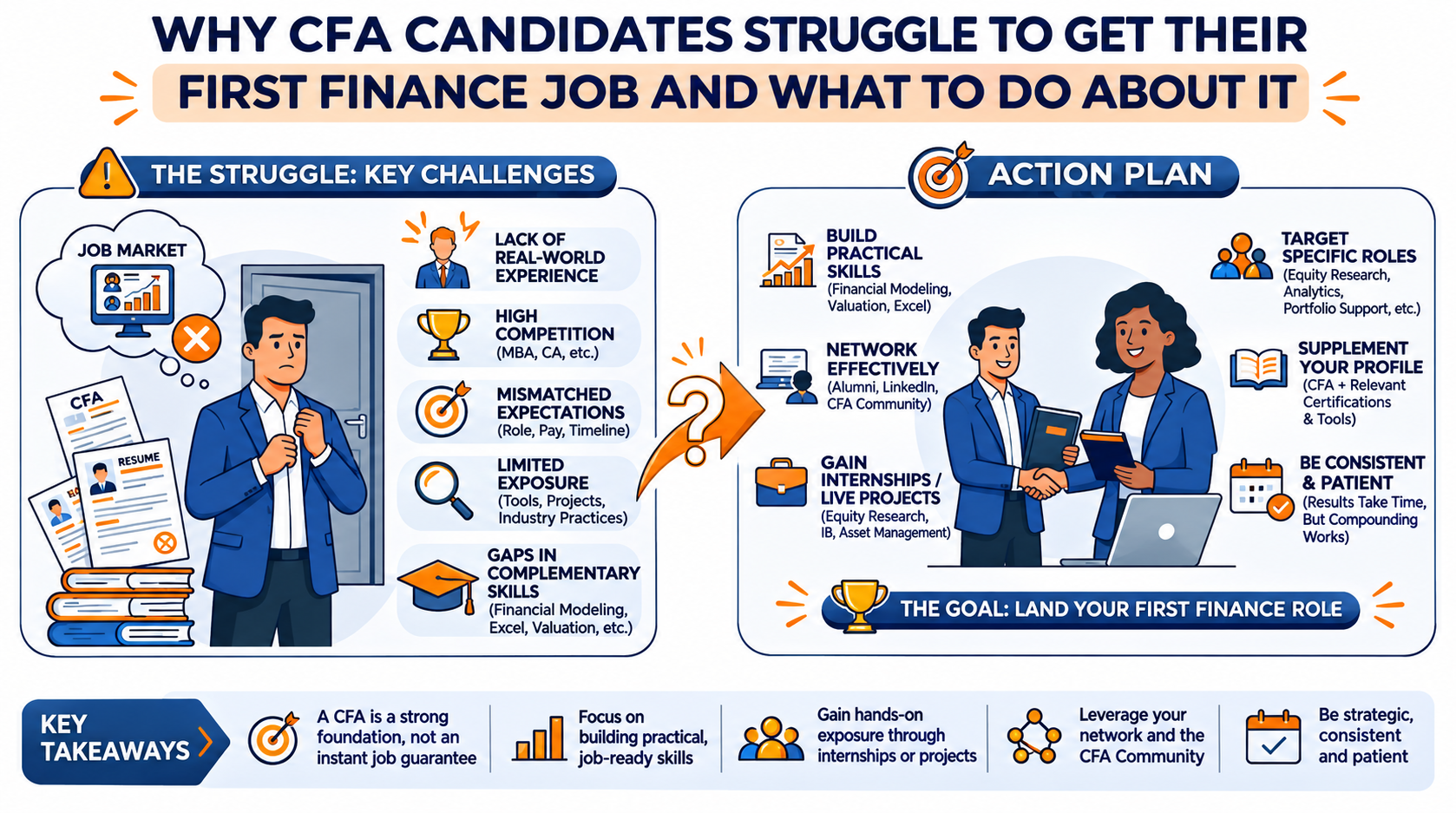
Why Is It Difficult to Get the First Finance Job?
The “Experience Required” Problem
Every entry-level job asks for experience. Landing the first job gets difficult here. But companies are not willing to give the job to a fresher they are unsure about.
So, it’s recommended to start creating evidence of practical ability yourself. Internships, research projects, finance competitions, investment clubs, apprenticeships and independent projects can help you build that evidence.
Just be honest about what it is. A personal valuation project is not professional experience. So, while preparing your CV, make sure you put it under Projects, Financial Analysis or Investment Research, instead of putting it under work experience, because it is not.
Keep in mind that your internship is not your work experience.
💡 Want to stand out in the job market?
Upskill yourself with our guide on building finance skills.
2. Knowing finance is different from applying finance
You may know DCF, financial ratios, derivatives, portfolio theory and financial statements.
But instead of the theoretical definitions, employers ask:
- Can you analyse a company?
- Can you build a financial model?
- Can you interpret messy data?
- Can you explain an investment view?
- Can you present your findings clearly?
This is the knowledge-to-application gap. Your CFA preparation can give you the foundation. Your projects need to show that you can use it.
3. Making CFA the entire CV
“CFA Level I Passed” is useful information. But it is not a credential of your work experience. It tells an employer what you have studied, but they still don’t know what you can deliver.
While applying for the job,, your profile should communicate:
Qualification + Capability + Evidence + Relevance
For example, instead of stopping at “CFA Level I Passed”, show genuine work such as a three-statement model, a DCF valuation, company research or an industry analysis.
4. Targeting Only the Most Competitive Finance Roles
If your entire job search consists of Investment Banking, Private Equity, Equity Research and Asset Management, you are narrowing your entry points considerably.
Finance also includes roles in:
- Credit Analysis
- Risk
- FP&A
- Valuation
- Treasury
- Corporate Finance
- Investment Operations
- Financial Research
- Financial Analytics
These roles are not interchangeable, and CFA does not automatically qualify you for all of them. But they can give you more realistic entry points into the finance ecosystem.
ℹ️ Want to explore other roles?
Read our handy guide on building a finance career apart from investment banking.
What Does CFA Actually Demonstrate?
CFA can strengthen your profile by demonstrating:
- Structured finance knowledge
- Understanding of financial markets
- Investment and valuation knowledge
- Analytical foundation
- Commitment to finance
- Professional development
But CFA alone may not demonstrate practical financial modelling, workplace communication, industry research, presentation skills, stakeholder management or commercial judgment.
Think of your profile as a CFA+ model: CFA + Technical Skills + Practical Work + Communication + Relevant Experience
The more of these you can demonstrate, the easier it becomes for an employer to understand your value.
What Skills Should CFA Candidates Build?
Financial modelling is one obvious gap. You should be comfortable working with areas such as:
- Three-statement modelling
- DCF
- Comparable-company analysis
- Forecasting
- Scenario and sensitivity analysis
- Financial ratios
- Excel
Then add data and technology skills based on your target role. Power BI, SQL, Python, financial databases and data visualisation can strengthen your profile.
AI literacy is becoming relevant too. Using AI for research and analysis, while knowing how to verify its output and spot when it is wrong.
Can You Show That You Know How to Analyse a Company?
This could be your edge over your peers, and you can build the evidence yourself.
So, it’s important to pick one listed company and work through:
- Understand its business model.
- Analyse revenue, profit and cash flow.
- Study the industry and its key drivers.
- Build reasonable forecasts.
- Value the company.
- Identify the major risks.
- Write your investment conclusion.
One well-executed company analysis can give you something concrete to discuss in an interview.
Do Communication Skills Matter in Finance?
This is one of the key differentiators, and knowing the answer is not enough. It’s crucial to explain the answer.
Compare these two statements:
Weak:
“I understand DCF valuation.”
Stronger:
“I built a DCF model for a company, tested WACC and terminal-growth assumptions, and identified the variables driving the valuation range.”
Isn’t the second statement giving the interviewer something to explore?
This is why communication should not be treated as a soft add-on to technical finance skills. You need to explain your analysis, defend your assumptions and communicate your conclusion.
What Should a CFA Fresher Put in a Proof-of-Work Portfolio?
Build projects around the role you want.
| Target Role | Useful Proof of Work |
|---|---|
| Equity Research | Research report, DCF, comparable-company analysis and investment thesis |
| Corporate Finance | Three-statement model, budgeting model and variance analysis |
| Risk | Credit analysis, stress testing and scenario analysis |
| Asset Management | Portfolio analysis, asset allocation and investment memo |
| Financial Analytics | Financial dashboard, data analysis and industry report |
The goal is not to create projects just to fill your CV. The goal is to have work you can explain in an interview.
What If You Cannot Get a Core Finance Role Immediately?
Do not assume that your career is off track.
A career can sometimes develop through a bridge:
Generalist role → Bridge role → Core finance
Depending on your background, bridge roles can include financial operations, KPO research, business analysis, MIS/data analysis, banking operations, credit operations, accounting or audit.
The important question to ask yourself is whether this role will help you build experience that moves you closer to the dream finance role”
That changes how you evaluate your first job.
A 90-Day Job-Readiness Plan
If you currently have little or no practical experience, make the next 90 days measurable.
Days 1–30: Build the foundation
Strengthen accounting, financial statements, Excel, valuation and your understanding of the roles you want.
Days 31–60: Build proof
Complete one company analysis, one financial model, one industry report and one presentation.
Days 61–90: Position yourself
Rework your CV and LinkedIn profile, identify target companies, start networking, apply to relevant roles and practise interviews around your projects.
This is not a guaranteed 90-day route to employment. It is a way to replace passive preparation with visible evidence of capability.
How Can CFA Candidates Stand Out in Current Job Market?
The stronger finance candidates are the ones who bring project experience alongside a degree. At the same time, they must have good communication skill, industry understanding as well as the internship certificate or similar other things that becomes a proof of application.
Your ability to apply what you have learned is what can move that conversation towards an interview and, eventually, a job.
FAQs
Q: Why can't I get a job after passing CFA Level I?
A: Because CFA demonstrates finance knowledge, but employers may also look for practical skills, relevant experience, communication and evidence that you can apply your knowledge.
Q: Can I get a finance job with CFA Level I and no experience?
A: Yes, but CFA alone may not be enough. Internships, projects, technical skills and relevant entry-level roles can strengthen your profile.
Q: What jobs can CFA freshers apply for?
A: Depending on their background and skills, candidates can explore areas such as financial analysis, credit, risk, FP&A, valuation, investment operations, research and other finance-related roles.
Q: Do CFA candidates need financial modelling skills?
A: For many finance roles, practical modelling skills can significantly strengthen a CFA candidate's profile.
Q: Is Excel important for CFA candidates?
A: Yes. Excel remains an important practical skill across many finance roles.
Q: Do CFA candidates need Python?
A: Not necessarily for every finance role. Its value depends on the role, particularly where data analysis, automation or quantitative work is involved.
Q: Should CFA candidates take bridge roles?
A: A bridge role can make sense when it builds relevant experience and skills that can help you move towards your longer-term finance career.
ℹ️ Still need help?
Need some more clarity? Fill out the form below and get in touch with an expert counselor.