
41% of employers expect to reduce their workforce where AI can automate tasks. At the same time, 70% plan to hire people with new AI-related skills.
That sounds contradictory, but it reveals the workplace reality we are moving towards.
AI is not only changing which jobs get automated. It is also creating jobs around the technology itself. Finance is certainly a great example.
As banks and financial institutions use AI and increasingly complex models for credit, fraud detection, investments and risk management, they also need people who can answer a simple question:
Can we trust the model to make the decision it is being used for? That is where Model Risk Management (MRM) comes in.
What is Model Risk Management?
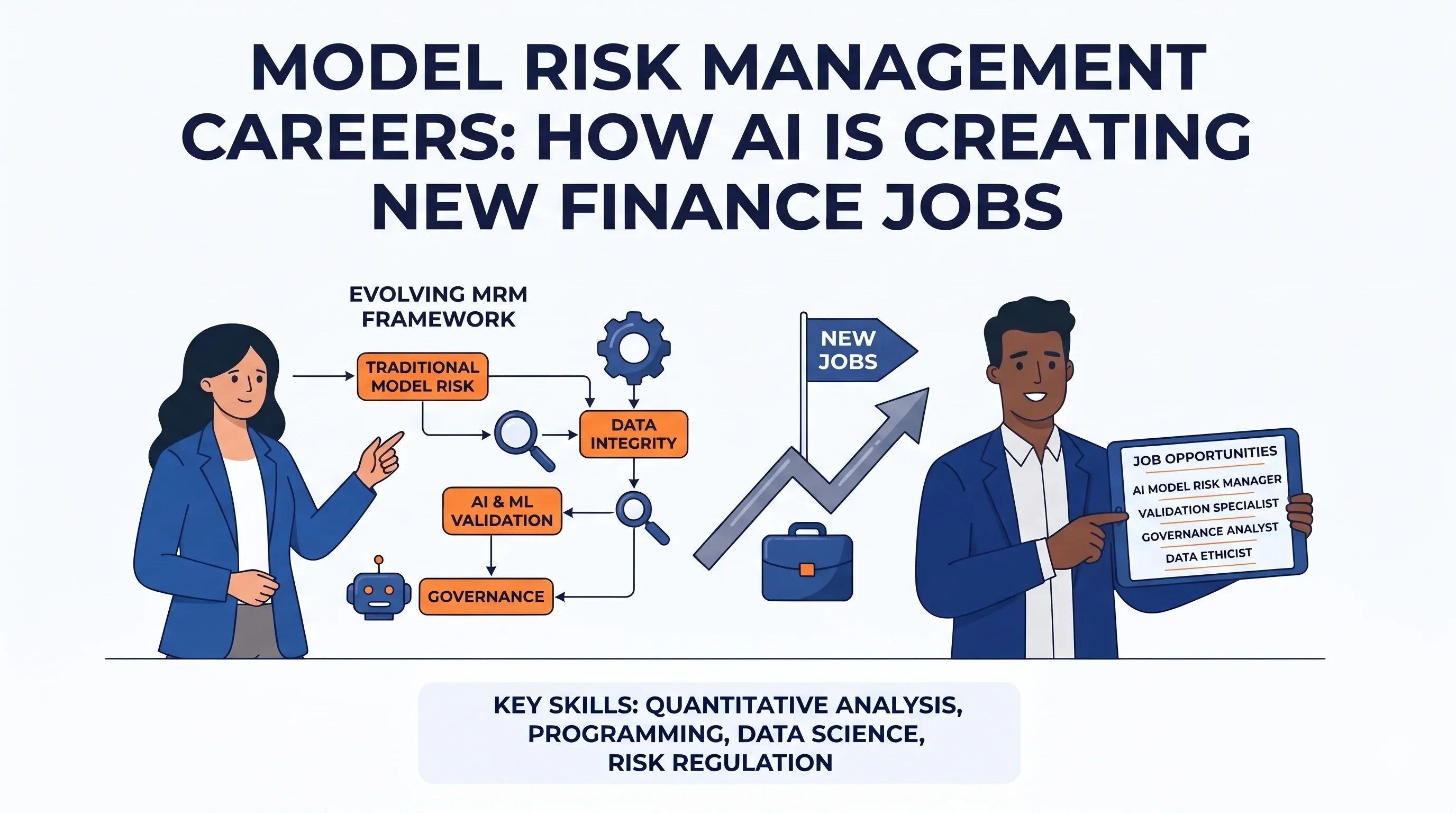
Model Risk Management is the process financial institutions use to identify, assess, monitor and control the risk that models produce incorrect, unreliable or misused outputs.
Models are already part of everyday financial decision-making. They can help determine whether someone gets a loan, estimate the probability of default, calculate market risk, detect fraudulent transactions, optimise portfolios or forecast financial outcomes.
If the model is wrong, the consequences can be expensive. The job of an MRM professional is not to build every model. It is to question, test, validate and monitor them.
Why is AI changing Model Risk Management?
Traditional financial models usually work with defined assumptions, structured data and established validation techniques. AI models introduce another layer of complexity Machine learning models come with:
- More complex relationships between variables
- Explainability challenges
- Data drift
- Bias
- Less predictable behaviour
Generative AI creates additional concerns such as hallucinations, inconsistent outputs, privacy risks and prompt sensitivity.
Agentic AI goes a step further. These systems can use tools, make multi-step decisions and take actions with less direct human intervention.
That changes the question from: "Does the model work?" to: "Does it work reliably, safely and as intended across different situations?"
This is creating demand for professionals who understand both finance and technology. Citi, for example, currently has a Bengaluru role within its Model Risk Management organisation focused on reviewing and validating AI systems across areas including Generative AI, Agentic AI, NLP, computer vision, recommender systems and anomaly detection.
ℹ️ Want to know about Agentic AI?
Check out our recent blog to know how agentic AI handles financial risk.
What does a Model Risk Management professional actually do?
Think of the role as an independent check on models. A typical MRM lifecycle looks like:
Model development → Risk assessment → Validation → Monitoring → Governance → Reporting
A model validation professional may:
- Test the assumptions behind a model
- Evaluate its methodology
- Check performance against benchmarks
- Conduct sensitivity and robustness testing
- Assess limitations and potential bias
- Review documentation
- Monitor the model after deployment
- Challenge model developers when something does not look right
MRM is not simply about checking whether someone has followed a process. It involves independent challenge of model developers and model owners.
What jobs can you explore?
Job titles vary across financial institutions, but some roles include:
| Role | Typical focus |
|---|---|
| Model Risk Analyst | Assess and monitor financial models |
| Model Validation Analyst | Independently test models |
| AI Model Validator | Evaluate AI/ML models |
| Quantitative Risk Analyst | Analyse quantitative financial risk |
| AI Risk Analyst | Assess risks associated with AI systems |
| AI Governance Analyst | Build controls, policies and oversight |
| Model Risk Manager | Lead model risk frameworks |
The titles are evolving too. Citi currently lists a Gen AI Validation Engineer role in Bengaluru, while other institutions are using titles such as AI Model Validation and AI Model Risk. So if you are searching only for "Model Risk Analyst", you may be missing relevant opportunities.
ℹ️ Interested in FRM jobs?
Explore our detailed blog for insights on financial risk management jobs.
What skills do you need?
You do not need to become a full-time data scientist. But having a combination of four skill sets gives you an advantage over your peers.
- Finance: Financial markets, credit, market risk, banking, investments and financial products.
- Quantitative skills: Statistics, probability, regression, time series and hypothesis testing.
- Technology: Python, SQL, Excel, data analysis and basic machine learning.
- Risk and governance: Model validation, documentation, risk assessment, regulatory frameworks and communication.
The exact combination depends on the role. Some positions are highly quantitative and technical. Others have a stronger focus on governance, oversight and risk management.
Do you need to be a Data Scientist?
While a straight answer is a “NO”, it’s important to understand how models work well enough to question them.
The distinction is useful:
- Data Scientist: Builds analytical and ML models
- Model Developer: Develops and implements models
- Model Validator: Independently tests models
- Model Risk Professional: Assesses model risk and challenges model owners
- AI Governance Professional: Focuses on controls, policies and responsible use
There is overlap, but they are not the same career.
Is CFA or FRM useful for Model Risk Management?
Both CFA and FRM can provide relevant foundations, but neither is a substitute for the technical skills some MRM roles require.
CFA can help build knowledge of:
- Financial markets
- Investments
- Portfolio management
- Valuation
- Ethics
FRM is more directly aligned with areas such as:
- Market risk
- Credit risk
- Operational risk
- Quantitative analysis
- Risk management
For someone moving from finance into MRM, FRM can be a useful foundation. But model validation roles may also require statistics, programming, machine learning and model-development knowledge.
Can finance professionals move into AI Model Risk?
Yes, but the transition usually requires adding technical skills.
For example:
- CFA → Statistics/Python → Risk Analytics → Model Validation
- FRM → Quantitative Methods → Python/SQL → Model Validation
- Data Science → Financial Risk → Model Governance → AI Model Validation
The point is not to collect every possible qualification. It is to build the combination the role actually requires.
✅ Curious about other finance professionals skills?
Check out our blog to learn what other skills are necessary in today's finance professionals.
What does the career path look like?
A typical progression could look like:
Analyst → Senior Analyst → Model Validator → Manager → Senior Manager/Director → Chief Model Risk Officer
Titles vary by organisation, but the broader path is from analysing models to independently challenging them, managing model risk frameworks and eventually overseeing the function.
Where can you work?
Model risk professionals can work across:
- Banks
- Asset managers
- Financial data and market infrastructure firms
- Consulting firms
- FinTech
- InsurTech
- WealthTech
The opportunity is also expanding beyond traditional statistical models as financial institutions deploy more AI and machine learning systems.
Model Risk Management vs AI Risk vs AI Governance
| Area | Main focus |
|---|---|
| Model Risk Management | Risk arising from models and their outputs |
| Model Validation | Testing whether a model is fit for its intended use |
| AI Risk Management | Broader risks associated with AI |
| AI Governance | Policies, controls, accountability and oversight |
| AI Safety | Preventing harmful or unsafe AI behaviour |
| AI Governance Analyst | Build controls, policies and oversight |
| Model Risk Manager | Lead model risk frameworks |
There is overlap between these areas, especially as AI becomes part of financial decision-making.
How do you start?
If you are an early-career finance professional considering this path, start with the basics.
1. Build your finance fundamentals.
Understand financial products, markets and risk.
2. Strengthen statistics and probability.
These are central to understanding how models work.
3. Learn Python and SQL.
You do not need to become a software engineer, but you should be comfortable working with data.
4. Understand machine learning basics.
Know how models are trained, evaluated and monitored.
5. Learn model validation.
Understand concepts such as back-testing, benchmarking, sensitivity analysis, robustness and model limitations.
6. Build one practical project.
For example, build a simple credit-risk model, test its performance, identify its limitations and write a short validation report.
That gives you something more useful than simply adding another course to your CV.
The bigger career opportunity
The interesting part of AI in finance is not only who builds the next model.
It is also who decides whether that model should be trusted. As financial institutions deploy increasingly complex AI systems, they need professionals who can question, test, validate and govern those systems.
That creates an interesting career intersection: Finance knowledge + quantitative skills + AI literacy + risk management
For professionals in their 20s and 30s, that combination could be worth paying attention to. Because the future of finance may not belong only to the people building AI. It may also belong to the people who know when to trust it, when to question it and when not to use it.
FAQs
Q: What is Model Risk Management?
A: Model Risk Management (MRM) is used to identify, assess, monitor and control the risk that models produce incorrect, unreliable or misused outputs. It includes model validation, monitoring, governance and independent challenge.
Q: What does a Model Risk Analyst do?
A: A Model Risk Analyst assesses and monitors financial models. The role can involve reviewing model assumptions, testing performance, analysing limitations, monitoring changes and documenting findings for management and regulators.
Q: What is an AI Model Validator?
A: An AI Model Validator independently tests AI and machine learning models to assess whether they are fit for their intended use. This can include evaluating performance, data quality, robustness, explainability, bias and other AI-specific risks.
Q: What skills are required for Model Risk Management?
A: MRM roles typically require a combination of finance, quantitative, technical and risk skills. Useful areas include financial markets, statistics, probability, Python, SQL, machine learning, model validation, governance and communication.
Q: Do Model Risk Management jobs require Python?
A: Not every MRM role requires advanced Python skills. However, Python is increasingly useful, particularly for quantitative model validation and AI/ML-focused roles. Governance and oversight positions may place greater emphasis on risk, documentation and regulatory knowledge.
Q: Is FRM useful for a Model Risk Management career?
A: Yes. FRM can provide a useful foundation in financial risk, quantitative analysis, market risk and credit risk. However, it does not replace the statistics, programming, model development and validation skills that some MRM roles require.
Q: Can CFA candidates work in Model Risk Management?
A: Yes. CFA can provide a strong foundation in financial markets, investments, valuation, portfolio management and ethics. Candidates may need to add quantitative, programming and model validation skills depending on the MRM role they target.
Q: What is the difference between Model Validation and Model Development?
A: Model Development focuses on building and implementing models. Model Validation independently tests whether those models are conceptually sound, perform as expected and are fit for their intended use.
Q: Is Model Risk Management a good career?
A: MRM can be a strong career option for people who enjoy finance, quantitative analysis, technology, risk and critical thinking. The field is also evolving as financial institutions adopt more machine learning, Generative AI and agentic AI.
Q: How do I start a career in AI Model Risk Management?
A: Start by building finance and statistics fundamentals, then develop skills in Python, SQL, machine learning and financial risk. Learn the basics of model validation and governance, and build a practical project that demonstrates your ability to evaluate a model and explain its limitations.
ℹ️ Still need career guidance?
Fill out the form below to get in touch with our experts to get personalized career counseling.