

Investment banking often becomes the default goal in finance. For many aspirants, the path seems straightforward with CFA preparation, financial modelling, relevant experience and eventually a role in one of the industry’s most competitive areas.
But investment banking is only one part of the finance landscape. CFA can lead into equity research, asset management, wealth management, investment consulting, credit and private markets. FRM offers a more specialised foundation for careers in financial risk.
The real career decision is not simply which qualification or job title to pursue. It is the kind of work you want to build your expertise around.
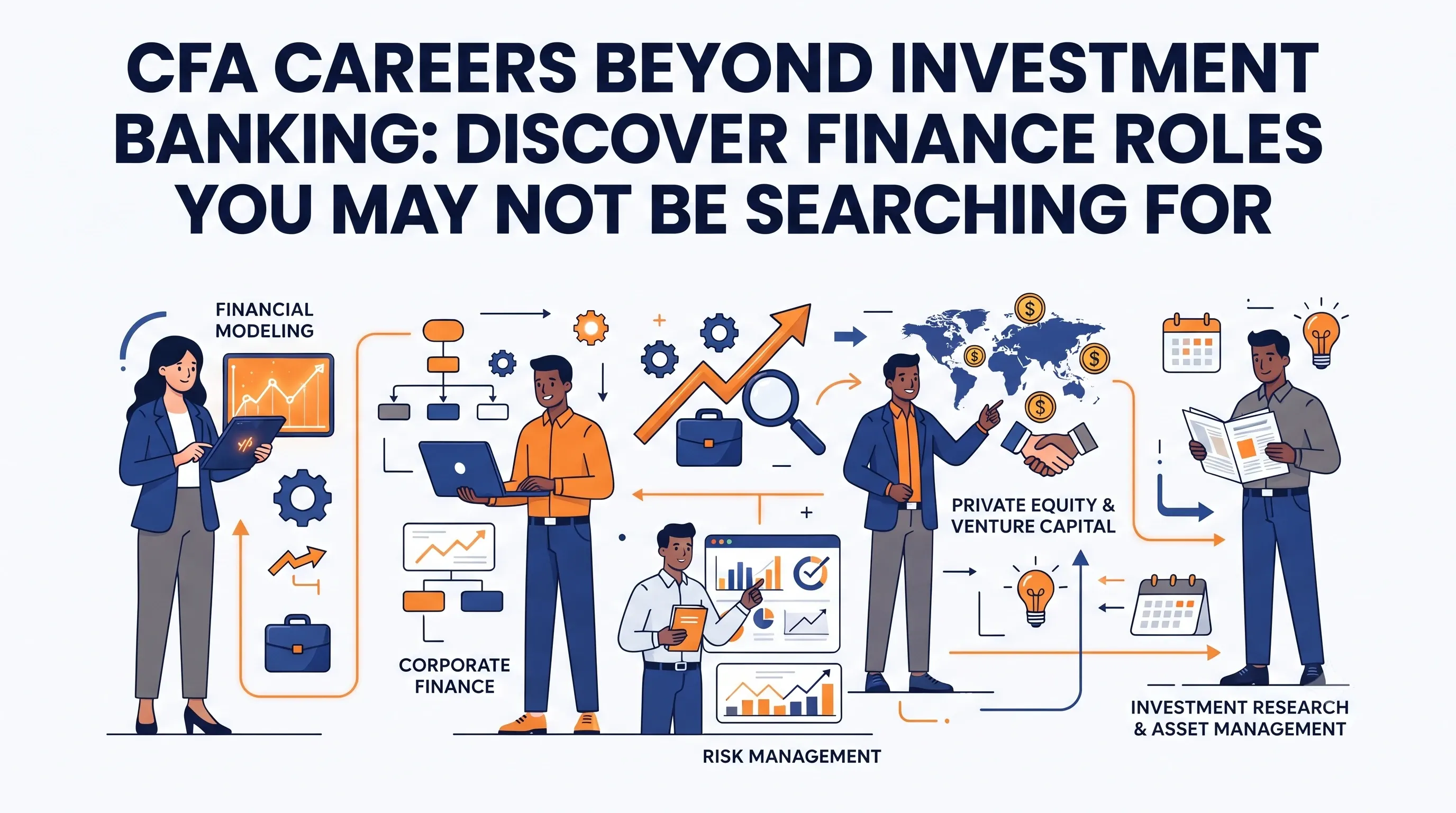
Look beyond the obvious and check out these 10 roles that often stay outside the spotlight.
10 Finance Careers Beyond Investment Banking
1. Equity Research
Equity research is about understanding a company’s value and what could drive its future performance.
Analysts study financial statements, industries, company strategy and market trends. They build forecasts, work on valuations and communicate their investment views through research reports and presentations.
This is a suitable career option for you if you are interested in knowing why a business is performing the way it is.
For entry-level roles, financial modelling, Excel, accounting, valuation and strong writing skills are worth developing while doing CFA preparation.
2. Asset Management and Portfolio Management
Asset management is about turning individual investment ideas into portfolio decisions.
Depending on the role, you could work on security selection, portfolio construction, asset allocation, performance analysis or investment strategy. The focus shifts from finding one attractive company to understanding how different investments work together.
It can be a strong fit if you enjoy markets and investing but want to think at the portfolio level.
Build skills in portfolio analytics, asset allocation, risk and performance attribution. Following real funds and reading portfolio commentary can help you connect what you learn with how investment decisions are actually made.
3. Risk Management
Every investment comes with risk. Risk professionals focus on identifying, measuring and managing it.
Roles can cover market risk, credit risk, liquidity risk, operational risk and model risk. The work can involve analysing scenarios, monitoring exposures, developing risk reports and assessing how portfolios or institutions could respond to changing market conditions.
This is relevant if you enjoy understanding downside and uncertainty rather than simply chasing returns.
For candidates targeting risk, the FRM certification is worth considering alongside skills in statistics, financial markets, Excel, Python and risk analytics.
💡 Want to know more about FRM?
Check out our detailed guide on the FRM certification course and its career scope.
4. Private Wealth Management
Private wealth management combines investment knowledge with client relationships. Professionals work with individuals and families to understand their financial objectives, develop investment strategies and monitor portfolios over time.
The role requires more than technical knowledge. You need to understand client needs and explain financial concepts clearly enough for them to make informed decisions.
This can be a good fit if you enjoy investments and also value regular interaction with people. Alongside technical skills, build capabilities in communication, portfolio planning and client management.
5. Investment Consulting
Investment consultants work with institutional investors and help them make better portfolio decisions.
A project could involve reviewing an existing portfolio, evaluating investment managers, assessing asset allocation or analysing performance and risk.
Unlike portfolio management, you may not be making the investment decisions yourself. Your role can be to analyse the problem and advise the client on what they should consider doing.
That makes communication and structured problem-solving particularly important.
If you enjoy investment concepts but also like presenting recommendations, comparing alternatives and working through business problems, investment consulting is worth exploring.
6. Commercial Banking and Credit
Banking is not synonymous with investment banking.
Commercial and corporate banking focus on businesses and their financing needs. Credit analysts, for example, assess whether a company can repay its borrowing by studying its financial statements, cash flows, industry position and debt obligations.
The question here is different from equity research.
Instead of asking, “Is this company’s stock attractive?”, you may be asking, “Can this company comfortably repay what it owes?”
This makes financial statement analysis, credit analysis, cash-flow assessment and industry research important skills.
It can be a strong option for candidates who enjoy understanding businesses but are more interested in lending and credit decisions than capital markets transactions.
7. Private Markets
Private markets include private equity, private credit, venture capital, infrastructure and other alternative investments.
The work can involve screening investment opportunities, conducting due diligence, analysing industries, building financial models and evaluating potential returns and risks.
These roles are highly competitive, so a qualification alone is unlikely to differentiate you.
Relevant internships, financial modelling, valuation, commercial understanding and the ability to build a strong investment case matter considerably.
For candidates interested in private markets, the focus should be on combining investment knowledge with practical deal and analytical skills.
ℹ️ Private Credit Boom
Check out the latest career opportunities emerging from the recent private credit boom in India.
8. Investment Strategy and Asset Allocation
If you naturally follow interest rates, inflation, economic growth and market cycles, investment strategy may be a better fit than company-level research.
Investment strategists look at the broader market environment and assess what it could mean for different asset classes and portfolios.
The work can involve macroeconomic research, market analysis, asset allocation and communicating investment views to portfolio managers or clients.
You need to be comfortable connecting different pieces of information. For example, how could a change in interest rates affect bonds, equities, currencies or credit?
Strong economics, market knowledge, quantitative analysis and communication skills can help you build towards these roles.
9. Financial Data and Investment Analytics
Finance and technology are creating a growing set of hybrid roles. Financial and investment analytics professionals work with market data, portfolios, financial datasets and performance metrics.
Titles vary across firms, from Financial Data Analyst and Investment Analytics Analyst to Business Analyst.
A finance qualification becomes more valuable when paired with technical skills. Excel is essential, while SQL, Python, Power BI and statistics can widen your options.
The advantage is simple. You can analyse the data and understand what it means for a financial decision.
10. Financial Services Consulting
Financial services consulting combines finance with business strategy. Consultants work with banks, asset managers, insurers, fintechs and wealth managers on areas such as strategy, risk, operations, transformation and business performance.
The work varies across projects, making it suitable for candidates who want broader exposure early in their careers.
Simultaneously, with finance knowledge, you need structured thinking, problem-solving, presentations, Excel and strong stakeholder communication.
If you enjoy understanding how financial businesses work and solving different types of problems, this can be a strong career path.
Which Finance Career Fits You?
This one depends on the capability of the person pursuing the same. Here’s a snapshot of the roles that
Look at the work itself.
- Deep company analysis: Equity Research
- Portfolio decisions: Asset Management
- Numbers and uncertainty: Risk Management
- Investing and relationships: Wealth Management
- Businesses and credit: Commercial Banking
- Deals and alternative assets: Private Markets
- Macro and markets: Investment Strategy
- Advising investors: Investment Consulting
- Finance and technology: Financial Analytics
- Finance and business problems: Financial Services Consulting
The better question is not which role sounds impressive, but which type of work you can see yourself becoming good at.
CFA and FRM: Build the Foundation, Then Add Skills
CFA and FRM can give you structured finance knowledge, but employers still need evidence that you can apply it.
| Qualification can help you build | You still need to demonstrate |
|---|---|
| Finance knowledge | Practical application |
| Valuation concepts | Financial modelling |
| Market knowledge | Research ability |
| Portfolio concepts | Portfolio analysis |
| Risk concepts | Risk analysis |
| Quantitative foundation | Data skills |
| Ethics and professional standards | Professional judgement |
If you are targeting investment-oriented roles, CFA can help build a strong foundation across financial analysis, valuation, investments and portfolio management.
If risk is your preferred direction, FRM provides focused exposure to financial risk management.
You can explore our CFA and FRM courses here as part of building that technical foundation, but your preparation should sit alongside practical projects, internships and role-specific skills.
Build Proof, Not Just Qualifications
One of the easiest ways to make your profile stronger is to create evidence of what you can actually do.
You can do the following to become the
- Research: Analyse a listed company and write an investment report.
- Risk: Build a basic credit or market-risk analysis.
- Asset Management: Review a portfolio and explain its performance.
- Private Markets: Develop an investment thesis for a company.
- Financial Analytics: Work with a financial dataset using SQL or Python.
- Consulting: Solve a financial-services case and present your recommendation.
These projects will not replace experience.
They will, however, give you something concrete to show in an interview and help you understand whether you actually enjoy the work.
💡 Make yourself career-ready
Learn which skills to learn to make your resume stand out in the financial job market.
Stop Searching Only for “CFA Jobs”
There is no single category called a “CFA job”.
Search by function.
Instead of repeatedly searching for “CFA jobs”, try:
- Equity Research Analyst
- Investment Research Analyst
- Credit Analyst
- Market Risk Analyst
- Credit Risk Analyst
- Wealth Management Analyst
- Investment Analytics Analyst
- Financial Data Analyst
- Valuation Analyst
- Investment Consulting Analyst
- Financial Services Consultant
- Private Credit Analyst
Then read the job descriptions. If the same skills appear repeatedly, pay attention. Ten research roles asking for financial modelling tells you something about what you need to learn. The same applies to Python in risk roles or SQL in financial analytics.
Your target job descriptions can become a practical roadmap for your skill development.
✅ Interested in learning how much you can earn with a CFA?
Check out our detailed CFA Salary Guide to get detailed insights on career prospects and salary ranges. You can also use the following tool to explore your potential earnings.
What Can CFA Level I Candidates Target?
CFA Level I candidates can explore entry-level roles such as Financial Analyst, Research Analyst, Credit Analyst, Risk Analyst, Investment Operations Analyst, Wealth Management Analyst and Financial Data Analyst.
But passing Level I does not automatically qualify you for these roles.
Your degree, internships, technical skills, communication and relevant experience still matter.
The same principle applies at higher levels. CFA can strengthen your knowledge and demonstrate commitment to finance, but employers ultimately need to see how that knowledge translates into workplace capability.
A 90-Day Career Plan
If you are preparing for CFA or FRM but still unsure what to do professionally, make the next three months more targeted.
Days 1–30: Explore
Choose three career paths and analyse 15–20 job descriptions for each. Note the qualifications, technical skills, experience and responsibilities that appear repeatedly.
Days 31–60: Build
Pick your biggest skill gap and work on one relevant project.
Research? Analyse a company.
Risk? Build a risk analysis.
Analytics? Work with a financial dataset.
Days 61–90: Apply
Rework your CV and LinkedIn around your target roles. Identify relevant companies, network with professionals, apply selectively and practise interviews around your projects.
The goal is not to guarantee a job in 90 days.
It is to move from passive preparation to visible proof of capability.
Your CFA or FRM Is One Part of the Career Plan
You do not need to decide your entire career before starting CFA or FRM.
But as you progress, your preparation should become increasingly connected to the kind of work you want to do.
Investment banking is one option.
It is not the definition of a finance career.
Research, asset management, risk, wealth, credit, private markets, strategy, consulting and analytics can all lead to different careers in finance.
The goal is not simply to add CFA or FRM to your CV.
It is to build the knowledge, skills and evidence that make the qualification useful in the workplace.
FAQs
Q: What careers can CFA candidates pursue besides investment banking?
A: CFA candidates can explore equity research, asset management, wealth management, investment consulting, risk, credit, private markets, investment strategy and financial analytics.
Q: Is CFA useful outside investment banking?
A: Yes. CFA knowledge can be relevant across investment, research, portfolio management, wealth and financial analysis roles. Its value depends on the role and the candidate's ability to apply that knowledge.
Q: Can CFA candidates work in risk management?
A: Yes. Risk is a viable career path, particularly for candidates interested in quantitative analysis and financial markets. FRM can provide more focused preparation for financial risk roles.
Q: Can CFA candidates work in private equity?
A: Yes, but private equity is highly competitive. Financial modelling, valuation, relevant experience and commercial understanding are important alongside CFA.
Q: Can CFA candidates work in consulting?
A: Yes. Investment consulting and financial services consulting are both potential paths. Consulting also requires structured problem-solving and communication skills.
Q: Can CFA candidates work in commercial banking?
A: Yes. Credit analysis and corporate or commercial banking roles can suit candidates interested in businesses, financial statements and lending decisions.
Q: Does CFA guarantee a finance job?
A: No. CFA is a professional qualification, not a job guarantee. Skills, experience, projects and communication also influence employability.
Q: What should CFA candidates learn besides CFA?
A: The answer depends on the career path. Financial modelling can help in investment roles, Python and statistics can support risk and analytics roles, while SQL and Power BI can be useful in data-focused positions.
ℹ️ Need help with career counseling?
Fill out the form below to get in touch with our experts to get insights on your financial career journey.