

If you are studying finance or building a career in the field, you will eventually face this question: Should you learn financial modelling or data analytics first?
The answer depends on the role you want.
For investment banking, equity research, corporate finance, valuation, private equity and similar finance-first roles, financial modelling is usually the better starting point. For risk, FinTech, business intelligence and data-heavy roles, data analytics is more relevant.
And you do not have to choose one forever. The stronger long-term combination is financial modelling + data analytics + financial judgement.
CFA Institute's recent research supports this broader skill mix. In India, 51% of employers surveyed identified financial modelling and forecasting as an important skill, while 51% also identified Excel and data tools. The 2026 global research also highlights the growing importance of Python, AI and coding alongside traditional financial modelling.
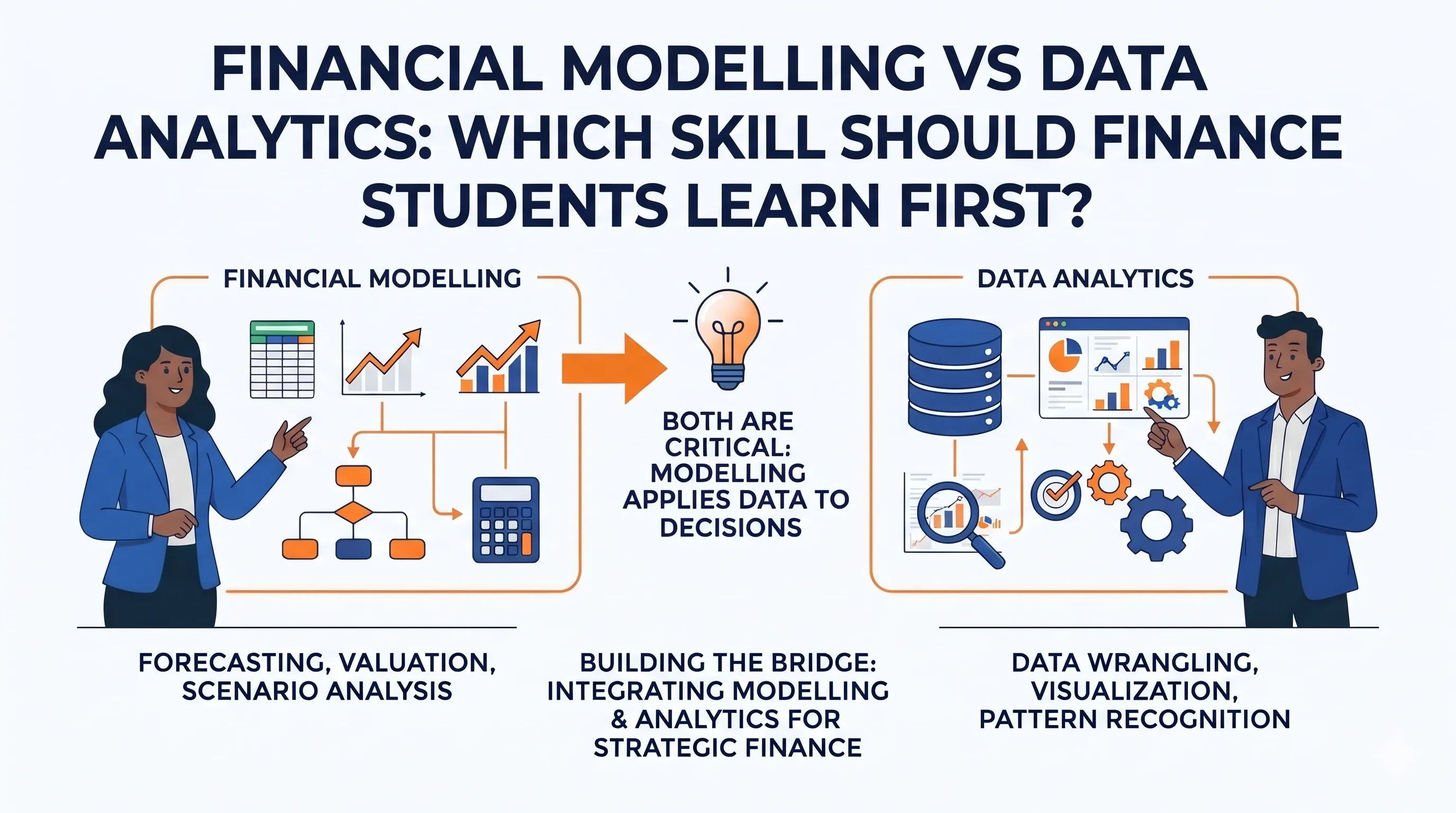
Financial Modelling vs Data Analytics: Which Should You Learn First?
| If you want to work in... | Learn first |
|---|---|
| Investment Banking | Financial Modelling |
| Equity Research | Financial Modelling |
| Corporate Finance / FP&A | Financial Modelling |
| Valuation | Financial Modelling |
| Private Equity / Private Credit | Financial Modelling |
| Financial Data Analytics | Data Analytics |
| Risk Analytics | Data Analytics |
| FinTech | Data Analytics |
| Business Intelligence | Data Analytics |
| Quantitative Finance | Data Analytics + Programming |
| Not sure yet | Financial Modelling, then Data Analytics |
The reason is simple: the first skill should match the kind of problems you want to solve at work.
What Is Financial Modelling?
Financial modelling is the process of building a structured representation of a company's financial performance to analyse its past, forecast its future and support business or investment decisions. Most models are built in Excel and connect financial statements, assumptions and forecasts.
Financial Modelling in Simple Terms
Think of a financial model as a structured way to ask:
"If these assumptions change, what happens to the business?"
A typical model can include:
- Income statement
- Balance sheet
- Cash flow statement
- Revenue and cost assumptions
- Working capital
- Debt
- Capital expenditure
- Scenario analysis
- Valuation
- Sensitivity analysis
For example, an analyst might change revenue growth, margins or debt assumptions and see how that affects cash flow and valuation.
Tools Used in Financial Modelling
Core tools
- Microsoft Excel
- Google Sheets
- PowerPoint
- Financial databases
Increasingly useful
- Python
- SQL
- Data tools
Excel remains particularly important because financial modelling, forecasting and scenario analysis are still central to many finance roles. CFA Institute continues to include financial modelling as a practical skill and teaches three-statement modelling in Excel.
Careers That Use Financial Modelling
Financial modelling is particularly relevant to:
- Investment Banking
- Equity Research
- Private Equity
- Private Credit
- Corporate Finance
- FP&A
- Valuation
- Asset Management
- M&A
- Transaction Advisory
💡 Want to learn finance modeling?
Check out our detailed guide to understand and make finance models.
What Is Data Analytics in Finance?
Financial data analytics involves collecting, cleaning, analysing and interpreting data to identify patterns, answer business questions and support decisions.
The question here is less about how the company's financial statements look like, rather more on what the data reveals.
CFA Institute lists skills such as Python, SQL, data visualisation, forecasting and machine learning among the analytical and programming skills relevant to finance careers.
What Does a Finance Data Analyst Actually Do?
The work can involve:
- Collecting data
- Cleaning it
- Combining different datasets
- Identifying trends
- Building dashboards
- Finding anomalies
- Running analysis
- Building forecasts
- Communicating insights
- Supporting business decisions
For example, a risk analyst might analyse thousands of transactions to identify unusual patterns. A FinTech analyst might study customer behaviour to understand why certain users stop using a product.
Tools Used in Financial Data Analytics
Beginner
- Excel
- Google Sheets
Intermediate
- SQL
- Power BI
- Tableau
- Python
Advanced
- Pandas
- NumPy
- Machine learning
- APIs
- Cloud data platforms
Careers That Use Data Analytics
- Financial Data Analyst
- Risk Analyst
- Business Analyst
- Investment Analyst
- Portfolio Analyst
- FP&A Analyst
- FinTech Analyst
- BI Analyst
- Quantitative Analyst
- Data Scientist
ℹ️ Explore other finance professionals' skills
Read our blog on the latest skills demanded by employers in current job market.
Financial Modelling vs Data Analytics: What's the Difference?
Financial modelling builds a structured view of financial outcomes. Data analytics extracts insights from data.
| Factor | Financial Modelling | Data Analytics |
|---|---|---|
| Main purpose | Forecast and model financial outcomes | Find patterns and insights in data |
| Core question | What could happen? | What does the data tell us? |
| Primary tools | Excel | Excel, SQL, Python |
| Finance knowledge | High | Moderate to high |
| Programming | Not essential initially | Increasingly important |
| Statistics | Useful | Important |
| Valuation | Highly relevant | Less central |
| Forecasting | Financial forecasting | Statistical/data forecasting |
| Data volume | Usually structured | Can involve large datasets |
| Visualisation | Useful | Core capability |
| Investment banking | Highly relevant | Supporting skill |
| Equity research | Highly relevant | Supporting skill |
| Risk | Useful | Highly relevant |
| FinTech | Supporting skill | Highly relevant |
| Automation | Increasing | Strong |
| AI integration | Increasing | Strong |
| Best starting point | Excel | Excel → SQL/Python |
They are not competing skills in the long run.
Modern finance increasingly requires professionals who can understand financial statements, work with data and use technology without losing business judgement.
Which Is More Difficult: Financial Modelling or Data Analytics?
It depends on what you find difficult.
Financial Knowledge: Financial Modelling
You need a solid understanding of:
- Accounting
- Financial statements
- Valuation
- Business models
- Corporate finance
A technically perfect model is not useful if you do not understand what the numbers represent.
Mathematics and Statistics: Data Analytics
Data analytics can require more comfort with:
- Statistics
- Probability
- Correlation
- Regression
- Forecasting
Programming: Data Analytics
Once you move beyond Excel, SQL and Python introduce a different learning curve.
Business Understanding: Both
This is where many learners miss the point.
Neither skill is valuable simply because you can operate the tool. You need to understand the business question behind the numbers.
Which Skill Should You Learn First?
Choose Financial Modelling If You Want To Work In...
- Investment Banking
- Equity Research
- Corporate Finance
- FP&A
- Valuation
- Private Equity
- Private Credit
- M&A
- Transaction Advisory
A practical starting stack would be:
Finance fundamentals → Excel → Financial Modelling → Valuation
CFA Institute specifically identifies financial modelling across investment banking, asset management, corporate finance and equity research.
Choose Data Analytics If You Want To Work In...
- Financial Data Analytics
- FinTech
- Risk Analytics
- Business Intelligence
- Quantitative Finance
- Data Science
- Technology-enabled finance
A practical starting stack would be:
Excel → Statistics → SQL → Python → Data Visualisation
What If You Don't Know Which Finance Career You Want?
This is where many students overcomplicate things. You do not need to learn every tool before deciding. Use your target role as the starting point:
Investment Banking / PE / Equity Research
→ Financial Modelling
Corporate Finance / FP&A
→ Financial Modelling
Risk / FinTech / Analytics
→ Data Analytics
Quant / Data Science
→ Python + Statistics + Data Analytics
Still undecided?
→ Excel + Financial Modelling first, then add SQL and Python.
That gives you a useful finance foundation without closing the door on data-oriented roles.
Financial Modelling vs Data Analytics Across Finance Careers
Instead of treating the two skills as either-or, think about their relative relevance.
| Career | Financial Modelling | Data Analytics |
|---|---|---|
| Investment Banking | High | Medium |
| Equity Research | High | Medium |
| Private Equity | High | Medium |
| Private Credit | High | Medium |
| Corporate Finance | High | Medium |
| FP&A | High | High |
| Asset Management | High | High |
| Risk Management | Medium | High |
| FinTech | Low to Medium | High |
| Quant Finance | Low to Medium | High |
| Financial Data Analyst | Low | High |
These are directional comparisons, not industry-wide ratings. Individual job descriptions can vary considerably.
Excel vs Python vs SQL: What Should Finance Students Learn?
Excel Still Matters
Excel remains useful for:
- Financial modelling
- Forecasting
- Valuation
- Scenario analysis
- Reporting
- Ad-hoc analysis
It is not becoming irrelevant simply because Python and AI are growing.
In CFA Institute's 2026 research on new finance professionals, Excel proficiency was identified by 51% of respondents as a key technical capability for performing confidently from day one.
Why Learn SQL?
SQL helps you work directly with databases.
It becomes useful when you need to:
- Extract financial data
- Query large datasets
- Analyse transactions
- Build reporting workflows
- Support dashboards
Why Learn Python?
Python becomes particularly useful for:
- Automation
- Data cleaning
- Statistical analysis
- Financial datasets
- Forecasting
- Machine learning
- Quantitative analysis
A Practical Learning Sequence
For a traditional finance career:
Excel → Financial Modelling → SQL → Python → Power BI/Tableau → AI tools
For a data-heavy career:
Excel → Statistics → SQL → Python → Financial Analytics → Machine Learning/AI
CFA Institute itself now offers practical modules covering financial modelling, Python, data science and AI, reflecting how these skills are increasingly being combined.
Can You Combine Financial Modelling and Data Analytics?
Yes. In fact, that is increasingly how finance work is evolving.
Consider an investment analyst.
- Financial modelling:
Build a valuation model. - Data analytics:
Analyse historical financial and market data. - Judgement:
Decide which assumptions actually make sense.
Or consider an FP&A analyst:
- Financial modelling:
Build budgets and forecasts. - Data analytics:
Analyse business performance across products, regions or customers. - Judgement:
Explain what is driving the change.
The same pattern applies to risk, investment banking and other finance roles.
The future is not financial modelling vs data analytics. It is financial modelling + data analytics + financial judgement.
CFA Institute's 2026 employer research makes a similar point: finance employers increasingly want AI and coding skills alongside financial analysis, modelling and human judgement.
Which Has Better Career Opportunities?
Financial modelling is particularly relevant to traditional finance careers involving:
- Transactions
- Valuation
- Investment analysis
- Corporate finance
- Private markets
Data analytics is particularly relevant to:
- FinTech
- Risk
- Business intelligence
- Data-heavy investment roles
- Technology-enabled financial services
So do not choose a skill simply because it appears more "in demand."
Choose the skill that gets you closer to the work you want to do.
And remember that employers are increasingly looking for combinations of skills rather than isolated tools. CFA Institute's India research found employers value both financial modelling and Excel/data tools alongside market knowledge and soft skills.
What About CFA Students?
For CFA students, financial modelling and data analytics complement different parts of the curriculum.
CFA + Financial Modelling
The combination is particularly useful for:
- Financial Statement Analysis
- Equity valuation
- Corporate finance
- Investment research
- Company analysis
CFA + Data Analytics
This combination can support:
- Investment research
- Risk analysis
- Portfolio analytics
- Financial datasets
- Quantitative analysis
There is little reason to treat them as mutually exclusive. CFA Institute currently includes both Financial Modelling and Python/Data Science/AI among its practical skills offerings.
A useful combination is:
CFA + Excel + Financial Modelling + Python/SQL
Financial Modelling vs Data Analytics for Indian Finance Careers
The Indian finance market has a mix of traditional and technology-enabled roles.
You may find these skills across:
- Investment banks
- Global Capability Centres
- Big Four firms
- Asset management companies
- FinTech companies
- NBFCs
- Banks
- Consulting firms
- PE/VC firms
- Corporate finance teams
CFA Institute's India workforce research, based on more than 100 finance and investment firms, found that employers look for a combination of market knowledge, technical skills and soft skills. Financial modelling and forecasting were identified by 51% of employers, while Excel and data tools were also identified by 51%.
That tells you something important: the Indian finance market is not moving from finance skills to technology skills. It is adding technology skills to finance.
ℹ️ Interested in a CFA career?
Read our detailed guide on CFA careers in India to learn about its prospects.
How Long Does It Take to Learn These Skills?
Avoid thinking in terms of "30 days to become job-ready."
The useful question is: Can you apply the skill to a real finance problem?
Financial Modelling Roadmap
Excel fundamentals
↓
Financial statements
↓
Three-statement model
↓
Valuation
↓
Scenario and sensitivity analysis
↓
Real company projects
Data Analytics Roadmap
Excel
↓
Statistics fundamentals
↓
SQL
↓
Power BI/Tableau
↓
Python
↓
Finance datasets and projects
The CFA Institute's own Financial Modelling practical skills module, for context, is designed as a 10–20 hour module. That is useful for understanding the scope of a structured introduction, but becoming proficient enough to perform well in a job requires continued practice.
Common Mistakes Finance Students Make
Financial Modelling
Learning Excel shortcuts without understanding finance.
A model is not good because it looks sophisticated.
Other common mistakes include:
- Copying templates without understanding formulas
- Ignoring accounting fundamentals
- Building unrealistic assumptions
- Focusing too much on formatting
Data Analytics
Learning Python without understanding the business problem.
Other mistakes include:
- Collecting certificates instead of building projects
- Ignoring statistics
- Learning tools without finance context
- Creating dashboards without actionable insights
The Biggest Mistake
Trying to learn Excel + Python + SQL + Power BI + AI all at once.
You will know a little about everything and may still struggle to demonstrate competence in anything.
Build depth first. Then add breadth.
The Final Takeaway
Start with financial modelling if you are targeting traditional finance roles. Choose data analytics if you are pursuing data-driven roles. Then build the complementary skill.
For most students who are still exploring finance careers, Excel and financial modelling provide a practical starting point. Add SQL, Python and data analytics as your career direction and the problems you want to solve demand them.
Do not try to learn every tool at once, and do not mistake knowing software for being job-ready. Build the ability to apply these skills to real financial problems, interpret the results and defend your assumptions.
Your competitive advantage will not come from choosing one skill over the other. It will come from knowing which tool to use, understanding what the numbers mean, and making sound decisions based on them.
FAQs
Q: Is financial modelling or data analytics better for finance students?
A: It depends on the career. Financial modelling is particularly useful for investment, valuation and corporate finance roles, while data analytics is valuable in risk, FinTech and data-heavy roles. Both can complement each other.
Q: Should finance students learn Python?
A: Not everyone needs Python. It becomes particularly useful for roles involving automation, large datasets, statistics, forecasting or quantitative analysis.
Q: Is data analytics useful for finance careers?
A: Yes. Data analytics is increasingly used across investment research, risk, portfolio analytics and FinTech. Skills such as Excel, SQL, Python and data visualisation can complement traditional finance knowledge.
Q: Which finance careers require financial modelling?
A: Financial modelling is particularly relevant to investment banking, equity research, private equity, private credit, valuation and corporate finance. The depth required varies by role.
Q: What technical skills should finance students learn in 2026?
A: Start with Excel and finance fundamentals, then add skills based on your career path. Financial modelling and valuation may be more relevant for traditional investment roles.
💡 Still have questions?
If you are still confused about your career, fill out the form below to get in touch with our counselors.