


What if your finance career was built around deals and not just spreadsheets?
That is one way to look at investment banking. Investment bankers help companies raise capital, acquire businesses, sell assets, restructure finances and make major strategic decisions. The work sits at the intersection of finance, strategy, analysis and client relationships.
That combination is what attracts many finance professionals.
You get exposure to major transactions, develop strong analytical skills, work with senior decision-makers and build experience that can open doors to private equity, corporate development, asset management and other finance careers.
But there is another side.
Investment banking is highly competitive; the entry funnel for front-office roles is narrow, and junior professionals can expect demanding workloads.
So, is it worth it?
Let’s explore what the career graph in investment banking looks like in India.
What Is Investment Banking?
Investment banking is a financial services business that helps companies and institutions raise capital, execute mergers and acquisitions, and manage complex financial transactions.
The work broadly falls into two areas.
1. Advisory
Investment banks advise clients on:
- Mergers and acquisitions
- Acquisitions and divestitures
- Restructuring
- Strategic transactions
2. Capital Raising
They also help companies raise money through:
- IPOs
- Follow-on offerings
- Rights issues
- Debt issuance
- Private placements
Precisely, an investment bank helps a company answer questions such as:
- Should we acquire this business?
- How much is it worth?
- How should we finance the transaction?
- Should we raise equity or debt?
What Do Investment Bankers Actually Do?
Investment bankers help companies raise money, buy or sell businesses, and make major financial decisions. The work usually involves understanding the client's objective, researching the company and industry, analysing financials, valuing the business, building financial models and supporting the transaction through to closing.
A typical transaction can move through:
Client requirement → Research → Financial analysis → Valuation → Financial modelling → Pitch / proposal → Due diligence → Deal execution → Closing
For an analyst, the day-to-day work can include:
- Building and updating financial models
- Analysing companies and industries
- Performing valuation
- Preparing pitch books and CIMs
- Supporting due diligence
- Creating client presentations
- Revising materials based on senior and client feedback
The headline may be "Company X acquires Company Y."
The investment banker's work is everything that helps make that transaction happen. A large part of the job is getting the numbers right, understanding the business behind them and presenting the analysis clearly.
ℹ️ Want to learn finance modelling?
Read our detailed guide on how to make finance models.
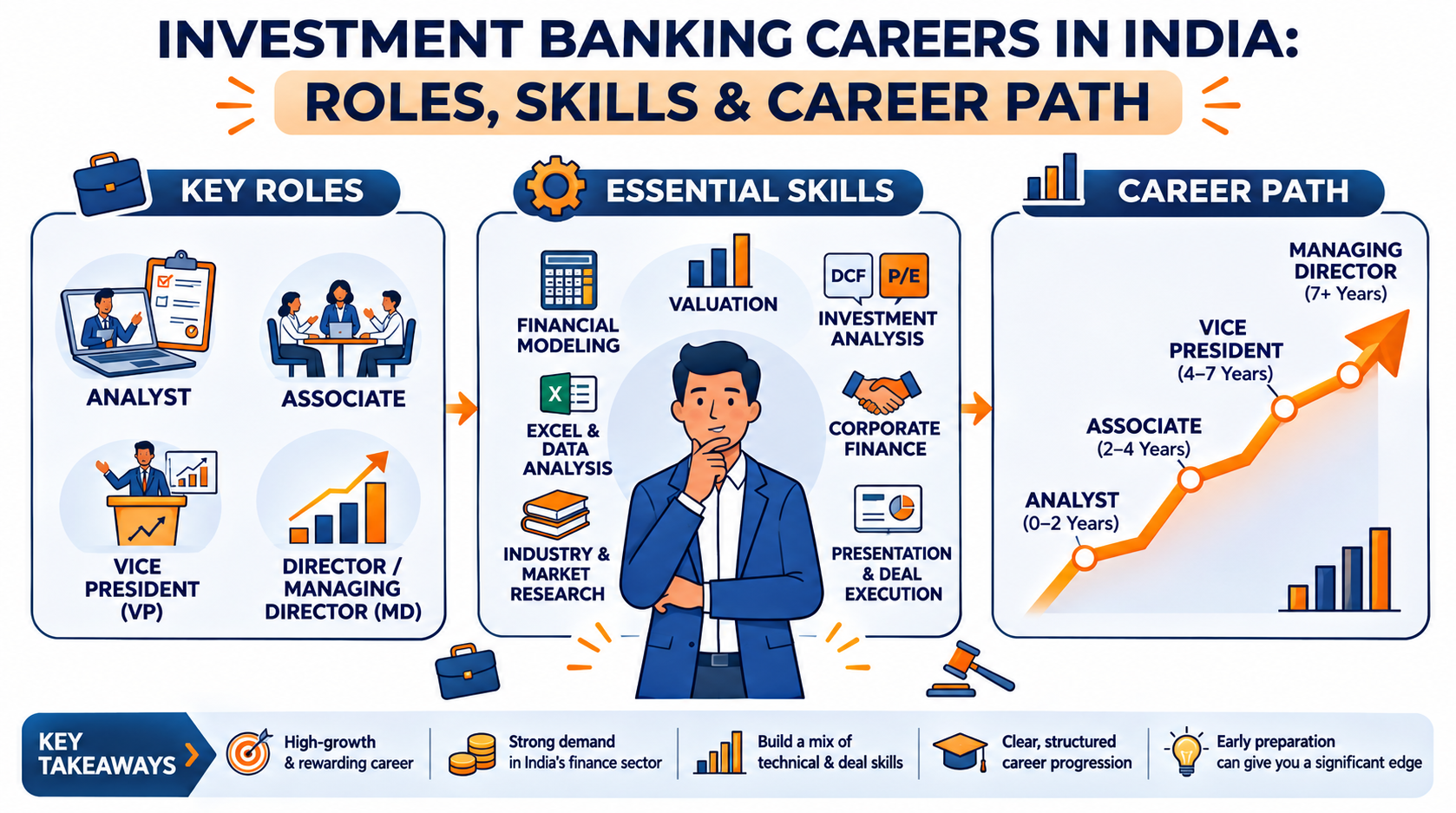
Investment Banking Roles in India
| Role | Main Focus |
|---|---|
| Analyst | Research, modelling, presentations and execution |
| Associate | Review, coordination and deal execution |
| Vice President | Deal management and client interaction |
| Director | Origination, relationships and negotiations |
| Managing Director | Client relationships and winning mandates |
Different Types of Investment Banking Sectors
Not every investment banker works on the same type of transaction. Here are the different types of sectors where Investment Bankers Work
M&A Advisory
Focuses on buying, selling and combining businesses. You may work on:
- Buy-side transactions
- Sell-side transactions
- Valuation
- Deal execution
2. Equity Capital Markets
ECM teams help companies raise equity through transactions such as IPOs and follow-on offerings.
3. Debt Capital Markets
DCM focuses on debt financing, including bonds and other debt issuance.
4. Restructuring
This involves companies facing financial stress and may include debt restructuring, refinancing and turnaround situations.
Investment Banking vs Other Finance Careers
| Career | Main Focus | Key Skills |
|---|---|---|
| Investment Banking | Deals and capital raising | Valuation, modelling |
| Equity Research | Company and investment research | Analysis, valuation |
| Private Equity | Investing in companies | Due diligence, valuation |
| Asset Management | Managing investments | Portfolio analysis |
| Corporate Finance | Internal financial decisions | Forecasting, planning |
| Risk Management | Identifying and managing risk | Statistics, risk analysis |
| Consulting | Business strategy | Problem solving, communication |
The better question is not "Which career is best?" It is "What kind of work do I want to do every day?"
If you enjoy transactions and fast-moving deal environments, investment banking may fit. If you prefer researching companies and forming investment views, equity research may be more relevant.
If you want to invest rather than advise, private equity or asset management may be closer to your interests.
ℹ️ Want to explore other careers?
Check out our guide on model management careers to discover other paths.
What Skills Do Investment Bankers Need?
Investment banking requires more than knowing finance terminology.
Financial modelling
You should understand:
- Three-statement modelling
- DCF
- Comparable-company analysis
- Precedent transactions
- Merger models
- Basic LBO concepts
Accounting
You need to be comfortable with:
- Income statements
- Balance sheets
- Cash flow statements
- Working capital
- Debt
- EBITDA
Valuation
You should know how to think about:
- Enterprise value
- Equity value
- DCF
- Trading comparables
- Precedent transactions
Tools
In-depth knowledge of Excel and PowerPoint remain extremely important, when you are looking for a career in investment banking.
Depending on the role, you may also encounter financial databases such as Bloomberg, along with Python or SQL for analytical work.
But technical skills are only half the equation.
Soft Skills Matter More Than You Think
An investment banker has to turn financial analysis into a story that a client can understand.
That requires:
- Communication
- Attention to detail
- Presentation skills
- Commercial awareness
- Teamwork
- Time management
- Handling pressure
- Client communication
You could build a technically correct financial model and still struggle if you cannot explain what the numbers mean.
What Qualifications Do You Need for Investment Banking in India?
There is no single qualification that guarantees an investment banking career.
Common backgrounds include:
- B.Com
- BBA
- Economics
- Finance
- Engineering
- Mathematics or Statistics
- MBA
- CA
- CFA
A qualification can build your foundation. It cannot replace practical skills.
The CFA certification alone does not teach you how to build every transaction model. Similarly, an MBA does not automatically make you deal-ready. Your competitiveness comes from the combination of qualification, institution, experience, modelling ability and networking.
Can You Get Into Investment Banking Without an IIM?
Yes. But the route can be less direct.
The traditional path is somewhat like this : Top undergraduate/MBA programme → Analyst → Associate
But there are other routes.
- Big 4 Transaction Advisory → M&A/Valuation → Investment Banking
- Boutique Investment Bank → Deal Experience → Larger Investment Bank
- GCC/Offshore Banking Role → Experience → Internal Mobility or Lateral Move
- CA → Transaction Advisory/Valuation → Investment Banking
The important part is building experience that an investment banking team values. A relevant transaction on your CV can sometimes be more useful than another generic finance course.
Investment Banking Career Path in India
The broad progression looks like: Student → Intern → Analyst → Associate → VP → Director → Managing Director
The nature of the job changes at every stage.
- Analyst: execution and analysis
- Associate: execution plus team management
- VP: transaction and client management
- Director: origination and relationships
- MD: business generation and strategic relationships
Timelines vary by bank, performance and market conditions, so there is no universal promotion schedule.
How Long Does It Take to Become an Investment Banker?
While the timeline varies, one could enter after graduation as an analyst, progress to associate after a few years, and gradually move into transaction and client management.
For many professionals, the bigger question is not how quickly they can get promoted. What experience are they accumulating at each level? A strong deal sheet, sector expertise and client exposure can become increasingly valuable as you move towards senior roles.
Investment Banking Salary in India
Investment banking compensation varies widely.
It depends on:
- Role and seniority
- Front-office vs support function
- Global vs domestic bank
- Boutique vs large institution
- Location
- Experience
- Bonus
- Deal performance
That is why a single number for "investment banker salary in India" can be misleading. For an early-career professional, it is worth looking beyond the first salary figure and asking:
- What skills will this role give me?
- What deals will I work on?
- Who will I learn from?
- What exits will this experience create?
Where Can Investment Bankers Work in India?
Investment banking opportunities exist across several types of firms.
Global Investment Banks
- Goldman Sachs
- J.P. Morgan
- Morgan Stanley
- Citi
Indian Investment Banks
- Kotak Investment Banking
- Axis Capital
- ICICI Securities
- JM Financial
Boutiques
- Avendus
- Equirus
- Ambit
- Spark Capital
Transaction Advisory
- Deloitte
- EY
- PwC
- KPMG
A large global bank, a domestic investment bank, a boutique and a Big 4 transaction advisory team may all offer finance experience, but the work, exposure and career path can be very different.
Where Are Investment Banking Jobs Concentrated in India?
Mumbai: Mumbai remains a major financial centre, with strong activity across investment banking, M&A and capital markets.
Bengaluru: Bengaluru has a significant presence of global banking and GCC operations, particularly where finance intersects with technology and analytics.
Delhi NCR: Delhi NCR offers opportunities across corporate advisory, investment firms and financial services.
For candidates outside these centres, the rise of GCCs and distributed finance teams has created more routes into the industry than the traditional Mumbai-only model.
Is Investment Banking a Good Career?
It can be.
But it is not automatically the right career for everyone.
The advantages
- Strong learning curve
- Exposure to major transactions
- High earning potential
- Professional network
- Senior client exposure
- Multiple exit opportunities
The challenges
- Long working hours
- Competitive entry
- High pressure
- Repetitive execution work at junior levels
- Work-life balance concerns
Investment banking can suit you if you enjoy finance, business, numbers, deals and fast-paced environments. If you want predictable hours and more control over your schedule, you may want to consider other finance careers.
ℹ️ Curious about CFA career?
Read our detailed guide on CFA careers in India to explore its scope.
What Are the Exit Opportunities From Investment Banking?
Investment banking can become a platform for other careers. Common exits include:
- Private Equity
- Venture Capital
- Corporate Development
- Asset Management
- Equity Research
- Strategy and Consulting
- Corporate Finance
- Entrepreneurship
But an important point often gets missed: The exit opportunity depends on what you actually did in investment banking. Deal exposure, sector experience, transaction experience, seniority and network all matter. Simply having "investment banking" on your CV is not enough.
How to Start Preparing for an Investment Banking Career
You don't need to wait until your final year to start.
A practical sequence is:
1. Learn accounting
Understand the three financial statements and how they connect.
2. Learn valuation
Start with DCF and comparable-company analysis.
3. Learn financial modelling
Build models rather than only watching tutorials.
4. Improve Excel
Speed and accuracy matter.
5. Understand financial markets
Follow companies, transactions, IPOs and M&A deals.
6. Build transaction knowledge
Pick a recent deal and understand why it happened, how it was valued and how it was financed.
7. Get an internship or project
Try to create evidence of practical work.
8. Network
Speak to professionals and understand what the job actually involves.
9. Prepare for technical interviews
Be ready to explain accounting, valuation, modelling and transactions.
10. Apply strategically
Target roles where your current skills and experience give you a realistic entry point.
Investment Banking Interview Questions
Expect questions such as:
Technical
- What is enterprise value?
- How do you calculate DCF?
- What happens to DCF valuation when WACC increases?
- What is the difference between enterprise value and equity value?
- Explain a three-statement model.
- How does an acquisition affect financial statements?
- What is accretion/dilution?
Behavioural
- Why investment banking?
- Why our bank?
- Tell me about a transaction you follow.
- Why should we hire you?
The best preparation is to understand why the numbers work the way they do.
CFA vs MBA vs CA for Investment Banking
| Route | Main Advantage | Best Suited For |
|---|---|---|
| CFA | Investment and valuation knowledge | Finance-focused candidates |
| MBA | Recruiting, network and management | Career switchers and investment banking aspirants |
| CA | Accounting and transaction knowledge | M&A and transaction advisory routes |
| Financial Modelling Certification | Practical modelling | Skill building |
FAQs
Q: What is investment banking?
A: Investment banking is a financial services business that helps companies and institutions raise capital, execute mergers and acquisitions and manage complex financial transactions.
Q: What does an investment banker do in India?
A: Investment bankers work on financial analysis, valuation, modelling, research, due diligence and deal execution. Senior bankers also manage clients and win mandates.
Q: What are the different roles in investment banking?
A: Common roles include Analyst, Associate, VP, Director and MD. Teams may specialise in M&A, ECM, DCM, restructuring or industry coverage.
Q: What skills are required for investment banking?
A: Key skills include accounting, financial modelling, valuation, Excel, research, communication and attention to detail.
Q: How can I get into investment banking in India?
A: Build accounting, valuation and modelling skills, gain relevant experience, network with professionals and prepare for technical interviews.
Q: Can I get into investment banking without an MBA?
A: Yes. Routes include undergraduate recruitment, CA, CFA, transaction advisory, boutiques and GCCs. Some routes offer more direct access to front-office roles.
Q: Can CFA help me get into investment banking?
A: Yes. CFA builds knowledge of finance, valuation and investments. Combine it with financial modelling, transaction knowledge and relevant experience.
Q: Is CFA better than an MBA for investment banking?
A: Neither is universally better. An MBA can offer stronger recruiting and networking, while CFA builds finance and valuation knowledge. The right choice depends on your starting point and goals.
Q: Can a B.Com graduate become an investment banker?
A: Yes. B.Com provides a foundation in accounting and finance. You will need to add valuation, modelling, Excel and transaction skills.
Q: What is the investment banking career path?
A: A typical path is Intern → Analyst → Associate → VP → Director → MD, with responsibilities shifting from execution to client management and business generation.
Q: How much does an investment banker earn in India?
A: Compensation varies by seniority, firm, location, experience, role and bonus. Role-specific, dated salary ranges are more useful than a single industry-wide figure.
Q: How many years does it take to become an investment banker?
A: You can enter as an analyst after graduation or through other relevant routes. Promotion timelines vary by firm, performance and experience.
Q: Is investment banking a good career in India?
A: It can suit professionals who enjoy finance, deals and analytical work. The trade-offs include long hours, high pressure and competitive entry.
Q: What are the exit opportunities from investment banking?
A: Common exits include private equity, venture capital, corporate development, asset management, equity research, consulting and corporate finance. Deal experience and sector exposure matter.