

Your first job may not be your final career.
A fresher may want to work in equity research, FP&A, investment banking, risk management or corporate finance, but their first offer could be in operations, sales, customer support, KPO, business operations or another generalist function.
That does not automatically close the door to finance.
It does, however, mean you need to think carefully about what you do next.
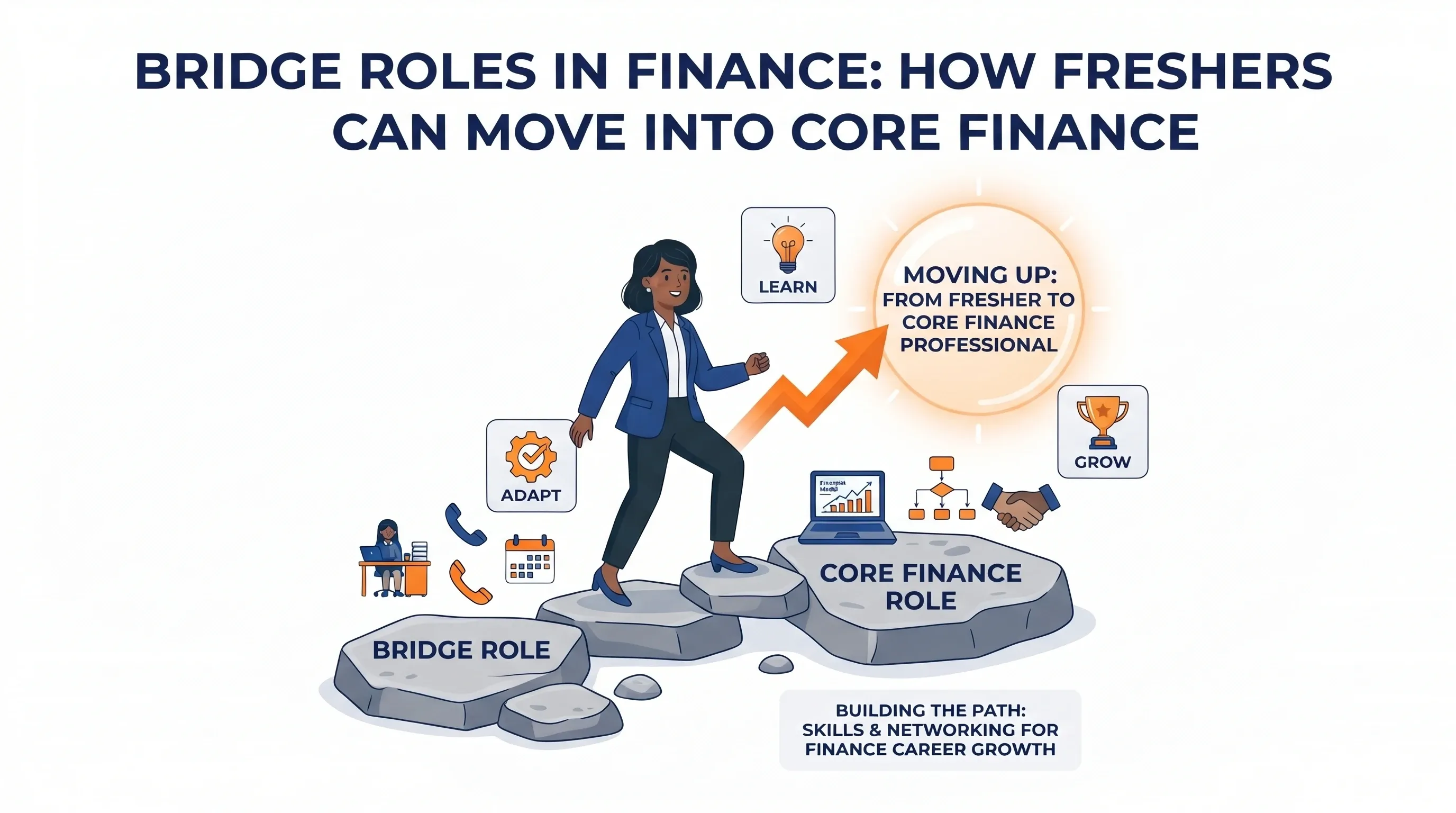
You can think of a bridge role: a position that helps you build the financial knowledge, analytical skills, industry exposure or practical experience needed to move towards a more specialised finance role.
The important thing is that it helps.
An operations job does not automatically lead to FP&A. A KPO role does not automatically lead to equity research. A certification does not automatically compensate for a lack of relevant experience.
The transition depends on what you actually do, what you learn and whether you can demonstrate that your experience is relevant to the role you want next.
What Is a Bridge Role in Finance?
A bridge role in finance is a job that sits between a generalist or non-finance position and a specialised finance career. It can help a professional develop transferable skills, financial knowledge, analytical experience, industry exposure or internal connections that support a move into roles such as financial analysis, FP&A, risk, corporate finance or equity research.
Think of the progression as:
Generalist role → Bridge role → Specialised finance role
For example:
- Operations → Business Analyst → FP&A
- KPO → Financial Research Analyst → Equity Research
- Accounting → FP&A Analyst → Corporate Finance
- Banking Operations → Credit Analyst → Credit Risk
- Data/MIS → Financial Analyst → FP&A
These are potential pathways, not guaranteed career ladders.
Why Are Bridge Roles Becoming More Relevant?
Finance employers increasingly want people who can combine technical knowledge with analytical and professional skills.
CFA Institute's research on India's finance workforce, based on more than 100 firms, found demand for a combination of market and product knowledge, financial modelling, communication and stakeholder-management skills. Its findings also show that the CFA Program is highly valued for entry- and mid-level investment roles, while relevant industry experience becomes more important at senior levels.
A separate 2026 CFA Institute survey of 1,350 finance professionals in the US, UK and Canada points to a similar direction: finance professionals increasingly need a blend of technical knowledge, AI competency, communication and practical experience.
The World Economic Forum's Future of Jobs Report 2025 also identifies analytical thinking as the leading core skill among employers, while AI, big data and technological literacy are among the fastest-growing skills. Employers expect 39% of existing skill sets to change or become outdated by 2030.
That creates an important distinction:
Qualifications can demonstrate knowledge. Your work can demonstrate application.
A bridge role can help connect the two.
ℹ️ Interested to know AI's effect on finance job market?
Check out our detailed guide on how AI is influencing current financial careers.
What Counts as a Core Finance Role?
Before choosing a bridge, define the destination.
| Finance area | Examples of core roles |
|---|---|
| Corporate Finance | Financial Analyst, Corporate Finance Analyst |
| FP&A | FP&A Analyst, Business Finance Analyst |
| Investment Banking | Investment Banking Analyst |
| Equity Research | Equity Research Analyst |
| Asset Management | Investment Analyst, Portfolio Analyst |
| Risk | Credit Risk Analyst, Market Risk Analyst |
| Treasury | Treasury Analyst |
| Valuation | Valuation Analyst |
| Private Markets | PE, VC or Private Credit Analyst |
Once you know the destination, it becomes easier to identify which adjacent roles actually make sense.
Common Bridge Roles for Freshers
1. Business Analyst → FP&A or Corporate Finance
Business analyst roles can develop financial skills in data analysis, reporting, dashboards, business performance and stakeholder management.
The transition becomes more relevant when your work starts involving financial KPIs, budgets, forecasting, revenue analysis or business performance.
Business Analyst → Finance-heavy projects → FP&A Analyst
The goal is not simply to add "Business Analyst" to your CV. It is to accumulate experience that a finance employer can recognise as relevant.
2. Financial Operations → Core Finance
Finance operations, banking operations, investment operations, reconciliation and settlements can provide exposure to financial products, transactions and processes.
Possible directions include financial analysis, risk, treasury and asset-management operations.
Operational knowledge becomes more valuable when combined with analytical ability. Knowing how a transaction works is different from knowing what its financial or risk implications are.
3. KPO / Research Analyst → Equity Research
For candidates targeting equity research, a KPO or research role can provide exposure to company and industry research, financial data, comparable companies and report preparation.
But there is an important distinction:
Doing research is not automatically the same as doing investment research.
To move closer to equity research, build financial statement analysis, valuation, financial modelling and investment-thesis skills.
The progression might look like:
KPO Research → Financial Research → Equity Research
4. Accounting → FP&A or Corporate Finance
Accounting is one of the clearest examples of an adjacent finance skill set.
You may already understand the P&L, balance sheet, cash flow, month-end reporting and variance analysis.
To move towards FP&A or corporate finance, add forecasting, budgeting, financial modelling, scenario analysis and business partnering.
The shift is essentially from:
What happened financially?
to:
Why did it happen, and what should the business do next?
5. Banking Operations → Credit, Risk or Treasury
Banking operations can expose professionals to financial products, transaction workflows, documentation, controls and regulatory processes.
Depending on the work, possible destinations include credit analysis, risk, treasury and corporate banking.
For risk-focused roles, FRM can be one possible learning pathway. GARP's FRM curriculum covers areas including quantitative analysis, financial markets and products, valuation and risk models, market risk, credit risk, operational risk, liquidity and treasury risk.
Again, the qualification should complement relevant work rather than replace it.
6. Data Analyst / MIS → Financial Analysis
This is increasingly relevant as finance becomes more data-driven.
A Data or MIS Analyst may already have experience with Excel, SQL, Power BI, dashboards, Python or KPI analysis.
What may be missing is the finance layer:
Data skills + financial knowledge + business context
That combination can support a move towards financial analysis, FP&A or investment analytics.
CFA Institute's current research similarly highlights the continued importance of traditional finance capabilities alongside AI, data and technology skills.
ℹ️ Learn more about data analytics
Read our detailed blog on finance modelling and data analytics for more information.
7. Compliance / Audit / Controls → Risk
Audit, compliance and controls roles can develop skills in risk identification, regulatory interpretation, documentation and analytical review.
Possible pathways include:
Audit → Risk
Internal Controls → Operational Risk
Compliance → Regulatory Risk
The closer your responsibilities are to identifying, measuring, monitoring or managing risk, the easier it becomes to explain the connection to a risk-focused employer.
A Bridge-Role Map for Freshers
| Starting point | Potential bridge role | Potential destination |
|---|---|---|
| Operations | Business Analyst | FP&A |
| KPO | Financial Research Analyst | Equity Research |
| Accounting | FP&A Analyst | Corporate Finance |
| Banking Operations | Credit Analyst | Credit Risk |
| Banking Operations | Risk Analyst | Financial Risk |
| Data/MIS | Financial Analyst | FP&A |
| Audit | Risk/Controls Analyst | Risk Management |
| Compliance | Risk Analyst | Financial Risk |
| Research | Investment Research Analyst | Equity Research |
| Client Services | Investment Operations | Asset Management |
| Treasury Operations | Treasury Analyst | Corporate Treasury |
| Business Operations | Business Finance Analyst | Corporate Finance |
Think of these as possible routes, not promises.
How Should You Choose a Bridge Role?
Before accepting a role, ask five questions:
- Will I work with financial or business data?
- Will I develop analytical skills that my target role requires?
- Will I gain exposure to financial products, markets or business performance?
- Is there an opportunity for internal mobility?
- Can I clearly explain how this role prepares me for my target finance job?
The fifth question is particularly important.
If you cannot explain the connection, the role may not be the right bridge.
A simple framework is:
Target role → Required skills → Adjacent role → Skill gap → Transition plan
How to Turn a Bridge Role Into a Finance Career
Step 1: Pick the destination first
"I want a finance job" is too broad.
Try:
"I want to become an equity research analyst."
Or:
"I want to move into FP&A."
That gives you something specific to work towards.
Step 2: Reverse-engineer job descriptions
Look at 20–30 job descriptions for your target role.
Identify the skills that appear repeatedly.
For FP&A, you may repeatedly see accounting, Excel, budgeting, forecasting and financial modelling.
For equity research, you may see financial statements, valuation, modelling and industry analysis.
For risk, you may see quantitative analysis, financial markets, risk concepts and data skills.
Step 3: Build the missing skills
Do not collect skills randomly.
Build the ones your target role actually requires.
Your finance skill stack could include:
Finance: accounting, financial statements, corporate finance, markets, valuation
Analytics: Excel, financial modelling, statistics, data analysis
Technology: Power BI, SQL, Python and AI tools
Professional: communication, critical thinking, presentation and stakeholder management
Step 4: Find finance exposure inside your current job
Look for projects involving:
- financial reporting
- budgeting
- forecasting
- revenue analysis
- financial KPIs
- risk
- dashboards
- business analysis
You do not necessarily need a new job to start building relevant experience.
Step 5: Build proof
Do not simply write "interested in equity research" on LinkedIn.
Show your capability.
Build a financial model. Analyse a company. Create a valuation. Prepare an industry report. Build an FP&A dashboard. Analyse a risk case.
Evidence is stronger than intention.
Can CFA Help With a Career Switch Into Finance?
It can provide structured knowledge in areas such as financial analysis, valuation, markets and portfolio management, and can signal commitment to a finance career.
CFA Institute's India workforce research found the CFA Program is highly valued for entry- and mid-level investment roles. At the same time, the same research highlights the importance of relevant industry experience, particularly as professionals move into more senior positions.
So the useful combination is not:
CFA = finance job
It is:
CFA knowledge + relevant experience + demonstrated skills
Can FRM Help With a Career Transition?
For someone targeting risk, the FRM certification can provide structured knowledge across market risk, credit risk, operational risk, liquidity and treasury risk and related areas. GARP states that the certification requires passing both exams and submitting two years of relevant professional experience.
Potential pathways include:
Banking Operations → Risk Operations → Risk Analyst
Banking → Credit → Credit Risk
Data/Analytics → Model Risk
Compliance → Operational or Regulatory Risk
The key is to make the qualification relevant to the work you are already doing or want to do next.
Common Mistakes to Avoid
Taking any job and assuming it will lead to finance.
Adjacency matters.
Staying in a bridge role without building relevant skills.
Time spent is not the same as relevant experience.
Collecting certifications without practical work.
Knowledge becomes more valuable when you can apply it.
Ignoring internal mobility.
Your next finance opportunity may exist inside your current organisation.
Listing tools without showing application.
"Excel" on a CV is less useful than showing what you built with it.
Treating CFA or FRM as substitutes for experience.
They can strengthen a profile, but they do not erase the need for relevant capability.
How Long Does the Transition Take?
There is no universal timeline.
It depends on your starting role, target role, existing finance knowledge, technical skills, internal mobility, networking, quality of work and the market for the roles you are targeting.
An illustrative planning framework could be:
0–6 months: Build finance fundamentals and relevant projects.
6–12 months: Seek finance-heavy responsibilities and internal opportunities.
12+ months: Apply for specialised roles where your experience and skills now match the requirements.
These are planning milestones, not industry-standard timelines.
Conclusion
A generalist first job is not necessarily a dead end.
But neither is it a shortcut.
The mistake is to think of your career as a sequence of job titles. Think of it as a sequence of capabilities.
If your destination is equity research, build research, accounting, valuation and modelling skills.
If it is FP&A, build forecasting, budgeting, accounting and business-analysis skills.
If it is risk, build risk, quantitative, market and data skills.
Then choose roles that let you accumulate those capabilities.
Your first job may not be the job you wanted.
It can still be useful if you know what you are trying to build next.
FAQs
Q: What is a bridge role in finance?
A: A bridge role is a job that helps a professional move from a generalist or non-finance position toward a specialised finance career by developing relevant financial knowledge, analytical skills, industry exposure or practical experience."
Q: Which jobs can help freshers move into core finance?
A: Potential bridge roles include business analyst, financial operations, financial research analyst, accounting, banking operations, data or MIS analyst, audit, compliance and investment operations roles. The best option depends on the target finance career.
Q: Can operations experience help you move into finance?
A: Yes. Operations experience can become relevant when it provides exposure to financial products, transactions, business data, reporting, controls or analytical work. The transition is not automatic and depends on the skills and responsibilities gained.
Q: Can CFA help with a career switch into finance?
A: CFA can provide structured knowledge in areas such as financial analysis, valuation, markets and portfolio management and can signal commitment to a finance career. It works best alongside relevant experience and demonstrated practical skills rather than as a substitute for them.
Q: Can FRM help you move into risk management?
A: FRM can provide structured knowledge across areas such as market risk, credit risk, operational risk, liquidity and treasury risk. It can complement relevant work experience and skills when transitioning toward risk-focused roles.
Q: How long does it take to move from a bridge role into core finance?
A: There is no universal timeline. The transition depends on the starting role, target role, existing finance knowledge, technical skills, internal mobility, networking, quality of work and the job market.
💡 Want to know more?
Fill out the form below to get in touch with an expert counselor to get more career insights.