

Almost every new investor reaches this crossroads.
You decide to invest in the Nifty 50. You open your investment app expecting a straightforward choice. Instead, you find two products tracking the same index: a mutual fund and an ETF.
The obvious question follows: If both invest in the same companies, why do both exist? And more importantly, which one should you choose?
It’s not as straightforward as comparing expense ratios. The right choice depends on how you invest, how often you transact and what kind of investing experience you want. A 22-year-old investing ₹2,000 a month has different constraints from a 35-year-old rebalancing an existing portfolio. Yet we often tend to look at mutual funds and ETFs as identical.
Key Takeaways
- The best investment product is not the one with the lowest cost. It is the one you can invest in consistently for years.
- Mutual funds and ETFs can track the same index, but they differ in costs, convenience, liquidity, and the way you invest.
- A lower expense ratio does not always mean lower overall cost. Brokerage charges, bid-ask spreads, and investing behaviour also affect long-term returns.
- Choose an investment product based on your investing setup, not on what is theoretically superior. Your Demat account, SIP preference, and investing habits all matter.
This guide takes a different approach. Instead of asking which product is better, you should consider which one is better for your situation.
Info:
Interested in finance? Learn more about Markets, Mindsets & Macro Realities from the industry expert.
What Each Product Actually Does
At their core, both mutual funds and ETFs can achieve the same objective. A Nifty 50 mutual fund and a Nifty 50 ETF both invest in the same 50 companies in the same proportion. The difference isn’t in what they own. It’s in how you invest in them.
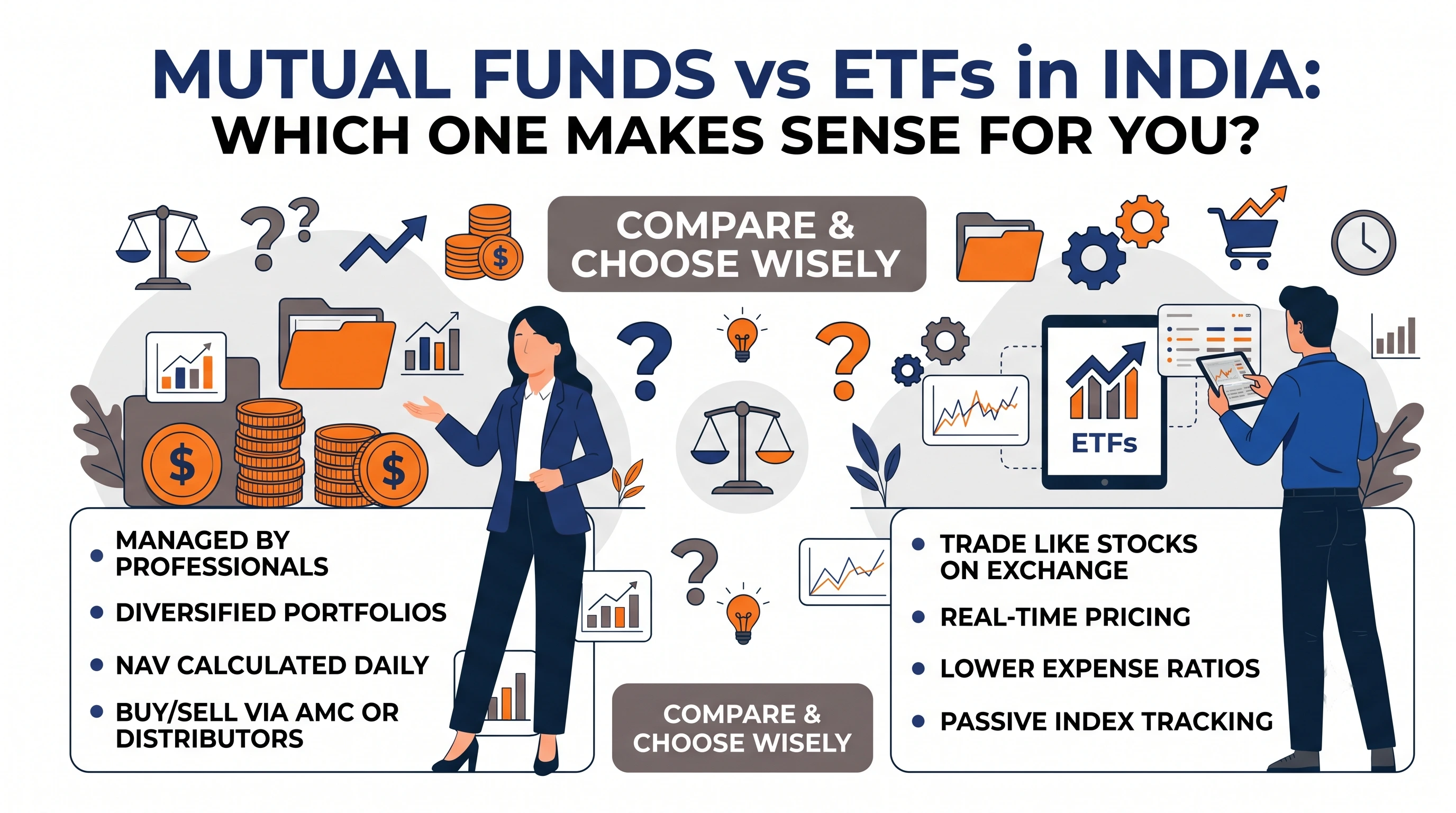
With a mutual fund, you invest directly through the asset management company (AMC). Your purchase or redemption is processed at the day’s closing Net Asset Value (NAV), regardless of when you place the order. You don’t need a Demat or trading account.
An ETF, on the other hand, is bought and sold on a stock exchange just like a share. Its price changes throughout the trading day based on market demand and supply. To invest in an ETF, you need a Demat and trading account.
So while the underlying investments may be identical, the investing experience is quite different. That difference ultimately determines which option is better suited to your needs.
The Differences That Actually Affect Your Returns
Cost
This is where ETFs have a clear edge. Their expense ratios are typically lower than actively managed mutual funds and often comparable to, or even lower than, index funds.
Over 20 years, even a 0.5% annual difference in expenses can significantly impact your final corpus. Lower costs mean you keep more of your returns.
That said, ETFs aren’t entirely cost-free. Brokerage charges and bid-ask spreads apply to every transaction. While these costs are usually small, they can add up for investors making frequent, small purchases.
| Investment Type | Typical Expense Ratio | Additional Investor-Level Costs |
|---|---|---|
| Actively managed mutual fund (direct plan) | Highest | None beyond standard MF transaction charges |
| Index fund, mutual fund (direct plan) | Moderate | None beyond standard MF transaction charges |
| ETF | Lowest | Brokerage, exchange charges, and bid-ask spread |
For long-term, low-frequency investors using direct plans, mutual funds usually do not add meaningful per-trade costs beyond the expense ratio. For ETFs, brokerage on each buy and sell is unavoidable. The impact is small if you buy a few times a year, but meaningful if you trade often.
SIP Convenience
Mutual fund SIPs are among the most frictionless ways to invest. AMFI data shows monthly SIP contributions have crossed ₹31,000 crore, highlighting how automation helps investors stay disciplined.
While some platforms offer ETF SIPs, they are not universally available and often require more manual effort. For investors who depend on automation, this difference matters.
The biggest threat to long-term wealth isn’t choosing the wrong product; it’s investing inconsistently. Any option that reduces friction improves outcomes.
Liquidity and Trading
ETFs trade throughout the day, which sounds like an advantage. For long-term investors, it is mostly irrelevant, and for anyone prone to checking prices and panic-selling, it is actually a risk.
Mutual funds process redemptions at end-of-day NAV. That one-day buffer removes the temptation to exit at an intraday low.
Large ETFs like Nifty 50 or Sensex-tracking funds have sufficient trading volumes. Niche or sector ETFs can carry liquidity risk through wide bid-ask spreads, particularly in volatile markets.
Transparency
ETFs disclose holdings that closely mirror the index. You always know what you own. Active mutual funds can shift allocations frequently based on the fund manager’s view, and disclosure is periodic rather than real-time.
For investors who want to know exactly what is in their portfolio at any given moment, ETFs are more transparent.
Minimum Investment
| Vehicle | Minimum Entry Point |
|---|---|
| Mutual fund SIP | As low as ₹100 to ₹500 per month |
| ETF | Price of one unit on the exchange |
Mutual funds are more accessible at the lowest ticket sizes. An ETF unit priced at ₹200 or ₹2,000 is still accessible, but fractional investing is not possible the way SIPs allow.
Active vs Passive: The Underlying Question
Choosing between mutual funds and ETFs often comes down to one question: does active management justify its higher cost?
Active fund managers aim to outperform the benchmark. While some succeed for certain periods, consistent long-term outperformance is difficult, and higher expense ratios reduce net returns.
In India, SPIVA scorecards show that most large-cap active funds have underperformed the Nifty 50 over 5–10 year periods. Mid- and small-cap active funds have performed better in some cases because these segments are less efficiently priced.
ETFs and index funds take a different approach. Instead of trying to beat the market, they aim to match it at the lowest possible cost.
| Situation | Better Suited To |
|---|---|
| Investing in large-cap equities long term | ETF or index fund |
| Seeking alpha in mid or small-cap space | Active mutual fund |
| Wanting gold exposure with low cost | Gold ETF |
| Starting with ₹500 per month via SIP | Mutual fund |
| Building a core passive portfolio | ETF |
Info:
Check out our blog on CTC vs In-hand salary to get insights on your savings before you decide to invest.
Who Should Use Which Product
Mutual funds are ideal if you are starting, prefer automated SIPs, don’t have a Demat account, or want a fund manager to make investment decisions.
ETFs are better if you already have a Demat account, want the lowest possible costs, and are comfortable buying and selling on the stock exchange.
Many investors use both ETFs for low-cost core index exposure and active mutual funds for categories where skilled fund managers can add value.
| Investor Profile | Suggested Approach |
|---|---|
| First-time investor, no Demat account | Mutual fund SIP in a diversified equity fund |
| Cost-conscious investor with Demat account | Core Nifty or Sensex exposure via ETFs, rest via mutual funds |
| Investor seeking gold allocation | Gold ETF |
| Long-term retirement portfolio builder | Mix of index funds and ETFs for core, plus selective active funds if desired |
| Investor wanting mid-cap alpha | Active mutual fund |
| Investor who panic-checks prices regularly | Mutual fund SIPs in diversified equity rather than ETFs |
The Taxation Picture
Equity mutual funds and equity ETFs are taxed similarly in India. The key factor is the holding period.
For equity investments, gains on holdings under 12 months are taxed at the prevailing short-term rate, while gains on holdings over 12 months are taxed above the applicable exemption limit as per the rules in force at the time of sale. Since tax laws change, always refer to the latest regulations when filing.
Debt fund taxation has also changed in recent years, so verify the current rules or consult a tax advisor before investing.
Tax should influence your holding period, not determine whether you choose a mutual fund or an ETF.
Common Mistakes That Apply to Both Products
Selecting based on recent returns. Past outperformance in a fund or ETF says very little about future performance. Selecting last year’s top performer is one of the most documented errors in retail investing.
Ignoring the total cost. If you are comfortable choosing funds yourself, direct plans avoid distributor commissions and reduce the expense ratio. Regular plans pay intermediaries and cost more every year. On the ETF side, frequent trading adds brokerage costs that erode the expense ratio advantage.
Over-diversifying across funds. Holding ten equity mutual funds often means holding the same 50 stocks with more paperwork. Concentrated, deliberate portfolios outperform cluttered ones over time.
Treating ETF liquidity as a feature to use. Intraday liquidity is useful in genuine emergencies. Using it to react to every market headline is how long-term returns get destroyed.
If you only take one thing from this: The mutual fund versus ETF decision is less important than staying invested consistently over a long period. Pick the product that fits your current setup and keeps friction low. Then let time do its work.
Conclusion
India’s mutual fund industry had crossed roughly ₹81 lakh crore in AUM, while passive funds were holding around ₹14 lakh crore. Both are growing. Both are useful. The debate about which is better misses the point.
What matters is whether the product you choose fits your access, your discipline, and your time horizon. An ETF you never buy because the setup feels complicated is worse than a mutual fund SIP running quietly every month.
Start with what you will actually use. Add complexity to the portfolio only as your knowledge and account setup allow.
Info:
Want to get started with finance? Check out our finance courses or fill the form below to get a one-to-one consultation.
FAQs
Q: Are ETFs safer than mutual funds?
A: No. Neither is inherently safer. Risk depends on what they hold. An equity ETF and an equity mutual fund tracking the same index carry similar market risk.
Q: Which is better for beginners: mutual funds or ETFs?
A: Usually mutual funds. SIP automation, no Demat requirement, and simpler onboarding matter more than a small expense ratio difference at the start.
Q: Can ETFs give higher returns than mutual funds?
A: They can, over long periods, when the active fund fails to justify its higher cost. Lower expenses improve net returns. ETFs still carry full market risk.
Q: Do ETFs have SIP options in India?
A: Some brokers offer them, but mutual fund SIPs are more widely available and more seamless to automate.
Q: Is a Demat account required for ETFs?
A: Yes. ETFs trade on stock exchanges, so a Demat and trading account are required to buy and hold them.
Q: Are index funds and ETFs the same?
A: No, though both are passive products. Index funds are bought from AMCs at end-of-day NAV. ETFs trade on exchanges throughout the day. The underlying portfolio may be identical. The mechanics are different.
Q: Should long-term investors prefer ETFs or mutual funds?
A: Both work. Use ETFs for core large-cap passive exposure if you have the setup. Use mutual funds for SIP convenience and active allocation in categories where manager skill matters. Many long-term portfolios benefit from both.