

Markets, Mindsets & Macro Realities – My 4-Part Conversation with Aditya Khemka
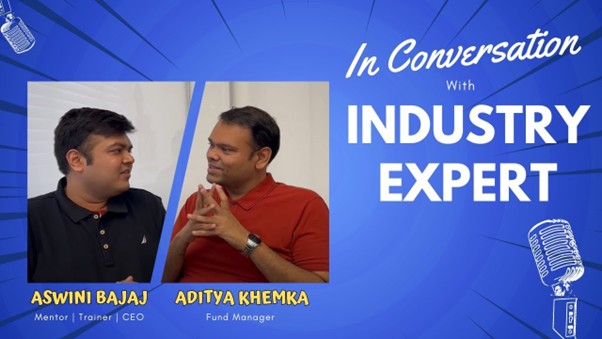
Throughout these episodes, Aditya Khemka, Fund Manager at InCred Asset Management, opens up about his journey, the investment frameworks he believes in and the practical realities of navigating the markets as an analyst and a fund manager.
These conversations are filled with real-life examples, cautionary tales, and decision-making blueprints offering rare access to top fund managers' thinking. Whether you're a finance student, a professional in transition, or a market enthusiast, this blog is a must-read.
The Theory vs Practical of the Stock Market!
In the first episode, Aditya answers a fundamental question generally asked: Why don't stock prices always reflect what's happening in the economy? He explains the concept of stock beta vs. business beta, showing how industries like healthcare and FMCG have low or near-zero business beta due to their non-discretionary, price-inelastic nature. These sectors behave like "steady walkers" (the man), while stock prices often behave like "excited dogs" reacting to every noise.
-
We also explore :
- The Efficient Market Hypothesis (EMP)— does it still hold?.
- Why are markets efficient long-term but erratic in the short run?
- How India's market maturity is a decade behind the U.S.and what that means for investors today.
- The impact of digitization, inclusion, and policy shifts on investor behaviour.
Watch Part 1 here :
The Making of a Pharma Fund Manager — Industry Analysis & Beyond
This episode reveals Aditya's inspiring and unconventional journey, from analyzing physical IPO share certificates with his grandfather to becoming a treasurer at Glenmark and eventually transitioning into equity research and fund management.
-
Beyond the personal story, this part dives into :
- Why industry research is the foundation of effective stock selection.
- How to decode an industry's value chain, cash flow trail, and regulatory setup.
- What makes the pharmaceutical sector complex yet incredibly compelling.
- The internal workings of the Indian diagnostic space,using case studies like Dr. Lal, Thyrocare, and Tata 1mg, and explaining how their vastly different models impact margins, scalability, and disruption risk.
Aditya also emphasizes the importance of a top-down approach: first understanding the sector dynamics, then identifying the right companies, and finally aligning with the strategy that resonates with your conviction.
Watch Part 2 here :
How to Be a Fund Manager? Skills, Mindset & the Daily Grind
In this student-focused session, Aditya unpacks what it takes to become a fund manager, beyond just educational qualifications. He speaks about the critical blend of financial literacy, observation skills, empathy, and analytical depth that separates great analysts from average ones.
-
Some key insights include :
- Why, seeing from all perspectives — company, customer, competitor — makes sharper decisions?
- How to analyze industries by following incentives, cash flow paths, and ecosystem behaviour.
- Why it's better to go deep in fewer sectors rather than skim the surface across many.
- A typical day in the life of a fund manager's background.
Enter equity research or fund management, with actionable advice on building depth, structuring learning, and creating sectoral expertise even if you come from a non-finance background, and finally aligning with the strategy that resonates with your conviction.
Watch Part 3 here :
IPO Investing, Red Flags & the Art of Portfolio Construction
The final chapter of the series ties everything together with real-world investing wisdom. Aditya shares his IPO investing framework, beginning with a critical question: Is this IPO raising funds for business growth, or just helping private equity exit? If it's the latter, it's a red flag.
-
We dive deep into :
- Why buying a business without future cash flows is dangerous, unless you have a firm belief in its future.
- How to detect financial manipulation, using tools like CFO/EBITDA ratios, interest income checks, and reserve anomalies.
- His preference for avoiding sampling error 1 (too many bad apples) in favour of sampling error 2 (missing a few good apples) — which leads to a more concentrated, high-conviction portfolio.
- The mindset required when your thesis is not playing out — when to be humble, and when to be defiantly right.
This conversation is not just about numbers — it's about building a philosophy of investing that combines data with discernment.
Watch Part 4 here :
In Conclusion
Aditya Khemka brings a rare mix of grounded experience, analytical frameworks, and forward-looking thinking to the table, and there's something in it for everyone, whether you're just beginning your finance journey or fine-tuning your investing lens.
Don't forget to share your favourite insight from the series — and pass it on to someone who needs to hear it.
F A Qs :
Q: What is the difference between stock beta and business beta?
A: Stock beta is market-price sensitivity, while business beta reflects the variability of underlying demand; staples and healthcare can have low business beta despite stock volatility.
Q: Does EMH still hold?
A: EMH frames how information reflects in prices; markets may be more efficient long-term, with short-term deviations due to behavior and frictions.
Q: How to start analyzing a sector like pharma?
A: Map the value chain, cash flows, and regulation, then compare business models on margins, scale, and disruption risk.
Q: What's a quick IPO red-flag check?
A: If proceeds largely facilitate investor exits rather than growth, treat as caution and scrutinize fundamentals harder.
Q: Is it better to specialize or diversify as an analyst?
A: Depth in fewer sectors can improve conviction and decision quality over surface-level breadth.