

You finish a two-hour financial modelling tutorial feeling confident. The next day, you open Excel to build a model on your own... and suddenly you don’t know where to start.
This is where most finance students get stuck.
They mistake watching a model being built for learning how to build one. The problem isn’t a lack of effort or something related to poor intelligence.
The reality is financial modelling isn’t about memorizing formulas, rather understanding the logic behind every assumption, calculation, and link in the workbook.
Key Takeaways
- Financial modeling is a skill you build by creating models, not by just watching tutorials.
- Master the fundamentals first—Excel, accounting, and three-statement modeling—before moving to valuation.
- Employers value models that are clear, structured, and easy to explain, not just technically correct.
- A portfolio of real-world financial models can demonstrate your skills more effectively than course certificates.
- Consistent practice in real companies, combined with feedback and iteration, is the fastest way to become interview-ready.
So, why do so many learners struggle despite putting in the effort? The answer lies in how they approach the learning process. Most either jump straight to advanced concepts like DCF valuation without understanding the balance sheet mechanics that power the model, or they stay stuck on Excel shortcuts without ever building anything real.
Both approaches eventually hit a wall. What works is a structured progression where each stage builds on the last and prepares you for the next.
How Financial Modelling is Relevant in the Current Job Market
Financial modelling is not a technical party trick. It is the mechanism by which analysis becomes a decision. When a business wants to know whether to launch a product, raise capital, or cut costs, someone has to build a structured representation of the decision and show what happens under different assumptions.
CFA Institute frames this precisely in their Practical Skills Module on financial modelling: building a three-statement model that showcases business understanding, design discipline, and technical skill.
That framing is important. The emphasis is on all three, not just the technical part. The three-statement model is also described across mainstream modelling training as the bedrock on which DCFs, LBO models, and merger models are built. The sequence in this blog reflects that same position.
Employers filling roles in FP&A, equity research, investment banking, corporate finance, and startup finance all need people who can forecast, test assumptions, and explain what the numbers mean to someone who did not build the model. A candidate who can do that in a structured, readable way is demonstrably more useful than one who cannot.
Info:
Finance professionals also need to upskill themselves while preparing for their CFA journey.
The Foundation Most People Skip
A lot of learners try to jump straight into valuation models. That usually creates gaps that show up later, in interviews, in model errors, or in the inability to explain assumptions under pressure.
The foundation that needs to come first is not exciting, but it is load-bearing.
Understanding how a business generates revenue and converts it into cash is the prerequisite for forecasting anything meaningfully. Without that, a three-statement model becomes a template-filling exercise rather than an analytical one. Understanding how the income statement, balance sheet, and cash flow statement connect is the prerequisite for avoiding the most common modelling errors.
Build this base before touching a valuation model. It takes less time than most people expect, and it changes the quality of everything that follows.
The Skill-Building Path, Stage by Stage
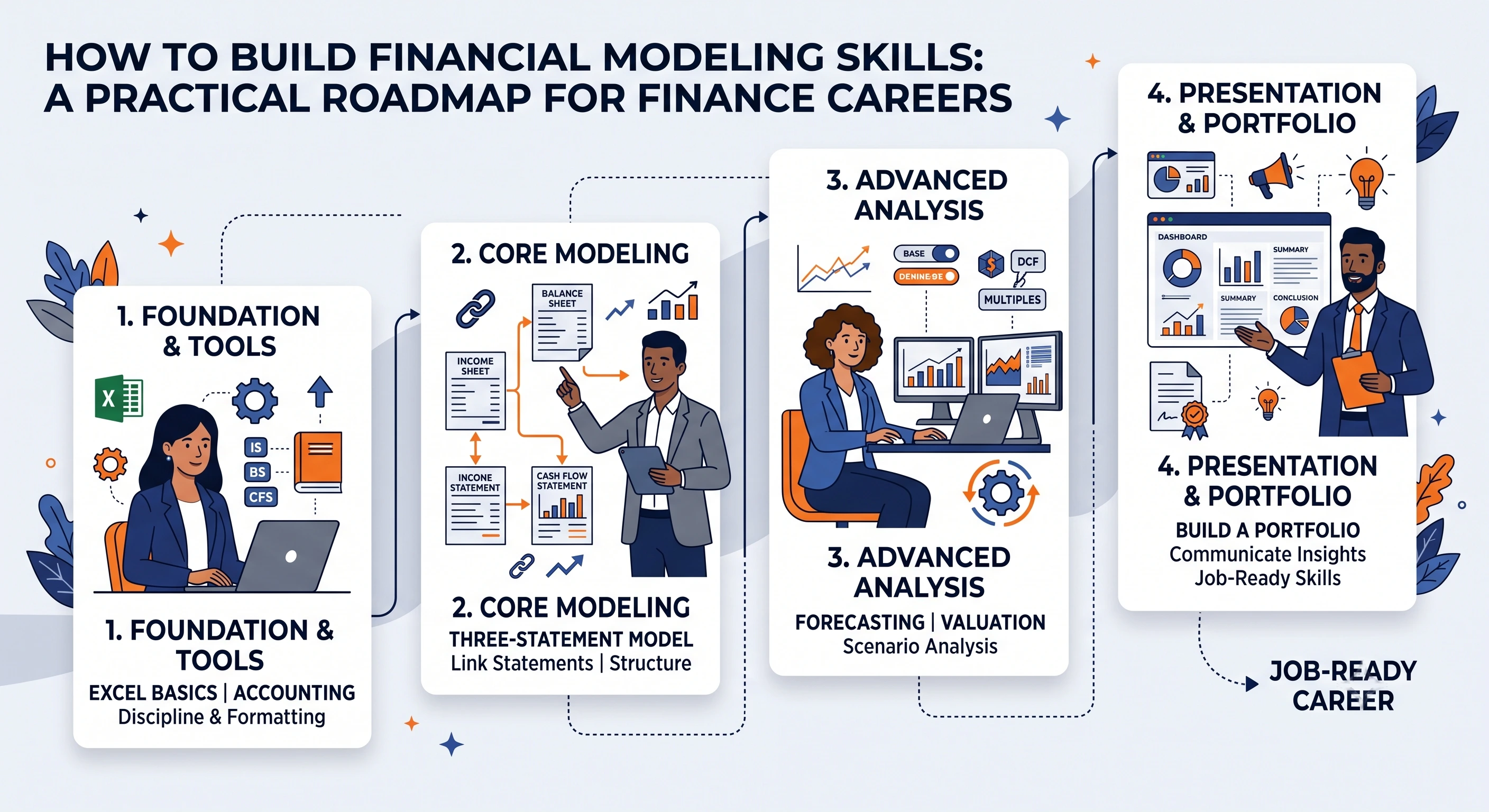
A structured sequence works far better than accumulating random tutorials. Each stage in the following path produces a usable output, not just knowledge.
| Stage | Focus | What You Produce | Typical Time | Common Mistake |
|---|---|---|---|---|
| 1 | Excel and accounting basics | Clean spreadsheet habits and formatting discipline | 1 week | Learning shortcuts in isolation without applying them to real data |
| 2 | Historical financial analysis | Common-size statements and ratio work on a real company | 1 week | Reading about ratios without calculating them on actual filings |
| 3 | Three-statement modeling | Linked income statement, balance sheet, and cash flow | 2 weeks | Copying a template instead of building the links yourself |
| 4 | Forecasting and assumptions | Revenue drivers, cost structure, scenario logic | 1 to 2 weeks | Guessing revenue growth instead of tying it to identifiable business drivers |
| 5 | Valuation | DCF, comparable company analysis, sensitivity tables | 1 to 2 weeks | Running a DCF without checking whether the free cash flow logic is correct |
| 6 | Presentation | Output dashboard, written commentary, clear recommendation | 1 week | Showing the numbers without explaining what they mean or what decision they support |
Most learners underestimate how much time stage 3 deserves. The three-statement model is where all the conceptual understanding from stages 1 and 2 becomes structural. Spend real time here before moving on.
Excel: What to Actually Learn
Excel remains the primary modelling tool across most finance roles. This will likely remain true even as complementary tools grow in importance.
The goal is not to memorise every function. It is to use efficiently enough that your model is readable and maintainable by someone who did not build it. The clearest standard: you should be able to rebuild a simple three-statement model in a clean workbook from scratch, in a few hours, without copying formulas.
Non-negotiable skills for modeling:
- Keyboard shortcuts for speed and navigation
- Absolute and relative cell referencing
- IF, IFERROR, INDEX-MATCH or XLOOKUP
- Consistent formatting and clear section labelling
- Error checks built directly into the model
Worth adding as you advance:
- Pivot tables for data summarisation
- Scenario Manager and data tables for sensitivity work
- Named ranges for larger, more complex models
Error checking is one of the most overlooked skills. A model with no error checks is a model that an employer cannot trust without verifying everything manually. Build in checks from the start.
Info:
Get started with our MS Excel course to learn advanced functions for finance professionals.
What Makes a Model Job-Ready
A model is not impressive because it is large or complicated. It is impressive because it is reliable, flexible, and easy to follow. Those are the characteristics that make a model useful in a real work environment.
The difference between a model that looks finished and one that is actually job-ready comes down to a few things:
Separate your inputs from your calculations. Hardcoding assumptions inside formulas is one of the most common structural mistakes. Assumptions should live in one clearly labelled section. Calculations reference those assumptions. Outputs draw from calculations. Anyone reviewing the model should be able to change one assumption and see the entire model update correctly.
Make it scenario-ready. A static model that only shows one outcome answers one question. A model with scenario and sensitivity analysis answers the questions that actually come up in real decision-making: what if revenue grows more slowly, what if margins compress, what if the deal takes six months longer to close.
Explain the logic in the model itself. Brief labels, clear section headers, and notes on non-obvious assumptions turn a spreadsheet into a communication tool. A hiring manager reviewing a candidate model is evaluating whether they could hand it to a colleague without a 30-minute explanation.
Role-Specific Application
Modelling shows up differently depending on the job. Understanding the application that matters for your target role helps you prioritise which model types to build first.
| Role | Primary Modelling Uses |
|---|---|
| FP&A | Budgeting, variance analysis, rolling forecasts, performance dashboards |
| Equity research | Company valuation, earnings estimates, investment thesis support |
| Investment banking | DCF, transaction analysis, accretion-dilution, comparable valuations |
| Corporate finance | Capital allocation, business case modeling, fundraising scenarios |
| Startup finance | Runway and burn modeling, operating plan, fundraising scenario analysis |
If your target is FP&A, build budget-vs-actual dashboards and forecasting models. If your target is equity research, build company valuations and investment memos that reference your model. Match your practice projects to the role you are targeting before you start building.
Practice Projects That Build a Portfolio
Knowledge becomes skill through application. A portfolio of two to three well-built and well-explained models is more useful in a job search than any number of course certificates.
Beginner projects to start with:
- Three-statement model for a listed company using its public annual report
- Revenue forecast for a simple business with clear drivers
- Budget-vs-actual dashboard comparing plan to actuals
- Sensitivity analysis on a margin or growth assumption
Intermediate projects to build next:
- Full DCF valuation with scenario and sensitivity tables
- Comparable company analysis across a peer group
- Working capital forecast linked to a three-statement model
- KPI dashboard connected to a financial forecast
Each project should include a brief written explanation: what the model is for, what assumptions were made, what the output shows, and what decision it supports. That explanation is often what separates a strong portfolio piece from a spreadsheet that just sits there.
To make this concrete, here is what a complete beginner portfolio piece looks like in practice. Pull three years of annual reports for any listed company. Build the historical three-statement model from scratch, with no template. Add a simple DCF off the free cash flow line.
Run two scenarios: a base case and a downside. Write one page on what the output implies about whether the stock looks over- or undervalued at current prices. That is a portfolio piece. It demonstrates sourcing, modeling discipline, valuation logic, and written communication in a single exercise.
Modern Tools That Extend Modeling Value
Excel is the foundation, but the finance roles that pay the most attention to modeling candidates in 2026 also value adjacent skills that make models more useful.
Power BI and data visualisation tools help translate model outputs into dashboards that non-finance stakeholders can actually use. SQL helps pull and clean the data that feeds into models, particularly in FP&A and corporate finance environments where data lives in systems rather than spreadsheets. Python is increasingly used for automation and handling larger datasets than Excel manages well.
These tools extend the value of modeling skills. They do not replace the underlying ability to build a clean, logical financial model. Build the Excel foundation first. Add these tools as your career develops.
Common Mistakes That Slow Progress
These are the errors that appear most consistently in early-stage modeling work. Each one is avoidable.
Starting with valuation before understanding the three-statement model. A DCF built without understanding how free cash flow connects to the income statement and balance sheet is a template, not a model.
Hardcoding assumptions inside formulas. This makes the model rigid, error-prone, and difficult for anyone else to use or audit.
Ignoring the balance sheet. Many beginners focus on the income statement and cash flow but treat the balance sheet as an afterthought. The balance sheet is what keeps the model internally consistent. If it does not balance, something is wrong.
Building models that cannot be reviewed. Inconsistent formatting, unlabelled sections, and no error checks make a model difficult to trust. Employers notice this immediately.
Not explaining the output. A model that produces a number without any context about what that number means or what decision it supports is half-finished.
How to Use Your Models in Interviews
Building the model is only half the work. The other half is being able to talk about it under pressure.
When an interviewer asks you to walk through your modeling experience, most candidates describe what the model contained. That is the wrong instinct. Interviewers are not assessing your ability to list features. They are assessing whether you understand why the model was built and what it was used for.
For each project in your portfolio, prepare to answer three questions clearly.
The question: what decision or problem was the model built to support? This establishes that you started with a business purpose, not just a spreadsheet exercise.
The structure: how you linked the three statements, where assumptions live, and how scenarios work. This is where technical competence shows. Walk through the logic, not the formula list.
The takeaway: what the output showed and how you would explain it to a non-technical stakeholder. This is where communication skill shows. If you can explain the implication of a model in two plain sentences, you demonstrate the quality that employers actually need in practice.
That framing mirrors how financial models are used in real work environments: as integrated tools for forecasting, valuation, and decision-making, not as static spreadsheets that get filed away.
Info:
Learn more about finance professionals skills that can help you get interview-ready.
A 30-Day Build Plan
For candidates who want a concrete starting point, this four-week structure moves from basics to a complete portfolio piece.
| Week | Focus | Target Outcome | Daily Practice |
|---|---|---|---|
| 1 | Excel and accounting review | Solid spreadsheet habits, clean formatting, financial statement fluency | 45 to 60 minutes: 20 minutes Excel drills, 20 minutes reading financial statements, 20 minutes rebuilding simple schedules |
| 2 | Historical analysis and ratio work | Common-size analysis of a real company’s last three years | 45 to 60 minutes: work through one year of filings per day, calculate ratios, write one observation per session |
| 3 | Three-statement model | Fully linked model with error checks and clear structure | Spend at least half your time fixing what breaks. That is where most of the learning happens |
| 4 | Valuation and scenario analysis | DCF with sensitivity table and a short written output summary | Build the DCF off your stage 3 model. Write the one-page memo last, after the model is stable |
By the end of week four, you have a complete portfolio piece. That is enough to walk into an interview and demonstrate real capability.
If you only do one thing after reading this: Build a three-statement model for any listed company using its public annual report. Do not use a template. Start from a blank spreadsheet. That single exercise will reveal more about your current gaps, and close more of them, than any course you could take.
Conclusion
Financial modeling is learnable in a relatively short time if the path is right. The candidates who build genuine competence are not the ones who watched the most tutorials. They are the ones who built something, found the gaps when it broke, fixed it, and built something more complex next.
The sequence matters. The practice matters. The explanation of what you built matters. All three together are what turns a modeling skill from something you claim on a resume into something you can demonstrate in a room.
Start with the foundation. Build the three-statement model. Then let the portfolio do the talking.
Info:
Have questions on how to build financial modelling skills? Fill out the form below and get in touch with our expert to know more.
FAQs
Q: What is the best way to learn financial modeling?
A: Start with accounting basics and Excel, then build a three-statement model from scratch using a real company’s annual report. That sequence produces more lasting skill than any course-first approach.
Q: How long does it take to learn financial modeling?
A: A solid foundation is achievable in four to six weeks of consistent daily practice. Advanced competence across multiple model types takes longer, but the foundation is enough to open most entry-level conversations.
Q: Is Excel enough for financial modeling?
A: For most finance roles, yes. Excel is still the primary tool. Power BI, SQL, and Python are worth adding over time, but they extend the foundation rather than replace it.
Q: What models should beginners build first?
A: A three-statement model, followed by a simple revenue forecast and a basic sensitivity analysis. In that order.
Q: Do employers actually care about modeling skills?
A: Yes, consistently. Modeling supports forecasting, valuation, budgeting, and decision-making across nearly every finance function. Candidates who can demonstrate it have a concrete advantage over those who only claim familiarity.
Q: Which roles need financial modeling the most?
A: FP&A, equity research, investment banking, corporate finance, and startup finance all use modeling extensively. The type of model varies by role, but the underlying skill set transfers across all of them.
Q: How do I make a model job-ready?
A: Separate inputs from calculations, build in error checks, add scenario flexibility, and write a short explanation of what the model does and what its output means. A model that passes those tests is one an employer can actually use.
Q: Should I include modeling projects in my portfolio?
A: Yes. Two to three well-explained models are more persuasive than a resume full of course names. The portfolio makes the claim; the model makes the proof.