

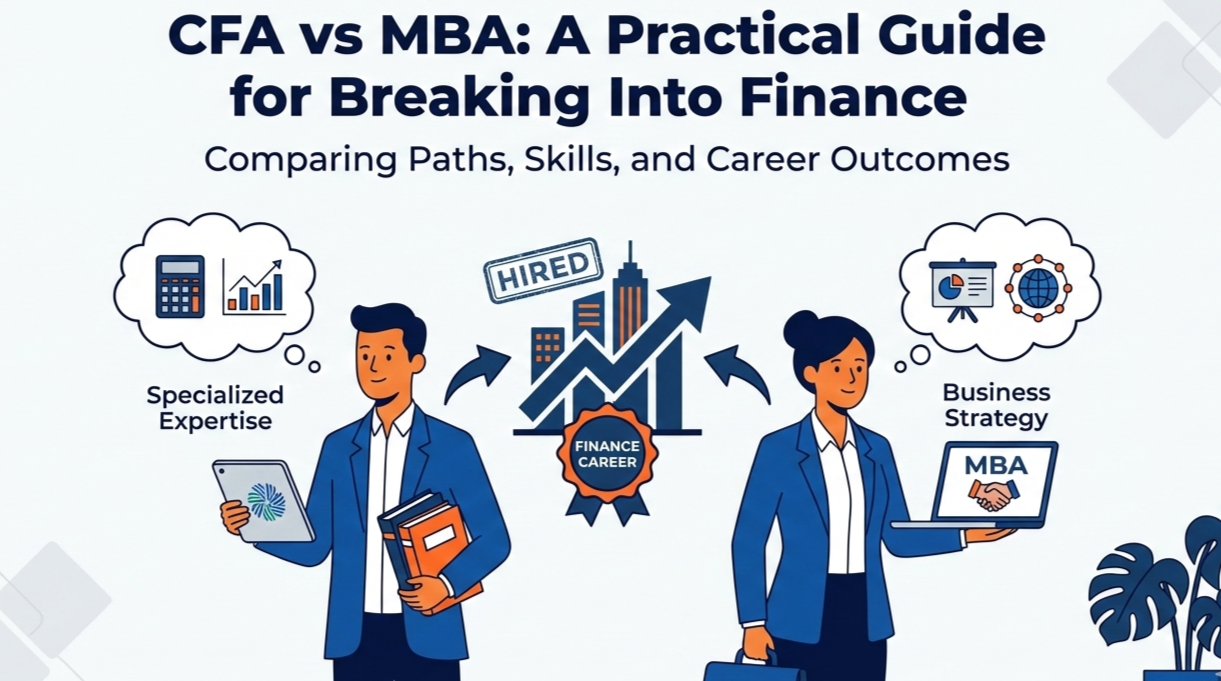
Choosing between CFA and MBA is not a prestige contest. It is a utility decision based on what role you want, how hiring works in India, and what you can realistically invest in time and money.
The CFA vs MBA decision becomes easier once you treat CFA as a specialist path for investment depth and MBA as a generalist path for broader business leadership and campus recruiting access.
Key Takeaways
-
- Choose CFA when you want investment-focused depth and you can study alongside work.
- Choose an MBA when you need a structured recruiting channel through a school and broader business training.
- If your goal is front-office roles that hire heavily through campuses (IB, consulting), an MBA from the right campus can be the fastest access route.
- If your goal is long-term investing roles (research, portfolio, wealth, risk), CFA-first is often more aligned, but only if you build proof of skills alongside it.
- Do not choose based on trends. Choose based on whether you want to manage portfolios (CFA) or manage people and companies (MBA).
This guide gives you a role-first decision framework, then shows how to validate outcomes using placement data and alumni paths so you can pick the credential that removes your next career bottleneck.
MBA vs CFA: The Strategic Framework
Step 1: Start with your target role (not the credential)
CFA Institute frames the CFA Program as aligned to investment-focused work such as investment analysis, portfolio management, and wealth management style career paths. An MBA is a broad business degree, so it tends to fit roles where leadership, general management skills, and cross-functional exposure matter as much as pure finance depth.
Other credentials to break into finance include CA and FRM. Those who are interested in the management side of finance can do an MBA specialized in Finance. Regardless, most confusion disappears when you start with the job you want. CFA and MBA are designed for different career outcomes and hiring channels. The following table will help understand which credential you need based on your choice.
Credential fit by finance career direction (India context)
| Career direction | CFA tends to be strongest | MBA tends to be strongest | Doing both can help when |
|---|---|---|---|
| Markets and portfolios | Investment analysis, equity research, portfolio management track | Less direct unless paired with deep finance specialization | You want to lead investment teams and strategy |
| Research and risk | Analytical credibility for investment and risk thinking | Helpful for broader leadership and stakeholder-heavy roles | You want to grow from analysis into management |
| Banking, consulting, corporate leadership | Useful but not always the main hiring lever | Strong access credential via campus hiring and internships | You want access plus deep technical credibility later |
Quick role map
Pick the row that matches your real target:
-
- Equity research / asset management / wealth management: CFA-first is usually the cleaner fit because these roles reward investing depth and repeatable analytical skills.
- Risk roles (market risk, credit risk, treasury risk): CFA can help, but FRM plus relevant risk experience can also be a strong route; MBA helps more when the role is stakeholder-heavy or leadership-track.
- Investment banking / management consulting: MBA-first is often the more reliable access route because internships and campus recruiting are a major pipeline.
- Corporate finance leadership (FP&A → finance manager → CFO track): MBA can be more relevant earlier because the role expands into leadership, cross-functional work, and business decisions.
If you cannot name the function you want, pause and clarify first. A credential will not fix an unclear direction.
Step 2: The core difference in one line
-
- CFA (specialist): deep technical qualification aligned to investment analysis and portfolio decision-making.
- MBA (generalist): broad leadership degree that often improves recruiting access and network leverage, especially via campus placements.
There is no universal right answer. Your best choice depends on three constraints: target role, budget, and timeline.
Step 3: Cost, time, and opportunity cost (the real ROI math)
CFA cost is spread across multiple years with no forced career break for most candidates. Moreover, it is much cheaper than an MBA and its pass rates reflect rigor, skill, and expertise.
MBA cost is concentrated and can include a major opportunity cost if you leave your job for a full-time program.
A simple opportunity-cost formula (use before deciding)
Think of MBA ROI like this (roughly):
MBA total cost = Tuition + living + fees + (salary you give up during the program)
Now compare that against the probability-weighted outcome:
Expected upside = (chance of target role) × (incremental earnings + career acceleration)
The point is not perfect math. The point is to avoid decisions based on "average package" headlines that hide role mix.
The ROI and salary expectations may be different across roles in both CFA and MBA. However, you can use our CFA Salary Calculator to get a rough estimate of what you can expect.
CFA vs MBA: Credential Comparison
| Dimension | CFA | MBA |
|---|---|---|
| Time style | Multi-year exams | Time-bound program (often 1–2 years full-time) |
| Study style | Self-study + practice + mocks | Classes + cases + projects + recruiting |
| Work alongside? | Typically yes | Full-time often requires a career break |
| Primary upside | Investing depth, technical credibility | Recruiting access, brand, leadership and network |
| Primary risk | Attrition or inconsistent study over years | High cost + opportunity cost if outcomes disappoint |
Step 4: CFA Deciding Factor
Choose CFA when
-
- You want careers tied to security analysis, portfolio construction, and investment decision-making.
- You can study consistently alongside work for months at a time.
- You want a globally standardized credential and you prefer a lower cash outlay compared to a top MBA.
Avoid CFA-first when
-
- Your true target is campus-heavy front-office entry (IB, top consulting) and you are not planning a parallel strategy (network + internships + deal proof).
- You know you struggle with long self-study cycles and tend to burn out without external structure.
Practical note: CFA alone is rarely the "full story." For break-in roles, you need proof assets (models, write-ups, projects) and networking, not only exams.
Step 5: MBA Deciding Factor
Choose MBA when
-
- You need a structured recruiting channel and want a reset into roles where internships and campus pipelines matter.
- You want broader business training that expands beyond markets and valuation.
- You can afford the financial hit and your plan is based on role outcomes, not just brand.
Avoid MBA right now when
-
- You are unclear about outcomes and are using MBA to "buy time."
- Your financial plan depends only on a best-case placement without backups.
Step 6: Recruiting reality (this is where outcomes are decided)
In India, credentials matter, but hiring channels matter more. MBA as a degree is widely understood, but the real global portability comes from the school brand, recruiter network, and alumni density, not from the word "MBA" alone. In practice, a top school in your target country can be highly valuable locally, while a lesser-known program may not carry the same weight outside its region.
Note: Check out our blog on common career-related questions and answers for more insights.
How CFA typically converts into roles
CFA works best when paired with:
-
- Proof of skill: a valuation model, a written thesis, a stock pitch, a credit memo, or a risk note.
- Role-relevant experience: even research support, analytics, or risk roles can be stepping stones if your work output is strong.
- Focused networking: conversations with people in the seat you want next.
If you want a structured learning path for Level I and a guided prep plan, check out our CFA Level 1 course page.
How MBA converts into roles (India)
MBA outcomes depend heavily on: Campus recruiting mix and internship pipelines. Alumni density in your target industry. Role outcomes, not "average CTC."
Why MBA is still relevant (and when it isn't)
MBA remains relevant when it gives you: A strong placement ecosystem and internship pipeline. Grooming that forces communication reps: presentations, group projects, case discussions, events, clubs. Updated curriculum and practical exposure (bootcamps, live projects, tool training). MBA becomes less useful when the curriculum is outdated, placements are weak, and there's little real skill-building beyond lectures.
MBA shortlisting checklist (use before you apply)
Verify these things, in this order:
-
- Decide the college before you go all-in on CAT: Many aspirants treat CAT as the main goal and "college selection" as a later step. That's backwards. Decide what tier and what outcome you need first, then build your CAT strategy around those targets.
- Add work experience while preparing (if you can): If you have time before MBA, adding relevant work experience can materially improve your admissions story and your placement outcomes because it gives you real proof points for interviews. Even 6 to 18 months of finance-relevant work can strengthen your profile more than another round of generic certifications.
- Role outcomes: Check what % of the batch gets to your target function.
- Recruiter mix: Identify which firms hire and for what roles.
- Alumni outcomes: Do a thorough research on what alumni actually do 2 to 5 years later.
Tier 2 and Tier 3 MBA: when it can work
A Tier 2 or Tier 3 MBA may not move the needle much if it doesn't change your recruiting access or skill level. It becomes worth considering only when the college genuinely provides: Strong grooming and placement training (communication, interviews, aptitude, presentations). Updated curriculum with practical exposure (cases, tools, live projects). A recruiter network aligned to your target roles, not just generic sales-heavy outcomes.
If these are missing, the degree can become an expensive delay rather than a career accelerator. Hence, it reflects the difference between a high-ROI MBA decision and an expensive gamble.
Step 7: The decision matrix (the simplest way to choose)
If you want one table that settles the debate, use this.
| Your situation | CFA-first | MBA-first |
|---|---|---|
| You want equity research / AM / portfolio path | Strong fit | Only if you need brand access and can land finance roles through campus |
| You want risk roles | Fit, especially with risk-aligned work | Fit if targeting leadership-track risk roles |
| You want IB / consulting | Possible but harder without campus access | Often the more reliable route |
| You cannot take a career break | Usually better | Only via part-time/executive formats (outcomes vary) |
| You need fast recruiting access | Slower unless you already have experience | Faster if the campus is the right one |
Step 8: When doing both makes sense (and when it's inefficient)
A dual-credential strategy can compound value, but it is not an entry-level flex. It is most logical when your long-term goal is senior leadership in investment-driven organizations.
Doing both makes sense when
-
- You want to remain close to capital allocation and also influence firm-level strategy.
- You are thinking in a 10-year horizon: CIO-track, Head of Investments, MD, Partner-style paths.
Doing both is inefficient when
-
- You are doing it to avoid choosing a direction.
- You have not yet built a base of role clarity and work proof.
Sequencing that works in real life
-
- CFA → work in investing/risk → MBA later for leadership and platform expansion.
- MBA → enter finance via campus → CFA later to deepen investing credibility (if you move toward markets/portfolios).
For people staying in finance long term, CFA + MBA can be a strong combination because CFA adds investing depth and MBA adds leadership leverage, but it compounds best only after you've built role clarity and a base of experience.
Step 9: Practical execution plans (choose your track)
This is the part that turns clarity into outcomes.
If you choose CFA first (90-day plan)
-
- Pick a target function: equity research, portfolio analytics, risk, wealth.
- Build 2 proof assets: one valuation model + one written thesis note.
- Build the application package: test plan, story, leadership proof.
- Shortlist schools using the recruiting checklist, not rankings alone.
- Create a finance plan: tuition + living + lost salary + backup outcomes.
Not sure finance is for you yet? (do this before spending money)
If you are at an early-stage (UG or first job) and you are unsure whether finance fits your interests, test your direction before committing to CFA or MBA timelines. Try our 'Is Finance for you?' quiz to understand if it is the right career path for you.
How to explain career gaps (simple, credible, non-defensive)
A resume gap is not a dealbreaker. The problem is an unexplained gap.
Use this structure: One-line reason (factual). 2 to 3 proof bullets (skills gained, outputs created).
Examples: "Dedicated 12 months to CFA Level II preparation; built two valuation models and wrote two initiation notes." "Career break for family reasons; completed modeling course and freelanced on a valuation project."
Conclusion
CFA vs MBA is not about which credential is "better." It is about which one removes your next bottleneck in India's hiring market. Choose CFA for investment depth you can build alongside work.
Accordingly, choose MBA for structured recruiting access and broader leadership training when the campus is the right fit. If you eventually want senior investment leadership, doing both can compound, but only after you have role clarity and real execution proof.