

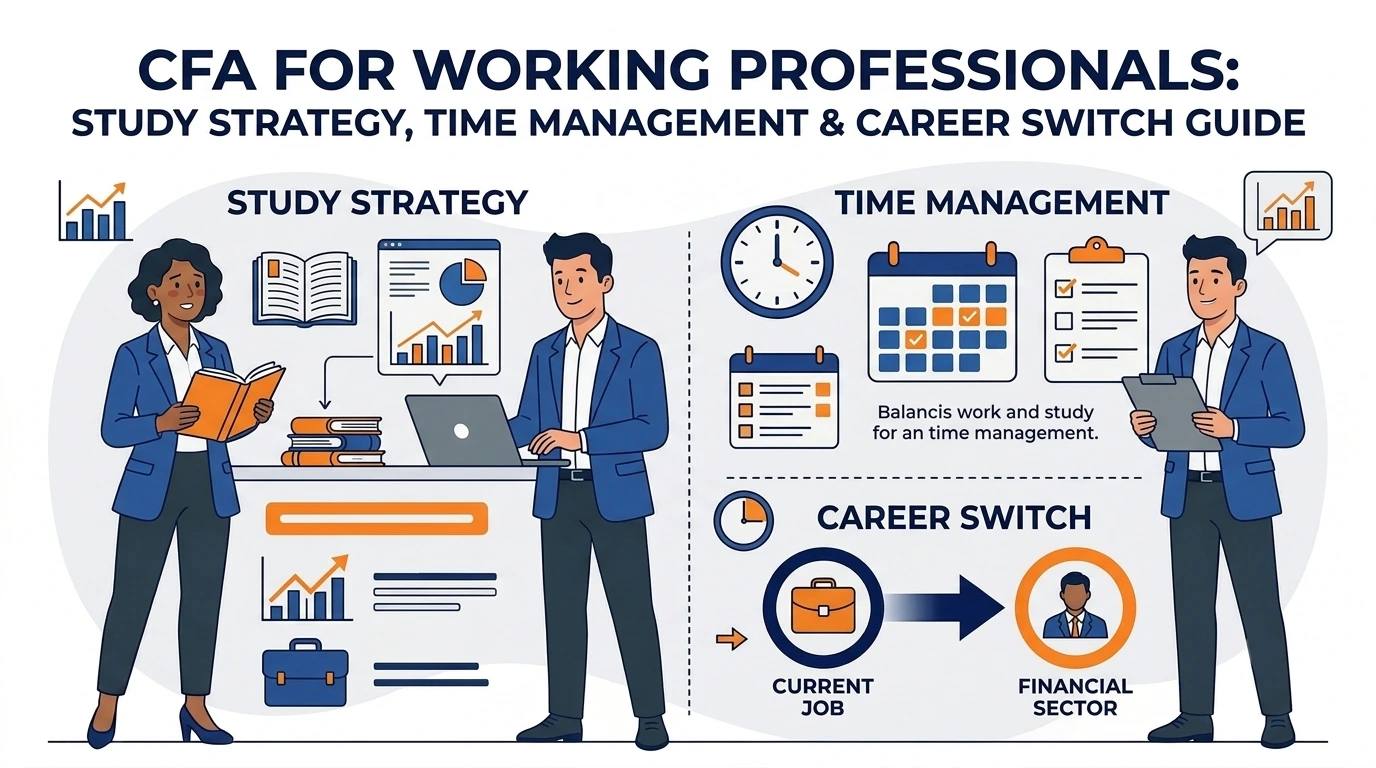
Preparing for CFA while working full-time can feel overwhelming. Long work hours, increasing responsibilities, and limited study time often make the qualification seem out of reach. But clearing CFA isn’t about finding more time; it’s about having the right strategy. Whether you’re looking to grow in finance or transition into the industry, this guide will help you build a preparation plan that works alongside your career.
Key Takeaways
- Preparing for CFA while working full-time is not about finding extra hours in the day; it is about building a realistic and repeatable study system that fits around your professional responsibilities.
- The biggest challenge for working professionals is rarely capability; it is usually fatigue, inconsistency, and the absence of a structured preparation plan.
- A successful CFA strategy for working professionals depends on focused resources, level-wise planning, regular revision, and consistent weekly study hours maintained over several months.
- Working professionals do not necessarily need a career break to pursue CFA, but they do need discipline, smart time management, and a routine they can sustain alongside work.
- CFA can be a strong option not only for finance professionals seeking long-term growth, but also for non-finance professionals looking to transition into finance with a structured and credible qualification.
- The long-term value of CFA does not come from quick outcomes, but from the way it strengthens knowledge, credibility, and career direction over time.
Who Should Pursue CFA While Working?
CFA is suitable if you are:
- A working finance professional seeking faster career growth
- A non-finance professional planning a structured transition into finance
- Someone aiming for global credibility rather than short-term certificates
- A professional who wants a long-term career with compounding value
And before pursuing CFA, it’s important to understand what is CFA.
Why Working Professionals Struggle with CFA?
Before strategy, let’s address the real blockers many professionals face:
- I don’t have enough time
- I’m too tired after work
- Others are smarter / younger
- I’ll start after things settle (they never do)
- Starting to study after so many years, will I be able to focus?
CFA failure is rarely due to lack of capability, but mostly it’s due to lack of structure. That’s why a mentor-led, exam-oriented approach matters.
How to Study CFA with a Full-time Job?
Working professionals should ideally plan 6–9 months per CFA level with consistent weekly targets rather than last-minute study.
What Study Materials Should Working Professionals Use?
Core Resources (Must-Have):
- CFA Institute Curriculum (for depth & exam language)
- Mentor-led video lectures (to save time)
- Question banks & exam-oriented notes
As a working professional, using CFA’s official curriculum is critical as it is the most comprehensive and detailed. For a more concise approach, Schweser Notes provide summarized material and practice questions. Make use of CFA’s official mock exams and question banks — practicing under timed conditions prepares you for the real exam day.
Focused Study Approach
- Prioritize Topics: The CFA curriculum is vast. Focus on high-weight topics like Ethics, Financial Reporting & Analysis, and Portfolio Management.
- Active Learning: Actively engage with the content by solving practice questions after studying each section. This reinforces concepts and improves retention.
- Avoid Memorization: Understanding concepts is key. Don’t focus too much on memorizing formulas — focus on the logic behind them and their application.
- Chunking: Break down the study material into manageable chunks. Take it one topic at a time and take regular breaks to refresh your mind.
Many professionals delay their CFA journey waiting for the “right time.” Careers and responsibilities only grow with time, making disciplined planning — not perfect conditions — the key to success.
Info:
Interested in CFA? Learn how you can prepare for CFA and how Aswini Bajaj Classes can guide you.
Is CFA Worth It for Working Professionals?
The answer depends on why you are pursuing it. If your objective is a quick salary increase or a short-term credential, CFA may not be the right choice.
However, if you are looking to build long-term expertise in finance, investments, valuation, portfolio management, risk, or corporate finance, few qualifications offer the same depth and credibility. This is particularly relevant for:
- Finance professionals seeking career progression
- Chartered Accountants and MBAs looking to strengthen their finance foundation
- Engineers, consultants, analysts, and other professionals planning a transition into finance
- Professionals seeking a globally recognized benchmark of competence
Keep in mind that CFA cannot bring you overnight success. The value of CFA is not created in one year — it compounds over an entire career.
Students vs Working Professionals: Who Has the Real Advantage?
Many students believe working professionals have an advantage because they are more mature, disciplined, and better at managing their time. At the same time, many working professionals believe students have the advantage because they have more time to study, fewer responsibilities, and can focus entirely on their preparation.
Both perspectives are partly true. However, the real challenge for working professionals isn’t just time; it’s fatigue. After a full day of work, even sitting down to study requires significantly more effort.
Info:
Check out our blog on Professional Finance Skills to help stand out in the job market.
How Much Time Do You Actually Need for CFA?
One of the biggest mistakes candidates make is underestimating the time required for consistency. A realistic framework looks like this:
| CFA Level | Ideal Duration | Weekly Study Hours |
|---|---|---|
| Level I | 6–7 months | 12–15 hours |
| Level II | 8–9 months | 15–18 hours |
| Level III | 6–7 months | 12–15 hours |
A professional who studies 12 productive hours every week for seven months is usually in a much stronger position than someone who studies aggressively for a few weeks before the exam.
Info:
Before deciding on your preparation strategy, make sure CFA aligns with your academic background and career objectives. Try our online eligibility tool to check beforehand.
Best CFA Study Strategy for Working Professionals
Many professionals approach CFA preparation by consuming more content, collecting more resources, watching more videos, and reading more notes. This creates activity but not necessarily progress. A better approach is surprisingly simple:
- Focus on the CFA Institute Curriculum
- Use mentor-led lectures to improve efficiency
- Practice questions consistently
- Revise regularly
The objective is not to cover the maximum amount of material. The objective is to understand what is most relevant and apply it correctly. For Level I, this typically includes Financial Statement Analysis, Ethics, Equity Investments, and Fixed Income.
Info:
Check our mentorship-driven CFA online course that helps you build concepts and crack the exam.
How to Balance CFA with a Full-time Job?
Many professionals try to compensate for busy weekdays by planning unrealistic weekend schedules. This rarely works. A more sustainable approach is:
Weekdays
1 to 1.5 focused hours daily, ideally before work when mental energy is highest.
Weekends
5 to 6 focused study hours dedicated to learning, revision, and question practice.
The principle is simple: consistency beats intensity. A routine you can sustain for eight months is more valuable than a routine you can sustain for eight days.
Can CFA Help You Switch Careers?
One concern frequently heard is: “I don’t come from a finance background. Is CFA still relevant for me?” Absolutely. Many successful candidates begin from fields such as Engineering, Consulting, Sales and Marketing, Operations, and Analytics.
The CFA curriculum is designed to build knowledge progressively. What employers often look for is evidence of commitment, analytical thinking, and a genuine interest in finance. CFA helps communicate exactly that. However, the strongest candidates combine CFA knowledge with practical skills such as financial modelling, valuation, Excel, communication, and structured problem-solving.
Info:
Explore our career guidance program to help you fast-track your decision.
Final Thoughts
The perfect time to start CFA rarely arrives. Life only becomes busier.
Successful professionals don’t find more time — they build a system that works within their schedule. If you’re serious about a career in finance, focus on consistency, not motivation.
Wondering if pursuing CFA would lead you to your dream career? Just fill out this form to get guidance from the experts.
FAQs
Q: Can I pursue CFA without taking a career break?
A: Yes. The CFA Program is designed to accommodate working professionals. Most candidates prepare alongside full-time jobs by following a structured study plan over several months.
Q: Is it necessary to have a finance background before starting CFA?
A: No. Candidates from engineering, consulting, technology, law, and other fields regularly pursue CFA. While the curriculum is rigorous, it is structured to build concepts progressively.
Q: Does clearing CFA guarantee a higher salary or a better job?
A: No qualification can guarantee career outcomes. CFA strengthens your knowledge, credibility, and employability, but career growth also depends on your experience, practical skills, and performance.
Q: Should I complete all three CFA levels before applying for finance roles?
A: Not necessarily. Many candidates begin exploring finance opportunities after passing Level I or Level II, especially when combined with relevant skills and experience.
Q: How do I know if CFA is the right qualification for my career goals?
A: If you’re interested in investment management, equity research, portfolio management, corporate finance, or related finance roles, CFA can be an excellent fit. Before enrolling, evaluate whether the curriculum aligns with your long-term career aspirations rather than short-term salary expectations.
Q: Can CFA help working professionals switch to finance?
A: Yes. CFA can help working professionals build finance knowledge and demonstrate commitment to the field, but it is most effective when paired with practical skills such as Excel, financial modelling, valuation, and communication.