

The Chartered Financial Analyst (CFA) program is a highly respected, globally recognized course in finance, offered by the CFA Institute in the USA. This certification can open doors to roles like portfolio manager, financial advisor, consultant, and more, making it one of the most valued credentials in finance. The CFA exams are conducted in 3 levels, each becoming more complex and specialized than the previous one.
Candidates must wait at least 6 months between exams for each level. The CFA Level I exams are conducted 4 times a year (February, May, August, November), Level II is conducted 3 times a year (May, August, November), and Level III is conducted 2 times a year (February, August). You can visit our calendar to stay up to date with the latest dates.
Key Takeaways:
-
- Undergraduate students can register for Level I if their exam window is within 23 months of their bachelor's graduation month.
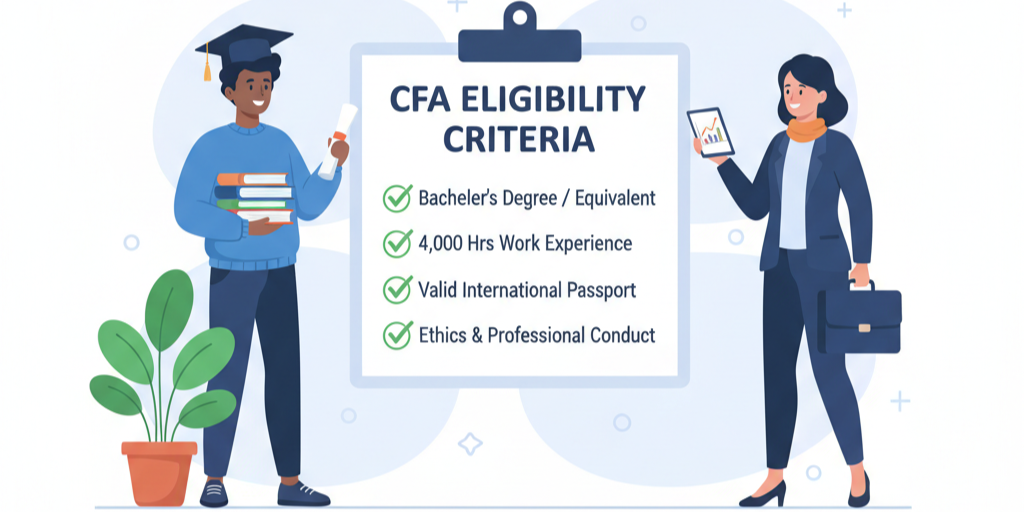
- Working professionals need a minimum of 4,000 hours of combined work experience and/or higher education over at least three years.
- A valid international passport and proficiency in English are mandatory requirements for all candidates.
CFA Eligibility Criteria
To qualify for the CFA program, candidates need to meet specific eligibility requirements. These requirements vary depending on whether you are an undergraduate student or a working professional.
For Undergraduate Students
-
- Level I: You can register if your selected exam window is within 23 months or less before your bachelor's graduation month.
- Level II: You must be within 11 months of graduating.
- Level III: You must have completed your bachelor's degree.
If you're in a 4-year degree program (per India's NEP), CFA Institute will consider graduation at the end of the third year, but you must verify your graduation date for eligibility.
For Working Professionals
-
- A minimum of 4,000 hours of combined work experience and/or higher education over at least three years is required to register for Level I.
- Education and work experience should not overlap; education hours are counted as 1,000 hours per year.
- Work experience does not need to be in finance but must be professional and paid. Paid internships and work in personal or family businesses can also be considered if they involve professional duties.
Additional Requirements
| Requirement | Details |
|---|---|
| Valid Passport | Candidates must have a valid international passport, as it is the primary identification used during the exams. |
| Approved Calculators | Only Texas Instruments BA II Plus (including Professional) and Hewlett Packard 12C (including Platinum and anniversary editions) are authorized. |
| Proficiency in English | Exams are conducted in English, so a good command of English is required to understand and answer questions effectively. |
| Country Recognition | The CFA Institute has blocked some countries from sitting for the exam. Verify if your country is eligible based on your location. |
| Commitment to Professionalism | Candidates must follow the Code of Ethics and Standards of Professional Conduct of the CFA Institute throughout the program. |
Understand Attempts and Exam Language
Attempt Limits
Candidates are allowed up to two sittings per calendar year (when applicable). However, they must not be in consecutive windows and never less than six months apart. A maximum of six total attempts per level is allowed, including partial exams.
Exam Language
The CFA exams are administered only in English. Therefore, candidates must be prepared to read, comprehend, and respond in English at all levels.
📝 Note
In the future, the CFA Institute is planning to introduce exam formats in other languages such as Japanese, Spanish, and Arabic.
Conclusion
Generally, students can start preparing for the CFA exam 6-7 months in advance. Some may start earlier or later, depending on their preparation needs and how quickly they grasp concepts. It is always wise to keep an eye on official CFA exam updates so that any policy or registration change does not catch you by surprise.
💡 Pro Tip
Start your CFA journey early by verifying your eligibility and ensuring your passport is valid well before the registration deadline. This gives you ample time to focus on preparation rather than administrative hurdles.
F A Qs :
Q: Can Level I be taken without a bachelor's degree through the 4,000-hour pathway?
A: Yes, candidates can qualify by accumulating 4,000 hours of work and/or higher education over at least three sequential years with no overlaps by the Level I registration date.
Q: What does "within 23 months of graduation" mean for undergraduates?
A: The selected Level I exam window must be no more than 23 months before the bachelor's graduation month listed by the institution, enabling earlier entry while studies continue.
Q: Is a passport mandatory, or can a national ID be used?
A: A valid, original, current, machine-readable international travel passport is required for registration and admission. Alternate IDs are only considered by exception requests submitted at least 30 days prior to the appointment.
Q: How many attempts are allowed per level, and are back-to-back windows permitted?
A: Each level allows a maximum of six total attempts, and candidates may sit up to two times per calendar year when applicable, not in consecutive windows and never less than six months apart.
Q: Can non-investment roles be used for enrollment hours?
A: For enrollment via the 4,000-hour pathway, non-investment work may count toward hours when combined properly with higher education and sequenced over at least three years without overlap, but charter eligibility later requires investment-related relevance.