

AI is no longer something investment firms can keep inside the technology department.
It is beginning to influence how investment decisions are made, how teams are structured, how work gets divided, what skills firms hire for and even how future talent is developed.
That makes the AI conversation in finance much bigger than automation. At present, the real question is becoming: What should an investment firm look like when AI becomes part of the way almost every important decision gets made?
CFA Institute's research into how investment firms are organising for AI points towards an industry that is beginning to rethink its operating model from the ground up. The change is not happening in exactly the same way everywhere, but a common theme is emerging: firms are moving from experimenting with AI tools to figuring out how AI should actually fit into the organisation.
And for students entering finance, that shift matters. Because when the operating model changes, the definition of a finance professional changes with it.
AI is becoming an operating-model question
The first mistake would be to think of AI as simply another productivity tool. Yes, AI can help analysts process information faster, automate repetitive work and generate analysis. But investment firms are increasingly looking at something broader.
- Where should AI sit within the organisation?
- Who should build and manage it?
- Which functions should use it?
- Which decisions can be supported by AI?
- Which decisions still require human judgment?
- And who remains accountable when an AI-supported decision goes wrong?
These questions take AI out of the technology function and into the heart of organisational design. The latest research describes firms experimenting with different approaches, including centralised AI capabilities, embedded technology and quantitative expertise within investment teams, and closer collaboration between technology and front-office functions.
In other words, firms aren't simply adding AI. They are figuring out where AI belongs.
ℹ️ Explore AI's influence in Finance
Read our latest blog on Agentic AI and finance to learn its uses in finance.
The traditional investment workflow is being reconsidered
Think about the way investment work has traditionally been organised.
An analyst researches a company.
- Data is collected.
- Information is processed.
- An investment thesis is developed.
- A portfolio manager reviews the analysis.
- A decision is made.
- Risk teams monitor the position.
- Client-facing teams communicate the outcome.
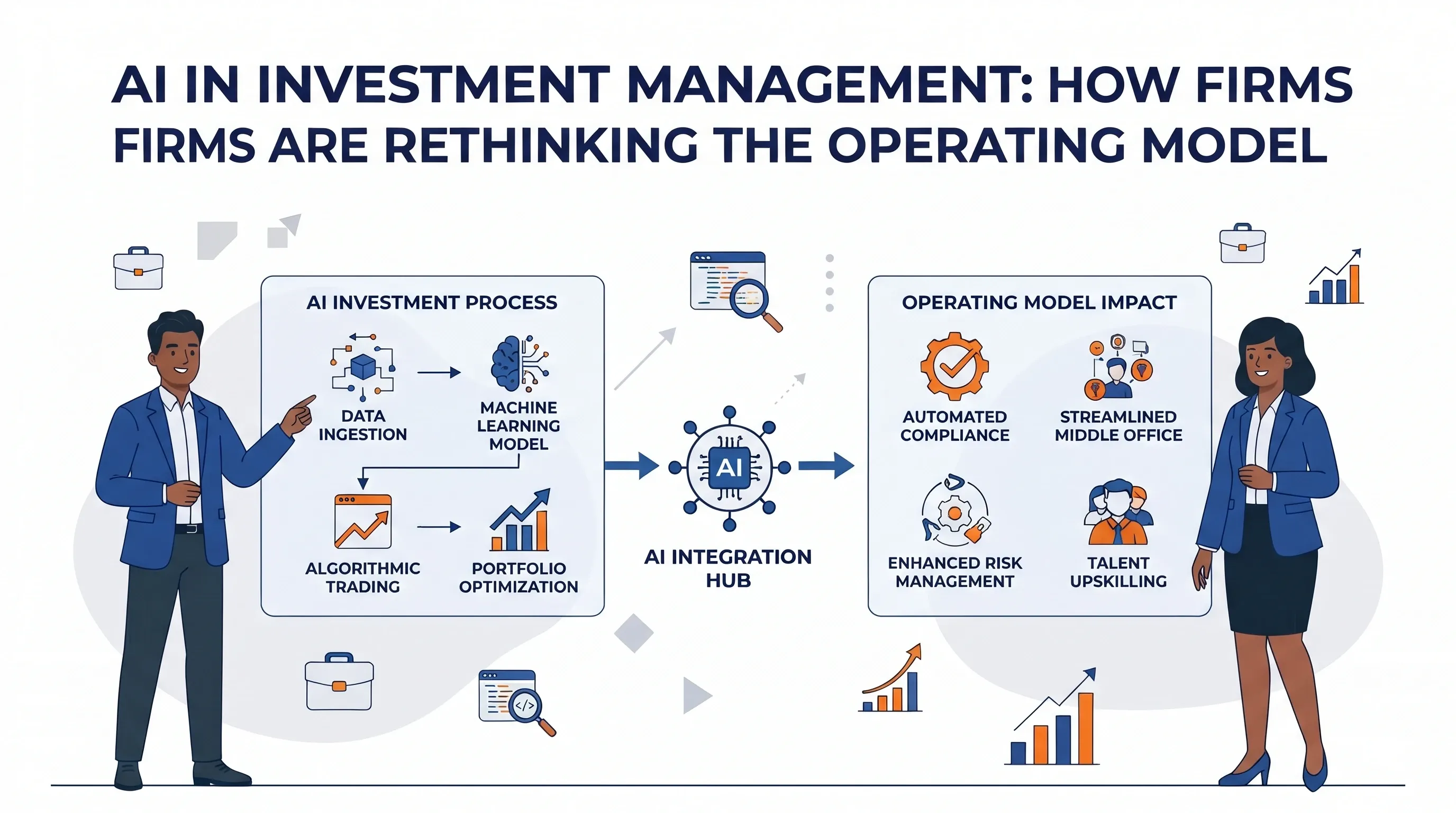
- AI can potentially touch almost every stage of that chain.
It can search and organise information, identify patterns, generate analysis, assist with research and support monitoring and decision-making.
That creates a new organisational question. If one technology can participate across multiple stages of the workflow, should those stages continue to be organised exactly as they were before?
This is where operating-model redesign comes in. The future may not simply involve humans doing the same jobs faster with AI. It could involve humans and AI dividing the work differently altogether.
From individual expertise to connected capabilities
The old model of finance often placed considerable emphasis on individual expertise.
An experienced professional accumulated knowledge, developed judgment and built an information advantage over time.
AI changes the economics of that model.
The broader CFA Institute research on AI and the future of finance notes that AI can scale analytical capacity and potentially shift differentiation away from simply producing information towards areas such as system design, data governance, model oversight and institutional integration.
That doesn't make human expertise irrelevant. It changes where expertise is applied. A professional may increasingly need to understand not only an investment decision, but also the system that helped produce it.
- What data went into the model?
- What assumptions did it make?
- How reliable is the output?
- What could cause it to fail?
- How should the result influence an actual investment decision?
This makes finance increasingly interdisciplinary. The person who understands finance but ignores technology may have a gap. The person who understands technology but doesn't understand investment principles may have an even bigger one. The emerging need is for people who can connect the two.
The talent model is changing too
This is where the operating-model shift becomes particularly relevant for Gen Z.
- When firms redesign workflows, they also have to rethink talent.
- What skills should they hire for?
- What work should junior professionals learn first?
How should people progress through their careers if AI is handling some of the tasks that traditionally helped young professionals build experience? CFA Institute's research points towards growing importance for finance skills such as critical thinking, judgment, communication, interpretation and oversight alongside technical capabilities.
That creates a subtle but important change. A junior professional may spend less time simply collecting information or preparing routine analysis.
But that doesn't mean there is less to learn. It means the learning curve may move towards understanding why the analysis matters, whether it is reliable and what should happen next.
For someone starting a finance career, that distinction is crucial. Don't just learn how to produce the output. Learn how to interrogate it.
AI may also change how teams are structured
AI creates another organisational challenge: centralisation versus integration. Should a firm have one central AI team that builds capabilities for everyone? Or should AI expertise sit inside individual investment teams?
Should technology specialists work separately from portfolio managers? Or should they work together? There is no single operating structure that automatically works for every firm.
The answer depends on factors such as the firm's investment strategy, size, existing technology infrastructure, regulatory environment and appetite for AI adoption.
But the direction of travel is clear. AI is pushing technology and investment expertise closer together. That means the boundaries between traditionally separate functions may become less rigid.
For young professionals, that creates an interesting opportunity. The finance career of the future may not fit neatly into labels such as “investment,” “technology,” “data” or “research.”
Some of the most valuable roles could sit between them.
💡 Learn more about AI's Governance
Read our guide to know more about how financial institutions are enforcing governance over use of AI.
Then comes the accountability problem
Here is the part that technology alone cannot solve. Suppose an AI system generates an investment recommendation.
The analyst relies on it. The portfolio manager approves the trade. The underlying data came from an external provider. The model was developed by another team.
And six months later, the decision causes a significant loss.
Who is responsible?
The broader CFA Institute research identifies accountability as one of the areas under pressure as AI becomes more autonomous and deeply embedded in financial decision-making. Responsibility can become distributed across models, data providers, technology teams, investment professionals and governance structures.
That means AI adoption cannot simply be about making processes faster.
- Firms also need clear governance.
- They need traceability.
- They need model validation.
- They need oversight.
And they need people who understand where human responsibility begins and where automated systems should stop. This is why the future investment professional may need to understand governance almost as much as technology.
There is a bigger market-level question
There is another reason operating-model redesign matters. If many investment firms adopt similar AI systems, use similar data and rely on similar analytical frameworks, their decisions could start becoming more alike.
The CFA Institute's broader research describes this as cognitive convergence. Similar models, training data and decision frameworks can reduce diversity in interpretation and potentially create a form of “monoculture” risk.
At an individual firm level, using AI may look like an efficiency gain. Across the market, however, widespread use of similar systems could create new forms of concentration and synchronisation. That means the operating model of one investment firm can eventually become part of a much larger market-structure question.
What happens when everyone gets smarter in roughly the same way? That is one of the questions the industry will have to keep asking.
What does this mean for the next generation of finance professionals?
The answer isn't that everyone needs to become a programmer. It is also not that traditional finance knowledge is becoming obsolete. Quite the opposite. The fundamentals become the foundation for judging whether AI-generated analysis is useful in the first place.
But students entering finance may need to build a broader combination of skills.
Know finance deeply
Understand markets, accounting, valuation, portfolio construction, risk and ethics. AI can generate analysis, but you need financial understanding to challenge it.
Become AI-literate
Understand what AI can do, where it can fail, how data influences outputs and why different systems can produce different answers.
You don't need to build every model. You do need to understand the environment you're working in.
Practise judgment
Don't stop at “What does the model say?”
Ask:
- Why does it say that?
- What assumptions are behind it?
- What could make it wrong?
Would I make the same decision without the model?
That is the beginning of independent thinking.
Strengthen communication
If AI makes analysis easier to produce, the ability to explain that analysis clearly becomes even more valuable. Investment professionals still need to communicate with clients, colleagues, senior decision-makers and stakeholders.
Understand accountability
Learn to think about governance, risk, validation and responsibility.
The more AI becomes embedded in financial decisions, the more important it becomes to know who is responsible for the outcome.
The operating model is changing. So is the career model
The most important takeaway from the AI shift in investment management may not be that machines are becoming better at finance. It is that firms are beginning to reconsider how finance itself should be organised around increasingly capable machines.
That means new questions about teams.
- New questions about skills.
- New questions about technology.
- New questions about governance.
And eventually, new questions about what a successful finance career looks like.
The broader CFA Institute research captures the shift through a particularly important idea: finance has historically operated in an environment where useful information was scarce. As AI makes analytical capacity increasingly abundant, the scarce resource may move towards judgment about how that intelligence should be deployed, governed and constrained.
For Gen Z entering finance, that is perhaps the most useful way to look at the AI era. Don't think only about the jobs AI might replace. Look at the operating model it is helping to create.
Then ask yourself: Where do I fit into that model?
Because the finance professional of the future may not simply be the person who knows the most. It may be the person who can connect finance, technology, judgment, communication and responsibility when all five need to work together.
FAQ
1. How is AI changing the investment industry?
AI is changing how investment firms conduct research, make decisions, manage risks and organise teams. It is also influencing the skills and roles firms need.
2. Why are investment firms rethinking their operating models?
AI is becoming part of multiple stages of investment workflows, not just routine tasks. Firms are reconsidering how technology, investment teams and other functions work together.
3. Will AI replace traditional finance roles?
AI may take over some routine tasks, but finance knowledge and human judgment remain important. Professionals will need to interpret AI outputs and make informed decisions.
4. What skills will finance professionals need in the AI era?
Finance fundamentals, AI literacy, critical thinking, communication and judgment will be important. Understanding risk, governance and model oversight will also matter.
5. Do finance students need to learn programming to work with AI?
Not necessarily. They need to understand how AI works, where it can fail and how to evaluate its outputs, alongside strong financial knowledge.
6. What is cognitive convergence in investment management?
It refers to the possibility of investment firms making increasingly similar decisions because they use similar AI models, data and analytical frameworks. This could increase market-wide concentration risks.
ℹ️ Confused about a career in finance?
Fill out the form below to get in touch with an expert counselor or browse our courses to get started.