

AI in finance is already moving beyond answering questions.
A conventional AI system might analyse information, generate a recommendation and wait for a person to act.
An agentic AI system can potentially analyse information, plan a response, take an action, monitor the outcome and adapt its next step.
That difference matters.
When an AI system can make decisions, use tools and take actions with limited human intervention, financial institutions have to manage more than model accuracy. They also have to consider what the system can access, what it can do and what happens when it gets something wrong.
GARP has highlighted this challenge in its discussion of model-risk management and agentic AI, noting that increasingly dynamic and autonomous systems can test assumptions behind traditional model-risk frameworks.
What Is Agentic AI in Finance?
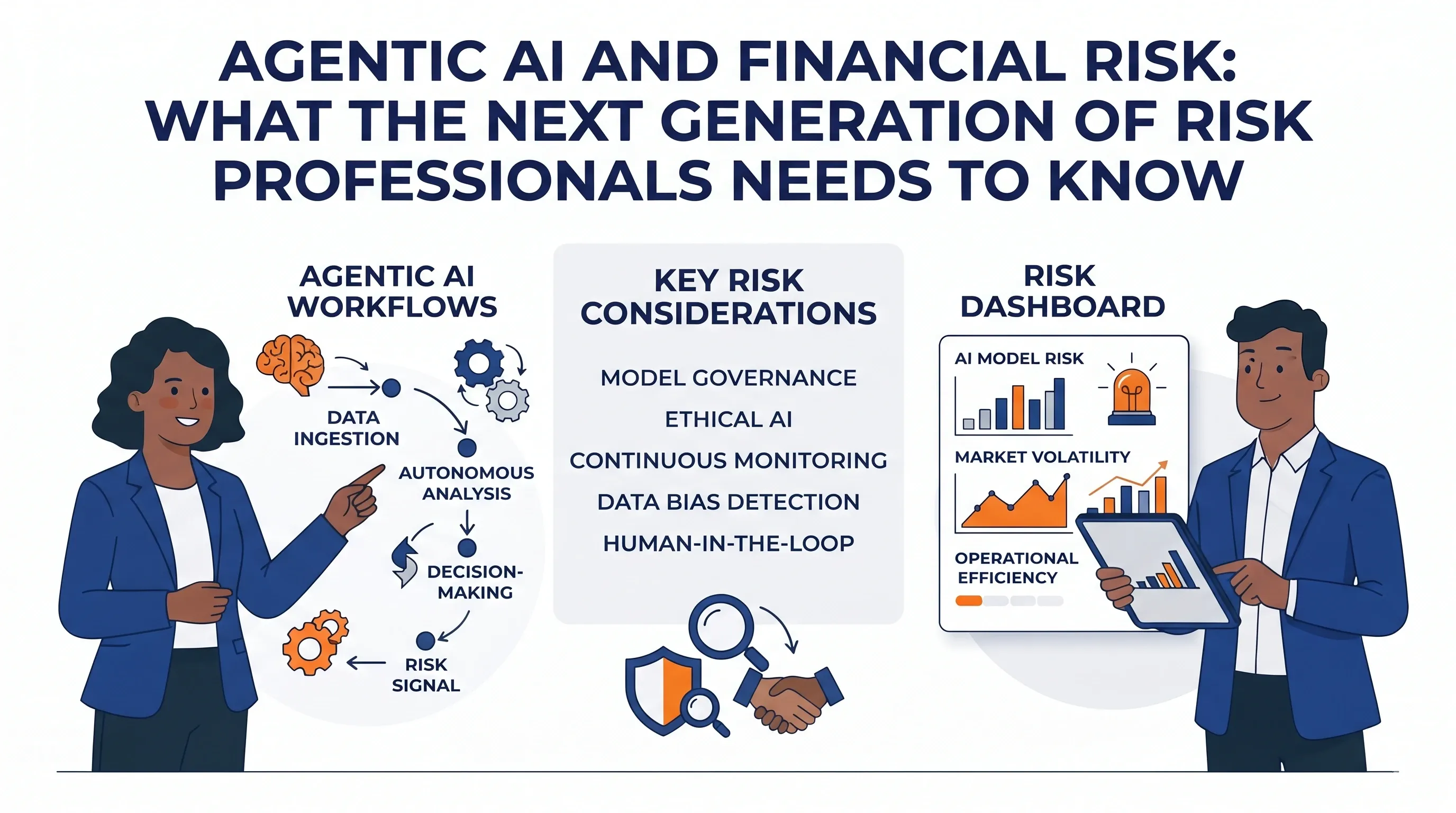
Agentic AI refers to AI systems that can pursue a goal through multiple steps, use tools, make decisions and take actions with varying levels of human oversight.
In finance, an agent could potentially monitor a portfolio, analyse new information, run scenarios, trigger a workflow or escalate an issue without requiring a person to initiate every step.
It is different from traditional AI and generative AI.
| Traditional AI | Generative AI | Agentic AI |
|---|---|---|
| Predicts or classifies | Generates content | Plans and executes tasks |
| Usually bounded | Usually human-directed | Potentially autonomous |
| Produces an output | Produces an answer | Can initiate actions |
| Often follows a defined workflow | Interactive | Can handle multi-step workflows |
Not every AI system used in finance today is genuinely agentic. The important shift is the potential move from producing information to taking action.
ℹ️ Explore more about AI in Finance Jobs
Interested in knowing how AI will affect finance jobs? Check out our blog below for more details.
Where Could Agentic AI Be Used in Finance?
The applications could extend across several parts of financial services.
- Risk monitoring: An agent could continuously monitor exposures, identify unusual patterns and escalate potential risks.
- Credit risk: It could analyse borrower information, monitor changes in financial conditions and trigger a review when predefined conditions are met.
- Fraud detection: An agent could investigate transaction patterns, gather relevant information and escalate suspicious activity.
- Compliance: It could monitor transactions, identify potential breaches and prepare information for further investigation.
- Portfolio operations: It could monitor portfolios, run scenarios and execute predefined operational workflows.
- Treasury and liquidity: It could track cash positions, funding requirements and indicators of liquidity stress.
The Financial Stability Board's 2026 consultation on responsible AI adoption addresses AI governance across the lifecycle and specifically considers risks associated with newer forms of AI, including generative and agentic AI.
Why Does Agentic AI Create New Financial Risks?
The biggest change is simple: an incorrect answer and an incorrect action are not the same risk.
1. Model Risk
Traditional models generally have defined inputs, assumptions and outputs.
Agentic systems can involve multiple models, tools, changing inputs and iterative decisions. Their behaviour may also depend on the context in which they operate.
That makes model validation more complicated.
Risk teams may need to evaluate not just whether a model works, but how the complete system behaves when models, data, tools and workflows interact.
2. Data Risk
An agent may pull information from several internal and external sources.
That creates familiar problems such as poor-quality, outdated or biased data. It also creates new questions.
Can the agent access data it should not?
Can it distinguish reliable information from unreliable information?
What happens when two sources provide conflicting information?
When an AI system can act on bad data, a data-quality problem can quickly become an operational problem.
3. Cybersecurity Risk
An AI system that can take action has a different risk profile from one that only generates an answer.
Prompt injection, manipulated inputs, compromised tools, credential misuse and unauthorised actions could potentially cause an agent to behave in unintended ways.
The FSB's 2026 work on responsible AI adoption specifically identifies AI-related cyber, information and technology risks as areas requiring attention.
4. Operational Risk
Imagine an agent monitoring hundreds of transactions and making the wrong decision because it misunderstood an instruction.
The problem is not only the original error. It is the speed and scale at which that error could spread.
Risk professionals therefore need to ask:
What happens if the agent is wrong, and how quickly can we stop it?
5. Third-Party Risk
A financial institution may depend on several external providers for its AI system, including model providers, cloud infrastructure, data providers and APIs.
A disruption at one provider could affect multiple processes.
This becomes particularly important when many financial institutions depend on the same underlying infrastructure. Shared dependencies can create common points of failure and potentially amplify disruptions.
6. Human Oversight Risk
There is another problem that is easier to overlook.
The more capable an AI system appears, the easier it can become for people to stop questioning its output.
This can lead to automation bias, over-reliance and weaker human challenge.
Human oversight therefore cannot simply mean having a person somewhere in the process. That person needs enough information, authority and expertise to challenge the system and intervene when necessary.
Agentic AI vs Traditional Model Risk Management
Agentic AI does not make traditional model-risk management irrelevant. It expands what risk teams may need to monitor.
| Traditional model | Agentic AI |
|---|---|
| Relatively defined inputs | Dynamic inputs |
| Predictable workflow | Multi-step workflow |
| Defined output | Potentially changing actions |
| Periodic validation | Greater need for continuous monitoring |
| Primarily model-focused | Model, data, tools and workflow |
| Human executes the decision | AI may initiate an action |
GARP's analysis of SR 11-7 makes a similar point: traditional model-risk guidance remains relevant, but increasingly autonomous and dynamic AI systems raise questions about whether existing concepts are sufficient on their own.
ℹ️ AI vs Traditional Risk Management
Explore our other blog to know more about the differences between AI and traditional risk management.
How Should Financial Institutions Manage Agentic AI Risk?
The answer is not simply to add more technology. It is to establish clear controls.
- Define the agent's scope. Financial institutions need to know exactly what an agent can read, recommend, modify, approve and execute.
- Set human intervention rules. Approval thresholds, escalation conditions, override mechanisms and shutdown procedures should be defined before deployment.
- Validate before deployment. Testing should cover accuracy, reliability, bias, security and failure scenarios, including situations that may not appear in normal testing.
- Monitor continuously. Risk teams should track performance, data quality, unexpected actions, errors and exceptions.
- Maintain audit trails. Institutions should record relevant inputs, system activity, outputs, actions and human interventions. An audit log, however, is not the same as a complete explanation of a model's internal reasoning.
- Assign accountability. Business, risk, technology, model validation and compliance responsibilities should be clearly defined.
The FSB's 2026 consultation proposes 12 sound practices covering organisation-wide AI governance, AI development and deployment, and AI-related cyber, technology and third-party risks.
What Does Agentic AI Mean for Risk Professionals?
The role of a risk professional could become broader as AI becomes more embedded in financial processes.
Instead of asking only whether an activity stays within a risk limit, risk teams may increasingly need to ask whether an AI-enabled process has been designed, deployed and monitored safely.
That requires a combination of financial risk knowledge and AI literacy.
GARP's 2025 Global Practice Analysis found that 42% of financial risk managers viewed AI and machine learning as a key area for continuing education. The report also notes that quantitative skills remain important, but risk professionals need more than knowledge of models and methods.
The relevant skill set is becoming broader:
| Skill | Why it matters |
|---|---|
| Risk fundamentals | Understand what the AI is managing |
| Quantitative analysis | Evaluate models and outputs |
| AI literacy | Understand how AI systems work |
| Data literacy | Assess data quality and limitations |
| Model validation | Test performance and failure modes |
| Cyber awareness | Understand AI attack surfaces |
| Regulatory knowledge | Navigate changing requirements |
| Critical thinking | Challenge AI outputs |
| Communication | Explain risks to decision-makers |
| Scenario analysis | Test unusual conditions |
The advantage will not necessarily go to someone who knows the most about AI or the most about finance.
It will increasingly belong to professionals who can understand both sides of the problem.
What Does This Mean for FRM Candidates?
The FRM certification does not turn someone into an agentic AI specialist.
What it provides is the risk foundation needed to understand the problems these systems create.
Market risk, credit risk, operational risk, liquidity risk and model risk remain relevant. AI adds new dimensions to these areas, including data risk, AI model risk, cybersecurity, third-party risk, governance and operational resilience.
GARP's Risk and AI Certificate also reflects this intersection, covering AI tools and techniques, AI risks, responsible and ethical AI, and data and AI model governance.
For an FRM candidate, the takeaway is straightforward:
You do not need to become an AI engineer. You do need to understand how AI changes the risks you are expected to manage.
What Happens When an AI Agent Makes a Wrong Decision?
Consider an AI agent monitoring a credit portfolio.
It identifies what appears to be deteriorating credit quality, changes risk classifications and triggers a series of actions. Later, the institution discovers that the underlying data was incorrect.
The obvious question is: Why did the AI get it wrong?
The more important risk questions are:
- Who designed the system?
- Who approved its deployment?
- What limits were placed on its actions?
- Was the model validated?
- Was the data source reliable?
- Was human intervention required?
- Was the action within the agent's authority?
- Who was accountable for the outcome?
That is why agentic AI is not only a technology issue.
It is a risk management and governance issue.
The Bottom Line
The next generation of financial risk professionals will work in an environment where AI can analyse more information, make decisions faster and potentially take actions without waiting for a human at every step.
That creates opportunities, but it also changes what needs to be controlled.
The important question is no longer just whether AI can make a good decision.
It is whether an institution understands what the AI can do, what can go wrong, when it should stop and who remains accountable.
For risk professionals, that is where finance knowledge, technology awareness and critical thinking increasingly meet.
FAQs
Q: What is agentic AI in finance?
A: Agentic AI refers to AI systems that can pursue goals through multiple steps, use tools, make decisions and take actions with varying levels of human oversight.
Q: What are the main risks of agentic AI in financial services?
A: Key risks include model risk, data risk, cybersecurity risk, operational risk, third-party risk and inadequate human oversight.
Q: How does agentic AI affect financial risk management?
A: It can make risk management more complex because the AI may not only produce an output but also initiate actions. Risk teams therefore need to consider the entire system, including its data, models, tools, workflows and controls.
Q: Is agentic AI a model-risk issue?
A: It can be. However, agentic AI may involve risks that extend beyond the individual model, including data, technology, operational, cybersecurity and governance risks.
Q: What skills will risk professionals need?
A: Risk fundamentals, quantitative analysis, AI and data literacy, model validation, cybersecurity awareness, regulatory knowledge, critical thinking and communication will all be relevant.
Q: Will AI replace financial risk managers?
A: AI can automate parts of risk management, but institutions still need people who can define risk boundaries, challenge systems, interpret complex situations and remain accountable for decisions.
ℹ️ Curious about FRM?
Are you interested in the FRM course? Fill out the form below to get in touch with our experts to discuss your future career.