

AI is no longer just a productivity tool in finance. CFA Institute’s 2026 research describes it as a force reshaping investment decisions, risk management and professional accountability as firms embed AI into research, trading and portfolio construction.
That creates a difficult question: when AI influences an investment decision, who is accountable for the outcome?
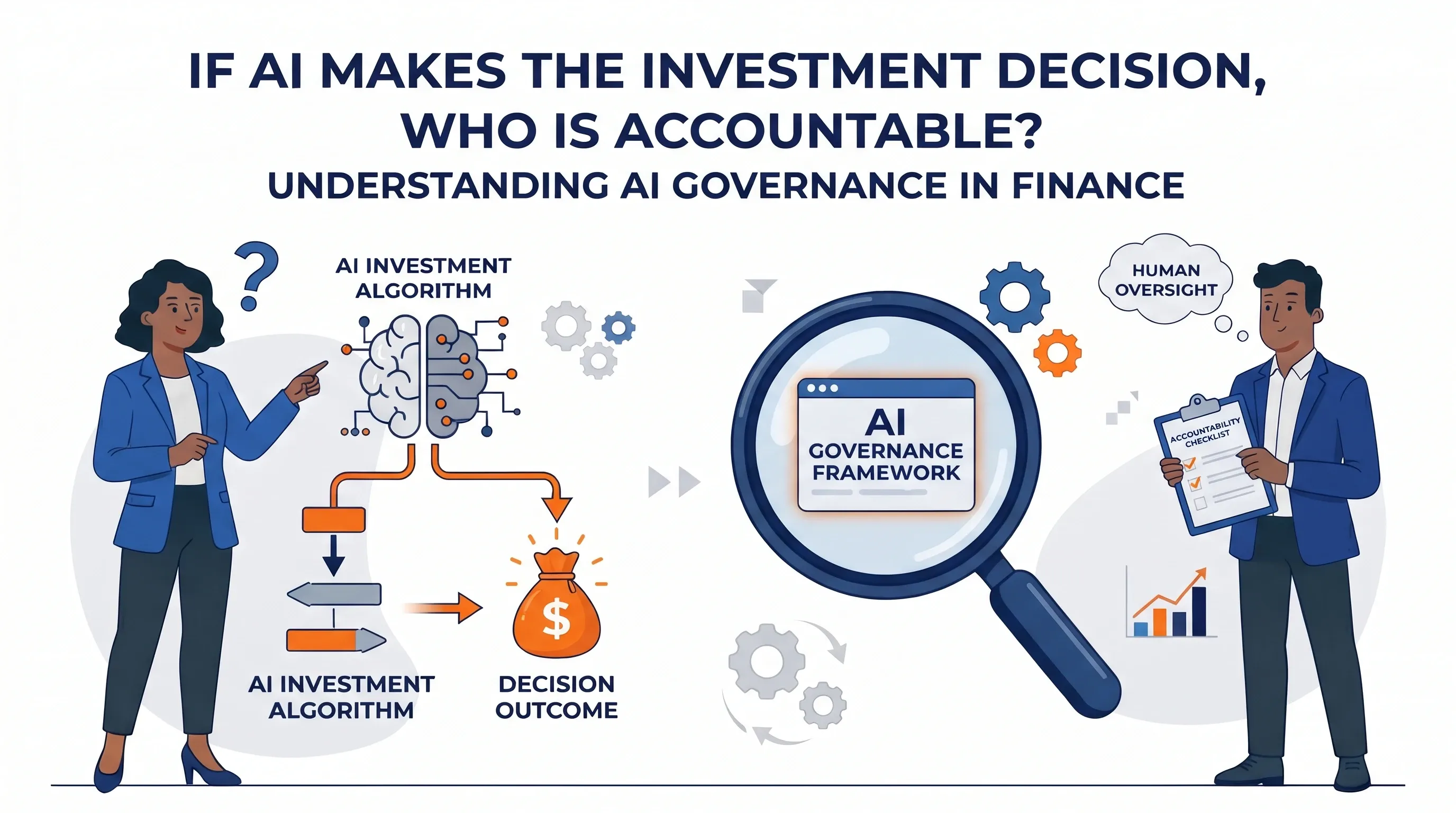
Consider a portfolio manager who uses an AI system to analyse market data, generate a recommendation and support an allocation decision. If the investment loses money, responsibility cannot simply be assigned to “the AI.” The portfolio manager, firm, model developer, data provider and other parties may be equally responsible.
More importantly, accountability and liability are not the same thing. Accountability concerns who oversees the system, follows the controls and makes or approves the decision. Liability concerns who may be legally responsible for harm or a regulatory breach, which depends on the applicable law, contracts and facts.
As AI becomes more deeply embedded in financial decision-making, understanding that distinction is becoming a core part of AI governance.
What Is AI Governance in Finance?
AI governance in finance is the framework of policies, controls, oversight and accountability used to ensure that AI systems are developed and used safely, transparently and within applicable requirements.
It covers the AI lifecycle, from development and testing to deployment, monitoring and retirement.
In practice, governance answers questions such as:
- Who can deploy an AI system?
- What data can it use?
- How is the model tested?
- Who validates it?
- Who monitors its performance?
- When must a human review or override its output?
- What happens when it produces an incorrect or unexpected result?
- Who is accountable for the system and the decisions it supports?
The Financial Stability Board's 2026 consultation on responsible AI adoption proposes 12 practices covering organisation-wide governance and different stages of the AI lifecycle.
The goal is not to stop financial firms from using AI. It is to make sure that greater automation does not mean weaker controls.
ℹ️ Interested to know more about its risk?
Get more detailed insights on AI and financial risk by reading our blog below.
Why Does AI Accountability Matter in Investment Decisions?
AI introduces several risks when its output starts influencing where money is invested.
Model risk
A model can produce an incorrect output because of its assumptions, training data, design or changing market conditions. Generative AI can also produce information that sounds convincing but is inaccurate.
A model that performs well during testing may behave differently after deployment. That makes validation and continuous monitoring important.
Data risk
Investment decisions depend on data. If that data is incomplete, outdated, biased or poorly sourced, the recommendation can also be affected.
Firms therefore need to understand where data comes from, whether it can legally be used and how its quality is maintained.
Third-party and concentration risk
Financial firms may rely on external foundation models, cloud providers, data vendors or AI infrastructure.
What happens if many institutions depend on the same provider or model?
A problem at one important provider could potentially affect multiple firms at the same time. This is one reason the FSB's AI work looks beyond individual models to the wider AI supply chain.
Cybersecurity and manipulation
AI systems can also face manipulated data, adversarial inputs, prompt injection and other attacks. The concern is not only that an AI system might make a mistake, but that someone could deliberately influence its output.
Who Is Actually Accountable When AI Influences an Investment Decision?
Accountability can exist at several levels because different people control different parts of the AI process.
| Participant | Potential area of accountability |
|---|---|
| Portfolio manager / investment professional | Investment judgment, oversight and decision-making |
| Investment firm | Governance, controls, compliance and risk management |
| Model developer | Model design and technical controls |
| Model validator | Independent testing and validation |
| Data provider | Data quality and provenance |
| Technology provider | Infrastructure and service reliability |
| Risk and compliance teams | Monitoring, controls and escalation |
| Senior management / board | Organisation-wide AI governance |
A portfolio manager may be accountable for reviewing and challenging an AI recommendation. The firm may have regulatory responsibilities for how the system is deployed and controlled. A developer or third-party provider may have separate responsibilities depending on its role, contract and applicable law.
Whether any party is legally liable for an investment loss is a separate question. A loss by itself does not establish liability.
That distinction matters because “the AI made the decision” is not an answer to either question.
ℹ️ Managing risk in algorithmic portfolios
Discover how risk oversight and human judgment intersect with advanced machine learning in modern portfolio management.
Human-in-the-Loop vs Human-on-the-Loop
These terms become important as financial firms give AI more autonomy.
Human-in-the-loop means a human must review or approve the AI's output before action is taken.
For example: AI analysis → investment recommendation → portfolio manager review → trade
Human-on-the-loop means the AI operates with greater autonomy while humans monitor the system and intervene when required.
For example: AI → portfolio decisions → continuous monitoring → human intervention when thresholds are breached
The more autonomy a system has, the more important monitoring, escalation procedures, audit trails and override mechanisms become. This matters even more with agentic AI, where systems can perform multiple steps with less direct human intervention.
Can AI Create Conflicts of Interest?
AI optimises according to an objective. But who defines that objective?
Suppose a system is designed to maximise a firm's revenue. Could the way it makes recommendations conflict with an investor's interests?
This concern has already appeared in financial regulation. In 2023, the US Securities and Exchange Commission proposed rules addressing potential conflicts of interest involving predictive data analytics used by broker-dealers and investment advisers. The SEC withdrew those proposed rules in June 2025, so they should not be treated as current requirements.
The proposal nevertheless illustrates a broader regulatory concern: technology can create conflicts if the objectives built into a system do not properly account for the interests of the investor.
At this point, it’s crucial to think what is AI optimising for, and who is responsible for setting and overseeing that objective?
What Does AI Governance Look Like in India?
India provides a clear example of how regulators can assign responsibility when regulated entities use AI.
SEBI's 2025 guidelines for investment advisers state that an investment adviser using AI tools remains responsible for the security, confidentiality and integrity of client data, the information used to arrive at investment advice, advice based on AI output and compliance with applicable law. The guidelines also require disclosure of the extent of AI use in providing investment advice.
SEBI's 2025 Intermediaries Amendment Regulations similarly make regulated entities responsible for safeguarding investor and stakeholder data, ensuring the accuracy of AI/ML outputs and complying with applicable laws when they use such tools, whether developed internally or obtained from third parties.
The principle is straightforward: Using AI does not, by itself, transfer regulatory responsibility to the AI system or its technology provider.
That does not mean every loss automatically makes an adviser or firm legally liable. It means the use of AI does not remove the regulated entity's existing responsibilities.
How Should Financial Firms Govern AI?
A practical governance framework can be built around seven questions:
- Who owns it? Every AI system should have identifiable business and technical owners.
- Has it been validated? Firms should test its performance, assumptions, limitations and failure scenarios.
- Where does the data come from? Data sources, quality, permissions, updates and security need to be understood.
- When does a human step in? Firms should define when human review, approval or intervention is required.
- Is it still performing as expected? AI systems need continuous monitoring for errors, drift, bias and unexpected behaviour.
- Can the decision be reconstructed? Relevant model versions, inputs, outputs, human decisions and overrides should be recorded.
- What happens when something goes wrong? There should be clear escalation procedures and, where appropriate, a way to stop or restrict the system.
These are not just technical controls. They help determine who owns the consequences of using the technology.
Can AI Replace Investment Professionals?
AI can support information retrieval, data processing, pattern recognition, research summaries, scenario analysis and monitoring.
But investment decisions involve more than producing an output.
Someone still has to understand the client's objectives, question the assumptions, interpret the result, consider the wider context and decide whether the recommendation makes sense.
That changes what can make a finance professional valuable. The skill is not simply knowing how to produce analysis. It is knowing which analysis matters, whether the output is reliable and what should happen next.
ℹ️ Navigating risk in the age of AI
Learn how traditional risk models hold up against machine learning disruptions and what every risk professional must know.
What Does AI Governance Mean for Finance Careers?
For students entering finance, AI governance is not just a technology topic. It connects directly to investment, risk and financial decision-making.
Relevant skills include AI and data literacy, financial modelling, quantitative analysis, model risk, risk management, critical thinking, regulatory awareness, professional judgment and communication.
This is also where qualifications such as the CFA and FRM programs can provide a useful foundation.
They do not turn someone into an AI specialist. Their value is that they build the financial and risk knowledge needed to question, interpret and challenge AI outputs.
The CFA Program covers areas such as financial reporting, economics, quantitative methods, equity, fixed income, portfolio management and investment analysis. That foundation can help an investment professional assess whether an AI-generated recommendation makes financial sense, understand its assumptions and consider how it could affect a portfolio.
Subsequently, the FRM certification focuses more directly on risk, including quantitative analysis, market risk, credit risk, operational risk and risk management. These concepts become particularly relevant when AI itself introduces model, data or operational risk.
The connection is therefore not:
CFA/FRM → AI expertise
It is:
CFA → investment knowledge → AI-supported investment decisions → better judgment
and
FRM → risk knowledge → AI-related model and operational risk → better risk management
For finance professionals, the goal is not to choose between finance and technology. It is to understand both well enough to know when to use AI, when to question it and when not to trust its output.
The Final Takeaway
The real question is not whether AI can influence an investment decision because it is already doing the same.
The answer cannot simply be “the algorithm.”
As AI becomes part of investment management, firms need clear ownership, strong controls and people who can understand both the technology and the financial decision it supports.
For the next generation of finance professionals, that means learning more than how to use AI. It means building enough finance and risk knowledge to know when to trust it, when to challenge it and who remains responsible for the decision.
FAQs
Q: What is AI governance in finance?
A: AI governance is the framework of policies, controls and oversight used to manage how AI systems are developed, deployed, monitored and used within financial institutions.
Q: Who is accountable when AI influences an investment decision?
A: Accountability can sit across different roles. Investment professionals may be accountable for decisions and oversight, while firms, model teams, risk teams and senior management can have responsibility for governance and controls.
Q: What is the difference between accountability and liability?
A: Accountability concerns who is responsible for overseeing a process, making a decision or explaining what happened. Liability concerns who may be legally responsible for harm, loss or a regulatory breach. Liability depends on the applicable law, regulations, contracts and facts.
Q: Can AI be legally liable for an investment loss?
A: AI itself does not automatically become the legal party responsible for an investment loss. Whether a person or organisation may be liable depends on the relevant legal and regulatory framework and the facts of the case.
Q: What are the main risks of AI in investment management?
A: Key risks include model risk, poor-quality or biased data, cybersecurity threats, third-party dependencies, concentration around shared models and conflicts between the objectives of an AI system and investor interests.
Q: What is human-in-the-loop AI in finance?
A: It means a human reviews or approves an AI output before a financial action is taken. In a human-on-the-loop system, AI operates with greater autonomy while humans monitor it and intervene when necessary.
Q: How is SEBI approaching AI in investment advice?
A: SEBI's 2025 guidelines place responsibility on investment advisers using AI for client data, information used in advice, advice based on AI output and compliance with applicable law. They also require disclosure of the extent of AI use in investment advice.
Q: How do CFA and FRM help finance professionals working with AI?
A: CFA builds knowledge across investment analysis, financial reporting, markets, portfolio management and related areas. FRM focuses on risk, including market, credit, quantitative and operational risk. Neither is an AI qualification, but both can provide the financial foundation needed to evaluate and challenge AI-generated outputs.
💡 Confused about career scope?
Fill out the form below to talk one on one with our career counselor to help plan your career path.