

With the CFA Level 1 November 2026 exam approaching, your biggest challenge is no longer just how much you can study. It is deciding what deserves your time, what needs another round of practice, and what you should stop trying to cover.
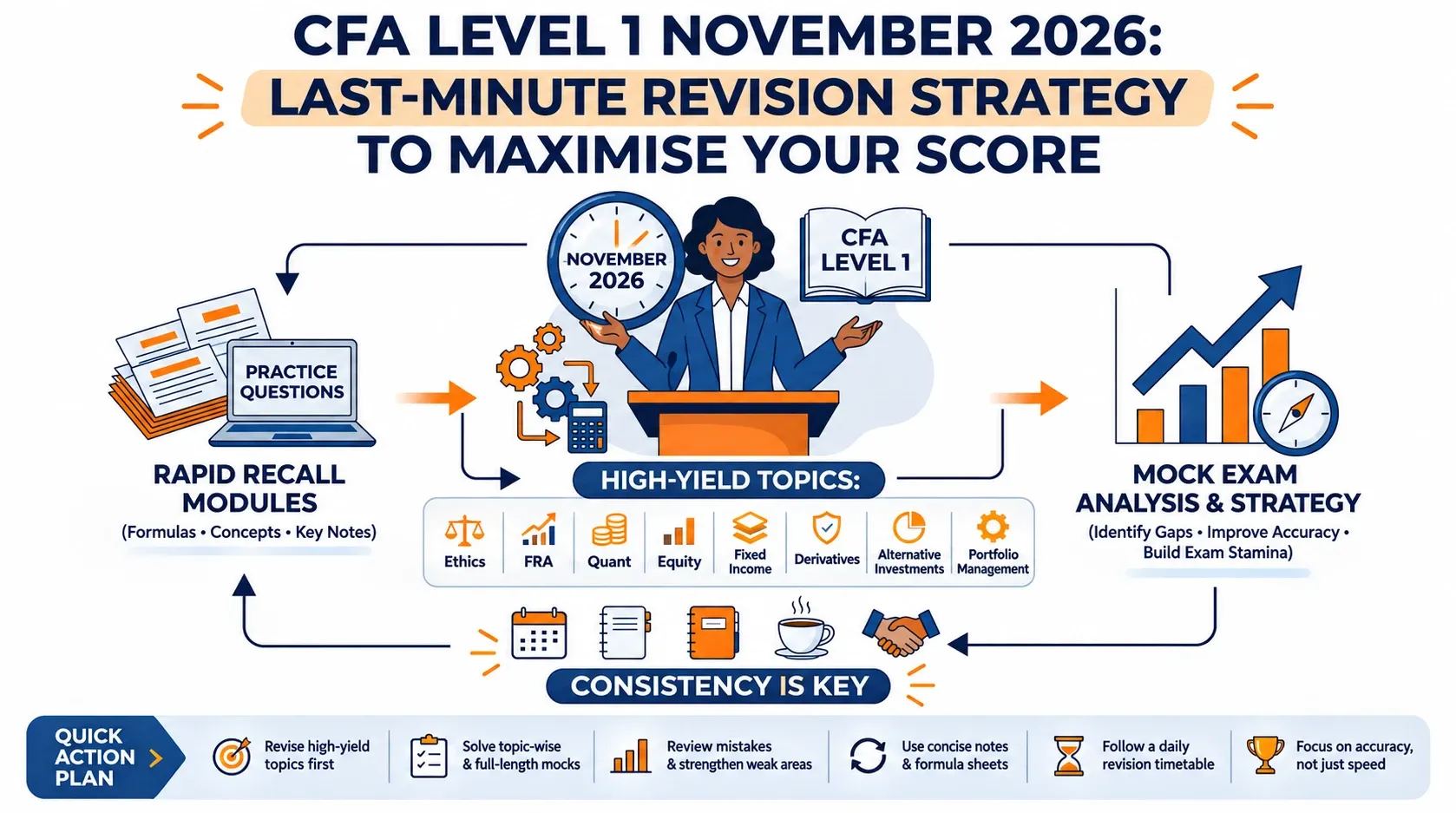
In the final days, focus on five priorities:
- Revise high-weight topics, especially where your performance is weak.
- Use mock exams to identify gaps and practise time management.
- Strengthen Ethics, formulas and commonly confused concepts.
- Stop switching resources or rereading the entire curriculum passively.
- Protect your sleep and prepare for exam-day logistics.
Here is a practical revision strategy, including how to adapt it to the time you have left.
CFA Level 1 November 2026: What Should You Revise First?
Not every topic deserves equal revision time. Your priorities should depend on two things: how much a topic contributes to the exam and how confidently you can solve its questions.
According to CFA Institute, the 2026 Level I topic weights are as follows.
| Topic | Exam Weight |
|---|---|
| Ethics & Professional Standards | 15–20% |
| Financial Statement Analysis | 11–14% |
| Equity Investments | 11–14% |
| Fixed Income | 11–14% |
| Portfolio Management | 8–12% |
| Alternative Investments | 7–10% |
| Quantitative Methods | 6–9% |
| Economics | 6–9% |
| Corporate Issuers | 6–9% |
| Derivatives | 5–8% |
How to use subject-wise weightage to prioritise your preparation
- Priority 1: High-weight topics where you are weak: These offer a strong reason to direct your revision time here.
- Priority 2: High-weight topics where you are reasonably confident: Practise questions to retain accuracy and identify smaller gaps.
- Priority 3: Lower-weight topics with major gaps: Cover essential concepts and frequently tested applications instead of attempting an exhaustive restart.
- Priority 4: Topics you consistently score well in: Give these a quick revision rather than spending hours repeating familiar material.
The goal is not to predict exactly which questions will appear. It is to allocate your remaining time where revision can make the biggest difference.
How to Plan Revision Based on the Time You Have Left
While many students follow a structured routine, it is good to change your structured plan depending on how close you are to exam day.
If you have 10–14 days
- Attempt a full mock and analyse every mistake.
- Revise weak, high-weight topics.
- Schedule dedicated Ethics revision.
- Review key formulas and calculation-heavy concepts.
- Practise targeted questions.
- Attempt one or two additional mocks, allowing enough time to analyse them.
If you have 5–7 days
- Avoid restarting the curriculum from scratch.
- Focus on weak areas and high-weight topics.
- Revise Ethics, formulas and important concepts.
- Practise exam-style questions daily.
- Review your mistake sheet and revisit recurring mistakes.
If you have 1–3 days
- Revise key formulas and concepts.
- Review Ethics and your error log.
- Practise a limited set of questions to maintain familiarity.
- Resolve essential doubts and check exam logistics.
- Avoid taking on major new topics unless a specific gap is both important and manageable.
One rule applies to every timeline: don't confuse more study hours with better preparation. The value of your revision depends on what you correct and retain.
If Your CFA Level 1 Syllabus Is Still Incomplete, What Should You Do?
If you still have lectures pending in November, don't panic or try to rush through the syllabus just to finish it. At this stage, your priority should be to understand the concepts rather than juggle lectures, practice questions and revision simultaneously.
Here's how you should approach it:
- Prioritise pending lectures: Complete your lectures carefully. Focus on understanding the concepts, following the explanations and building a clear understanding of each topic.
- Don't force question practice just yet: If a significant part of your syllabus is still incomplete, avoid splitting your time between lectures and extensive practice. Finish learning the concepts first.
- Use the final two weeks for practice and revision: Once your lectures are complete, use this window to solve questions, revisit important concepts, work on weak areas and attempt mocks.
- Stay focused on understanding, not just completion: Rushing through lectures to mark topics as complete won't help if you haven't understood what was taught.
The idea is simple: finish your learning phase with focus and squeeze in focused practice and revision during the final two weeks. Don't let pending lectures make you panic and abandon a structured approach to preparation.
ℹ️ Still unsure about studying methods?
Explore our guide on passive studying and active recall and what works for financial exams like CFA and FRM.
CFA Level 1 Ethics: How to Revise in the Final Days
Ethics carries 15–20% of the 2026 Level I exam weight. It deserves dedicated attention, even if you are more comfortable with calculation-heavy subjects.
What should you revise?
Focus on:
- CFA Institute's Code of Ethics and Standards of Professional Conduct.
- Confusing or closely related Standards.
- Conflicts of interest and disclosure requirements.
- Material non-public information.
- Duties to clients and employers.
- Misconduct and professional conduct.
- Research, investment recommendations and scenario-based applications.
How should you practise Ethics?
Follow this sequence:
Read the principle → understand its application → solve a scenario → analyse why the other options are incorrect.
Ethics questions often test your ability to apply a Standard to specific facts. Memorising the wording without understanding the situation can leave you vulnerable to similar-looking answer choices.
Watch out for three common mistakes:
- Selecting what seems morally reasonable instead of what the relevant Standard requires.
- Missing a crucial detail in the question.
- Confusing similar Standards or overlooking disclosure obligations.
How should you revise CFA Level 1 Ethics in the last week?
Review the Code and Standards, practise scenario-based questions, and revisit mistakes from earlier tests. For every incorrect answer, identify the specific principle you misunderstood and why the correct option applies to the scenario.
✅ Need a separate refresher on Ethics?
For those not enrolled in our classes, they can take our lectures on Ethics separately from our CFA Level 1 program.
Important note: These are comprehensive lectures on Ethics with around 10+ hours and are not revision or recap lectures.
CFA Level 1 Derivatives: What to Revise Before the Exam
Derivatives can become confusing when you memorise formulas without understanding the positions and relationships behind them.
Prioritise these concepts from your CFA 2026 curriculum:
- Forward contracts and futures.
- Options and their payoffs.
- Pricing and valuation concepts.
- Put-call parity.
- Hedging applications.
- Relevant formulas and their interpretation.
How to revise Derivatives effectively
For every important formula, work through four steps:
Concept → Formula → Interpretation → Question application
For example, when revising an option payoff, understand the position first, calculate the payoff at different underlying prices, and distinguish the payoff from the overall profit after accounting for the premium.
Common mistakes include mixing up long and short positions, making sign errors, confusing payoff with profit, and using the wrong underlying asset perspective.
Solve questions immediately after reviewing a concept. This helps reveal whether you understand the formula or merely recognise it on the page.
CFA Level 1 Formula Sheet: What Deserves Your Attention?
A formula sheet is useful only if you can recognise when and how to apply each formula. Organise your revision around these formula groups:
| Topic | What to Review |
|---|---|
| Quantitative Methods | Rates of return, time value of money, probability and statistical measures |
| Financial Statement Analysis | Financial ratios, profitability, liquidity, leverage and cash flow analysis |
| Fixed Income | Bond valuation, yield measures, duration and interest rate risk |
| Equity Investments | Equity valuation models and relevant valuation ratios |
| Derivatives | Forward and futures valuation, option payoffs and put-call parity |
| Portfolio Management | Risk and return measures, portfolio concepts and CAPM |
| Economics | Relevant calculations involving elasticity, growth and economic relationships |
Use the official curriculum and your own revision notes to identify the formulas applicable to your syllabus.
For each formula, check three things:
- Can you recall it without looking?
- Do you understand what each variable represents?
- Can you apply it correctly in an exam-style question?
Avoid spending the final days creating elaborate new notes. Consolidate the material you already have and maintain a short list of formulas or applications you repeatedly get wrong.
CFA Level 1 Mock Exams: Is 60–70% Enough?
There is no mock exam score that guarantees a CFA Level I pass.
A score of 60–70% can help you assess your preparation, but it should not be treated as a definitive pass prediction. Mock difficulty varies, and an overall score can hide significant weaknesses in individual topics.
Instead of focusing only on your percentage, examine:
- Consistency: Are your scores stable across mocks, or do they fluctuate significantly?
- Topic-wise performance: Are you repeatedly losing marks in the same areas?
- Error patterns: Are mistakes caused by conceptual gaps, calculation errors, misreading questions or time pressure?
- Retention: Can you solve similar questions correctly after revising the underlying concept?
What should you do after every mock?
Use this cycle:
Score → Analyse → Categorise mistakes → Revise → Practise → Retest
Classify each incorrect answer as a knowledge gap, a calculation error, a misinterpretation or a time-management issue. Then revise the specific weakness and solve similar questions again.
Taking another mock without analysing the previous one may give you another score, but it does not necessarily improve your preparation.
Should you take a mock the day before the exam?
Not necessarily. If a full mock is likely to cause unnecessary stress or interfere with sleep, targeted revision is a better use of that day. Review your error log, key formulas and Ethics, and practise a small set of questions if needed.
💡 Try our Mock Exams
Take our CFA Mocks to get a feel for the exam questions and identify your weak areas to help study accordingly through our mock analyzer.
What NOT to Do During Last-Minute Revision
Avoid these common traps:
- Restarting the entire curriculum: You may leave important revision unfinished.
- Making new notes for hours: Consolidate existing notes instead.
- Avoiding weak topics: Uncomfortable areas need targeted attention, not indefinite postponement.
- Taking mocks without reviewing mistakes: Identify the reason behind every recurring error.
- Memorising formulas without application: Practise using them in questions.
- Spending the entire week on one subject: Maintain a balanced revision plan.
- Neglecting Ethics: Its exam weight makes it too important to leave until the last moment.
- Sacrificing sleep: Exhaustion can undermine concentration and decision-making.
CFA Level 1 Final 7-Day Revision Plan
Use this as a sample schedule, not a fixed prescription. Adjust it according to your weak areas, remaining syllabus and mock performance.
| Day | Revision Focus |
|---|---|
| Day 1 | Ethics, formulas, error log and light revision |
| Day 2 | Derivatives, Alternative Investments and formula revision |
| Day 3 | Quantitative Methods, Economics and Corporate Issuers |
| Day 4 | Ethics and Portfolio Management |
| Day 5 | Equity Investments and Fixed Income |
| Day 6 | Financial Statement Analysis and identified weak areas |
| Day 7 | Full mock and detailed analysis, if appropriate for the candidate's exam timing and preparation level |
If your weakest topic is Derivatives or Fixed Income, move time towards it. If you have already mastered a subject, a shorter review may be enough.
The schedule should guide your revision, not force you to follow a timetable that ignores your actual performance.
CFA Level 1 Final Revision Checklist
Use this checklist before exam day.
Knowledge
- High-weight topics reviewed.
- Weak areas revisited.
- Ethics revised.
- Derivatives concepts and formulas reviewed.
Practice
- Mock exams attempted where appropriate.
- Incorrect answers analysed.
- Error log reviewed.
- Question timing checked.
Formulas
- Key formulas revised.
- Calculator functions practised.
- Formula applications understood.
Exam readiness
- Exam appointment checked.
- Required identification and documents ready.
- BAII Plus calculator ready.
- Travel and logistics planned.
- Sleep schedule maintained.
Final Takeaway
Last-minute CFA Level 1 revision is not about trying to remember every page of the curriculum. It is about using your remaining time intelligently: prioritising high-weight and weak areas, strengthening Ethics and calculation-heavy concepts, revising formulas, learning from mock mistakes and arriving at the exam rested.
A mock score tells you where you stand today. What you do with the mistakes it reveals determines how effectively you use the time left.
FAQs
Q: What should I revise first for CFA Level 1?
A: Start with topics that combine high exam weightage with weak personal performance. Ethics, Financial Statement Analysis, Equity Investments and Fixed Income have substantial weights in the 2026 curriculum. Use mock analysis to determine which of these needs the most attention.
Q: How many days are enough for CFA Level 1 revision?
A: There is no universal number. If you have 10–14 days, you can plan several revision cycles and mocks. With 5–7 days, prioritise weaknesses, Ethics and formulas. With 1–3 days, focus on consolidation rather than restarting the syllabus.
Q: Should I study new topics in the final week?
A: Generally, prioritise revision and correction of existing weaknesses. Consider a new topic only if it is important, manageable within the time available and worth addressing without sacrificing stronger revision priorities.
Q: What should I do the day before the CFA Level 1 exam?
A: Review Ethics, key formulas, important concepts and your error log. Check your appointment, identification, calculator and travel arrangements. Avoid an unnecessarily demanding study session that compromises sleep.
Q: How should I revise CFA Level 1 formulas?
A: Group formulas by topic, practise recalling them, understand their variables and solve questions that require their application. Keep a short list of formulas you repeatedly forget or apply incorrectly, and revisit that list during the final revision.
Q: How should I revise Derivatives for CFA Level 1?
A: Prioritise forwards, futures, options, payoffs, valuation, put-call parity and hedging concepts in line with the 2026 curriculum. Understand the position and economic meaning behind each formula, then practise questions to identify errors in signs, interpretation and application.
ℹ️ Need more help?
Fill out the form below to get in touch with our counselors to get expert help in studying and preparation.