

Unlike the earlier levels, CFA Level III offers three specialized pathways: Portfolio Management, Private Markets and Private Wealth. Each builds on the same core curriculum but is focused on a different area of investment management.
If you are a student, an aspiring finance professional or someone planning a career switch, this choice deserves some thought. You might be interested in equity research today but want to move into portfolio management. Or perhaps you are exploring investment banking as a route into private equity. Your pathway should reflect where you want your career to go, not just where you are right now.
The right choice depends on your career goals, existing experience and the kind of work you want to do.
The selected pathway accounts for 30–35% of the CFA Level III exam, while the remaining 65–70% covers the common core. So, how do you choose the right one? Here are some insights from the finance mentors.
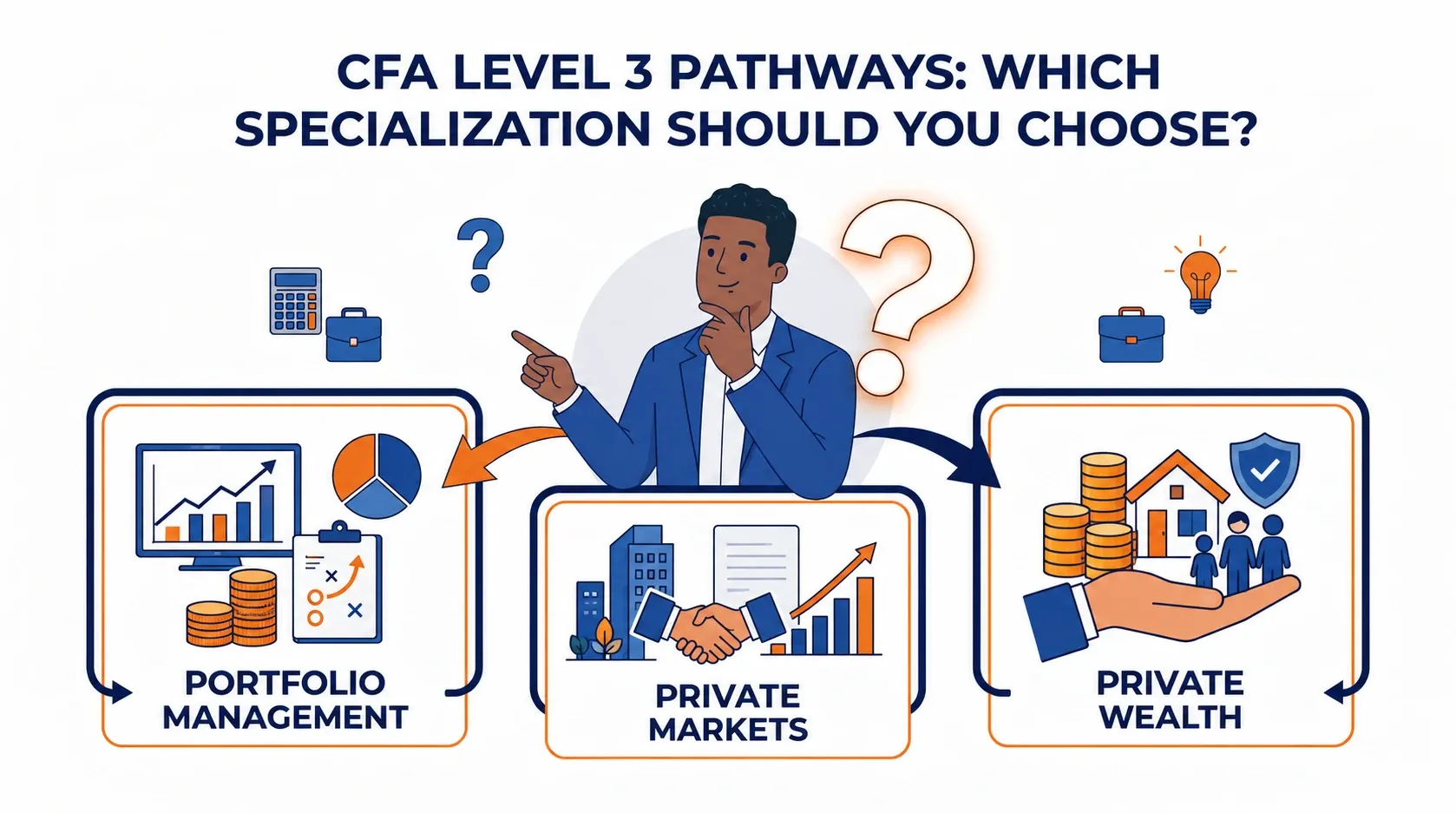
What Are the CFA Level 3 Pathways?
CFA Level III offers three pathways, each focused on a different area of investment management.
- Portfolio Management
- Private Markets
- Private Wealth
All three pathways lead to the same CFA charter. Your choice determines the specialized curriculum you study, not a separate designation.
ℹ️ Want to know how to become a CFA charterholder?
Check out our detailed blog to learn what you need to do after passing CFA Level 3.
How Much of CFA Level 3 Is Pathway-Specific?
The common core covers:
Keep in mind that choosing a pathway does not restrict your future career to that specialization. It shapes the content you study for the exam, but your professional opportunities will also depend on your skills, experience, qualifications and career decisions.
CFA Level 3 Portfolio Management Pathway
What it covers?
If you are interested in public markets, portfolio management could be the ideal pathway to choose. It explores how investment professionals build portfolios, select securities, manage risk and make investment decisions.
Key areas include:
- Index-based equity strategies: Understanding market-cap-weighted and factor-based strategies, index replication and tracking error.
- Active equity investing: Exploring fundamental and quantitative strategies designed to outperform a benchmark.
- Active portfolio construction: Applying risk budgeting and portfolio management techniques.
- Fixed-income strategies: Examining yield curve positioning, credit strategies and liability-driven investing.
- Institutional portfolios: Understanding the considerations involved in managing institutional investments.
- Trading and execution: Evaluating trade strategies, execution benchmarks and transaction-related considerations.
The pathway builds on Level III's common core and develops a more specialized understanding of public-market investment management.
Is this pathway for you?
It is, if you want to work in:
- Asset management
- Portfolio management
- Equity research with a potential move to the buy side
- Fixed-income analysis and investment management
- Institutional investing
- Public-market investment strategy
It may be a good fit if you enjoy studying markets, analysing securities, comparing investment strategies and understanding how individual investments contribute to a portfolio.
What career paths could it align with?
Depending on your experience and qualifications, the knowledge may be relevant to career paths such as:
Equity Research Analyst → Buy-Side Analyst → Portfolio Management
Fixed-Income Analyst → Fixed-Income Portfolio Management
Investment Analyst → Investment Manager
However, choosing this pathway does not automatically qualify you for these roles. Employers also consider practical investment skills, relevant work experience, analytical ability and your broader professional profile.
💡 Curious about AI and portfolio management?
Read our specialized guide to learn AI's role in modern portfolio management.
CFA Level 3 Private Markets Pathway
What it covers?
Private Markets is designed for candidates interested in how private investments are evaluated, structured, managed and eventually exited.
Unlike public-market investing, where securities are traded on exchanges, private-market investments often involve transactions, negotiations and longer investment horizons.
The pathway covers:
- Private equity, venture capital and growth equity
- Buyouts and private debt
- Special situations and distressed investments
- Real estate and infrastructure investments
- Deal sourcing, screening and valuation
- Deal structuring, financing and negotiation
- Due diligence and value creation
- Fund structures, performance measurement and exit strategies
The curriculum primarily adopts the General Partner perspective, making the investment process behind private funds a central theme.
Who should consider this pathway?
Private Markets may suit candidates interested in:
- Private equity
- Venture capital
- Private credit
- Alternative investments
- Real estate and infrastructure investing
- Investment roles involving deal analysis and execution
If you enjoy understanding how businesses are valued, how transactions are financed and how investors create value before exiting an investment, this pathway may align with your interests.
Should investment banking candidates choose Private Markets?
This is an important question for candidates considering a move from investment banking to private equity.
If your goal is to move from investment banking into private equity, the Private Markets pathway is more directly aligned with the investment work involved. It covers areas such as deal analysis, valuation, financing, due diligence, value creation and exits.
However, the pathway alone will not secure a private equity role. Relevant experience in mergers and acquisitions (M&A), leveraged buyout (LBO) modelling, transaction execution and financial due diligence can be important when pursuing such positions.
Think of the pathway as a way to build relevant knowledge, not as a substitute for transaction experience.
CFA Level 3 Private Wealth Pathway
What it covers?
Managing wealth involves much more than choosing investments. Wealth managers must understand their clients' financial goals, family circumstances, tax considerations, liquidity needs and long-term plans.
The Private Wealth pathway explores this broader advisory process through topics such as:
- The private wealth management industry and its business models
- Client management and family dynamics
- Financial and wealth planning
- Investment planning and asset allocation
- Tax considerations and liquidity strategies
- Risk mitigation and wealth preservation
- Wealth transfer, inheritance and philanthropy
- The needs of high-net-worth (HNW) and ultra-high-net-worth (UHNW) clients
The focus is on developing an understanding of how investment decisions fit into a client's wider financial life.
Who should consider this pathway?
Private Wealth may be relevant if you want to work as a:
- Wealth manager
- Private banker
- Investment adviser
- Relationship manager
- Family office professional
It may appeal to candidates who enjoy combining financial analysis with client interaction, understanding individual financial goals and developing long-term wealth strategies.
The distinction is important: Private Wealth is not simply portfolio management for richer clients. It includes the wider planning, relationship and wealth-transfer responsibilities involved in advising individuals and families.
Which CFA Level 3 Pathway Is Best for Investment Banking?
There is no dedicated Investment Banking pathway in CFA Level III. The right choice depends on the career graph you have decided.
- Investment banking → Private equity: Consider Private Markets because it covers private investments, deal valuation, due diligence and transaction-related decisions.
- Investment banking → Asset management or public-market investing: Consider Portfolio Management because it focuses on public markets, security strategies and portfolio construction.
- Investment banking → Private banking or wealth advisory: Consider Private Wealth because it covers client relationships, wealth planning and investment advice.
Investment banking and buy-side or advisory roles involve different skills and workflows. If you're planning to move from investment banking to private equity, choose a pathway that aligns with your next role. Remember, a CFA Level III pathway builds relevant knowledge but does not guarantee a job.
Which CFA Level 3 Pathway Is Best for Equity Research?
Portfolio Management is generally the most relevant pathway for candidates interested in moving from equity research into portfolio management or broader public-market investing.
It covers active equity strategies, portfolio construction, risk budgeting, benchmarking and the execution of investment decisions.
However, equity research and portfolio management are not the same job. An equity research analyst typically focuses on analysing individual companies and securities. A portfolio manager must also consider how those securities fit into a portfolio, how much risk to take and how to allocate capital across investments.
If you want to continue specialising in security analysis, evaluate the pathway alongside the other skills and experience your target research roles require.
Which CFA Level 3 Pathway Is Best for Private Equity?
Private Markets is the most directly aligned pathway for candidates interested in private equity.
Its curriculum includes private equity strategies, buyouts, deal valuation, financing, due diligence, value creation and exit strategies. These subjects relate closely to the investment process used by private-market investors.
That said, choosing Private Markets does not automatically make you eligible for a private equity position. Relevant modelling skills, transaction experience, commercial judgement and an understanding of businesses remain important.
Use the pathway to strengthen your understanding of private investments while continuing to build the practical capabilities required for your target role.
Which CFA Level 3 Pathway Is Best for Wealth Management?
Private Wealth is the most directly aligned pathway for candidates interested in wealth management, private banking and investment advisory.
It covers financial planning, client management, asset allocation, tax considerations, liquidity, risk mitigation and wealth transfer.
These areas matter because wealth managers must connect investment decisions with a client's goals, circumstances and long-term financial needs.
If you enjoy both financial analysis and working with clients, Private Wealth may be worth considering.
Is One CFA Level 3 Pathway Easier Than the Others?
No pathway is officially considered the easiest. The difficulty depends on your background and familiarity with the subject.
- Portfolio Management: May feel more familiar to candidates with equity research experience.
- Private Markets: May suit those with transaction experience.
- Private Wealth: May be more familiar to candidates in wealth advisory.
Rather than choosing based on perceived difficulty, review the official curriculum and sample questions. Consider your interest in the subject and how well it aligns with your career goals.
💡 Curious about CFA salary in India?
Read our detailed CFA salary guide to get earning insights or try our interactive tool to know your earning possibility.
Should You Choose a Pathway Based on Difficulty or Study Material?
Preparation resources matter, especially the availability of notes, question banks and mock exams across pathways. However, don't choose a pathway just because study materials are easier to find.
Use this framework to weigh your options. The percentages are a suggested guide, not an official CFA Institute formula.
Note: These percentages are a suggested decision-making framework, not an official CFA Institute formula.
Start with career fit. Then assess how your current knowledge, interests and available study resources support that choice.
A pathway that aligns with your professional direction may also help you build a more coherent understanding of the work you want to pursue.
💡 Preparing for the CFA Exam?
Check out our blog on CFA exam preparation for best study guidance.
Can You Change Your CFA Level 3 Pathway?
CFA Institute states that candidates cannot change their selected pathway after completing registration for an exam.
If you take Level III again, you can select a different pathway for the subsequent attempt, subject to the applicable registration requirements.
This makes it important to review your options before registering. Check the curriculum for your exam year, understand what each pathway covers and make sure your selection reflects your interests and career plans.
Does Your CFA Charter Show Which Pathway You Chose?
No. All three CFA Level III pathways lead to the same CFA charter. The pathway you select is a specialization within the Level III curriculum, not a separate credential.
Your choice can influence the knowledge you develop during preparation, but the charter awarded after successfully completing the CFA Program remains the same.
What Changed for CFA Level 3 Pathways in 2027?
For the 2027 CFA curriculum, CFA Institute continues to offer three Level III pathways: Portfolio Management, Private Markets and Private Wealth. The selected pathway accounts for 30–35% of the exam, with 65–70% allocated to the common core.
The 2027 Practical Skills Modules also include pathway-specific options:
- Portfolio Management: Macro Insights for Investing
- Private Markets: Due Diligence
- Private Wealth: Managing Private Wealth Clients
These modules are designed to connect curriculum knowledge with practical applications relevant to each specialization. Candidates should check CFA Institute's official requirements for their exam year, including which modules they need to complete.
CFA Level 3 Pathway Decision Tree
Still unsure which specialization to choose? Start with the type of work you want to do.
Question 1: Do you want to work primarily with public-market investments and portfolios?
Question 2: Are you more interested in private investments, transactions and deal-making?
Question 3: Do you want to advise wealthy individuals and families on investments and broader financial planning?
If more than one option interests you, compare the actual curriculum and consider which pathway best supports your next career move. You do not need to choose based only on your current job title.
Final CFA Level 3 Pathway Checklist
Before registering, ask yourself:
- What role do I want to pursue in the next three to five years?
- Am I more interested in public markets, private investments or wealth advisory?
- Do I enjoy investment analysis, deal-oriented work or client relationships?
- Does my current experience support the pathway I am considering?
- Which pathway's subject matter interests me most?
- Have I reviewed the official curriculum for my exam year?
- Have I checked the relevant Practical Skills Module?
- Am I choosing based on career fit rather than perceived difficulty?
Frequently Asked Questions
1. What are the three CFA Level III pathways?
- Portfolio Management: Public markets and investment portfolios.
- Private Markets: Private equity, private debt and alternative investments.
- Private Wealth: Wealth management and financial planning for wealthy clients.
2. Which CFA Level III pathway should I choose?
Choose based on your career goals: Portfolio Management for public markets, Private Markets for private investments, and Private Wealth for wealth management.
3. Which CFA Level III pathway is best for private equity?
Private Markets, as it covers deal analysis, valuation, due diligence and exit strategies. However, it doesn't guarantee a PE job.
4. Which CFA Level III pathway is best for portfolio management?
Portfolio Management, which focuses on public markets, asset allocation and investment portfolio construction.
5. Which CFA Level III pathway is best for wealth management?
Private Wealth, which covers client management, financial planning, investment advice and wealth transfer.
6. Is the CFA Level III Portfolio Management pathway easier?
No pathway is officially considered the easiest. Difficulty depends on your background, subject familiarity and preparation resources.
7. Can I change my CFA Level III pathway after registering?
No. You cannot change your pathway after registering for an exam. You may choose a different pathway if you retake Level III.
8. Does the CFA charter mention the pathway I selected?
No. All three pathways lead to the same CFA charter, with no separate designation for your chosen pathway.
9. How much of CFA Level III is pathway-specific?
30–35% of the exam covers your chosen pathway; the remaining 65–70% covers the common core, including asset allocation, portfolio construction, risk management and ethics.
10. What changed in the CFA Level III pathways for 2027?
The three pathways remain unchanged. The 2027 pathway-specific Practical Skills Modules are Macro Insights for Investing (Portfolio Management), Due Diligence (Private Markets) and Managing Private Wealth Clients (Private Wealth).
ℹ️ Planning Your CFA Level III Preparation?
Fill out the form below to speak to a counsellor free of cost in order to discuss your goals, compare your options and make a more informed decision about your CFA journey.