
Pursuing a career in finance requires more than ambition. It demands credibility, expertise, and a commitment to excellence. The Chartered Financial Analyst (CFA) designation is the gold standard for investment professionals worldwide, recognized across 160 locations and earned by more than 200,000 professionals globally.
Whether you're starting your finance career or looking to advance to senior roles in investment management, portfolio management, or wealth planning, the CFA charter is a transformative credential. This guide teaches you how to become a CFA charterholder: the CFA program structure, career opportunities, exam requirements, study strategies, and practical next steps.
What is a CFA Charterholder?
A CFA charterholder is a professional who has completed the CFA Program requirements and is authorized to use the designation according to the CFA Institute's rules. The Chartered Financial Analyst credential is a globally recognized professional certification established by the CFA Institute, headquartered in the United States. The CFA charter demonstrates expertise in investment analysis, portfolio management, financial analysis, and ethical financial decision-making.
Earning the CFA designation isn't simply about passing three exams. Passing all three exams is necessary, but CFA Institute also requires completion of Practical Skills Modules (PSM) and a formal membership application process before you can use the designation. Upon completing all three exam levels and meeting qualification criteria, candidates are authorized to use the CFA charterholder title and represent themselves as CFA professionals to employers, clients, and colleagues.
What It Takes
| Requirement Area | What You Must Complete |
|---|---|
| Exams | Pass CFA Level I, II, and III. |
| Practical Skills Modules | Complete the required PSM(s) as part of the program pathway. |
| Eligibility + Policy Compliance | Meet enrollment/registration rules and agree to program policies. |
| Membership Step | Apply for membership to use the credential. |
Understanding CFA Eligibility and CFA Level 1
The CFA exam has three levels that build on each other, so knowing what Level 1 looks like helps you plan your start. Level 1 is offered four times a year - February, May, August, November. The Institute allows candidates to enroll/register for Level I if they meet one of its eligibility pathways including a combination of professional work experience and/or higher education totaling 4,000 hours over a minimum of three sequential years.
If you use the mixed pathway, CFA Institute states that the dates of education and professional work experience cannot overlap, and it provides a standard assumption of 1,000 hours per year of higher education for calculating eligibility.
ℹ️ Info
To know about eligibility in detail, check out our blog on CFA Eligibility Criteria.
The CFA Level 1 syllabus covers ten topics - Ethics, Quantitative Methods, Economics, Financial Reporting, Corporate Issuers, Equity, Fixed Income, Derivatives, Alternative Investments, and Portfolio Management. It includes 180 standalone multiple-choice questions split into two 2-hour-15-minute sessions, with pass rates typically around 45% per window.
You have 270 minutes for 180 questions, so about 90 seconds per question, which makes time management crucial. A simple approach is to decide within roughly 45 seconds whether you can solve a question confidently; if not, flag it and move on, then return later if time allows, so you do not lose marks by spending too long on a few difficult items.
Understanding the Three Levels of the CFA Exam
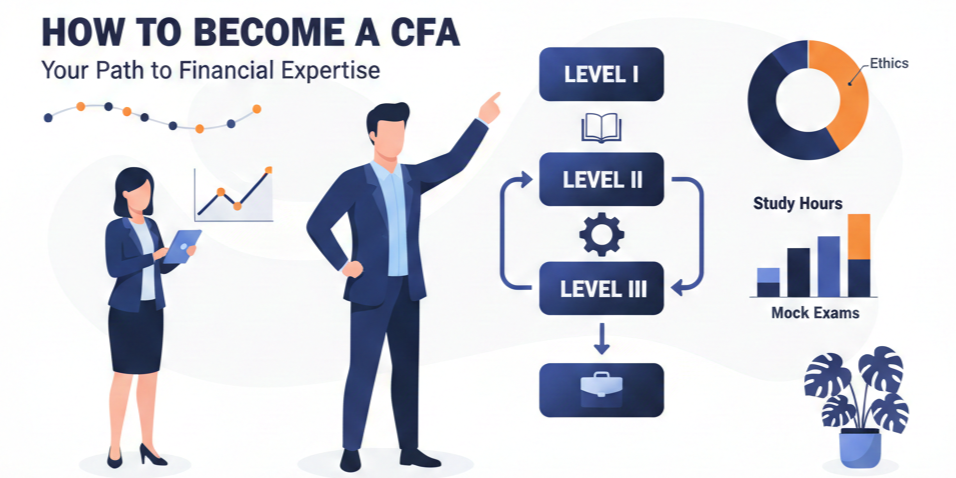
The CFA Program has three progressive levels, each testing deeper skills and preparing you for real-world investment decision-making.
Level I — Build Your Foundation
When it's offered: February, May, August, November
Focus: Broad coverage of ten core topics including Ethics, Economics, FRA, Equity, Fixed Income, Derivatives, Alternatives, and Portfolio Management.
Level I introduces the language of finance and tests fundamental concepts and basic analytical tools.
Level II — Apply Your Knowledge
When it's offered: May, August, November
Focus: Application-heavy questions based on realistic investment scenarios.
Level II deepens your understanding of the same ten topics, pushing you to analyze data, interpret situations, and make informed investment decisions.
Level III — Master Strategic Judgment
When it's offered: February, August
Focus: Portfolio management, wealth planning, and high-level decision-making.
Level III moves beyond multiple-choice questions and evaluates how well you synthesize concepts, justify your reasoning, and think like a senior investment professional.
Registration Options: Early Bird vs. Standard
You have two registration windows for each exam:
Early Bird Registration (recommended):
-
- Opens approximately 5-6 months before the exam date
- Offers significantly lower fees than standard registration
- Typically saves $200-300 per level across all three levels
- Provides better selection of exam dates and test center locations
- Signals your commitment and helps with planning your study schedule
Standard Registration:
-
- Opens 4-5 months before the exam date
- Higher fees due to administrative costs
- Fewer choices of exam dates and test center locations as popular slots fill up
- Final opportunity to register for that exam window
Early bird registration is strongly recommended if you've identified your target exam date. The fee savings alone justify the slightly earlier commitment, and you'll have flexibility if your schedule changes.
📝 Note
Check out our blog on 'CFA Exam Fees & Registration Updates 2026' to get a detailed overview on costs and savings.
Current Pass Rates: What to Expect
Understanding CFA pass rates helps set realistic expectations for your exam journey. Here's what current data shows:
-
- Level 1 Pass Rate: Approximately 43-45% depending on the exam window. February and May 2025 both saw 45% pass rates, while August 2025 came in at 43%. This means roughly four out of every ten candidates pass each administration.
- Level 2 Pass Rate: Significantly more variable, ranging from 39% to 54% depending on the exam window. May 2025 saw a notably high 54% pass rate, while November 2024 dipped to 39%. This volatility indicates that Level 2 difficulty can vary considerably between windows. Your specific exam window matters more for Level 2 than for Level 1.
- Level 3 Pass Rate: Approximately 48-50%, making it slightly more passable than Levels 1 and 2. August 2025 hit 50%, while February 2025 came in at 49%. This higher pass rate reflects that only the most committed candidates reach Level 3.
These pass rates highlight an important reality: the CFA exams are genuinely challenging. Roughly half of all candidates at each level don't pass on their first attempt. This isn't a reflection of your intelligence. It's a reflection of the rigor the CFA Institute maintains. The designation's value depends on maintaining these standards.
Preparing for the CFA Exams: Time and Strategy
The CFA Institute recommends about 300 hours of study per level, though this varies based on your background, work schedule, and study efficiency. A finance or accounting background typically requires fewer hours; engineering or unrelated fields may need more. Full-time professionals usually need 6–9 months, while those with flexible schedules can compress to 4–5 months with intensive daily study.
Most candidates realistically begin 5–6 months before their target exam. If you allocate 12–15 hours per week, you'll hit roughly 288–360 hours over 6 months—right in the recommended range. The key principle: consistent weekly study beats sporadic cramming.
A practical three-phase approach works well:
-
- Prepare Phase (90–120 hours): Learn concepts through curriculum and lectures; build your foundation without rushing.
- Practice Phase (120–150 hours): Work through question banks and topic tests; transform knowledge into usable skills.
- Perform Phase (60 hours): Take full-length mock exams in the final 4–6 weeks; review mistakes and tighten weak areas.
This structure ensures you balance learning, reinforcement, and testing—essential elements the 300-hour number alone doesn't capture. You can learn more on CFA exam preparation by checking our blog.
Selecting Your CFA Study Materials: A Strategic Approach
You can prepare using only official CFA Institute curriculum resources, but many candidates add third-party notes and question banks to improve speed and retention. The best approach depends on your time, background, and whether your main weakness is concepts or practice.
With dozens of CFA study resources available online, knowing where to focus your time and money matters enormously. The right materials accelerate your learning; the wrong ones waste both.
You have three main categories of CFA preparation resources:
-
- Official CFA Institute Materials: The CFA Institute provides its official curriculum for free to all registered candidates. This includes study notes, learning modules, and access to the CFA curriculum. These materials are authoritative and 100% aligned with what the exam tests.
- Third-Party Prep Providers: Companies like Kaplan Schweser, Wiley, AnalystPrep, and Princeton Review offer comprehensive study packages that condense, organize, and supplement the official curriculum. These providers employ expert instructors and use data from thousands of past candidates to optimize their materials.
- Supplemental Resources: YouTube channels, question banks, flashcard apps, and tutoring services offer targeted help for specific topics or learning styles.
Conclusion
Becoming a CFA charterholder is a demanding journey, but it is also one of the most credible ways to signal long-term commitment to a career in finance. You are taking three rigorous exams, several hundred hours of focused study per level, and a strict ethical standard.
In return, you gain a globally respected qualification that employers recognize across major financial markets. With consistent effort, the right resources, and a clear understanding of what each level expects from you, the path from aspiring candidate to CFA charterholder remains challenging but well within reach.
📚 Want to Learn More?
Check out our online CFA Level 1 course for more details.
F A Qs :
Q: How do I become a CFA charterholder?
A: To become a CFA charterholder, you must pass all three CFA exam levels, meet the CFA Institute's work experience requirements in investment-related roles, and adhere to the CFA Code of Ethics and Standards of Professional Conduct.
Q: How long does it take to complete the CFA program?
A: Most candidates take 3–5 years to complete all three CFA levels, depending on exam scheduling, pass rates, and personal/work commitments, as each level typically requires around 300+ study hours and at least several months of preparation.
Q: How many hours should I study for each CFA level?
A: Candidates generally plan for about 300 study hours per level, though surveys suggest many successful candidates study slightly more, around 300–320 hours depending on background and learning speed.
Q: What are the current CFA exam pass rates?
A: Recent data shows average pass rates of roughly mid-40% for Level I and Level II and close to 50% for Level III, underscoring the program's difficulty and the need for structured, consistent preparation.
Q: Which CFA level is the hardest to pass?
A: Many candidates find Level II the hardest due to dense, application-heavy item sets, while statistics show Level III often has slightly higher pass rates, as only committed candidates typically reach the final level.