

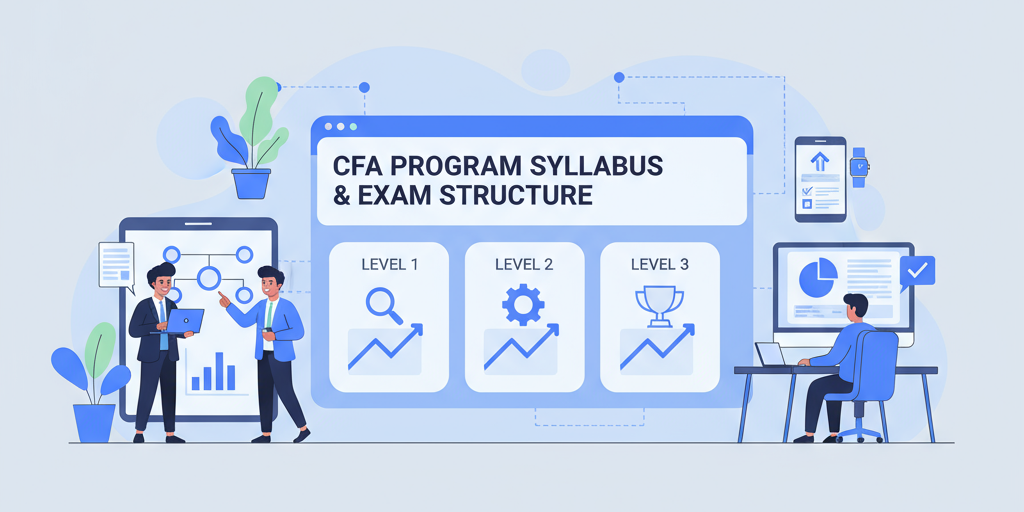
The Chartered Financial Analyst (CFA) stands as the global benchmark for finance professionals, renowned for its rigorous curriculum and career-transforming impact. CFA offers a comprehensive pathway to mastering investment analysis, portfolio management, and ethical standards.
Whether you're preparing for CFA Level 1, 2, or 3 in 2026, understanding the detailed syllabus, curriculum weightings, and exam structure is key to achieving success. This guide breaks down what to expect across all three levels, helping you plan your study approach efficiently and effectively.
CFA Level 1 Detailed Syllabus and Topics
The CFA Level 1 exam focuses on foundational knowledge and comprehension across a broad range of investment and financial topics. It targets finance aspirants with diverse academic backgrounds, offering 10 topic areas that form the basis for the entire CFA journey. Here is a breakdown of the topics.
| Topic | Weightage (%) |
|---|---|
| Ethics and Professional Standards | 15–20% |
| Quantitative Methods | 6–9% |
| Economics | 6–9% |
| Financial Statement Analysis | 11–14% |
| Corporate Issuers | 6–9% |
| Fixed Income | 11–14% |
| Equity | 11–14% |
| Derivatives | 5–8% |
| Alternative Investments | 7–10% |
| Portfolio Management | 8–12% |
For a detailed breakdown you check out the CFA Level 1 syllabus on our website.
Exam Structure
-
- Total 4 hours 30 minutes, split into two sessions - 2 hours 15 minutes each
- Total 180 multiple-choice questions - 90 questions each session
- No negative marking
Question Format
-
- 3 answer choices (A, B, C)
- Two types of questions: sentence completion and direct questions
- Designed to test analytical thinking and application of concepts
Interested candidates can also sign up for our CFA Level 1 course for additional resources.
CFA Level 2 Detailed Syllabus and Topics
The CFA Level 2 exam shifts from foundational knowledge to application and analysis. It includes vignette-style item sets, which test your ability to apply financial concepts in real-world scenarios. The CFA Level 2 curriculum dives deeper into financial analysis, valuation, and risk management.
| Topic | Weight (%) |
|---|---|
| Ethics and Professional Standards | 10–15% |
| Quantitative Methods | 5–10% |
| Economics | 5–10% |
| Financial Statement Analysis | 10–15% |
| Corporate Issuers | 5–10% |
| Fixed Income | 10–15% |
| Equity | 10–15% |
| Derivatives | 5–10% |
| Alternative Investments | 5–10% |
| Portfolio Management | 10–15% |
Exam Structure
-
- Total 4 hours 24 minutes, split into two sessions - 2 hours 12 minutes each
- 22 item sets consisting of vignettes with 88 MCQs - 11 item sets and 44 MCQs each session. (20 are scored and 2 are unscored trial questions.)
- No negative marking
Question Format
-
- 3 answer choices (A, B, C)
- Questions are vignette-based, not standalone
- Must refer to the vignette for each question
- Topics appear randomly across both sessions
- Designed to test critical thinking and applied knowledge
For a detailed breakdown you check out the CFA Level 2 syllabus on our website.
💡 Tip
The best way to tackle Level 2 is to focus on mastering application over theory.
CFA Level 3 Detailed Syllabus and Topics
Level III is where everything you've learned finally comes together. It's the final step of the program, emphasizing Portfolio Management, Private Wealth, and Private Markets. With a mix of essay-type and vignette-based questions, this level tests not just your understanding but your ability to explain and defend your investment decisions clearly.
| Topic | Weight (%) |
|---|---|
| Asset Allocation | 15–20% |
| Portfolio Construction | 15–20% |
| Performance Measurement | 5–10% |
| Derivatives and Risk Management | 10–15% |
| Ethical and Professional Standards | 10–15% |
| Pathways Portfolio Management Private Markets Private Wealth | 30–35% |
For a detailed breakdown you check out the CFA Level 3 syllabus on our website.
Exam Structure
-
- Total 4 hours 24 minutes, split into two sessions - 2 hours 12 minutes each
- The Level III exam includes item sets and constructed-response (essay) sets, both based on vignettes
- Each session has 11 question sets (mix of 5–6 item sets and 5–6 essay sets)
- In total, 20 sets are scored, and 2 are unscored trial questions
- All topics may appear in either or both sessions, with each vignette showing the topic and 12-point value
Question Format
-
- The Level III exam features two types of questions — essay (constructed response) and multiple-choice, both based on vignettes
- Essay responses are typed in text boxes; command words are bolded, and bullet points are accepted
- Only the number of responses requested will be graded, in the order presented
- Correct numerical values alone earn full credit; showing steps can help gain partial credit
- Each vignette-based item set includes 4 MCQs, totaling 44 questions worth 3 points each
💡 Tip
For Level 3, practice writing detailed responses. The essay format requires clarity and structured responses, so work on time management during mock exams.
CFA Exam Tips for All Levels
-
- Focus on IFRS: Most Financial Statement Analysis questions follow IFRS unless U.S. GAAP is mentioned
- Attempt every question: There's no negative marking—don't leave anything blank
- Master your calculator: Know all key functions to save valuable time
- Practice regularly: Use mock exams in the Learning Ecosystem to build speed and accuracy
- Stay comfortable: Dress in layers to manage varying exam hall temperatures
- Be tech-ready: Familiarize yourself with the test centre hardware and software beforehand
- Ask for help if needed: Proctors are available—keep working until assistance arrives
These simple habits can make a big difference in your exam-day confidence and performance.
Curriculum Changes for 2026
There are no significant changes to the Level 1 and Level 2 curriculum from 2025 to 2026. Only in Level 2, a LOS has been deleted from the Machine Learning chapter. You can refer to the blog on CFA 2026 Curriculum Changes to know about the changes in detail.
Pass Rates and Exam Statistics (2025)
Here's an overview of the CFA exam pass rates for Levels I, II, and III across the most recent exams:
| Exam Level | Pass Rate (2025) |
|---|---|
| Level I | 45% (Feb 2025), 45% (May 2025), 43% (Aug 2025) |
| Level II | 54% (May 2025), 44% (Aug 2025) |
| Level III | 49% (Feb 2025), 50% (Aug 2025) |
-
- Level I pass rates range from 43% to 45%, reflecting the challenge of mastering foundational concepts at the start of the CFA journey
- Level II pass rates fluctuate, with a higher pass rate of 54% in May 2025, showing that the exam can be more manageable in some months compared to 44% in August
- Level III pass rates remain steady at 49% in February and 50% in August, highlighting the consistent difficulty at this advanced level
These variations show that while each level has its own challenges, candidates must continue to adapt and deepen their understanding to succeed. To dive deeper into historical pass rates, you can explore the CFA Institute's official pass rate PDF, which covers data since 1963. Check out our blog on CFA August 2025 results to know more about it in detail.
Pass rates are influenced by several factors:
-
- The broad syllabus
- The complexity of vignette-style questions at higher levels
- The ability to synthesize and apply knowledge effectively
As you advance through the CFA program, the number of candidates decreases at each level. After clearing Level I, you move to Level II, and then tackle the final challenge—Level III.
These pass rates highlight the increasing difficulty, but with focused preparation and a solid plan, you can successfully navigate each stage. The journey may be tough, but persistence leads to success.
Conclusion
Navigating through the CFA program is undoubtedly a challenging journey, but it offers a rewarding career path for those who persist. As you prepare for the CFA 2026 exams, understanding the detailed syllabus, topic-wise weightings, and exam structures is essential to success.
Dedicated preparation, a solid study plan, and the right resources will take you towards success. The key to conquering the CFA exams lies in staying focused, practicing regularly, and continuously adapting your approach. Stay committed, and your hard work will pay off in the end.
Explore CFA courses and helpful toolkits at Aswini Bajaj Classes to streamline your exam preparation today!
F A Qs :
Q: What to study for CFA Level 1?
A: Focus on 10 core topics, including Ethics, Quantitative Methods, Financial Statement Analysis, Economics, Fixed Income, and Portfolio Management. Ensure a strong understanding of foundational concepts and formulas.
Q: What is the pass rate for the CFA Level 1 2025?
A: The pass rate for CFA Level 1 in 2025 ranges from 43% to 45%, depending on the exam cycle.
Q: Is CFA Level 2 harder than Level 1?
A: Yes, CFA Level 2 is more challenging as it focuses on applying concepts through vignette-based questions and requires a deeper understanding of financial analysis and valuation.
Q: How should preparation differ across levels?
A: For Level 1, focus on understanding and memorization; for Level 2, emphasize application and analysis; and for Level 3, practice time management, essay writing, and strategic thinking.
Q: Are there recent curriculum changes for 2026?
A: There are no significant changes for Levels 1 and 3, but Level 2 has removed a Learning Outcome Statement (LOS) from the Machine Learning chapter.