

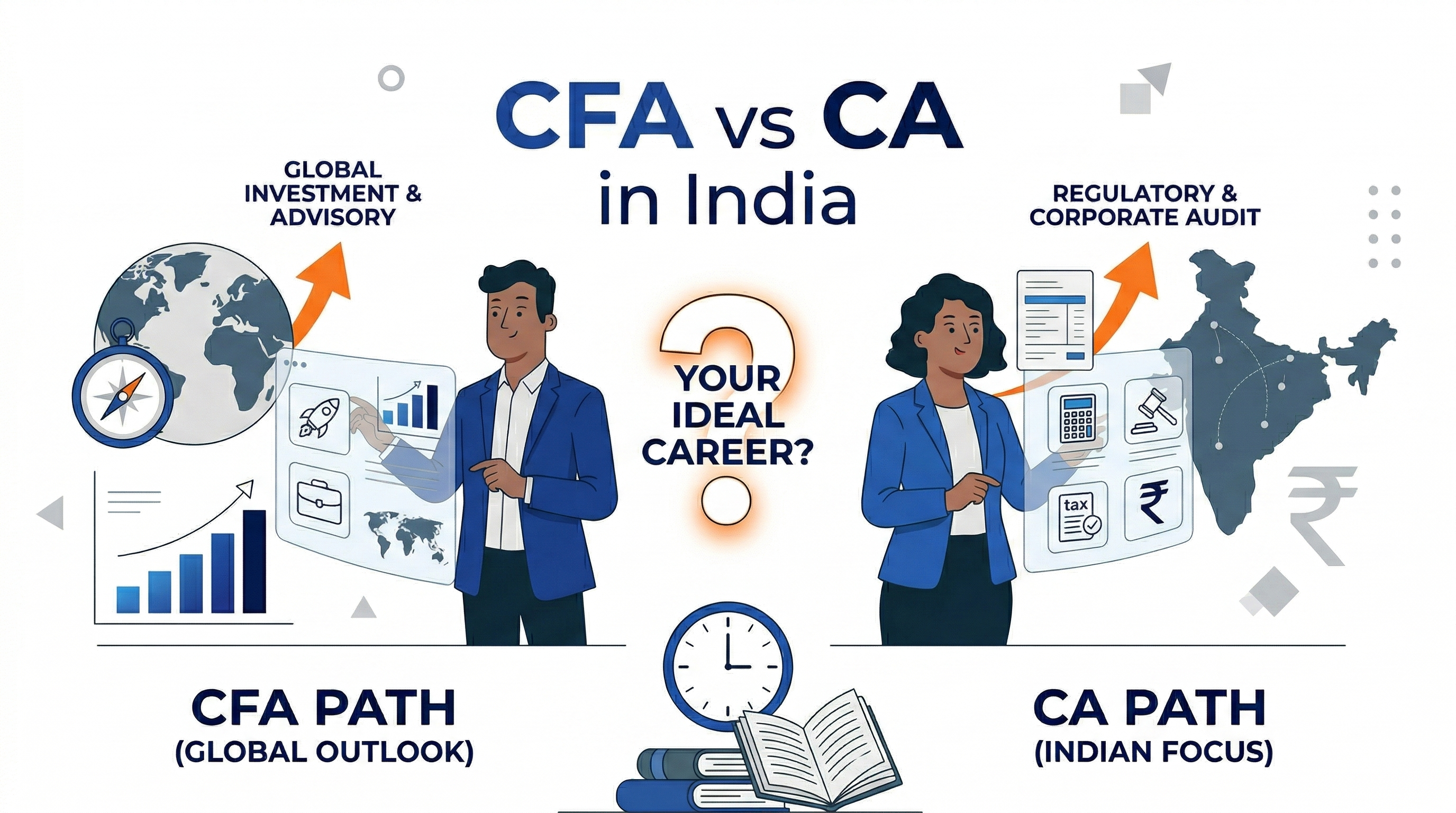
You may be considering two distinct career paths. One leads to boardrooms filled with balance sheets and tax codes. The other opens doors to trading floors and investment portfolios. Both the Chartered Accountant (CA) and Chartered Financial Analyst (CFA) designations can transform your career, but they are designed for different kinds of work and career trajectories. Choosing between them carefully matters because the time, cost, and day-to-day nature of work can be very different.
Read on to explore the CFA vs CA comparison and focus on the practical factors that matter most, including cost, salary, timeline, work reality, and long-term career fit.
Key Takeaways
Before you dive in, here's what you can expect inside this guide:
- Real cost and salary numbers for 2026: CFA costs ₹4.7-8.4L versus CA's ₹1.7-4.1L, with detailed salary breakdowns from starting (CA: ₹6-9 LPA, CFA: ₹8-15 LPA) to mid-career levels, including the premium for dual qualification.
- Honest timelines and eligibility: CA takes 4.5-5.5 years with mandatory articleship starting after 12th, while CFA takes 2-4 years and can be done alongside college or full-time job. We break down when you can actually start earning in each path.
- Day-to-day work reality, not just job titles: Understand exactly what you'll do every Monday morning, whether it's auditing financial statements and filing tax returns (CA) or analyzing stocks and building investment portfolios (CFA).
- Pass rates and backup plans: Only 5-8% who start CA complete it, and 10-15% complete CFA. We cover what happens if you fail, how many attempts are realistic, and what your options are.
- AI impact and future-proofing: How automation is reshaping both careers differently, which roles remain human-driven, and why both qualifications still matter in 2026 and beyond.
- When doing both makes sense: The CA + CFA combination can boost salaries by 25-40%, but only for specific roles like equity research and investment banking. We explain the right sequence and timing.
By the end of this guide, you'll have a clear decision framework based on your interests, budget, and career goals, not just generic advice.
The One Question That Matters More Than "Which Is Better?"
Instead of asking, "Which is better, CA or CFA?" start asking, "Am I more interested in financial reporting, compliance, and business control, or in valuation, investments, and market-facing finance?"
That question is often a useful starting point. If you prefer to analyze whether Reliance's financial statements are accurate rather than deciding whether to buy Reliance stock, CA may be a better fit for you. If building an investment portfolio for a billionaire fascinates you rather than auditing their company's books, then CFA is more aligned with your interests.
Still confused? Let's break it down further.
CA vs CFA: What You'll Actually Do Every Day
As a CA:
- Audit company financial statements for accuracy and compliance
- File GST returns, income tax returns, and manage tax planning
- Prepare balance sheets, profit & loss statements, and annual reports
- Ensure companies comply with accounting standards and regulations
- Handle statutory audits, internal audits, and forensic investigations
As a CFA:
- Analyze stocks to decide if they're worth buying or selling
- Build and manage investment portfolios for individuals or institutions
- Conduct equity research and publish buy/sell recommendations
- Value companies for mergers, acquisitions, or IPOs
- Manage mutual funds, hedge funds, or wealth portfolios
The Core Difference: CA professionals make sure the numbers are correct and legal. CFA professionals use those numbers to make investment decisions.
Info:
Interested in our Classes? Sign up to Aswini Bajaj Classes to evaluate before you commit.
Eligibility, Timeline & When You Start Earning
CA Route
Eligibility: After 12th (CA Foundation) or after Graduation (Direct Intermediate entry with conditions)
Timeline: 4.5 to 5.5 years
- Foundation: 4 months + exam
- Intermediate: 8-10 months + exam
- Articleship: 3 years mandatory (₹3,000-15,000/month stipend depending on city and firms)
- Final: 6-12 months + exam
Real Earning Start: After CA Final, around age 23-25, if you started after 12th
CFA Route
Eligibility: Start preparing along with college and take the Level 1 exam 23 months before your graduation month. Use this eligibility toolkit for better clarity.
Timeline: 2 to 4 years
- Three levels, each requiring 300+ study hours
- Can attempt twice per year (but not consecutive windows or within six months)
- Need 4,000 hours of relevant work experience for a charter which is not mandatory to apply. Without a charter, a candidate can still mention that they have cleared all three levels of the CFA.
Real Earning Start: Can work full-time while studying CFA, most start earning during or right after graduation (age 22+)
Cost Breakdown & Salary Reality
CA Total Investment
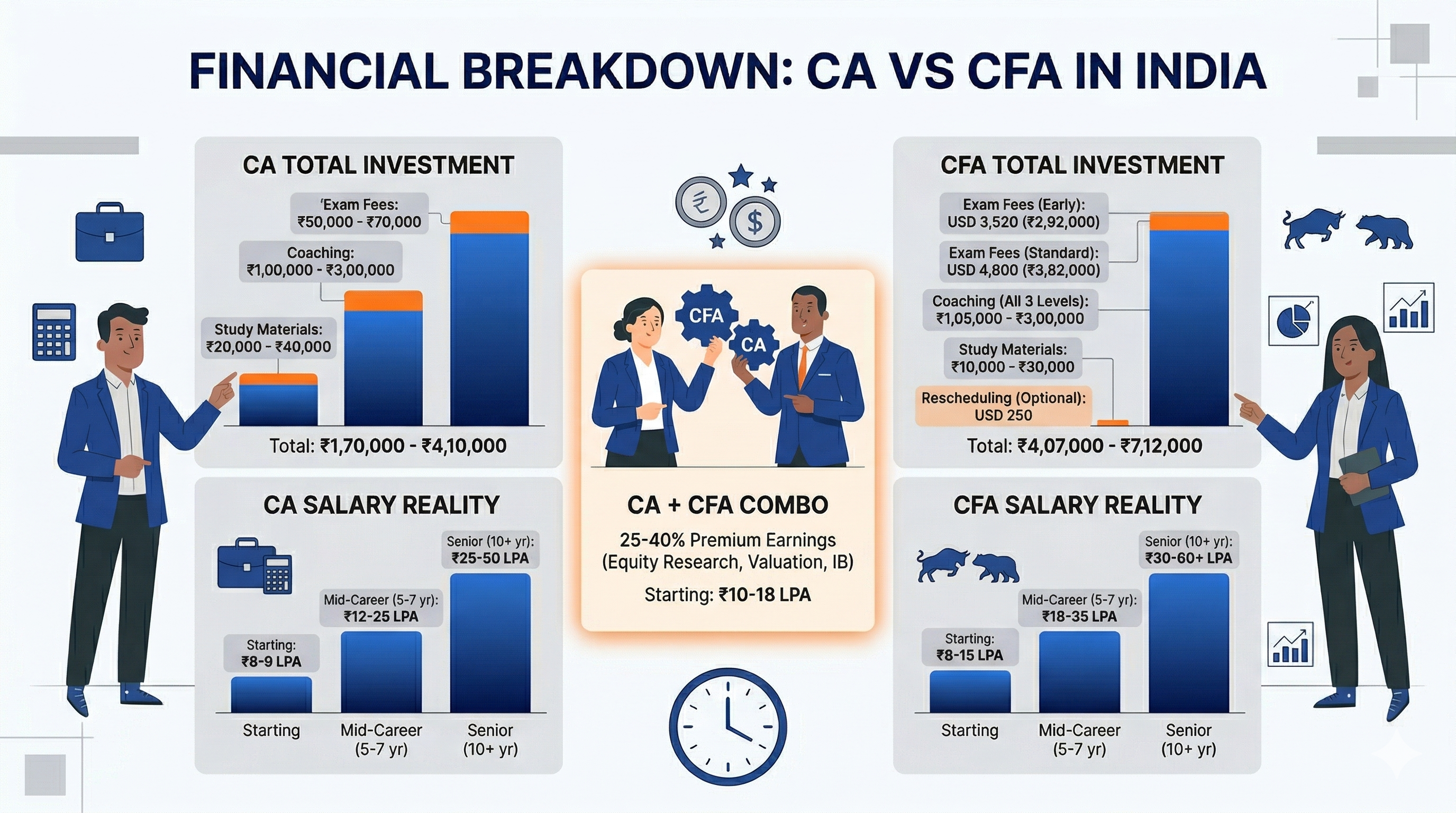
- Exam Fees: ₹50,000 - ₹70,000
- Coaching (optional): ₹1,00,000 - ₹3,00,000
- Study Materials: ₹20,000 - ₹40,000
- Total: ₹1,70,000 - ₹4,10,000
CFA Total Investment
- Exam Fees (all levels, early registration): USD 3,520 (₹2,92,000)
- Exam Fees (standard registration): USD 4,600 (₹3,82,000)
- Coaching (optional): ₹35,000 - ₹1,00,000 per level (₹1,05,000 - ₹3,00,000 for all three levels)
- Study Materials: ₹10,000 - ₹30,000
- Rescheduling Fee (if needed): USD 250 per attempt
- Total: ₹4,07,000 - ₹7,12,000
Starting Salaries
- CA: ₹6-9 LPA (Big 4, corporate finance, mid-size firms)
- CFA: ₹8-15 LPA (Investment banks, AMCs, equity research-role dependent)
Mid-Career (5-7 years)
- CA: ₹12-25 LPA
- CFA: ₹18-35 LPA
Senior Level (10+ years)
- CA: ₹25-50 LPA (CFOs, Partners)
- CFA: ₹30-60+ LPA (Fund Managers, Portfolio Managers)
CA + CFA Combo
Professionals with both qualifications earn 25-40% premiums, especially in equity research, valuation, and investment banking. Starting: ₹10-18 LPA.
Important:
CFA salaries depend heavily on role, company, and candidate's skill set. Just having CFA doesn't guarantee high pay. CA offers broader entry-level opportunities across industries.
Career Paths: Where Will Each Qualification Take You?
CA
Entry-Level Roles:
- Audit Associate (Big 4 or CA firms)
- Tax Consultant
- Accounts Executive
- Internal Auditor
- Statutory Auditor
Mid-Level Roles (5-8 years):
- Audit Manager
- Tax Manager
- Finance Manager
- Financial Controller
- Senior Accountant
Senior Roles (10+ years):
- Partner in CA Firm
- Chief Financial Officer (CFO)
- Finance Director
- Head of Taxation
- Independent Consultant
Top Hiring Companies for CA: Deloitte, PwC, EY, KPMG, Grant Thornton, TCS, Infosys, Reliance, HDFC Bank, ICICI Bank, all major manufacturing and service companies, government departments, regulatory bodies
Work Environment: Mix of office work, client visits, and during audit season (Jan-March), expect 12-14 hour workdays.
CFA
Entry-Level Roles:
- Research Analyst
- Investment Analyst
- Portfolio Analyst
- Equity Research Associate
- Financial Analyst
Mid-Level Roles (5-8 years):
- Senior Research Analyst
- Portfolio Manager
- Wealth Manager
- Buy-Side Analyst
- Valuation Specialist
Senior Roles (10+ years):
- Fund Manager
- Chief Investment Officer (CIO)
- Head of Research
- Director - Portfolio Management
- Investment Strategist
Top Hiring Companies for CFA: Goldman Sachs, Morgan Stanley, JP Morgan, HSBC, Citibank, Kotak Mahindra, ICICI Securities, Motilal Oswal, HDFC AMC, Aditya Birla Capital, Nippon India Mutual Fund, DSP Investment Managers
Work Environment: Primarily office-based with market hours focus. Less travel than CA. Work intensity spikes during earnings season and market volatility.
CA + CFA Combo
Dual-qualified professionals thrive in:
- Equity Research: Understanding both accounting (CA) and valuation (CFA)
- Investment Banking: Financial modeling with accounting depth
- Private Equity/Venture Capital: Valuing startups and conducting due diligence
- Family Offices: Managing ultra-high-net-worth wealth with tax and investment expertise
- M&A Advisory: Transaction structuring with regulatory knowledge
Info:
Use our CFA Salary Calculator to get insights on future scope and earnings.
Difficulty & Pass Rates: A Realistic View
CA Pass Rates
- Foundation: 30-40%
- Intermediate: 15-20%
- Final: 8-15%
- Only 5-8% who start CA actually complete it
CFA Pass Rates
- Level 1: 35-45%
- Level 2: 40-50%
- Level 3: 45-55%
- About 10-15% who start CFA complete all three levels
Study Requirements
CA:
- Study Hours: 6-8 hours daily during articleship, 10-12 hours for Final exams
- Difficulty: Heavy theory, law, and memorization; Indian taxation and accounting standards
- While Working: Very difficult due to mandatory articleship commitments
CFA:
- Study Hours: 300+ hours per level (typically 3-4 hours daily for 4-6 months)
- Difficulty: Concept-heavy, analytical, requires strong understanding of finance and economics
- While Working: Designed for working professionals, challenging but doable
Which Is Harder?
CA is harder if you:
- Struggle with Indian tax laws and regulatory compliance
- Dislike memorizing lengthy provisions and standards
- Can't commit to 3 years of articleship
- Need flexible study schedules
CFA is harder if you:
- Struggle with quantitative concepts and statistics
- Dislike self-driven, unstructured study
- Can't maintain discipline over 300+ hours per level
Both are demanding, but in different ways. CA requires consistency, structured preparation, and comfort with India's regulatory, accounting, and tax framework. Accordingly, CFA tests your analytical thinking, investment judgment, and ability to self-study dense material.
Which Path Aligns With Your Interests?
You're Probably a CA Person If:
- You enjoy creating order from financial chaos
- You prefer clear rules and frameworks
- You're detail-oriented and comfortable with compliance work
- You want broad employability across industries
- Subjects you enjoy: Accounting, Business Law, Taxation
You're Probably a CFA Person If:
- You follow stock markets and enjoy analyzing companies
- You prefer predictions over rules
- You're comfortable with market uncertainty
- You're fascinated by investment strategies
- Subjects you enjoy: Economics, Statistics, Financial Markets
Quick Self-Assessment Questions:
Question 1: A company reports ₹100 crore profit. What interests you more?
A) Verifying if the profit figure is accurate and compliant → CA
B) Deciding if the company's stock is worth buying at current price → CFA
Question 2: Your ideal Friday evening reading is:
A) New income tax amendments and GST updates → CA
B) Warren Buffett's latest shareholder letter → CFA
Question 3: You're more excited by:
A) Finding a ₹10 lakh accounting error in financial statements → CA
B) Identifying an undervalued stock before the market does → CFA
Question 4: Your career dream is:
A) Becoming a CFO or Partner in a reputed CA firm → CA
B) Managing a ₹1,000 crore mutual fund portfolio → CFA
Info:
Check out our other finance courses that can help in your career.
How AI May Affect Each Path over Time?
How AI Impacts CA
- What's Automated: Basic bookkeeping, standard tax filing, routine compliance checks
- Where CAs Stay Relevant: Complex tax planning, forensic auditing, business advisory, regulatory interpretation, client relationships
- ICAI's Response: Pushing tech-enabled training. Future CAs will use AI tools for smarter audit and advisory work.
How AI Impacts CFA
- What's Automated: Basic portfolio rebalancing, passive fund management, routine data analysis
- Where CFAs Stay Relevant: Investment judgment, complex valuation, portfolio strategy, market interpretation, behavioral finance
- CFAI's Take: The core value of CFA is not mechanical analysis but human judgment in investment decision-making. Introduced a few Practical Skill Modules (PSM) per level, including AI, to make candidates industry-ready.
Verdict: Both careers remain relevant but the nature of work in each field is evolving. CA shifts toward advisory and analytics; CFA focuses on judgment-heavy investment decisions. Candidates in either path can strengthen their long-term relevance by learning data tools, AI-assisted workflows, and communication skills alongside the core qualification.
So, Which Is MORE Future-Proof?
Both, but differently.
- CA is more resilient in India's regulatory environment. As long as India has complex tax laws and compliance requirements, CAs will be needed. The profession is also diversifying beyond traditional audit into consulting, ESG, and tech advisory.
- CFA is more globally portable and less geography-dependent. Investment principles don't change by country (though regulations do). If India's finance sector grows, demand for CFAs grows proportionally.
Pro Tip:
Learning AI tools, data analytics (Python, R, Tableau), financial modeling software, and developing strong advisory/communication skills regardless of which path you choose will make you irreplaceable.
Info:
Get more detailed insights on AI in Finance Jobs by reading our blog.
Should You Do Both CA + CFA?
Do Both If:
- You want equity research, investment banking, or PE/VC roles
- You have 6-7 years and ₹5.8-11 lakhs total to invest
- You have a specific career goal where both credentials add value
Don't Do Both If:
- You're doing it for brand value or without a clear role-based reason
- You're happy in pure audit/tax or pure investment roles
- Your career direction is still unclear
The Right Sequence
Most Common: CA first (by age 23-25) → Work 1-2 years → CFA while working (age 25-27)
Why This Works: CA gives earning capability early, work clarifies if you want investment roles. CFA costs are easier to manage when employed. Many students discover their long-term interest in finance only after gaining exposure through accounting or audit studies.
Work-Life Balance Reality
CA
- Demanding during audit season (Jan-March): 12-16 hour days, possible weekend work
- Moderate rest of the year: 9-10 hour days
- CA articleship is mentally demanding (low stipend + long hours)
CFA
- Work tied to market hours and volatility
- 9-11 hour days in investment banking/research
- Wealth management offers better balance
- Less travel than CA audit roles
Verdict: Neither offers easy work-life balance, but CFA roles generally have slightly better balance except in investment banking.
What If You Fail? (The Backup Plan)
CA Failure Scenarios
Failed CA Foundation/Intermediate: Unlimited retakes available. Most clear within 2-3 attempts. Alternatives include CMA, CS, or MBA if you want to switch paths.
Failed CA Final Multiple Times: You still have valuable articleship experience (3 years). Many companies hire "CA Inter + Articleship" candidates for finance roles at ₹4-7 LPA. Your practical experience has market value even without the Final qualification.
CFA Failure Scenarios
Failed CFA Level 1/2 Multiple Times: Each retake costs $1,000+. With only Level 1 cleared, job market value is limited. Re-evaluate if the investment career path is right for you.
Failed CFA Level 3 Multiple Times: You're already far along in the program, and that progress may still have signalling value depending on the role. Level 3 has ~50% pass rate. Even Level 2 alone can help in research analyst roles, though full charter is preferred.
A Practical Perspective
CA: Partial qualification + articleship has market value. You gain 3 years of accounting/audit work experience even if you don't clear Final.
CFA: Without clearing all three levels + relevant work experience, market value is limited. CFA doesn't give you built-in work experience like CA's articleship.
If your progress has stalled for a long period, it may help to reassess both your preparation approach and whether the path still aligns with your goals.
Your Next Steps
If Choosing CA:
- Visit ICAI official website
- Register for Foundation (after 12th) or Intermediate (after graduation)
- Decide on coaching vs self-study
- Start with Accounting basics
- Timeline: Qualified CA by 23-24 if starting now
If Choosing CFA:
- Visit CFA Institute
- Ensure eligibility (bachelor's degree or final year)
- Register early to save $350
- Download Level 1 curriculum
- Timeline: Complete all levels by 24-25 if working
If Considering Both:
Complete CA first → Work 1-2 years → Assess if investment roles genuinely interest you → Then pursue CFA while working.
Quick Comparison Table
| Factor | CA | CFA |
|---|---|---|
| Focus | Audit, Tax, Compliance, Reporting | Investment, Valuation, Portfolio Management |
| Eligibility | After 12th | Bachelor's degree or Level 1 exam can be taken 23 months before graduation month |
| Duration | 4.5-5.5 years | 2-4 years |
| Total Cost | ₹1.7-4.1L | ₹4.1-7.1L |
| Can I work while studying? | No (mandatory articleship) | Yes |
| Starting Salary | ₹6-9 LPA | ₹8-15 LPA |
| 5-Year Salary | ₹12-25 LPA | ₹18-35 LPA |
| Pass Rates | 8-40% | 35-55% |
| Global Mobility | Limited | High |
Final Verdict: Choose Based on Career Fit & Interests
Choose CA If:
- You want taxation, audit, compliance, and reporting work
- You can start after 12th (age advantage)
- You prefer structured training (articleship)
- You want broad employability across industries in India
- You need lower direct costs
Choose CFA If:
- You're passionate about markets and investments
- You want portfolio management, research, or wealth management roles
- You prefer global recognition and mobility
- You're already working and can study part-time
- You have strong analytical skills
Choose Both If:
- You want equity research, investment banking, or M&A roles
- You have clear career goals where both add value
- You're willing to invest 6-7 years and ₹5.8-11 lakhs
Conclusion
CA remains the gold standard for accounting, audit, tax, and compliance careers in India. CFA is the global credential for investment analysis, portfolio management, and capital markets work. The better choice depends less on prestige and more on the kind of work, learning environment, and career path that suits you.
Stop comparing which is "better." Start asking which work you want to wake up and do every Monday. That's your answer.
Info:
Still confused which to choose? Fill our form below to get a one-on-one consultation or begin your journey with CFA Level 1.
FAQs
Q: Is CFA better than CA in India in 2026?
A: Neither is universally "better." CA is better for audit, tax, compliance, and reporting roles across industries. CFA is better for investment research, portfolio management, and market-facing finance careers. Choose based on the work you want to do, not perceived prestige.
Q: Is CFA more expensive than CA?
A: Yes, significantly. CFA costs ₹4.1-7.1 lakhs total versus CA's ₹1.7-4.1 lakhs. However, CA has a hidden time cost - 4.5-5.5 years with low articleship stipends versus CFA's 2-4 years where you can earn full salaries while studying.
Q: Can I do CFA after CA?
A: Yes, this is common and strategic. Many CAs pursue CFA to transition into investment research, equity analysis, or portfolio management. The combination is powerful for equity research, investment banking, and valuation roles. Dual-qualified professionals often earn 25-40% salary premiums.
Q: Is CA harder than CFA?
A: Different difficulty types. CA has lower pass rates and requires 3 years of demanding articleship. CFA has moderate pass rates but requires 300+ hours self-study per level with strong analytical skills. About 5-8% complete CA; 10-15% complete CFA.
Q: Will AI reduce the value of CA or CFA?
A: AI will reshape both, not eliminate them. CA is evolving toward tech-enabled advisory and analytics. CFA remains relevant for investment judgment and portfolio strategy. Both stay valuable if you upskill in AI tools and data analytics.
Q: Who should choose CA over CFA?
A: Choose CA if you're interested in taxation, audit, compliance, and regulatory work. Also better if you want to start after 12th, prefer structured training, need lower costs, or want broad employability across Indian industries.
Q: What is the salary difference between CA and CFA after 10 years?
A: Senior CAs (managers/partners/CFOs) earn ₹25-50 LPA, with top performers crossing ₹1 crore. Senior CFAs (fund managers/portfolio managers) earn ₹30-60+ LPA, with performance bonuses reaching several crores. Dual-qualified professionals in equity research or investment banking often earn ₹50-80+ LPA at senior levels.