While there are no fixed numbers of mock exams that guarantee you will pass, taking the tests improves your preparation. Mock tests identify how well you understand your mistakes, address weak areas and improve your performance between tests.
The first full-length mock, henceforth, is always recommended after covering most of the CFA curriculum. Taking subsequent mock tests not only assess your progress, but also help you reserve enough time to analyse each attempt.
Focus on taking full-length mocks under exam-like conditions, reviewing every mistake and using the results to guide your remaining preparation.
How Many Mock Tests Should You Take?
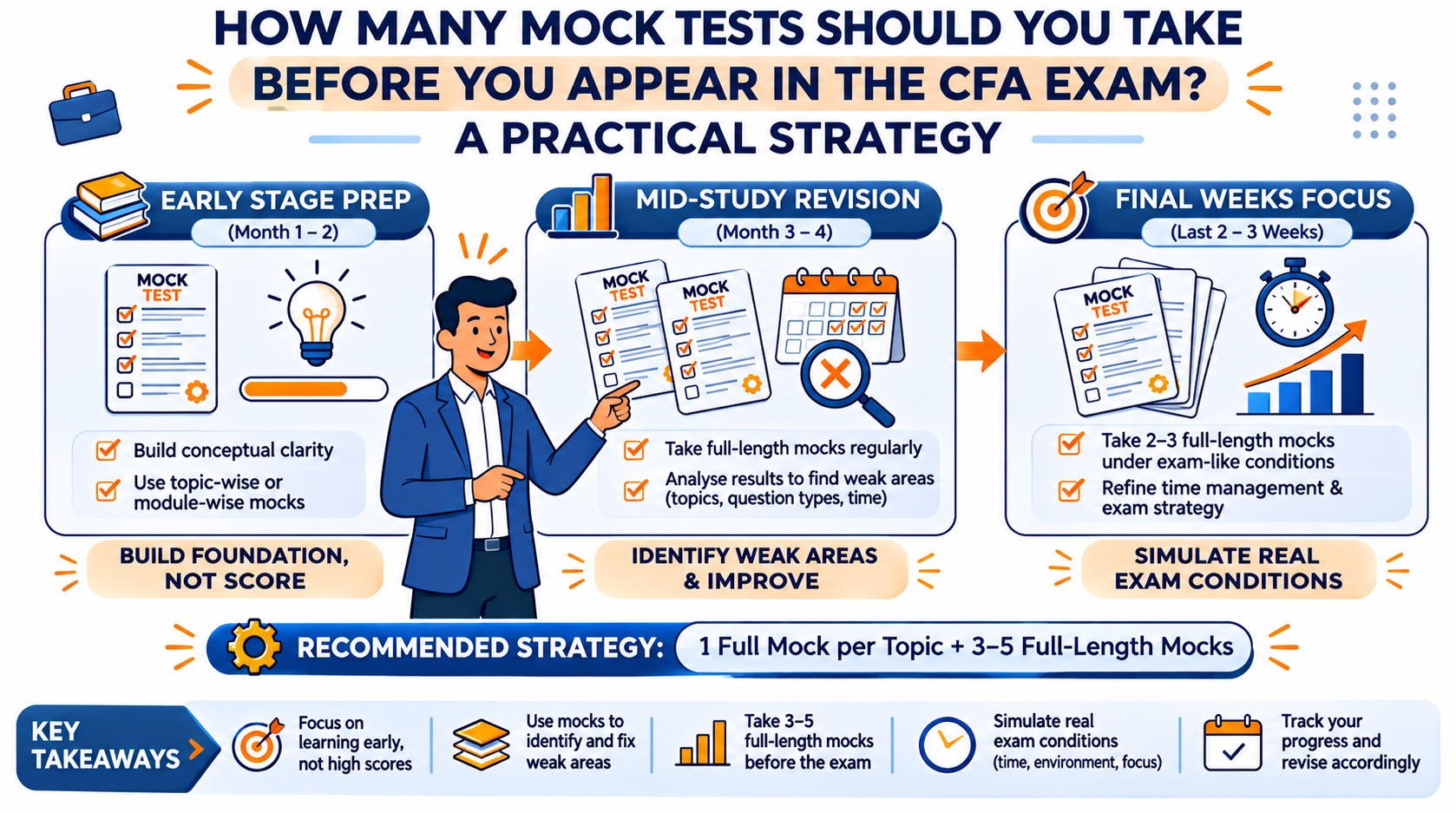
Rather than aiming for a fixed number, plan your mock tests around your preparation stage and the time remaining before the exam.
Here is a practical framework:
| Preparation Stage | What You Should Focus On |
|---|---|
| Early Preparation | Topic-wise practice questions and knowledge checks |
| Midway Through Preparation | First full-length mock to identify knowledge gaps |
| Final 2–3 Weeks | Multiple full-length mocks, detailed analysis and targeted revision |
| Final Week | A mock if useful, followed by focused practice and revision |
| Day Before the Exam | Light revision, reviewing mistakes and getting adequate rest |
The purpose of a mock changes as you get closer to the exam. Initially, it helps you understand where you stand. Later, it helps you assess whether your preparation is translating into better accuracy, time management and consistency.
Remember, completing four mocks without understanding your mistakes is less useful than completing two or three and working on the gaps they reveal.
When Should You Take Your First Mock?
You do not have to wait until you have mastered every topic before attempting your first mock. Doing it too late can leave you with very little time to address your weak areas.
A good time to attempt your first full-length mock is when:
- You have covered most of the curriculum.
- You can attempt questions without constantly referring to your notes.
- You have practised questions across the major topic areas.
- You have enough time left to revise topics in which you perform poorly.
Your first mock should primarily be a diagnostic exercise, not a final test of whether you are ready to pass.
For instance, you may score reasonably well overall but find that your accuracy in Fixed Income or Financial Statement Analysis is considerably lower than in other subjects. It gives you a clear picture of your revision strategy in future.
Do not let an early mock score discourage you. Its value lies in showing you what needs attention while there is still time to work on it.
How Many Mocks Should You Take before you Sit for the Exam
The number of mocks you can realistically attempt depends on the time you have for CFA exam preparation. More importantly, every mock needs to be followed by analysis and revision.
Here is how you can approach different timelines.
If You Have 3–4 Weeks Left
This gives you enough time to follow a complete mock-analysis-revision cycle.
A practical sequence would be:
- Attempt your first full-length mock under timed conditions.
- Analyse your performance and identify weak topics.
- Revise the concepts and formulas you struggled with.
- Practice additional questions from those areas.
- Attempt another mock and check whether your accuracy has improved.
If You Have 2 Weeks Left
At this stage, your focus should shift from covering everything again to identifying and correcting specific weaknesses.
Prioritise:
- Full-length mock exams under timed conditions.
- Reviewing incorrect and guessed answers.
- Revising high-weight topics where your performance is weak.
- Practising Ethics-based questions.
- Revising important formulas and calculation methods.
- Improving your time management.
You can attempt more than one full-length mock if your schedule allows, but do not sacrifice the time needed to analyse them.
For example, if a mock reveals that you are struggling with bond valuation, spend time revising the underlying concepts and solving related questions before attempting another test.
If You Have 7 Days Left
With only a week remaining, taking several full-length mocks may not be the best use of your time.
If you have not attempted a mock yet, consider taking one test, provided you have enough time to review it. If you have already taken mocks, use your previous results to identify what still needs attention.
Your priorities should be:
- Reviewing mistakes from previous mocks.
- Revising weak and high-weight topics.
- Practising Ethics questions.
- Revising formulas and important concepts.
- Solving targeted questions instead of repeatedly attempting full papers.
The objective is to improve the areas where you are losing marks, not simply add another mock score to your preparation record.
ℹ️ Interested in CFA Coaching?
Check out our CFA courses or read our detailed guide to get insights on coaching.
What Should You Do After Every CFA Mock Test?
This is arguably the most important part of your mock preparation. Your analysis should go beyond checking the overall percentage.
Follow these five steps after every mock.
1. Record Your Overall Score
Start by recording your score, but do not use it as the only measure of progress. Keep a record of your scores across different mocks so you can track your performance over time.
2. Categorise Every Incorrect Answer
Go through each incorrect answer and identify why you got it wrong.
You can classify mistakes into the following categories:
| Type of Mistake | What It Indicates |
|---|---|
| Concept Gap | You have not understood the underlying concept. |
| Formula Gap | You could not recall or apply the correct formula. |
| Calculation Error | You understood the concept but made a calculation mistake. |
| Misreading | You missed an important detail in the question. |
| Careless Mistake | You knew the answer but made an avoidable error. |
| Time Pressure | You could not solve the question within the available time. |
| Guess | You selected an answer without sufficient confidence or understanding. |
This classification helps you decide what kind of correction is required. A concept gap needs revision, while a calculation error may need more practice.
Also review questions you answered correctly by guessing. A correct guess does not necessarily mean you understand the concept.
3. Identify Topic-Level Patterns
Your overall score can sometimes hide significant weaknesses.
Consider this illustrative performance breakdown:
| Topic | Score |
|---|---|
| Ethics | 72% |
| Financial Statement Analysis | 68% |
| Fixed Income | 54% |
| Equity Investments | 76% |
Your overall performance might appear satisfactory, but Fixed Income needs considerably more attention.
Use the topic-wise breakdown to identify subjects where you consistently lose marks. Also consider the exam weight of each topic when deciding how to allocate your revision time.
A weaker performance in a heavily weighted topic deserves particular attention because it can affect a larger portion of your overall result.
4. Fix the Weak Areas Before Taking Another Mock
Do not rush into another full-length test immediately after checking your score.
Go back to the relevant curriculum material, revise the concepts, practise the questions and make sure you understand why you made those mistakes.
Maintain an error log with three things:
- The question or concept you got wrong.
- The reason behind the mistake.
- What you need to revise or practise to avoid repeating it.
This gives your next revision session a clear direction.
5. Retest and Compare Your Performance
After addressing the weak areas, attempt another mock or a targeted set of questions.
Compare your performance with the previous test.
Look beyond the overall score. Check whether:
- Your accuracy in weaker topics has improved.
- You are making fewer calculation errors.
- You are answering questions within the allotted time.
- You are repeating fewer mistakes.
- Your performance is becoming more consistent.
The purpose of the next mock is to check whether your corrective work has translated into better performance.
ℹ️ Need more practice?
Try our comprehensive exam-style CFA mocks to help practice and track your preparation.
Is 60–70% on Mock Exams Enough?
A score of 60–70% on a mock does not guarantee either a pass or a fail.
Mock scores should be interpreted in context. The difficulty of the questions, the provider, your topic-wise performance and the consistency of your results all matter.
For example, scoring 65% in one mock and 68% in another may indicate improvement, but you should also check whether the same topics are continuing to affect your performance.
Similarly, a high overall score should not make you ignore a significant weakness in a heavily weighted topic.
CFA Institute's Practice Pack information states that candidates who score 70% on at least one official mock exam are nearly twice as likely to pass. This is a useful indication of the relationship between mock performance and exam outcomes, but it is not a passing guarantee or an official exam threshold.
What Mock Score Should You Aim For?
CFA Institute does not prescribe a mock-exam percentage that guarantees a pass in the actual examination. Rather than treating 70% as a universal cut-off, work towards:
- Consistent performance across multiple mocks.
- Stronger accuracy in topics where you previously struggled.
- Fewer repeated conceptual and calculation errors.
- The ability to complete both sessions within the allotted time.
- A clear understanding of why the correct answers are correct.
A mock score is useful only when you understand what it tells you about your preparation.
Should You Take CFA Institute Mocks or Third-Party Mocks?
Both can contribute to your preparation, but they serve slightly different purposes.
CFA Institute Mock Exams
CFA Institute provides mock exams through its Learning Ecosystem (LES). These are based on the current curriculum and designed to reflect the topic weightings, question format and difficulty of the actual examination.
They are particularly useful for:
- Understanding the official question style.
- Practising questions based on the current curriculum.
- Assessing your preparation against the exam structure.
- Familiarising yourself with the expected level of application.
Registered candidates can access the mock exams included in the Learning Ecosystem. CFA Institute also offers an optional Practice Pack with additional questions and mock exams.
Third-Party Mock Exams
Third-party mock exams can supplement the official practice material by giving you additional questions and exposure to different question styles.
They can help you:
- Practise more questions across the curriculum.
- Identify concepts that you have not understood thoroughly.
- Test whether you can apply your knowledge to unfamiliar questions.
- Get additional timed practice.
However, do not judge a provider's mock solely by whether it is harder or easier than the official material.
Look at the relevance of the questions, curriculum coverage, quality of explanations and usefulness of the performance analysis.
A good mock should help you understand your preparation gaps, not just challenge you with difficult questions.
Mistakes to Avoid While Giving Mock Test
While planning your mock preparation, watch out for these common mistakes:
- Taking mocks without analysing them: You may keep repeating the same mistakes without improving.
- Focusing only on the overall score: Your topic-wise performance can reveal weaknesses that the total percentage hides.
- Comparing scores across different providers: Differences in question difficulty and construction make direct comparisons unreliable.
- Memorising answers: Remembering the correct option does not mean you understand the underlying concept.
- Ignoring Ethics: Do not neglect a topic simply because you feel more confident in other subjects.
- Skipping revision between mocks: Attempting another paper without addressing previous mistakes limits the value of the exercise.
- Taking back-to-back mocks: Full-length tests need time for analysis and recovery.
- Sacrificing sleep: Completing one more mock is not worth compromising your concentration on exam day.
Using Mocks for the Mock Exam
With the November 2026 exam approaching, candidates should use their remaining mocks primarily as diagnostic tools.
If you have already attempted multiple mocks, revisit your performance reports and error logs before scheduling another test. Identify the topics and question types where you continue to lose marks, and focus your remaining revision on those areas.
If you have not attempted a full-length mock yet, consider taking one if your preparation allows sufficient time for analysis. Do not spend the final few days attempting several tests without leaving time to revise.
FAQs
Q: How many mocks should I take?
A: There is no fixed number. Focus on taking a few full-length mocks, analysing mistakes and improving weak areas between attempts.
Q: When should I start taking mocks?
A: Start once you have covered most of the syllabus and practised topic-wise questions. Leave enough time to review your performance and revise weak areas.
Q: What is a good score in mocks?
A: Aim for consistent scores of 70% or above. CFA Institute reports that candidates scoring 70% on at least one official mock are nearly twice as likely to pass. However, this is not a guaranteed passing benchmark.
Q: Should I take a CFA mock every day?
A: No. Space out your mocks to allow enough time for analysing mistakes, revising concepts and improving your performance.
Q: Are CFA Institute mocks harder than the actual exam?
A: CFA Institute mocks are designed to reflect the actual exam's format and topic weightings. However, difficulty can vary, so treat your scores as a preparation indicator rather than a prediction.
Q: How should I analyse a CFA mock?
A: Review incorrect and guessed answers, identify weak topics, revise the underlying concepts and track your scores across attempts.
ℹ️ Need help with exam preparation?
Fill out the form below to get in touch with our counselors for expert guidance.