

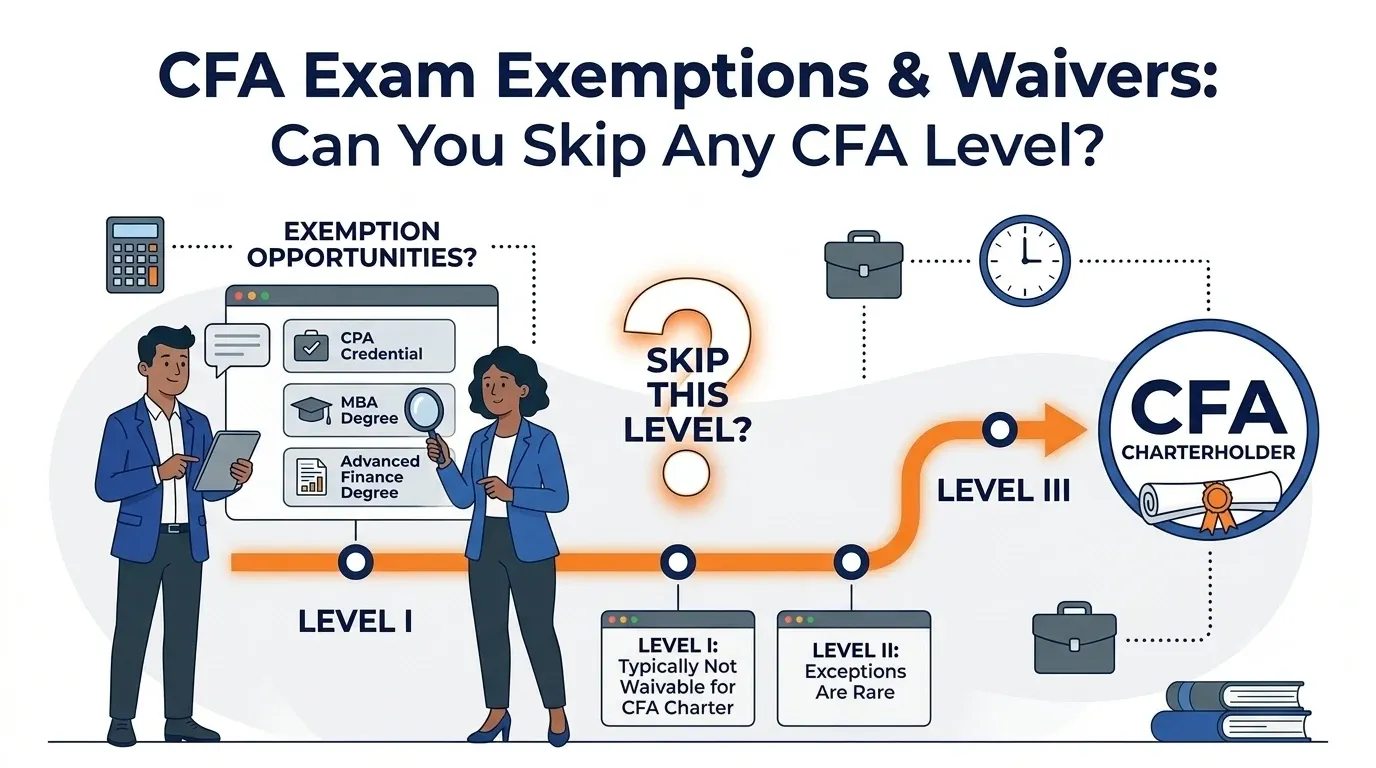
There are no exemptions from the CFA exams themselves. Every candidate must complete all three levels of the CFA Program, no matter if they have premium degrees like CA, MBA or similar others.
But here's the catch. Your progress in the CFA Program may help you qualify for waivers or exemptions offered by universities, regulators, and other professional bodies. In some cases, you could skip admission requirements, receive credit towards another qualification, or avoid taking additional certification exams.
Here, we will separate fact from fiction and explain where the CFA Program offers no exemptions, and where it can actually help you save time.
Why Doesn't CFA Institute Offer Exemptions?
The CFA Program is designed as an integrated curriculum. Each level builds on concepts tested in the previous one.
For example:
- Level I develops investment tools and financial concepts.
- Level II focuses on applying those concepts in valuation and analysis.
- Level III tests portfolio construction and wealth management.
The program's consistency and rigour prepare students for industry and the challenges it poses. Exempting any level would undermine the process of getting industry-ready.
Interested in registering for the CFA exam? Use our online tool to get started.
Do CA, MBA or FRM Holders Get Any Advantage?
While there are no formal exemptions, previous qualifications can make certain topics easier.
| Qualifications | Possible Advantage |
|---|---|
| CA | Financial Reporting, Corporate Finance |
| FRM | Derivatives, Fixed Income, Risk Management |
| MBA Finance | Corporate Finance, Economics |
| CPA | Accounting and Financial Statements |
| CAIA | Alternative Investments |
The CFA Program approaches these subjects from an investment and portfolio management perspective, often requiring a deeper understanding and different application than other qualifications.
Even experienced finance professionals need dedicated preparation to understand the CFA Institute's curriculum, question style, and learning outcomes. While your background may reduce the learning curve for some topics, you'll still need to prepare thoroughly for all three exam levels.
What About Work Experience?
Professional work experience helps you become eligible to register through the work-experience pathway if you don't meet the education requirement.
It does not exempt you from any level of CFA exam.
Currently, candidates may register through either:
- an eligible bachelor's degree pathway, or
- 4,000 hours of professional work experience and/or higher education completed over at least three consecutive years, subject to CFA Institute's eligibility requirements.
💡 Upskill Yourself
Want to stand out in the finance job market? Explore our upskilling courses to build your expertise.
Then Why Does CFA Institute Mention "Waivers" and "Exemptions"?
Many candidates get confused with this. The waivers and exemptions mentioned by CFA Institute generally do not apply to the CFA exams themselves. Instead, they refer to benefits offered outside the CFA Program.
These include:
1. University Exemptions
Some universities recognize CFA studies and may waive:
- GMAT/GRE requirements
- Certain university courses
- Admission prerequisites
This depends entirely on the CFA university's policy.
2. Professional Body Waivers
Certain regulators and professional organizations recognise the CFA Charter and may waive parts of their own certification requirements. Again, these waivers are granted by the external organization, not by CFA Institute.
3. Government Subsidies
In some countries, governments reimburse part of the CFA Program cost through workforce development or education schemes. Availability depends on your country of residence.
Can CFA Charterholders Receive Exemptions Elsewhere?
The CFA Charter is widely recognized globally. As a result, some universities, certification bodies, and regulators may grant exemptions or credit toward their own programs. These vary by institution and country, so candidates should check the official CFA Institute database of subsidies, waivers, and exemptions.
Some of the highlights of the waiver are mentioned here:
- Chartered Alternative Investment Analyst (CAIA) exams – CAIA allows CFA charterholders to skip CAIA Level 1 and proceed straight to the final CAIA Level 2 exam via its Stackable program.
- Chartered Market Technicians (CMT) charter – CFA charterholders can skip CMT Level 1, allowing them to obtain the CMT charter in just 12 months.
- Investment Management Certification (IMC) exams – Candidates who passed CFA Level 1 and above can be exempt from IMC Part 2 (but not Part 1).
- Professional Risk Manager (PRM) designation – CFA charterholders can be exempt from PRM Exam 1.
- Global accounting qualifications like ACCA, CIMA, and ACA have CFA exemptions too.
Final Thoughts
The CFA Program maintains the same examination pathway for every candidate, regardless of academic background or professional experience. While qualifications such as CA, MBA, FRM, or CPA may provide a strong foundation in specific subjects, they do not replace any level of the CFA Program.
What you may receive instead are external benefits, such as university admissions waivers, recognition from professional bodies, or government funding in certain countries. These should not be confused with exemptions from the CFA exams.
If your goal is to earn the CFA Charter, there is only one route: complete all three levels while meeting the program's eligibility and professional requirements.
✅ Info
Still confused about pursuing a career in CFA? Fill out the form below to get professional consultation.
Frequently Asked Questions
Q: Can a CA/MBA student skip CFA Level I?
A: No, there is no shortcut or waiver in CFA. Chartered Accountants and any professionals must complete all three CFA levels, no matter if they have already done CA or MBAZ.
Q: Is there a fast-track route to becoming a CFA charterholder?
A: No. Every candidate must pass all three CFA exam levels and meet the required work experience and membership criteria. There is no accelerated pathway to earning the CFA Charter.
Q: Does passing the CFA exams automatically make you a CFA charterholder?
A: No. Passing all three exam levels is only one requirement. Candidates must also meet the relevant work experience requirements and become regular members of CFA Institute before earning the CFA Charter.
Q: Can I pursue CA and CFA together?
A: Yes. Many students pursue both qualifications simultaneously or one after the other. Since the two programs have different focus areas, careful planning is essential to manage the workload.
Q: Is CFA more difficult if I don't have a finance background?
A: Not necessarily. While candidates from commerce or finance backgrounds may be familiar with some concepts, the CFA curriculum is designed to teach candidates from diverse educational backgrounds. Consistent preparation is more important than prior knowledge.
Q: Does clearing FRM make the CFA Program easier?
A: FRM may provide familiarity with topics such as risk management, derivatives, and fixed income. However, the CFA Program covers a much broader investment management curriculum, so dedicated preparation is still required.
Q: Can I register for CFA without a bachelor's degree?
A: Yes. Depending on CFA Institute's current eligibility criteria, candidates may qualify through the professional work experience pathway if they do not meet the education requirement.
Q: Is the CFA Charter recognised globally?
A: Yes. The CFA Charter is recognised by employers, universities, regulators, and professional bodies across many countries, making it one of the most respected credentials in investment management.