

If you are considering FRM, the first thing you need to understand is that it is not simply another finance qualification.
Think about what happens inside a bank.
Money is being lent. Securities are being traded. Interest rates are changing. Currencies are moving. Markets can become volatile. A borrower can default. A model can produce the wrong result. A liquidity problem can turn into a much bigger financial problem.
Someone has to identify these risks before they become losses.
That is where Financial Risk Management comes in.
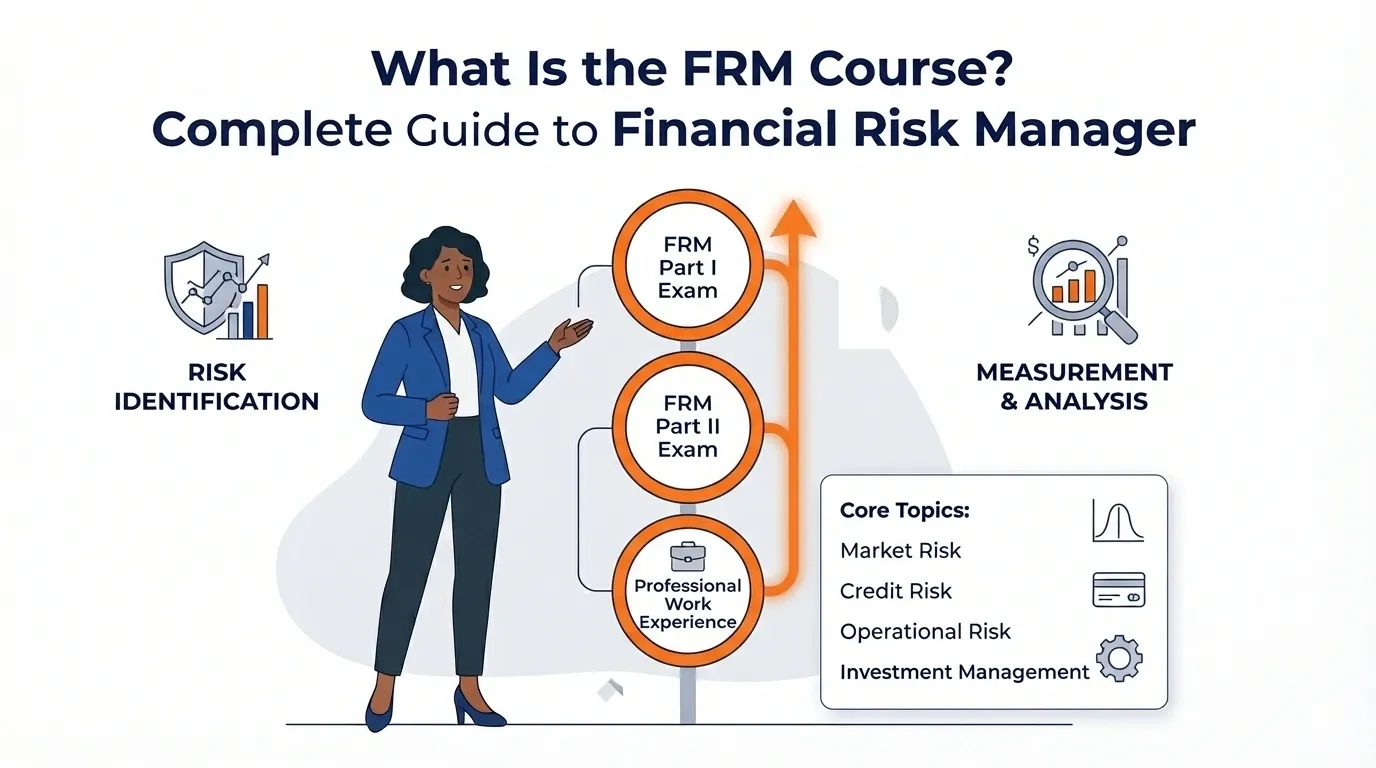
The FRM certification, offered by GARP, teaches you how to identify, measure and manage financial risk, and is open to students and professionals from diverse backgrounds without prior work experience. It has two exam parts, but becoming FRM-certified also requires two years of relevant full-time work experience.
Let’s Start With the Basics
FRM is a professional certification focused on financial risk management. At its core, it teaches you to understand what can go wrong, measure the potential impact and decide how that risk can be managed.
You build knowledge across:
- Financial markets and derivatives
- Probability and statistics
- Valuation and risk models
- Market and credit risk
- Liquidity and operational risk
Unlike a broad finance qualification, FRM goes deeper into how financial risks arise, how they are measured and how institutions manage them.
The FRM certification is offered by the Global Association of Risk Professionals (GARP), which develops and regularly updates the curriculum to reflect changes in financial markets and regulation.
Today, that means preparing for risks beyond traditional finance, including AI, cyber threats, climate risk, geopolitical uncertainty and digital assets.
When Is FRM the Right Career Choice?
FRM is ideal for students who are exploring career options in risk, financial analysis and decision-making under uncertainty.
It can be a strong choice if you are:
- A student looking to build a career in risk management, banking, treasury or related finance roles
- A finance professional looking to move into a specialised risk function
- Already working in risk and looking to strengthen your technical expertise and career progression
- Someone who wants a finance qualification with a clear focus on risk rather than broad-based finance
Build specialised expertise
FRM develops knowledge across market risk, credit risk, operational risk, liquidity risk, treasury risk, investment risk and model risk.
This gives you a stronger technical foundation for specialised finance careers.
Strengthen your career profile
For early-career professionals, FRM can demonstrate a clear interest in risk when applying for relevant internships and entry-level roles.
For experienced professionals, it can complement existing experience and support progression into more specialised positions.
Understand how financial institutions manage risk
Modern financial institutions operate within complex risk and regulatory frameworks.
FRM covers areas such as capital, liquidity, stress testing, credit losses and risk governance, helping you understand how risk is identified, measured and managed.
But certification alone isn't enough
FRM can strengthen your career profile, but it cannot replace practical experience, analytical ability or industry knowledge. The real value comes when you use the qualification to build capabilities that are relevant to the role.
ℹ️ Info
Interested in the FRM course? Use our online tool to know when to register for FRM Part 1.
Can Students from Non-Finance Backgrounds Pursue FRM?
Yes. FRM is open to candidates from any academic background. What matters more is whether risk is the career direction you want to pursue.
- Engineers: Your quantitative background in mathematics, statistics and analytical thinking can be an advantage. You will need to build your understanding of financial markets and risk.
- Data & Analytics Professionals: FRM can add financial context to your analytical skills, particularly for roles in risk analytics and model validation.
- Students & Working Professionals: You can pursue FRM whether you are still studying or already working. The key is having a clear interest in building a career in risk.
Your degree does not determine whether you can pursue FRM. Your career goals should.
The eligibility criteria for registering for the FRM Part 1 are simple. You do not need a specific finance degree or a particular job title to appear for this exam. However, there is one requirement you should keep in mind from the beginning. To become FRM-certified, you need 2 years of relevant full-time professional experience.
So you can start FRM as a student, pass both exams and complete the work-experience requirement later.
FRM Course Structure
FRM Certification Program has two parts
FRM Part I
Part I is designed to build your foundation in risk analysis.
You study:
- Foundations of Risk Management
- Quantitative Analysis
- Financial Markets and Products
- Valuation and Risk Models
There are 100 multiple-choice questions, and you have four hours to complete the exam.
FRM Part II
FRM Part II takes those foundations and applies them to specific risk areas.
You study:
- Market Risk Measurement and Management
- Credit Risk Measurement and Management
- Operational Risk and Resilience
- Liquidity and Treasury Risk Measurement and Management
- Risk Management and Investment Management
- Current Issues in Financial Markets
There are 80 multiple-choice questions, with four hours to complete the exam.
FRM Syllabus
Part 1
| Topic | Weight | Skills |
|---|---|---|
| Foundations of Risk Management | 20% | Risk frameworks, governance and risk principles |
| Quantitative Analysis | 20% | Probability, statistics, regression and quantitative methods |
| Financial Markets and Products | 30% | Derivatives, fixed income and financial markets |
| Valuation and Risk Models | 30% | Valuation, VaR, volatility and risk modelling |
Part II
| Topic | Weight | Skills |
|---|---|---|
| Market Risk Measurement and Management | 20% | Market exposure, VaR and stress testing |
| Credit Risk Measurement and Management | 20% | Default |
| Operational Risk and Resilience | 20% | Operational failures, controls and resilience |
| Liquidity and Treasury Risk | 15% | Liquidity, funding and treasury risk |
| Risk Management and Investment Management | 15% | Investment and portfolio risk |
| Current Issues in Financial Markets | 10% | Emerging financial-market risks |
Always use the Learning Objectives and study material for your specific exam year because GARP reviews the curriculum annually.
ℹ️ Enrolled in FRM?
Check out our detailed blog to learn the best way to prepare for the FRM course.
How Long Does It Take to Complete FRM?
There is no fixed completion time for FRM.
A typical path is:
Registration → Part I → Part II → Relevant Work Experience → Certification
GARP estimates around 240 hours of preparation per exam on average. Treat this as a benchmark, not a deadline.
If you're balancing FRM with college or a full-time job, you may need more time.
Don't optimise for speed. Optimise for readiness.
FRM Fees
FRM fees are quoted in US dollars and vary according to the registration window. For the November 2026 examination, GARP's published fees include:
| Fee | Amount |
|---|---|
| One-time enrolment fee | USD 400 |
| Part I early registration | USD 600 |
| Part I standard registration | USD 800 |
| Part II early registration | USD 600 |
| Part II standard registration | USD 800 |
| GARP Membership (Optional) | USD 195/year |
| Printed Books | Included |
| Deferral | USD 250 |
Applicable taxes are additional. Budget for more than the exam fee: factor in preparation, mocks, retakes, and check whether you qualify for GARP’s Academic Partner scholarship.
How Difficult Is the FRM Course?
FRM is challenging because it tests conceptual understanding, quantitative ability and application, not just memorisation.
If your mathematical foundation is weak, expect to spend more time on quantitative topics.
GARP estimates around 240 hours of preparation per exam, but your requirement will depend on your background and preparation.
Don't focus on finishing the syllabus. Focus on becoming exam-ready.
FRM Career Opportunities
FRM is most relevant when you want to build a career around identifying, measuring and managing financial risk. Depending on your interests, this can lead to roles such as:
- Risk Analyst: Monitor exposures, assess potential losses and prepare risk reports.
- Market Risk: Analyse how market movements affect portfolios and positions.
- Credit Risk: Assess borrower and counterparty risk.
- Treasury & ALM: Work on liquidity, funding and interest-rate risk.
- Operational & Enterprise Risk: Manage risks arising from processes, systems and the broader business.
- Model Validation: Evaluate financial and risk models.
- Stress Testing: Assess how institutions and portfolios perform under adverse scenarios.
- Risk Consulting: Work on regulation, governance, models and risk transformation.
- Fintech: Apply risk and financial knowledge in technology-driven financial businesses.
The common thread: understanding risk and using it to support better financial decisions.
ℹ️ Info
Want more career insights? Read our blog on FRM Jobs in India for roles, responsibilities, and expected salaries.
Top Companies Hiring FRMs
FRM-relevant roles exist across multiple financial and technology-driven organisations:
- Banks: Credit, market, liquidity, operational and enterprise risk.
- Investment Banks: Derivatives, valuation, market and counterparty risk.
- Consulting Firms: Risk transformation, regulation, model validation and governance.
- Insurance Companies: Investment, credit, liquidity and operational risk.
- Fintechs: Financial risk combined with data and technology.
- GCCs: Risk analytics, quantitative analysis, model validation and financial-risk technology.
FRM can strengthen your profile, but employers hire for the role, not the certification alone.
FRM does not guarantee a fixed salary. Compensation depends on your role, experience, employer and technical skills. A market-risk professional and an operational-risk professional can have very different career trajectories.
That is also why FRM is worth considering only when it aligns with your career direction.
Why Consider FRM?
- Global recognition
- Specialised risk knowledge
- Strong quantitative foundation
- Relevance across banking, consulting, fintech and GCCs
What to Keep in Mind
- Significant preparation required
- Quantitative content can be challenging
- No guarantee of employment
- Relevant experience is still required for certification
FRM + relevant experience + technical skills is far more valuable than FRM alone.
The Final Takeaway
Don’t ask only, “Will FRM help my career?” Instead, ask, “What kind of professional do I want to become?”
If you want to build a career in financial risk, quantitative analysis, banking, treasury or risk analytics, FRM can provide a strong foundation.
But the qualification is only the starting point. Build the skills. Gain practical experience. Learn to apply what you know. Because employers will ultimately care less about the certification and more about what you can do with it.
ℹ️ Questions?
Have more questions about the FRM exam? Just fill out this form and connect with our experts.
FAQs
Q: What is the FRM exam format?
A: Both FRM exam parts are computer-based and consist entirely of multiple-choice questions. Part I has 100 questions, while Part II has 80 questions, with four hours allotted for each exam.
Q: How often is the FRM exam conducted?
A: FRM exams are offered multiple times a year, giving candidates flexibility in planning their exam timeline.
Q: How long is FRM certification valid?
A: The FRM certification itself does not expire. Once you meet GARP's certification requirements, you remain an FRM as long as you comply with the relevant professional requirements.
Q: Does FRM require continuing education?
A: Yes. GARP's Continuing Professional Development (CPD) programme allows certified FRMs to maintain and strengthen their professional knowledge through ongoing learning.