
Preparing for the 2027 CFA exam doesn't necessarily mean you have to discard everything from the 2026 curriculum.
A large part of the CFA curriculum builds on concepts that remain relevant from one year to the next. However, the CFA Institute does make annual revisions, and some topics can see more significant changes than others.
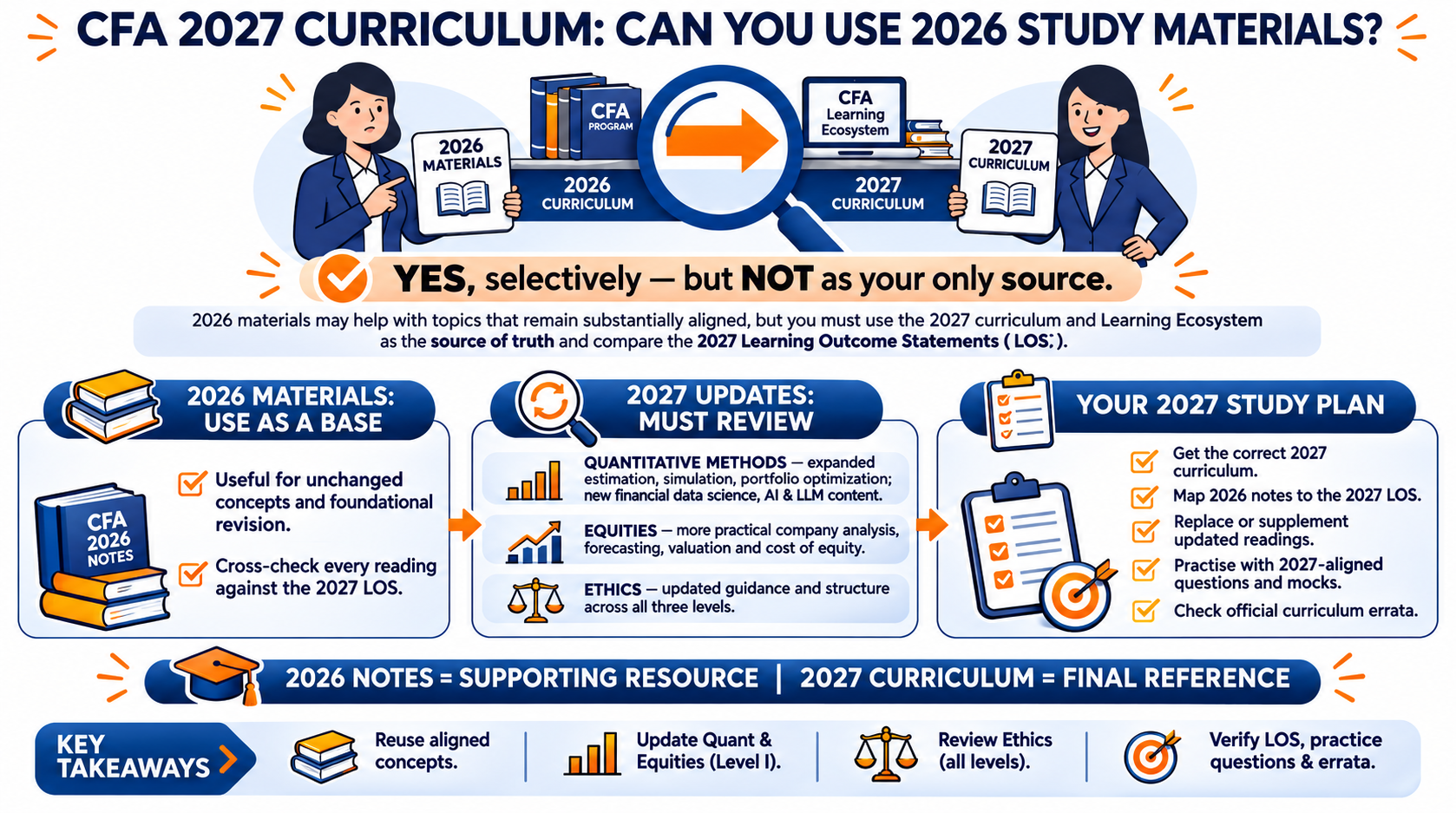
The 2027 curriculum includes notable updates to Quantitative Methods and Equities at Level I, along with Ethics revisions across all three levels.
So, how much of your 2026 study material can you actually use? Which topics need fresh notes, and where can your existing books and practice questions still help?
Let's break it down level by level.
What Has Changed in the CFA 2027 Curriculum?
Here's what you should know before planning your preparation.
CFA Level I: Pay Special Attention to Quantitative Methods and Equities
Level I has some of the most crucial changes in the 2027 curriculum. According to CFA Institute, the updates primarily focus on Quantitative Methods and Equity Investments, together representing approximately 25% of the Level I exam.
Quantitative Methods
The CFA 2027 curriculum places greater emphasis on applying quantitative concepts to practical financial problems. Some important additions and changes include:
- Financial Data Science: A new learning module introduces big data, machine learning, artificial intelligence and large language models (LLMs), along with their applications in finance.
- Estimation and Simulation: Coverage has been expanded to include practical implementation of historical simulation, bootstrapping and Monte Carlo simulation using Excel and Google Sheets.
- Portfolio Optimisation: The content has been expanded to provide a stronger foundation for Python-based portfolio optimisation.
- Equation Explorers: These are new interactive lessons that help candidates understand the relationships between financial variables rather than simply memorising formulas.
The Quantitative Methods prerequisite reading has also been retired from 2027 onwards because the revised curriculum makes it redundant.
Can you use 2026 Quantitative Methods notes?
You can use them to revise concepts that remain relevant, such as probability, statistics and regression. However, they should not be your primary preparation material for 2027.
The new financial data science reading, expanded simulation coverage and revised portfolio optimisation content require additional preparation.
Equity Investments
The Equities curriculum has also undergone substantial changes, with a stronger focus on practical valuation and investment analysis.
The important updates include:
- Financial statement forecasting, including separate projections for revenue, margins, investment and financing.
- Scenario analysis with probability-weighted valuations.
- Greater integration of industry analysis frameworks such as Porter's Five Forces and PESTLE with investment valuation.
- Practical applications of CAPM and multi-factor models for estimating the cost of equity.
- Understanding equity research reports, including sell-side and buy-side research and activist short sellers.
Can you use 2026 Equity Investments notes?
Your old notes can help you revise foundational concepts. However, you should not depend on them for the updated valuation methods, modelling applications and research-related content.
The 2027 curriculum expects you to connect company analysis with investment decisions, not just understand individual valuation concepts.
Ethics
Ethics has also been updated across all three CFA levels to reflect the 12th edition of the Standards of Practice Handbook.
At Level I, the presentation of the Standards has been reorganised into individual learning modules, with targeted practice questions.
Your 2026 Ethics notes can help with foundational understanding, but you should study the updated 2027 material to cover the revised guidance.
CFA Level II: Check Ethics and the Updated Curriculum
Compared with Level I, the 2027 changes at CFA Level II are less concentrated in a few major topic areas.
The broader topic structure remains familiar, covering Quantitative Methods, Economics, Financial Statement Analysis, Corporate Finance, Equities, Fixed Income, Derivatives and Risk Management, Alternative Investments, Portfolio Construction, and Ethics.
However, there are a few things to watch out for:
- Ethics: The updated Standards of Practice Handbook and revised learning modules mean you should use the 2027 material.
- Topic names: Some topics have been renamed. For example, Corporate Issuers is now Corporate Finance, Equity Investments is now Equities, and Portfolio Management is now Portfolio Construction.
- Practical Skills Modules: The 2027 offering includes updated options, including Equity Analyst Skills and Python-related modules.
Can you use 2026 Level II notes?
You can use them to revise concepts that remain part of the 2027 curriculum. However, don't assume that every reading, learning outcome or practice question is identical.
Compare the 2026 and 2027 learning outcome statements (LOS) and topic outlines before deciding what to retain.
Your preparation should follow the 2027 curriculum, even when you use older notes to understand a concept.
CFA Level III: Don't Overlook Ethics and Practical Skills Modules
At Level III, the overall structure continues to include the common core and your selected pathway: Portfolio Management, Private Markets or Private Wealth.
The 2027 topic structure includes:
- Asset Allocation
- Portfolio Construction
- Performance Measurement
- Derivatives and Risk Management
- Ethical and Professional Standards
- Your selected pathway
Ethics has been updated to reflect the latest Standards of Practice Handbook.
There are also updates to Practical Skills Modules (PSMs). For example, the 2027 offering includes Macro Insights for Investing, Due Diligence and Managing Private Wealth Clients, alongside other practical modules.
Can you use 2026 Level III notes for the 2027 Exam?
Your 2026 notes can still be useful for revising concepts that remain relevant to your selected pathway and the common core.
However, you should compare the 2027 topic outlines and learning outcomes with your existing material. Pay particular attention to Ethics and pathway-specific content.
Remember, Level III preparation also involves applying concepts through constructed-response questions and item sets. Having familiar notes is not enough if your practice material does not reflect the current curriculum.
ℹ️ Need help with PSM?
Check out our handy guide on CFA PSM module and how to manage them.
2026 vs 2027 CFA Study Materials: What Should You Reuse?
| CFA Level | Can You Reuse 2026 Notes? | What Needs Attention? |
|---|---|---|
| Level I | Partially | Quantitative Methods, Equities and Ethics |
| Level II | Partially | Updated Ethics, topic outlines and learning outcome statements |
| Level III | Partially | Updated Ethics, pathway content and Practical Skills Modules |
If a concept remains unchanged, your old notes can save you time. But if a reading has been revised, expanded or removed, studying only the 2026 version could leave you underprepared.
How to Decide Which 2026 Study Materials to Keep?
Step 1: Download the 2027 curriculum outline
Start with the official CFA Institute curriculum for your level. This gives you the correct list of topics, readings and learning outcomes for your exam year.
Step 2: Compare the Learning Outcome Statements
The LOS explains what you should be able to understand, calculate, analyse or evaluate after completing a learning module.
Compare the 2026 and 2027 LOS. If the learning outcomes have changed, your preparation needs to account for those changes.
Step 3: Identify revised, new and retired readings
Don't assume that a familiar topic has remained exactly the same. Check whether the reading has been updated, expanded or removed.
Step 4: Update your practice questions
This is particularly important. Understanding a concept from your old notes does not guarantee that you have covered the way it is taught or assessed in the new curriculum.
Practice questions that align with the 2027 learning outcomes.
Step 5: Use the official Learning Ecosystem
Once you register for your exam, you get access to the CFA Institute Learning Ecosystem (LES). It includes the digital curriculum, practice questions, mock exams, flashcards and study planner.
Use it as your reference point for the correct exam-year content.
You should also check the official curriculum errata regularly. CFA Institute updates confirmed corrections in the Learning Ecosystem, while PDF and eBook users need to refer to the online errata notices separately.
Should You Buy New CFA Study Materials for 2027?
If you have 2026 books, notes or revision material, don't discard them just because the exam year has changed. They can still be useful for topics where the underlying concepts and learning outcomes remain relevant.
However, using old material without checking the updated syllabus is a different matter.
A sensible approach is to:
- Retain your 2026 notes for unchanged concepts.
- Supplement them with the updated 2027 readings.
- Replace outdated notes for substantially revised topics.
- Practise using 2027-aligned questions and mock exams.
The Final Takeaway
You don't necessarily need to buy an entirely new set of CFA study materials every year. But you do need to make sure your preparation reflects the curriculum for your exam year.
Your 2026 notes can still help you revise concepts that haven't changed. However, use the 2027 curriculum, updated learning outcome statements and exam-aligned practice questions to identify and cover what's new or revised.
The goal is not to study everything again. It's to make sure you don't miss anything that has changed.
FAQs
Q: Can I use 2026 CFA study materials for the 2027 exam?
A: Yes, you can reuse some 2026 CFA notes and study materials for the 2027 exam if the underlying concepts and learning outcome statements remain relevant. However, you should compare the 2026 and 2027 curricula, update revised topics and practise using questions aligned with the 2027 syllabus.
Q: Which CFA Level I topics have changed for 2027?
A: The most notable Level I updates are in Quantitative Methods, Equities and Ethics. Quantitative Methods includes new financial data science content and expanded simulation and portfolio optimisation coverage. Equities places greater emphasis on practical financial statement forecasting, valuation and investment analysis. Ethics has also been reorganised and updated.
Q: Can I use 2026 CFA Level II notes for the 2027 exam?
A: You can use 2026 Level II notes to revise concepts that remain relevant to the 2027 curriculum. However, check the updated Ethics material, topic names, learning outcome statements and revised Practical Skills Modules before relying on older notes.
Q: Has the CFA Level III curriculum changed for 2027?
A: The overall Level III structure continues to include a common core and a selected pathway: Portfolio Management, Private Markets or Private Wealth. Ethics and Practical Skills Modules have updates, so candidates should compare the 2026 and 2027 learning outcomes and pathway content before reusing older materials.
Q: Do I need to buy new CFA books for the 2027 exam?
A: Not necessarily. You may retain 2026 books and notes for concepts that remain unchanged. However, use updated 2027 material for revised or new readings and make sure your practice questions and mock exams reflect the curriculum for your exam year.
Q: How do I compare the 2026 and 2027 CFA curricula?
A: Download the official curriculum outlines for both years and compare their learning outcome statements, readings, topic outlines and practice requirements. Identify new, revised and retired content, then update your study plan and practice questions accordingly.
Q: Where can I find the latest CFA 2027 curriculum updates and errata?
A: You can find the official CFA curriculum outlines, curriculum updates and errata notices through CFA Institute candidate resources. Candidates should regularly check the Learning Ecosystem and official errata notices for corrections and updates to their exam-year materials.
ℹ️ Still got questions?
Talk to one of our counselors to get your concerns clarified by filling out the form below.