

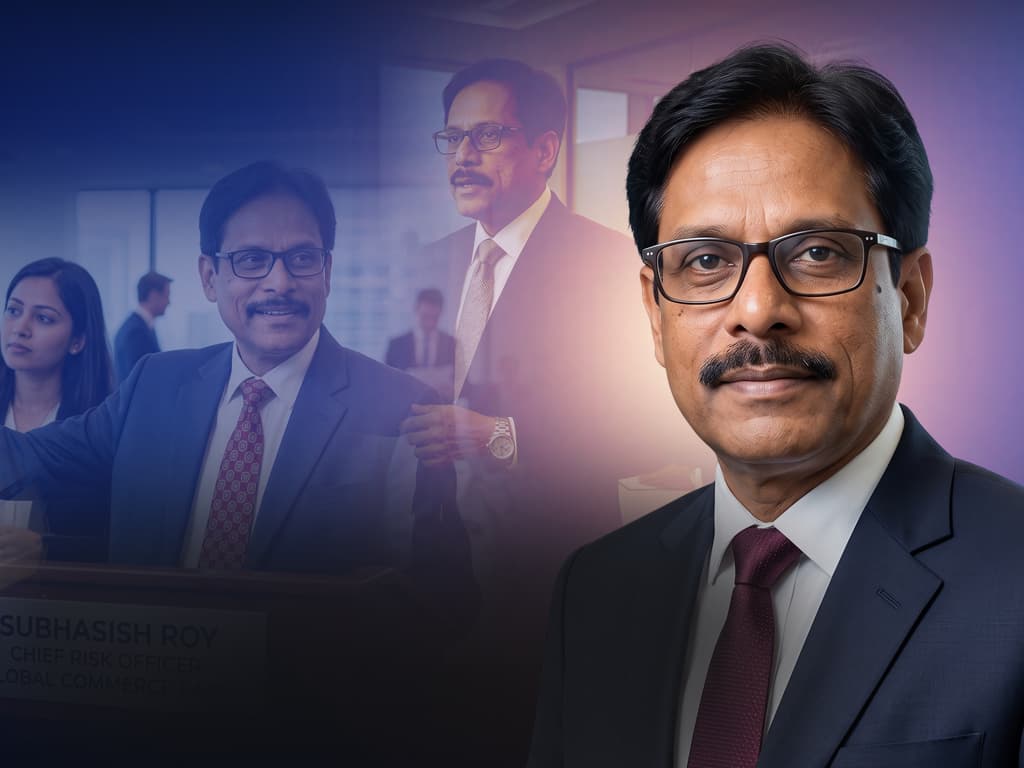
How Subhasish Roy Went from Being an Economist to Building a Career in Risk
Leadership positions are often seen as career milestones. But they are rarely built overnight. For Subhasish Roy, becoming the Chief Risk Officer of a leading public sector bank was not the result of a single examination, promotion, or opportunity. It was the culmination of decades spent learning, adapting, and deliberately building expertise across economics, banking, business, analytics, fraud risk, and enterprise risk management.
Along the way, he balanced demanding leadership roles with rigorous professional learning, completed the FRM course while working full-time, and continued expanding his understanding of risk long after entering the profession.
His journey demonstrates that leadership in risk is not built by knowing regulations alone. It is built by understanding businesses, solving problems, and never stopping the learning process.
Here is his journey, in his own words.
When One Career Prepared Me for Another
My career did not begin in risk management. I completed my MSc and MPhil in Economics at Calcutta University and began my professional journey as an economist at Canara Bank. For almost a decade, I worked in economics at various financial institutions before an opportunity arose to move into the risk function.
That decision changed the direction of my career.
At that time, risk management was still evolving in Indian banking. Basel guidelines were gradually changing the industry's approach, and banks were beginning to recognize that risk management was becoming a strategic function rather than just a compliance requirement.
I was fortunate to be involved in some of those early initiatives, from implementing operational risk management systems and business continuity frameworks to working on credit rating models, fraud risk management, analytics, and later enterprise risk.
Looking back, every role prepared me for the next one. None of those experiences felt disconnected.
Understanding That Risk Begins with Business
One lesson became very clear as I progressed in my career. You cannot become a good risk manager without understanding the business. Many people believe risk and business are separate functions. I think the opposite.
If there is no business, there is no risk. How can you assess a business's risks if you do not understand how it actually works? That is why I deliberately spent time working in business roles before returning to risk management.
Those years helped me understand how decisions are made on the business side, which later made my risk decisions far more practical. Risk management is not about saying \"no.\"
It is about understanding which risks should be accepted, which should be mitigated, which should be transferred, and which should be avoided.
That judgment only develops when you understand both sides.
Preparing for FRM While Working Full-Time
Preparing for FRM while working in senior leadership was one of the most demanding phases of my career. At that time, I was living in Navi Mumbai and travelling nearly three hours every day to Colaba. Instead of treating commuting as lost time, I converted it into study time.
I studied every morning before leaving for work. I read during my bus journey. On the way back, when I was too tired to read, I watched recorded lectures.
Late at night, I would study again before sleeping. On weekends, I often spent twelve to thirteen hours studying. There was no secret. It was simply a consistent effort over a long period. I also developed small systems that made revision easier.
I wrote important formulas on walls, kept summaries on my phone, and created concise notes for every chapter so that, before the examination, I only needed to revise my summaries instead of starting from the books again.
Why Determination Matters More Than Motivation
People often ask me how I stayed consistent despite a demanding job. The answer is simple. I had already decided that I would pass. Failure was never part of my plan. Once that decision was made, the daily effort became much easier.
There were difficult days. There were long working hours. There was exhaustion. But determination removes the need to negotiate with yourself every morning. I simply continued.
Learning Never Stops
One misconception many professionals have is that learning stops after reaching leadership positions. My experience has been exactly the opposite.
Even today, I learn every single day. Some learning comes from books. Some comes from observing markets. Sometimes, it comes from interactions with professionals and banks. After all, a risk manager cannot operate in isolation.
You need to understand interest rates, currencies, inflation, commodity prices, financial markets, regulations, technology, and how all these variables influence each other.
The more connected your thinking becomes, the better your decisions become.
Building Leadership Through Breadth
As my responsibilities increased, I realised that technical knowledge alone was no longer enough.
Leadership requires a different set of skills. You need to build teams. You need to identify people's strengths and assign responsibilities accordingly. You need to communicate clearly, remain calm under pressure, and solve problems that have no predefined answers.
Every day brings a different challenge. No textbook prepares you for all of them. Experience, judgment, and continuous learning become your biggest strengths.
Looking back, becoming a Chief Risk Officer was never the objective by itself. The objective was always to keep improving. The role became a natural outcome of that process.
Lessons from the Journey
-
- Risk cannot be understood in isolation: The better you understand the business, the better you understand its risks.
- Career growth comes from breadth, not just depth: Working across business, analytics, fraud, and risk creates stronger judgment than staying in one function.
- Determination simplifies difficult journeys: Once the decision is made, consistency becomes easier than constant negotiation.
- Professional qualifications are the beginning, not the destination: They prepare you for opportunities, but experience teaches you how to create value.
- The best risk managers are lifelong learners: Markets, regulations, technology, and businesses evolve constantly, and so must your thinking.