

CFA Deferrals Policy gives flexibility to postpone your exam when you actually need it. However, deferring your CFA exam can either save your attempt—or quietly burn through hundreds of dollars and months of effort, depending on how well you understand the deferral rules.
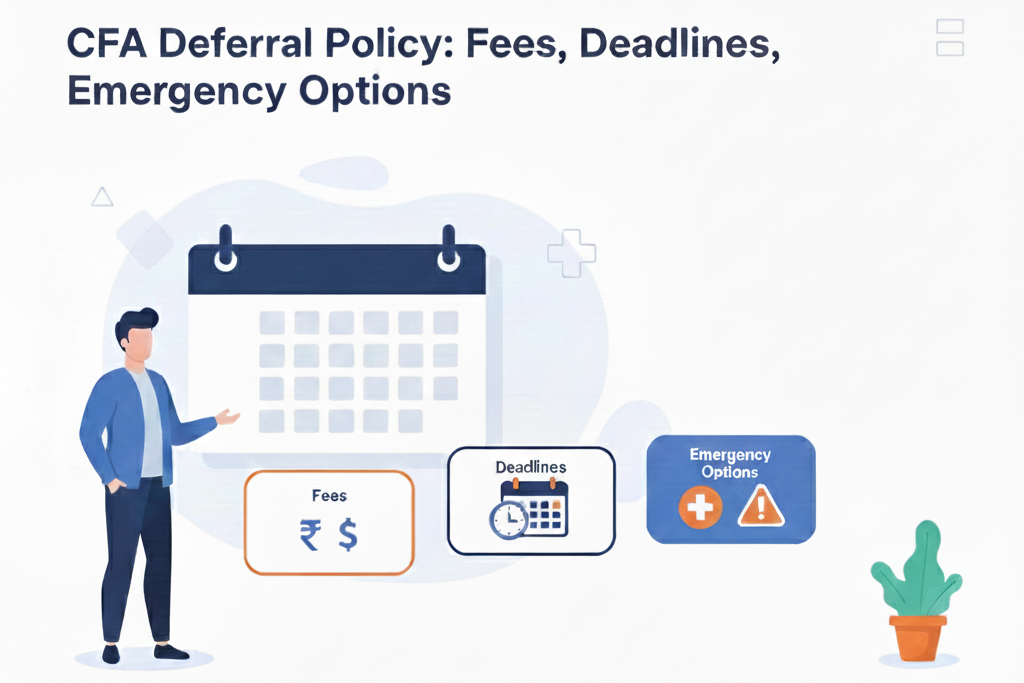
There are two types of deferral offered by the Institute: Paid Deferral for USD 449 (any reason, instant approval) and Emergency deferral for a USD 100 processing fee for documented hardships, both of which move your exam to a future window of roughly 12 months.
This guide explains how CFA deferral works in simple language—paid vs emergency deferral, what actually counts as a qualifying hardship, typical deadlines, and when to choose deferral instead of rescheduling so you protect both your CFA registration fees and your study plan.
Key Takeaways:
-
- Paid deferral costs USD 449 with instant approval for any reason; emergency deferral costs USD 100 but requires documented hardships and takes 2–7 weeks for approval.
- Only one deferral is allowed per exam registration—if you need another, you must withdraw and re-register at full cost.
- Candidates who defer typically see pass rates drop to nearly 20% due to lost momentum and extended preparation cycles.
What is the CFA Deferral Policy?
In simple language, purchasing a deferral allows you to delay your exam for any reason - be it a serious illness, a sudden accident, or you're not just prepared. Once purchased, a deferral cannot be cancelled or refunded. Only one deferral is allowed per exam registration.
Deferring your exam may feel like an easy way to escape when you're underprepared if you have enough money, but the data reflects something else. It is necessary to understand what the data actually shows about deferred candidates before taking any professional exam, like the CFA, so lightly.
⚠️ Important Statistics
Lower pass rates: Candidates who defer usually perform worse on their next attempt, with CFA pass rates dropping to nearly 20%.
Lost momentum: Deferring means restarting your preparation — another 300+ study hours, countless practice questions, and mock exams.
Extra costs: You'll pay a deferral fee and risk additional expenses if the curriculum changes in the next exam cycle.
Paid Deferral vs Emergency Deferral (Quick Comparison)
The CFA Institute has two types of deferral; the difference between them is pretty evident in the terminology. The common element is that a specific timeline is provided by the institute to apply for a deferral. Check out the deferral application form availability near your exam window.
| Feature | Paid Deferral | Emergency Deferral |
|---|---|---|
| Fee | USD 449 | USD 100 (if approved) |
| Reason Required | No (any reason) | Yes (documented hardship) |
| Approval Time | Instant | 2–7 weeks |
| Refundable | No | No |
| New Window | Up to 12 months | Up to 12 months |
Paid Deferral (USD 449)
This is the "no‑questions‑asked" option for any reason (e.g., under‑preparation, work clashes, travel issues, or simply not feeling ready). Purchasing a deferral from your CFA account immediately cancels your current exam appointment and gives you up to 12 months to reschedule within available exam windows.
-
- The deferral option is available until 24 hours before your scheduled exam, from the time the exam window opens.
- From 24 hours before your exam until 24 hours after the exam ends, the deferral option is temporarily unavailable.
- Deferral reopens 24 hours after the exam ends, and you have until the end of the deferral window to complete your purchase.
Emergency Deferral (USD 100)
This is reserved for serious, documented hardships such as life‑threatening illness, death in the immediate family, mandatory military deployment, pregnancy‑related complications, or a Prometric reschedule within 30 days where no workable alternative slot exists. Starting from February 2025, a processing fee of USD 100 applies to all approved emergency deferrals (except when Prometric postpones the exam).
-
- You must upload formal evidence (for example, a medical report covering the exam dates, a death certificate, deployment orders, pregnancy documentation, or Prometric correspondence).
- CFA Institute reviews each case individually, which can take around 2–7 weeks.
- If approved, you pay the processing fee of USD 100 and receive a 12‑month window to rebook.
- If the emergency deferral is rejected, you can still switch to a paid deferral, provided the deadline has not passed.
💡 Which Deferral Makes More Sense?
If you have strong, date‑specific documentation for a clear qualifying hardship, lean toward emergency deferral (cheaper, but slower and not guaranteed). If your reason is non‑qualifying, borderline, or you cannot wait weeks for a decision, use a paid deferral (more expensive, but instant and certain).
Fees, Validity, and the One-Deferral Limit
Fee Breakdown
Both deferral options have fixed fees that apply across all CFA levels (I, II, and III). In Indian rupees, that is roughly ₹40,000 for paid deferral and ₹9,000 for emergency deferral (at USD 1 = ₹89). If you qualify for emergency deferral, the savings are meaningful—and worth fighting for with solid documentation.
| Deferral Type | Fee | When Charged | Refundable? |
|---|---|---|---|
| Paid | USD 449 | At purchase | No |
| Emergency | USD 100 | If approved | No |
How Long Does Your CFA Deferral Last?
Once approved, both paid and emergency deferrals allow you to reschedule into any exam window within 12 months, provided three conditions hold:
-
- Exam availability in your chosen window and level (slots must be open).
- CFA registration and scheduling deadlines for that window have not passed.
- Your registration status is clean—no disciplinary suspension or violations.
After 12 months, your deferral expires, and you lose the registration. You cannot extend the 12-month window.
The Critical Rule: Only One Deferral Per Registration
Here is the trap many candidates miss: you get exactly one deferral per exam-level registration. That is it. If you defer once and later realize you need to push the exam back again—whether because life happens twice, you are still under-prepared, or circumstances change—you cannot defer a second time on the same registration. Your only option is to withdraw from that registration entirely and re-register from scratch.
⚠️ Re-registration Costs
Early Bird: USD 1140 (Levels 1 & 2) / USD 1240 (Level 3)
Standard: USD 1490 (Levels 1 & 2) / USD 1590 (Level 3)
If you defer once (USD 449) and later need to defer again, you'll have to withdraw + re-register, bringing the total to USD 1589–2039—significantly higher than the initial deferral fee.
Deferral Reversal: Irreversible Once Processed
Once your deferral is approved—whether paid or emergency—your original appointment is cancelled immediately and cannot be restored. You cannot change your mind and say, "Actually, I want to sit the original date." The booking is gone.
What Counts as a Qualifying Hardship for Emergency Deferral
CFA Institute maintains a strict list of hardship categories. If your reason is not on this list or you lack strong documentation, your emergency deferral will be denied—so knowing the boundaries upfront saves weeks of false hope.
1. Life-Threatening Illness (Candidate or Immediate Family)
CFA Institute typically looks for scenarios like hospitalization, emergency surgery, severe infections (such as COVID-19) that prevent sitting for the CFA exam, cancer diagnosis, or other serious medical conditions requiring hospital care during the exam window.
Documentation required: A doctor-signed medical report explicitly stating the candidate cannot sit the exam, with dates overlapping the exam window. Vague statements like "unfit to travel" will be rejected. The report should clearly state: "The Patient is hospitalized and cannot sit the CFA exam on [date]."
2. Death of an Immediate Family Member
If you lose an immediate family member around your exam window, CFA Institute may grant an emergency deferral if the relationship and timing clearly meet its rules. Immediate family includes: a spouse, a parent, a child, or a sibling.
Documentation required: An official death certificate or published obituary showing the name, date of death, and the relationship to the candidate, with dates close to the exam window. Note: For deferrals, grandparents are not considered part of a candidate's immediate family.
3. Mandatory Military Deployment (Candidate Only)
Unexpected active military service or deployment orders that conflict with the CFA exam window.
Documentation required: Official military orders confirming deployment dates overlapping the exam period.
4. Pregnancy (Candidate Only, One Deferral Per Exam Level)
Includes pregnancy complications or a candidate's choice to defer for pregnancy-related reasons. Only one pregnancy deferral is permitted per exam level; for instance, deferring Level I due to pregnancy does not preclude sitting Level II while pregnant, but a second pregnancy deferral at the same level is not allowed.
Documentation required: Medical confirmation, such as an ultrasound, antenatal report, or physician's note indicating pregnancy status with the exam window dates included.
5. Exam Rescheduled by Prometric with No Available Alternatives
When Prometric reschedules a candidate's exam within 30 days of the exam window start, and multiple attempts to secure an alternate slot fail.
Documentation required: Prometric's reschedule notice and records of communication (emails or chat logs) demonstrating the candidate's efforts to find alternative dates and Prometric's confirmation that no slots are available.
Documentation Reality Check: Why Rejections Happen
The single biggest reason emergency deferrals are rejected is weak or missing documentation. Here are the most common mistakes:
| Type of Case | Incorrect Documentation | Correct Documentation |
|---|---|---|
| Medical Cases | Doctor's note says "Patient is unwell; advise rest" (too vague) | Doctor's note says "Patient hospitalized with pneumonia; cannot sit examinations until [date after exam]" |
| Medical Cases | Note provided 3 weeks after exam window (too late to verify) | Note submitted before or within days of exam window (timely) |
| Bereavement Cases | No documentation, just "My grandfather passed." | Death certificate or obituary showing name, date of death, and your relationship |
| Prometric Reschedule | "Prometric moved my date; I could not find another slot." | Prometric reschedule email + follow-up emails asking for alternatives + Prometric's response confirming no availability |
The Safety Net: What Happens If Emergency Deferral is Denied
If CFA Institute rejects your emergency deferral request, you receive a denial notice via email. At that point, you typically have 48 hours to 1 week to pivot to a paid deferral before that deadline passes as well. This is why you should never assume emergency deferral will be approved—always mark the paid-deferral deadline on your calendar as a hard safety net.
Check Deferral Form Availability and Deadlines
CFA exam deferral forms usually open about four weeks before each exam window begins and appear in your CFA Institute candidate portal under options like My Enrollment or Manage My Exam. Each exam cycle has its own set of deadlines, and once that window closes, both paid and emergency deferral options for that cycle disappear.
| Item | Typical Timing | Where to Find | Applies To |
|---|---|---|---|
| Deferral forms visible | About 4 weeks before exam window opens | "My Enrollment" / "Manage My Exam" | Both |
| Emergency deferral request window | From shortly before or at start of window to window end | Emergency Deferral Request form | Emergency |
| Paid deferral deadline | Up to 24 hours before exam and 24 hours after until end of deferral window | Paid Deferral option in exam management | Paid |
| Decision time for emergency | Around 2–4 weeks (up to ~7 weeks in complex cases) | Email from CFA Institute | Emergency |
How to Manage Your Deferral Deadlines
-
- Add the exam window start date, exam window end date, paid deferral deadline, and emergency deferral last date to your calendar as soon as you register.
- Set two reminders: one two weeks before the paid deferral deadline, and another 24 hours before.
- If you experience a qualifying hardship, submit an emergency deferral request as early as possible in the window, not on the last day.
- If your emergency request is still pending and the paid deferral deadline is 48 hours away, consider purchasing the paid deferral as a safety net.
Reschedule vs Paid Deferral vs Emergency Deferral
| Feature | Rescheduling (Same Window) | Paid Deferral (New Window) | Emergency Deferral (New Window) |
|---|---|---|---|
| Move to a different window? | No, within the same exam window only | Yes, to a future window (up to ~12 months) | Yes, to a future window (subject to approval) |
| Typical fee | USD 250 | USD 449 | USD 100 (from 2025 onward) |
| Reason required | No | No (any reason) | Yes, documented serious event |
| Deadline | About 30 days before appointment | Up to 24 hours before/after exam until end of deferral window | Up to 24 hours before/after exam until end of deferral window |
| Approval time | Instant | Instant after payment | 2–4 weeks, up to ~7 weeks in complex cases |
Paid Deferral Processing (USD 449)
Paid deferral is the straightforward, "no‑questions‑asked" way to move your CFA exam to a future window within roughly 12 months, in exchange for a fixed USD 449 fee per registration.
It is processed almost instantly once payment is successful, which makes it the most reliable option when you are close to exam day but either under‑prepared or facing non‑qualifying personal constraints. The steps include:
Step 1: Log in to Your CFA Institute Account
-
- Go to the official CFA Institute website and sign in using the email and password linked to your CFA Program registration.
- Open your CFA Program dashboard to see your current level and exam window details.
Step 2: Go to Your Exam Management Area
-
- Click on the section labeled My Enrollment, Manage My Exam, or similar, depending on the latest portal design.
- Confirm that the exam level (Level I, II, or III) and window displayed are the ones you want to defer from.
Step 3: Locate the Deferral Options
-
- Look for a clearly named option such as Deferral Options, Paid Deferral, or Defer Exam.
- If you do not see it, check that you are within the allowed paid deferral window and that your registration is still active and upcoming.
Step 4: Choose Your New Exam Window
-
- Select the paid deferral option and review the list of available future exam windows for your level.
- Pick the window that best aligns with your personal, academic, and work commitments over the next 6–12 months.
Step 5: Review Rules and Pay the Fee (USD 449)
-
- Carefully read the on‑screen notes about the one‑deferral‑per‑registration rule, non‑refundable nature of the fee, and the 12‑month movement limit.
- Pay the USD 449 fee using a supported method in your region (typically major debit or credit cards and, in some countries, bank transfer or local payment gateways).
Step 6: Confirm Your New Registration Window
-
- After successful payment, your current exam appointment is automatically canceled and your registration is transferred to the new window.
- You should receive a confirmation email within minutes; also verify the new exam window on your CFA dashboard before logging out.
Step 7: Reschedule Your Actual Exam Date and Test Center
-
- Paid deferral only moves your registration; you must still pick a specific exam date and test center (or test region) within the new window using the normal scheduling process.
- Book your new appointment as early as possible, because seats in popular cities can fill up well before the scheduling deadline.
Emergency Deferral Processing (USD 100)
Emergency deferral is slower because it involves manual review and documentation, so you must build in more time and have a contingency plan.
Processing Timeline
-
- Initial review: Typically starts within 24 hours of submitting your emergency deferral request.
- Decision window: Most decisions arrive within 2–4 weeks, but complex cases can take up to about 7 weeks.
Status Tracking
-
- You receive email updates at key stages (submitted, under review, approved, or rejected).
- Your CFA portal may show a status label such as "Under Review," "Approved," or "Rejected."
If Approved
-
- You generally have a 7‑day window to pay the emergency processing fee (commonly quoted as USD 100 from 2025 onward).
- After paying this fee, your registration is moved to the new window within about 24 hours.
What to Watch For
Because emergency deferrals are not instant, you must actively monitor timelines and communication.
-
- If you do not receive an approval or rejection email within about 4 weeks of submission, contact CFA Support with your candidate ID and deferral case details.
- If a request is rejected for "insufficient documentation," you can usually resubmit with stronger proof, as long as you are still within the deferral deadline.
- Paying the emergency deferral processing fee after the 7‑day window can result in the deferral being voided and the fee being forfeited.
- The biggest risk: letting the paid deferral deadline pass while you are still waiting for an emergency decision; if the emergency deferral is then denied, you have no backup option.
A Sensible Contingency Plan
-
- Submit your emergency deferral as soon as your hardship arises.
- Track email and portal status at least weekly (and more frequently as deadlines approach).
- If you are still "Under Review" and the paid deferral deadline is about 48 hours away, seriously consider buying a paid deferral to lock in a guaranteed future window.
Conclusion
CFA deferrals give you two main paths: a fast, flexible paid deferral at a higher cost, and a slower, documentation‑heavy emergency deferral at a lower cost. The best choice depends on how close you are to CFA exam day, how strong your hardship evidence is, and how much uncertainty you can tolerate.
Plan ahead by marking all deferral and rescheduling deadlines when you register, knowing what qualifies as a hardship, and avoiding last‑minute decisions—if unsure, use the paid deferral as your safety net before the deadline.
Keep the hard limits in mind: one deferral per registration, a roughly 12‑month window to use it, and no reversals once a deferral or withdrawal is processed, so treat the decision like any other investment—balance cost, probabilities, and long‑term goals, then act early while all options are open.
F A Qs :
Q: How much does a CFA deferral cost? Is it the same for all levels?
A: Yes. A paid deferral costs USD 449, and an emergency deferral has a USD 100 processing fee (charged only if approved). Fees are the same for Levels I, II, and III and are non-refundable.
Q: What qualifies as an emergency hardship for a CFA emergency deferral?
A: CFA Institute accepts emergency deferral requests only for these five situations: 1) Life-threatening illness of the candidate or an immediate family member, 2) Death of an immediate family member (spouse, parent, sibling, or grandchild), 3) Mandatory military deployment of the candidate, 4) Pregnancy (candidate only; one per level), 5) Prometric rescheduling with no acceptable slot within 30 days. Reasons like lack of preparation, work conflicts, financial issues, or stress do not qualify.
Q: How long does it take for a CFA deferral to be processed?
A: Paid deferral: Almost instant (typically 5–10 minutes). Emergency deferral: Usually 2–4 weeks, sometimes up to 7 weeks. If approved, you have 7 days to pay the USD 100 fee, and your registration is moved to the new window within 24 hours after payment.
Q: Can I defer my CFA exam more than once?
A: No. Each registration allows only one deferral. If you need another, you must withdraw and re-register, which means paying the full exam fees again.
Q: What's the difference between deferral, rescheduling, and withdrawal?
A: Deferral: Moves your exam to a future window (cost: USD 449 or USD 100 for emergency).
Rescheduling: Changes your date or time within the same window (cost: USD 250).
Withdrawal: Cancels your registration completely. You lose all fees and must re-register if you decide to take the exam later.
Use deferral for changing exam windows, rescheduling for shifting the date within the same window, and withdrawal only if you don't plan to sit the exam this cycle.